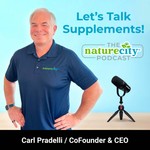
The Nature City Podcast dives into the world of supplements and nutrition to help you make the best decision for your health and lifestyle needs.
Hosted by CEO and Founder Carl Pradelli, The Nature City Podcast is your go-to podcast for all things supplements, nutrition, and much more.
To learn more about Nature City and our work, visit https://www.naturecity.com/
You can also follow us on Youtube to watch the latest episodes, of the Nature City Podcast
Site
RSS
Apple
Données mises à jour le 22/09/2026
Classements récents
Dernières positions dans les classements Apple Podcasts et Spotify.
Liens partagés entre épisodes et podcasts
Liens présents dans les descriptions d'épisodes et autres podcasts les utilisant également.
Could Astaxanthin Help Your Body Use More Fat for Fuel?
Épisode 149
vendredi 18 septembre 2026 • Durée 08:35
A new AstaReal astaxanthin study looked at something researchers hadn't isolated before: not whether astaxanthin supports exercise performance, but which fuel your muscles reach for while you're exercising.
20 recreationally active women completed a randomized, double-blind, placebo-controlled, crossover-design study — each woman served as her own control. After taking 12 milligrams of AstaReal astaxanthin daily for two weeks, their respiratory exchange ratio (RER) during a 30-minute cycling test was significantly lower than on placebo, meaning their bodies shifted more toward using fat and less toward carbohydrate to fuel the exercise. Heart rate, blood lactate, and perceived effort didn't change — the women weren't working harder or easier, but how their muscles fueled the work was different.
Carl breaks down what that shift actually means (and, just as importantly, what it doesn't mean — this was not a weight-loss study, and endurance wasn't tested here), why most previous astaxanthin-and-fuel research was conducted in men, and how this connects back to one of his favorite astaxanthin stories: salmon swimming hundreds of miles upstream to spawn without eating.
At NatureCity, our TrueAsta astaxanthin supplement uses the same AstaReal branded astaxanthin used in this study — two soft gels provide the 12-milligram daily amount studied here.
Timestamps
[00:00] Introduction
[00:08] The reversal: why "burn more fat" isn't a weight-loss claim here
[00:43] Two fuel tanks: carbohydrate vs. fat during exercise
[01:19] The new study: 20 women, crossover design, 12mg AstaReal daily
[02:13] What RER measures and why it matters (clean take begins after retake at [03:00])
[02:50] The result: lower RER on astaxanthin vs. placebo
[03:16] What this does NOT mean
[03:49] Heart rate, blood lactate, and perceived effort unchanged
[04:15] Metabolic flexibility, explained with the two-gas-tank analogy
[05:03] Why this study focused on women, not men
[05:40] Callback to Episode 128 and the salmon-swimming-upstream story
[06:17] Salmon, fat stores, and the "salmon aren't humans" caution
[06:40] Prior astaxanthin-and-exercise research: soccer players, cyclists, resistance training
[07:39] TrueAsta: used same AstaReal astaxanthin in a study
[08:02] Closing thoughts
Why Living Longer Isn't The Real Goal Of Aging
Épisode 148
vendredi 11 septembre 2026 • Durée 44:52
We live longer than people did in the 1950s, but many of those extra years can come with frailty and a loss of mobility and independence. Our health goal shouldn’t be to just live longer – you want those extra years to be good years. One powerful nutritional ally that can help support healthy aging is the pomegranate fruit. Carl Pradelli sits down with two Euromed scientists to review the latest research with their Pomanox P30 extract, which is made using the whole pomegranate fruit.
WHAT YOU'LL LEARN
This conversation moves the focus from lifespan to healthspan, the idea that quality years matter as much as total years.
Carl Pradelli, CEO and Co-Founder of NatureCity, talks with Dr. Andrea Zangara, scientific communications advisor at Euromed, and Silvia Mont, a registered pharmacist and nutritionist who is part of the Euromed scientific marketing team, about the numerous biological systems that Pomanox P30 can support and recent findings about the extract’s impact on several blood biomarkers linked to healthy aging and longevity.
Some of these include Urolithin A, AhR activity and IGF-1 levels. You will also hear how Pomanox P30 can help support heart and cardiovascular health. The discussion covers blood flow, nitric oxide, and maintaining flexible arteries. It closes on what studies show for skin appearance, muscle recovery, and staying functional as the years add up.
EPISODE SUMMARY
Aging well is not about chasing a longer number of years. Dr. Andrea Zangara opens by naming the shift researchers have already made: the focus is on healthspan, living well, not just living longer. As guest Silvia Mont notes, there is no single magic bullet, so a holistic approach is the most effective one. The episode focuses on the pomegranate fruit, a stable of the Mediterranean diet, and how the Pomanox P30 whole pomegranate extract stands out as a well-validated example of a dietary addition that can support healthy aging.
The guests explain how a standardized whole pomegranate fruit extract works with the body rather than around it. Instead of shortcutting the body's own processes, it supplies compounds the body already knows how to recognize, digest, and transform through the gut microbiome. That framing, a physiological approach over a single molecule, is the heart of the episode.
Tired at Work? Try This Instead of More Coffee
Épisode 147
vendredi 4 septembre 2026 • Durée 10:47
A newly published study compared EnXtra directly with caffeine — and what happened after one-hour and at the five-hour mark is worth understanding before you reach for another cup. Subscribe for research-backed conversations on supplements and health.
Carl Pradelli, CEO and Co-Founder of NatureCity, walks through a May 2026 study on EnXtra, the reason TrueMind was formulated without caffeine, and what he means by calming energy.
WHAT YOU'LL LEARN
- How this study was designed and what makes its comparison unusual
- What happened at 1, 3 and 5 hours in the four study groups
- The specific measurement where caffeine-only performance fell below baseline
- The combination that sustained alertness and mental energy the longest
- Why TrueMind was built without caffeine and 3 other nutrients instead
- What Carl means by calming energy, and the daily routine he uses
Most conversations about mental energy start and end with caffeine. Carl opens this episode with a simple question: when you are trying to maintain alertness for several hours or across the whole workday, is more caffeine always the best answer? A new study published in May 2026 in the Open Access Journal of Clinical Trials helps clarify answers to that question. It compared EnXtra directly with caffeine, not just with a placebo.
EnXtra is a standardized extract of Alpinia galanga — the plant related to ginger that is sometimes called Thai ginger or galangal. It has been studied for its effect on mental alertness and energy without acting as a stimulant. The study was randomized, double-blind and placebo-controlled, and it ran in two stages: an acute crossover with 128 people, then a 28-day arm with 127 people. Participants were healthy adults between 18 and 40, they were habitual caffeine consumers, and their sleep was deliberately restricted so the researchers were testing under real-world mental fatigue rather than fresh-from-eight-hours conditions.
How Eating the Rainbow Actually Protects Your Cells as You Age
Épisode 146
vendredi 21 août 2026 • Durée 15:31
You've heard that antioxidants fight free radicals. Carl Pradelli, CEO and Co-Founder of NatureCity, goes one step deeper: there isn't one kind of free radical, and no single antioxidant can handle them all.
WHAT YOU'LL LEARN
Carl explains why "free radicals" are really a whole spectrum of reactive compounds, each with different chemistry, locations, and challenges. He walks through how the body defends itself with a network of nutrients – both from diet and internally produced antioxidants – working as a relay team, not a single fighter.
You'll also hear why breadth beats brute force in antioxidant nutrition, how different colorful plant foods deliver different beneficial compounds, and what a large flavonoid study found about antioxidant variety and health outcomes. Carl closes with the same philosophy behind the TrueBerry7 formulation
This episode fits anyone thinking about how they age and how they choose supplements, with research kept in its proper framing throughout.
EPISODE SUMMARY
Carl Pradelli hosts this episode of the NatureCity podcast on antioxidant nutrition and why the popular picture of it is too simple.
The core idea: oxidative stress isn't one problem. Cells encounter a range of reactive oxygen and nitrogen species, and different antioxidants have different strengths against them. Carl references his earlier conversation with Dr. Karen Hecht and Dr. Susan Emrahi of AstaReal, who described antioxidants as having different "fingerprints" and capabilities.
He covers direct antioxidant activity versus compounds that help support the body's own internal defenses, the science behind eating a variety of colorful plant foods, and a study of roughly 125,000 adults linking flavonoid diversity to better health outcomes (discussed further in episode 109). The takeaway Carl lands on: think variety, think teamwork, think breadth over brute force.
Inflammation Isn't the Enemy - Why The “Cleanup” Process Matters for Healthy Aging
Épisode 145
vendredi 14 août 2026 • Durée 14:01
Most of us treat inflammation as the enemy. Carl Pradelli, CEO and Co-Founder of NatureCity, makes the case that you couldn't stay healthy without it, and how your body finishes an inflammatory response may matter as much (or more) as how it starts.
WHAT YOU'LL LEARN
Inflammation has a beginning, a purpose, and an ending. This episode focuses on that ending, the active biological process researchers call resolution. Carl explains why resolution isn't inflammation simply fading on its own, and why some of that cleanup machinery may become less efficient as we age.
You'll learn what specialized pro-resolving mediators (SPMs) like resolvins, protectins, and maresins do, and how omega-3 fatty acids EPA and DHA supply raw materials the body uses to make them. Carl covers the lifestyle factors that keep low-grade inflammation simmering, including visceral fat, poor sleep, chronic stress, smoking, and being sedentary.
He closes with three researched nutrients that support the healthy inflammation response and how each works: omega-3s (EPA and DHA), curcumin from turmeric, and PEA (Levagen+) found in NatureCity's TrueJoint FLX formula.
EPISODE SUMMARY
Carl Pradelli, CEO and Co-Founder of NatureCity, opens with a reframe: inflammation isn't a mistake your body makes, it's an essential defense and repair system. Cut a finger, fight an infection, or exercise, and an inflammatory response is part of how you heal, respond, build muscle, and adapt. The problem starts when that response becomes excessive, lingers too long, or doesn't resolve once its job is done.
To make it concrete, Carl uses a kitchen-fire analogy. When there's a fire, you want firefighters to rush in, break a door or window if needed, and spray water. You don't complain about the mess in that moment because you need them there. But once the fire is out, the hoses have to stop, the damaged material has to be cleared, and rebuilding has to begin. That second phase is resolution, and Carl describes it as an active process in which the body produces signals that stop the response, clear damaged cells, and shift tissue from defense mode into repair.
Bigger Doses Don’t Always Make Better Supplements
Épisode 144
vendredi 31 juillet 2026 • Durée 14:46
One bottle says 500 milligrams. Another says 1,000. Most of us reach for the bigger number, assuming it works better. After almost 25 years developing supplements, Carl Pradelli explains why that instinct steers shoppers wrong more often than they realize (and supplement companies take advantage of this).
WHAT YOU'LL LEARN
Carl Pradelli, CEO and Co-Founder of NatureCity, walks through 6 reasons why a bigger dose doesn’t necessarily make for a better supplement. Researchers don’t start studies by asking “what’s biggest dose we can fit into a capsule?” Instead, they ask a different question – “what’s the smallest dose that consistently produces the desired result?” Your body isn’t impressed by big numbers on a supplement label – it responds to nutrients it can actually absorb, utilize and put to work.
You'll learn why a better ingredient beats a bigger dose, and why absorption, standardization, and delivery systems often matter more than the milligram count on the front of the bottle. Carl uses named, studied ingredients to show the pattern in action, then leaves you with three questions to ask the next time you compare two bottles.
This episode fits Carl's researcher-formulator lane: mechanism first, research-framed throughout, and built for anyone who wants to shop for supplements with more confidence.
EPISODE SUMMARY
The big idea drives the whole episode: the biggest number on the label doesn't automatically make it the better supplement. Carl builds the case of why it’s more desirable to seek out ingredients that science shows work better and help your body make use of what you are taking.
He moves through a series of studied ingredients, each illustrating a different reason a smaller dose can win: a better ingredient, better metabolism, better delivery, a different mechanism, better absorption, and better standardization. Resveratrol, berberine, omega-3 fish oil, collagen, magnesium, and ashwagandha each carry one lesson in that chain.
Carl closes with a clear caveat and a practical tool. Smaller isn't always better either; every nutrient has its own effective range, and the right dose depends on the person. The goal is the right dose, backed by the right research.
The Best Form of Magnesium for Sleep, From a Supplement Formulator
Épisode 143
vendredi 24 juillet 2026 • Durée 10:58
Magnesium relaxes muscles, but that is only part of the story. Carl Pradelli, CEO and Co-Founder of NatureCity, explains how magnesium supports the nervous system, the stress response, and the brain's ability to settle down at night.
WHAT YOU'LL LEARN
Why magnesium is better understood as a supportive sleep nutrient rather than a sedative, and what that distinction changes for anyone lying in bed tired but wired.
How magnesium supports a calmer, better-regulated nervous system, and why so many sleep problems today are neurological and stress-related rather than purely physical.
The connection between stress and sleep, and how magnesium appears to play a role in supporting the body's response to stress so the cycle does not compound the next day.
Why the form of magnesium matters for absorption and tolerability, and why magnesium oxide, though cheap and common, tends to be poorly absorbed and harder on the stomach.
What makes magnesium bisglycinate chelate a preferred choice, including the calming amino acid glycine it is bound to and why a drink powder delivers a more meaningful amount than a capsule.
EPISODE SUMMARY
Carl Pradelli, CEO and Co-Founder of NatureCity, opens this episode with a small moment at home: mixing TrueMagnesium at night, he found himself thinking about how many processes in the body magnesium touches, and how it likely supports sleep in more ways than people assume. That thought frames the whole conversation.
Most people connect magnesium and sleep through one idea, muscle relaxation. Carl acknowledges that reason is real and shares an early NatureCity memory of helping his grandmother with nighttime cramps. But he moves quickly to the more interesting part of the story: magnesium is more than a muscle mineral. It plays roles in the nervous system, the stress response, and the brain's ability to settle down when the body is getting ready for sleep.
Magnesium is involved in over 300 processes in the body, and a lot of people are not getting enough. When intake is less than ideal, the body may have a harder time doing many things well, including winding down at night. Carl is careful to draw a line here: magnesium is not a sleeping pill, not a sedative, and does not force sleep. He frames it as a supportive sleep nutrient, not a knockout agent, and that is part of what he likes about it.
Resistant Starch: The Most Overlooked Fiber for Your Gut Microbiome
Épisode 142
vendredi 17 juillet 2026 • Durée 11:15
Not all fiber does the same job. Resistant starch is the type of fiber most modern diets have largely stripped out, and research suggests it may be one of the nutrients your gut microbiome misses most. Carl Pradelli explains what it is and why it matters.
What You'll Learn:
What resistant starch is and how it behaves differently from ordinary starch and other fibers.
Why current intake sits near 4 grams a day when 15 to 20 grams is often cited for gut and metabolic support.
How resistant starch may feed beneficial microbes like Bifidobacterium and Akkermansia.
Why Akkermansia is drawing research interest for metabolic health, healthy blood sugar metabolism, GLP-1, and the gut barrier.
How a low-dose resistant starch ingredient helps fill the gap and can easily fit into a daily routine.
A lot of people know fiber is important. Fewer realize that not all fiber is the same. In this episode, Carl Pradelli, CEO and Co-Founder of NatureCity, makes the case that resistant starch may be one of the most overlooked nutrients missing from diets in the 21st century.
For most of human history, people regularly ate starchy plants that naturally contained resistant starch, which gave the gut microbiome fermentable fuel. Modern food processing, refinement, and cooking practices have steadily removed much of it. Current intake is estimated at only about 4 grams per day across the United States and Europe, while 15 to 20 grams per day is often cited for supporting bowel, gut, and metabolic health.
Carl explains what makes resistant starch unique. It resists digestion in the small intestine and reaches the large intestine intact, where beneficial microbes can ferment it. That gives it qualities of both insoluble and soluble fiber. Research suggests this fermentable fiber may selectively feed beneficial bacteria, including Bifidobacterium and Akkermansia.
Akkermansia is drawing particular research interest for metabolic health and healthy blood sugar metabolism. Studies suggest it may help support healthy GLP-1 levels and help the body use insulin more efficiently, and it appears to play a role in protecting the gut lining and gut barrier function.
Most sleep supplements were built around one idea: make you sleepy. But if you have ever felt tired but wired at bedtime, you already know that making yourself drowsy does not guarantee a good night's sleep. In this episode, Carl Pradelli, CEO and Co-Founder of NatureCity, explains why modern sleep support has to do more.
Carl co-founded NatureCity over 20 years ago with his wife, Beth, and the company has since served more than 500,000 Americans. Poor sleep is rarely just a bedtime problem. It is often a brain overstimulation problem, a stress and cortisol problem, and a circadian rhythm problem at the same time.
WHAT YOU'LL LEARN
Why sleep quality matters as much as the number of hours you sleep, and why the best sleep supplements support your sleep biology instead of simply forcing drowsiness. Carl walks through the three systems better sleep support should address: a calmer brain, a healthy stress response, and the body's own circadian rhythm.
THE THREE-SYSTEM MODEL FOR BETTER SLEEP
First, helping the brain unwind naturally. L-theanine, an amino acid found in green tea, supports calming neurotransmitter activity, including GABA, and promotes relaxed alpha brainwave activity, helping the brain transition into a calmer state without acting like a sedative. TruZzzs uses Suntheanine L-theanine.
Second, supporting a healthy stress response. Cortisol is supposed to rise in the morning and gradually come down by evening, but when stress keeps it elevated too long, sleep quality can suffer, and not just your ability to fall asleep, your actual restorative sleep. TruZzzs uses Shoden ashwagandha, a form whose key compounds can stay in the bloodstream for nearly 24 hours, offering round-the-clock support from one dose.
Third, supporting the body's own circadian rhythm and evening melatonin biology. Rather than overriding the system with synthetic melatonin, Affron saffron extract helps support the enzymes in the pathway that converts the amino acid tryptophan into melatonin, helping support the body's own evening melatonin production.
Calcium Isn’t the Problem. Mismanaged Calcium Is.
Épisode 140
lundi 22 juin 2026 • Durée 10:02
Most people meet vitamin K2 through bone health. The less known story is what it does for your arteries. Subscribe for science-backed healthy-aging answers from Carl Pradelli.
Most of the vitamin K in your diet is K1, not K2, and the two do not behave the same way in the body. That distinction is the whole episode. Carl Pradelli, CEO and Co-Founder of NatureCity, walks through why vitamin K2 in the MK-7 form may be one of the most overlooked nutrients in the healthy-aging conversation, and why its role goes well beyond bone density into vascular health and arterial flexibility.
The mechanism is the part most people never hear about. Vitamin K2 activates two vitamin K-dependent proteins: Matrix Gla protein, which helps keep calcium out of artery walls and soft tissue, and osteocalcin, which helps bind calcium into bone. Carl frames it in one line: vitamin K2 helps the body put calcium where it belongs and keep it out of places where it does not. The problem was never calcium itself. The problem is mismanaged calcium, and mismanaged calcium is what can drive vascular calcification, reduced blood vessel elasticity, and arterial stiffness as you age.
Diet rarely closes the gap. Research on the different vitamin K forms show that MK-7 carries a much longer half-life than other vitamin K forms, but MK-7is typicallya very small part of our diets – unless you’re eating fermented foods regularly. That is why Carl points to the best researched MK-7 form for supplements, MenaQ7, which is used in NatureCity’s TrueK2D3 alongside vitamin D3, and in TrueOsteo+ alongside vitamin D3, plant calcium and magnesium for broader bone and vascular support.
He also references the work of Dr. Leon Schurgers from Maastricht University in the Netherlands, a leading vitamin K2 researcher who describes the loss of independence at age 80 as something that often begins decades earlier. Several published placebo-controlled research studies demonstrate how vitamin K2 can support vascular health and blood vessel elasticity. For healthy adults, the research suggests taking 180 micrograms of MenaQ7 vitamin K2 daily.
Podcasts Similaires Basées sur le Contenu
Découvrez des podcasts liées à The NatureCity Podcast . Explorez des podcasts avec des thèmes, sujets, et formats similaires. Ces similarités sont calculées grâce à des données tangibles, pas d'extrapolations !
Carl and his guests walk through the biological systems pomegranate polyphenols touch to help support healthy aging and longevity: gut bacteria that convert precursors into urolithins (stimulate cellular energy and the “cleanup” process known as mitophagy), AhR cellular protein activity (helps detox, immunity and metabolism), and keeping the vital IGF-1, protein hormone in a healthy range.
Blood flow gets its own segment. Carl explains pulse wave velocity in plain terms: a blood pressure pulse travels faster through stiffer arteries and slower through flexible ones, so a slower reading is what you want. The guests connect flexible arteries and healthy nitric oxide production to better circulation, which touches brain performance, energy, and recovery.
A healthy Inflammation response ties it together. Dr. Zangara describes “inflammaging”, the low-grade inflammatory state that builds quietly with age and often escapes a normal health test. Carl adds a point the podcast returns to often: inflammation protects us, and the challenge as we age is often in resolving it, cleaning up after the threat is gone, and getting back to normal function.
The episode ends on beauty from within, exercise recovery, and a consumer-facing summary from Silvia: it is not about magic, it is about science. The takeaway for a general listener is simple. Support the whole system, give the body what it already knows how to use, and pair it with a healthy lifestyle.
TIMESTAMPS
0:00 — Live longer and better
4:30 — Why there is no magic bullet
12:42 — Working with the body, not around it
21:52 — IGF-1 and the healthy range
27:53 — Pulse wave velocity explained simply
31:33 — Inflammaging, the silent state
35:45 — Beauty from within research
If this helped you think differently about aging well, like the episode and subscribe on YouTube so the next conversation finds you. Listening on the go? We are on Apple Podcasts and Spotify.
LINKS & RESOURCES
Learn more about TrueBerry7: https://www.naturecity.com/products/true-berry-7?srsltid=AfmBOoofH5NgS7II2oW5KAm52Sa2tuQT2lCKd8Ta9HAsQv4Szvt14GxW
The study had four arms: 300 milligrams of EnXtra, 200 milligrams of caffeine (roughly two cups of coffee, so caffeine was not being given a handicap), 300 milligrams of EnXtra combined with 200 milligrams of caffeine, and a placebo. Alertness was measured at baseline and again at one, three and five hours. Caffeine did what caffeine does — it worked, primarily at the one-hour measurement. By three and five hours those effects were much more limited. EnXtra continued to show benefits at later measurements, and at five hours the combination of EnXtra and caffeine produced the strongest result. On one measure of alertness, caffeine-only performance had actually fallen below where it started — the crash most heavy caffeine users can describe from experience.
Carl is careful about the limits. Sustained attention and psychomotor measurements showed favorable trends with EnXtra but were not consistently statistically significant. It was a fairly young cohort with restricted sleep. He is not extrapolating this study to every aspect of cognitive performance, and he says so on the record. What the study demonstrated most clearly was support for alertness and reduced fatigue, and the ability to sustain those benefits across several hours, which fits earlier research on the ingredient.
The rest of the episode is about why TrueMind was formulated the way it was. Carl explains that TrueMind does not contain caffeine on purpose — most listeners are already getting caffeine somewhere, and stacking more of it was not the goal. Instead, the formula pairs EnXtra with PharmaGABA (a naturally produced form of GABA studied for supporting a relaxed, focused state) and a third standardized ingredient Landkind Salidroside (salidroside is a compound found in the Rhodiola plant), which helps support mental energy while experiencing stress. Carl calls the target state calming energy — awake and alert and focused, but not wired. He closes with the routine he actually uses: tea between seven and eight in the morning, then a serving of TrueMind a few hours later, between ten and eleven.
None of this replaces sleep. Carl says it directly. Get more sleep.
TIMESTAMPS
0:00 - Why More Coffee Isn't the Answer
0:43 - How This Study Was Designed
2:05 - EnXtra vs Caffeine, Head to Head
3:50 - The 5-Hour Caffeine Crash
5:05 - Stimulated Is Not the Same as Focused
6:20 - What Calming Energy Actually Means
8:05 - Why Sleep Beats Any Stimulant
9:48 - Carl's Daily Routine
ABOUT NATURECITY
NatureCity is hosted by Carl Pradelli, CEO and Co-Founder. Carl started the company over 20 years ago with his wife Beth. The show covers the ingredients, research and formulation choices behind NatureCity supplements.
Learn more about True Mind: https://www.naturecity.com/products/true-mind?srsltid=AfmBOooMZNw1C7dDQun7l4vBDPv6ylnm8V1fvLJq2ZlTfFoiD0v9S2HX
#NatureCity #TrueMind #EnXtra #MentalEnergy
Use the timestamps below to jump to the sections most useful to you as you listen.
TIMESTAMPS
0:00 — Why one step deeper on antioxidants
1:24 — Free radicals are a spectrum of challenges
4:08 — Balance, not zero free radicals
5:41 — Your antioxidant network as a relay team
7:56 — Different fingerprints: the astaxanthin example
11:52 — Eat the rainbow and the flavonoid study
14:49 — Breadth over brute force and TrueBerry7
If this episode helped, like it and subscribe to the NatureCity YouTube channel so you don't miss future episodes. Find us on Spotify and Apple Podcasts.
The episode connects this to aging. Persistent low-grade inflammation, sometimes called “inflammaging”, becomes more common as we get older. Newer research adds a layer: we may not just be triggering more inflammatory responses with age - we may also become less efficient at resolving them. Carl introduces specialized pro-resolving mediators (SPMs) and the cleanup work of macrophages, then keeps the science practical with a single takeaway: putting out the fire is not enough, someone has to clean up the mess.
Carl grounds the discussion in what people can influence. Lifestyle matters tremendously, from visceral fat and metabolic health to smoking, chronic stress, poor sleep, and being sedentary, along with a diet built on minimally processed foods. Supplements, he stresses, should support those fundamentals rather than replace them.
He then walks through three researched ingredients working through different mechanisms toward the same goal. Omega-3s EPA and DHA supply building blocks for pro-resolving mediators, with human studies showing changes in circulating lipid mediators involved in inflammation and resolution. Curcumin, the key compound in turmeric, has been studied for modulating inflammatory signaling and oxidative stress, with favorable effects on markers including CRP, TNF-alpha, and IL-6. PEA (Levagen+) in NatureCity's TrueJoint FLX is a lipid signaling molecule the body already makes to help regulate inflammatory and discomfort responses.
Carl ends with a clear note of care: persistent, severe, or unexplained inflammation isn't something to self-treat, and it deserves evaluation by a healthcare provider. His closing line ties the science back to the analogy: inflammation isn't the enemy, and healthy aging depends on a response that has a beginning, a purpose, and an ending.
TIMESTAMPS
0:00 — Why inflammation isn't the enemy
1:51 — Resolution, the active cleanup process
4:06 — “Inflammaging” and why aging changes it
4:56 — SPMs and the cleanup crew explained
6:39 — Lifestyle factors you can influence
7:48 — Omega-3s EPA and DHA as building blocks
9:16 — Curcumin and PEA for joint support
11:23 — Three takeaways and a caution
If this changed how you think about inflammation, like the episode and subscribe to the NatureCity YouTube channel for more researcher-formulator conversations from Carl Pradelli. You can also follow along on Apple Podcasts and Spotify.
If today's episode changes the way you look at supplement labels, subscribe to the YouTube channel so you don't miss future episodes. You can also follow along on Spotify and Apple Podcasts.
From there the episode walks through what magnesium supports. A calmer, better-regulated nervous system matters because many sleep problems today are neurological and stress-related, driven by a body and brain that struggle to shift out of a stimulated, alert state. For good sleep to happen, the body needs to transition from go mode into a more relaxed, restorative mode, and magnesium helps support that transition through normal neurotransmitter activity and the conditions the body needs to move toward sleep readiness.
Carl then turns to stress and sleep, which he describes as tightly connected in a cycle: high stress hurts sleep quality, and poor sleep leaves the body less resilient to stress the next day. Magnesium does not erase stress, and no supplement can remove what is happening in your life, but it may help support the body systems involved in handling stress in a healthier way.
Carl explains a common consumer mistake: assuming all magnesium supplements work the same way. Magnesium oxide is common because it is inexpensive, contains a high percentage of elemental magnesium, and fits easily into capsules, yet it is one of the poorer absorbed forms and more likely to cause gastrointestinal effects at higher amounts. For evening use, he prefers magnesium bisglycinate chelate, which is better absorbed, better tolerated, and bound to glycine, an amino acid that may add its own calming, sleep-supportive layer.
He closes with why NatureCity made TrueMagnesium as a drink powder rather than a capsule: pure magnesium bisglycinate chelate is bulky and fluffy, so a powder delivers a more meaningful amount, with each scoop providing 200mg. Carl notes that magnesium is foundational, and for a highly overstimulated brain or elevated evening cortisol it may work best as part of a broader sleep support system. Even on its own, he argues, magnesium deserves more respect in the sleep conversation.
TIMESTAMPS
0:00 — Why magnesium and sleep
0:55 — More than a muscle mineral
1:37 — Not a sleeping pill or sedative
2:14 — Magnesium and the nervous system
3:35 — The stress and sleep cycle
6:21 — Why the form matters
8:14 — Bisglycinate chelate and glycine
9:06 — Why TrueMagnesium is a powder
If this helped, like the episode and subscribe to the NatureCity YouTube channel so you don't miss future episodes. You can also listen on Apple Podcasts and Spotify.
LINKS & RESOURCES
Learn more about True Magnesium: https://www.naturecity.com/products/true-magnesium?srsltid=AfmBOorF4xadONKdNLBILTlhh1j8I4p0zf32EDmgIPvDkKmUDwsNX_8x
Carl walks through additional research areas discussed for a low-dose resistant starch called Solnul that can deliver key benefits with just 3.5 grams per day. These include supporting a healthy inflammation response in the gut, consistent stool quality, intestinal barrier function, nutrient absorption, the gut-skin connection, and broader metabolic markers. Every claim stays in research framing.
The takeaway is practical. Resistant starch is a fermentable fiber the modern diet provides far less of than it once did and filling that gap at a sensible daily dose with Solnul may be a simple way to support the gut microbiome.
NatureCity features this low-dose resistant starch ingredient in its advanced TrueDYB digestive formula.
Timestamps:
0:00 — Why Not All Fiber Is The Same
1:18 — Resistant Starch, The Lost Nutrient
2:17 — What Resistant Starch Really Is
4:37 — Akkermansia And Blood Sugar Support
5:51 — The Gut Barrier And Protective Lining
7:06 — Stool Quality And Digestive Balance
8:41 — Nutrient Absorption, Skin, And Metabolic Health
10:06 — The Missing Fiber, Recapped
If this was helpful, like the video and subscribe to the NatureCity YouTube channel so you do not miss future episodes on gut and microbiome health.
LINKS & RESOURCES
Learn more about resistant starch and TrueDYB:naturecity.com.
Everyone's experience differs, but Carl outlines a week-by-week timeline: easier to fall asleep in the first one to two weeks, longer time in deeper sleep cycles after three to four weeks, and waking up more refreshed after five to six weeks. A sleep tracker such as a Fitbit or Oura Ring can help you measure the change.
LEARN MORE
Visit naturecity.com to learn more about TruZzzs or to reach out with any questions.
Educational note: This content is for educational purposes only and is not medical advice. Dietary supplements are not intended to diagnose, treat, cure, or prevent any disease. Talk with your healthcare provider before starting any new supplement.
Carl is careful to keep this in research framing: vitamin K2 doesn’t work in isolation – It’s part of a system with vitamin D3 and other nutrients like magnesium that work together to support healthy aging.
WHAT YOU’LL LEARN
How vitamin K2 routes calcium toward bone and away from arteries
Why dietary vitamin K1 cannot stand in for K2
What Matrix Gla protein and osteocalcin actually do
What three years of MenaQ7 K2 did to blood vessel elasticity
Why K2, vitamin D3, and magnesium work as a system
TIMESTAMPS
0:00 K2 Is More Than a Bone Nutrient
1:20 How Vascular Calcification Can Age You
2:07 Dr. Schurgers on K2 and Aging
2:50 Why Diet Falls Short on K2
4:03 Matrix Gla Protein and Osteocalcin
5:08 What MK-7 and MenaQ7 Really Are
5:55 The 3-Year Blood Vessel Study
8:03 K2 and Supporting Nutrients
ABOUT NATURECITY
NatureCity was founded by Carl Pradelli, CEO and Co-Founder, with a mission to deliver transparent, science-backed natural health supplements. With over 500,000 customers served, NatureCity is committed to quality, honesty, and results.