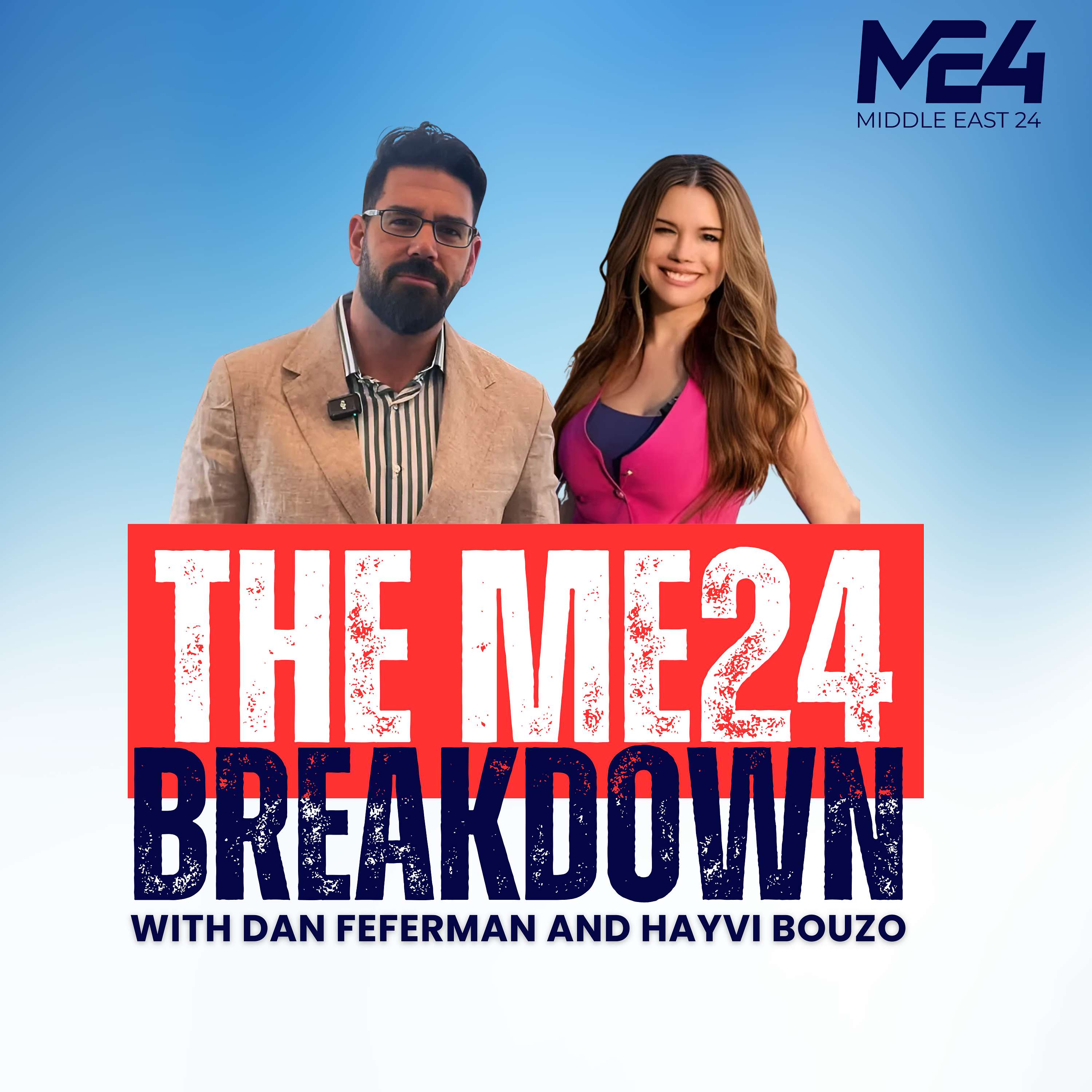
The Middle East Breakdown With Dan and Hayvi – Détails, épisodes et analyse
Détails du podcast
Informations techniques et générales issues du flux RSS du podcast.

The Middle East Breakdown With Dan and Hayvi
Middle East 24
Fréquence : 1 épisode/7j. Total Éps: 2

The Middle East Breakdown from Middle East 24 delivers clear, in-depth reporting and analysis on the forces shaping the region. Each episode takes a neutral, investigative approach to breaking news, geopolitics, and cultural shifts, with a focus on uncovering cutting-edge trends and long-term dynamics behind the headlines. Listeners get context, evidence, and clarity every time.
🌍 Website: middleeast24.org
🎥 YouTube: youtube.com/@MiddleEast_24
🎧 Spotify: open.spotify.com/show/3ZJcMz0Fz52rgzsqG5dTIp
📸 Instagram: instagram.com/middleast24
🐦 X (Twitter): twitter.com/MiddleEast_24
Classements récents
Dernières positions dans les classements Apple Podcasts et Spotify.
Apple Podcasts
🇩🇪 Allemagne - newsCommentary
23/04/2026#89🇩🇪 Allemagne - newsCommentary
22/04/2026#61🇩🇪 Allemagne - newsCommentary
13/01/2026#74🇨🇦 Canada - newsCommentary
27/12/2025#81🇫🇷 France - newsCommentary
13/12/2025#89🇫🇷 France - newsCommentary
27/10/2025#98🇫🇷 France - newsCommentary
05/10/2025#78
Spotify
Aucun classement récent disponible
Liens partagés entre épisodes et podcasts
Liens présents dans les descriptions d'épisodes et autres podcasts les utilisant également.
See allQualité et score du flux RSS
Évaluation technique de la qualité et de la structure du flux RSS.
See allScore global : 43%
Historique des publications
Répartition mensuelle des publications d'épisodes au fil des années.
Trump and Netanyahu Unveil “Comprehensive Peace Plan” to End Hamas War With Dan Feferman
Épisode 4
vendredi 3 octobre 2025 • Durée 07:41
The war that began on October 7 with Hamas’s brutal invasion of Israel has dragged on for nearly two years, leaving devastation and grief in its wake. Yesterday, at the White House, President Trump and Prime Minister Netanyahu unveiled a plan they called the most comprehensive and fair path to end the conflict. The world now looks on to see whether this proposal will finally bring justice, security, and peace after years of terror.
Is Peace Between Syria And Israel On The Horizon?
Épisode 3
vendredi 3 octobre 2025 • Durée 01:13:53
This episode of ME24 Middle East Breakdown tackles one of the most unexpected developments now under discussion: the possibility of a security agreement between Israel and Syria. What once sounded far-fetched is suddenly part of serious regional conversations, tied to the Gaza war, shifting U.S. strategy, and the future balance of power across the Middle East.
We start with reactions to the Trump–Netanyahu Gaza peace plan and the regional buy-in it received, then pivot to why Syria was left out of that announcement and what might be taking shape behind the scenes.
Former U.S. Assistant Secretary of State David Schenker lays out what Washington is really hoping to achieve: lifting sanctions, stabilizing the new Syrian government, and keeping Iran in check. Dr. Eran Lerman, vice president of the Jerusalem Institute for Strategy and Security, explains Israel’s core priorities stopping Iranian influence, preventing a direct clash with Turkey, and securing minorities like the Druze and Kurds. From Damascus, Shadi Martini, CEO of the Multifaith Alliance for Syrian Refugees, brings insight into what life in post-Assad Syria looks like, how locals view Israel’s moves, and why the Sunni majority will ultimately decide whether peace is possible.
Together, the panel debates the feasibility of a Syrian–Israeli deal, the risks of foreign fighters and jihadist influence, the legacy of the Assad regime, and whether Gulf states like Saudi Arabia and the UAE will bankroll Syria’s reconstruction. They also explore how October 7 changed Israel’s calculations, why the Druze community has become central to current dynamics, and what decentralization inside Syria could mean for minorities and regional stability.
We close with a lightning round: what’s realistic in the next six months, and what red lines could derail the entire process from U.S. caution over Turkey’s ambitions, to Israel’s demands for guarantees, to Syria’s own struggle to balance majority and minority fears.
This is a rare, three-sided conversation; American, Israeli, and Syrian perspectives all at the table, on an issue that could redefine the region’s security architecture.
📺 Watch and subscribe
• YouTube: / @middleeast_24
• Website: https://middleeast24.org/
• Spotify: https://open.spotify.com/show/3ZJcMz0...
👥 Guests
• David Schenker: https://x.com/davidschenker1
• Shadi Martini: https://x.com/shadimart
Post War Gaza, What Comes Next, with Ghaith Al Omari and Robert Silverman
Épisode 2
dimanche 28 septembre 2025 • Durée 01:14:44
ME24 Breakdown digs into the day after in Gaza. We cover what it would take to disarm Hamas, how a multinational authority could work, what role the Palestinian Authority and Arab states can realistically play, and what lessons Iraq, ISIS, Bosnia, and Lebanon offer. Clear analysis, no spin.
Guests, Raith Al Omari, senior fellow at The Washington Institute and former adviser to the Palestinian negotiating team. Robert Silverman, editor in chief of the Jerusalem Strategic Tribune, former senior U.S. diplomat and lecturer at Shalem College.
Chapters,
00:00 Intro and ME24 mission
02:25 Where the war stands now
09:10 Hamas disarmament, military versus political tracks
18:40 Post war models, multinational authority, local governance
32:15 The PA, Arab states, and U.S. leadership
44:20 Risks of insurgency, lessons from ISIS and Bosnia
55:10 Takeaways and next steps
Follow ME24, X, Instagram, YouTube.
Rate the podcast on Spotify and Apple Podcasts.
🔗 Stay connected with MiddleEast24:
🌍 Website: www.middleeast24.org
📸 Instagram: instagram.com/middleast24
𝕏 Twitter/X: x.com/middleeast_24
The Middle East 24 Breakdown
jeudi 18 septembre 2025 • Durée 01:22:00
Abraham Accords at 5 Years | Middle East 24 Podcast
Five years since the signing of the Abraham Accords, our ME24 team sat down to reflect on what has changed, what has endured, and what still lies ahead. In this episode, Hayvi and Dan welcome Dr. Waleed Phares, Mozah, and Aaesha to share their stories, experiences, and insights.
We talk about:
The UAE’s vision of peace and modernization
How the Accords have shaped daily life in Israel and the Gulf
Dr. Waleed Phares’s firsthand perspective on how the Accords were born
What October 7th means for the future of normalization
The challenges and opportunities facing the next chapter of Arab-Israeli cooperation
How younger generations are starting to see each other in new ways
It’s a conversation about resilience, hope, and the hard work of building peace. Join us as we look back on the past five years and ahead to what comes next.
Subscribe to Middle East 24 for more thoughtful conversations about the region, its people, and its future.
🔗 Stay connected with MiddleEast24:
🌍 Website: www.middleeast24.org
📸 Instagram: instagram.com/middleast24
𝕏 Twitter/X: x.com/middleeast_24
How Trump’s Peace Plan Will Change The Middle East | Dan Feferman With Guest Ahmed Quraishi
mardi 21 octobre 2025 • Durée 53:01
History has been made. After two years of brutal war, Israel and Hamas have reached an end to hostilities, culminating in a Donald Trump–led peace summit in Egypt that united eight Arab and Muslim nations behind a new vision for the Middle East.
In this exclusive episode of The Middle East Breakdown, host Dan Feferman sits down with veteran journalist, war correspondent, and Middle East analyst Ahmed Quraishi, speaking live from Islamabad. Together, they unpack the geopolitical earthquake now reshaping the region.
They explore how the Abraham Accords paved the way for this unprecedented coalition, how Arab leaders quietly backed Israel’s victory over Hamas, and why countries like Pakistan and Indonesia are now offering troops for Gaza’s stabilization. Quraishi, who has reported from conflict zones across the Muslim world, offers rare insight into what this means for the future of jihadist movements, the Iranian regime, and U.S. influence in the region.
The conversation goes deep into:
How the war changed the Arab world’s perception of Hamas and Iran
Why the Abraham Accords were the turning point in Arab–Israeli relations
How Trump’s direct diplomacy outmaneuvered decades of failed peace efforts
What it means when even Muslim-majority states now say “Israel must win”
The failures of Western media narratives that ignored Arab pragmatism
And what’s next for Gaza, peacekeeping, and the future of Palestinian leadership
Ahmed Quraishi explains how Arab governments—once Hamas’s loudest supporters—privately urged Israel to finish the fight, fearing the spread of Islamist militancy to their own countries. This marks the first war in history where most of the Arab world did not side with the Palestinians, and instead saw Israel’s fight as their own.
🎧 Watch, listen, and subscribe for a full breakdown of this turning point in modern Middle Eastern history:
🌍 Website: middleeast24.org
🎥 YouTube: / @middleeast_24
🎧 Spotify: open.spotify.com/show/3ZJcMz0Fz52rgzsqG5dTIp
📸 Instagram: instagram.com/middleast24
🐦 X (Twitter): twitter.com/MiddleEast_24
Ahmed Fouad Alkhatib on Gaza, Hamas, And A Path Forward
Épisode 4
vendredi 10 octobre 2025 • Durée 01:32:05
Hayvi Bouzo and Dan Feferman sit down with Ahmed Fouad Alkhatib, founder of Realign for Palestine at the Atlantic Council, for a comprehensive discussion on Gaza, Hamas, and what a sustainable endgame might look like. The conversation covers the proposed ceasefire and hostage deal, the question of Hamas disarmament, the political and security roles of Qatar, Turkey, and Washington, and the deeper issue of how accountability within Palestinian society could shape the future.
Ahmed, who grew up in Gaza and lost family in the war, shares his vision of “radical pragmatism”—a new Palestinian framework built on agency, responsibility, and coexistence. He describes how Gaza’s reconstruction could be linked to regional trade and energy corridors, including the IMEC project, and why the future of Gaza cannot depend on aid or isolation.
The discussion also turns to Israel’s post-October 7 trauma, the collapse of border trust, and the need for a stabilization force rather than a traditional UN peacekeeping mission. Together, the speakers explore how trust might one day be rebuilt and what both societies need to see before they can move forward.
Podcasts Similaires Basées sur le Contenu