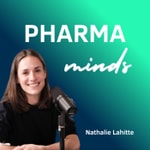
Bienvenue dans Pharma minds, le podcast qui vous emmène dans une aventure captivante à travers la Pharma et la Santé d'aujourd'hui ! Je suis votre hôte, Nathalie Lahitte. Mon objectif ? Découvrir comment des personnalités influentes ont contribué à façonner ce secteur.
À chaque épisode, nous plongeons dans leurs caractéristiques uniques, dévoilant les secrets de leurs parcours exceptionnels et leur rôle dans les grandes transformations de cet écosystème.
Explorez les coulisses de l'évolution de la Pharma et de la Santé à travers des discussions authentiques et percutantes. Ensemble, nous construisons l'avenir de ce secteur fascinant en le rendant plus innovant et inclusif. Rejoignez-nous pour des épisodes inspirants et motivants, et soyez aux premières loges de la Santé de demain.
🎧 Vous êtes nouveau par ici ? Pour comprendre en un clin d'œil le panorama des épisodes, téléchargez « 25 conseils pour un leadership engagé (https://pharma-minds.kit.com/ebookleadership) », un guide inspiré des meilleurs conseils de mes invités.
🤝 Vous voulez me parler ou échanger sur vos enjeux ? Connectons-nous sur LinkedIn (https://www.linkedin.com/in/nathalielahitte/).
📩 Et si vous voulez aller plus loin dans la compréhension des grandes transformations de l’écosystème pharma et santé, abonnez-vous à la newsletter Pharma Minds (https://nathalielahitte.substack.com/).
Hébergé par Ausha. Visitez ausha.co/fr/politique-de-confidentialite pour plus d'informations.
Site
RSS
Apple
Données mises à jour le 07/10/2026
Classements récents
Dernières positions dans les classements Apple Podcasts et Spotify.
Liens partagés entre épisodes et podcasts
Liens présents dans les descriptions d'épisodes et autres podcasts les utilisant également.
"Europe's Access Dilemma" (5/5) - "Germany has a target on its back" What will Europe give up?
lundi 5 octobre 2026 • Durée 27:45
"The worst of all outcomes is the current default: the level of Europe's contribution to the world will be decided by America." – Graham Cookson, Economist
Welcome to the 5th episode of Europe's Access Dilemma, the Pharma Minds mini-series on MFN and access to innovation in Europe. Pay more. Wait longer. Or change the model.
Europe wants three things at once: medicines people can afford, fast access to new drugs, and a strong pharma industry. Is that still possible?
My guest is Graham Cookson, Chief Executive of the Office of Health Economics (OHE) in London. He is an econometrician who works on healthcare efficiency, drug pricing and reimbursement. He starts with Germany, the country at the center of MFN.
What you will learn in this episode:
Germany's trilemma: a big buyer with a budget hole, a big producer of innovation, and a big exporter to the US. That is why it has "a target on its back".
The MFN paradox: why MFN should push US prices down, and why it is really about US revenues.
Something has to give: low prices, the latest drugs and more investment are not compatible in the short run.
The UK deal: paying more for medicines in exchange for tariff relief and investment.
No single European price: what a "NATO-style" agreement could look like instead.
The hidden trade-offs: why the worst outcome is letting America decide what Europe pays.
Health as an investment: why Europe can act as 27 nations, or as one bloc.
Listen to this episode for a European economist's view of pharma's big picture today: which ways out Europe still has, and what each one will cost.
Ressources:
📌 "FOIA Documents: Trump-Pharma MFN Drug Pricing Deals":
"Europe's Access Dilemma" (4/5) - Pharma Innovation: Your 8-Year Competitive Window Is Now Just 3
lundi 28 septembre 2026 • Durée 30:53
What happens to pharmaceutical innovation when your competitive window shrinks from eight years to just three?
In this episode of Pharma minds, I speak with Marine Baxendell, CFO and co-fonder at xcube.bio, about a fundamental shift in the economics of pharma innovation.
Science is moving faster. Competition is accelerating. And at the same time, MFN pricing, healthcare budget pressures and increasingly complex market access are challenging the traditional model on both sides of the Atlantic.
An innovative treatment could once expect five to eight years before serious competition entered the same space. Today, Marine argues, that window can be closer to two or three years, even while the original molecule remains protected.
So what happens when the time available to capture the value of innovation gets shorter?
We explore:
◾️ Why the next wave of pharma innovation is structurally different
◾️ What MFN reveals about the limits of today’s pricing model
◾️ Why demonstrating patient value earlier is becoming critical
◾️ What is really slowing market access in Europe
◾️ Why being first to market may no longer be enough
◾️ And what a more sustainable model for pharma, payers and patients could look like
Marine’s perspective reframes MFN not simply as a threat, but as a signal that the rules of pharmaceutical innovation are changing.
This is episode #4 of : five perspectives on how Europe can make innovation affordable.
"Europe's Access Dilemma" (3/5) - MFN Is Already Changing Pharma Launch Strategy. Here’s How to Prepare.
lundi 21 septembre 2026 • Durée 30:17
MFN isn't just a pricing debate. It is already changing how pharma companies think about where, when and how they launch new medicines.
In this episode of Pharma minds, I speak with Laure Nas de Tourris, Partner at Clarivate, about what she is seeing on the ground as pharma and biotech leaders start adapting their commercial strategies to the new Most Favored Nation (MFN) environment.
And one thing is clear:uncertainty is here to stay.
From early-stage assets to upcoming launches and portfolio decisions, MFN is forcing companies to rethink the traditional launch playbook. US and European pricing have always been interconnected, but those links now need to be considered much more intentionally, and much earlier, from Phase I or II of development. Launch sequencing is becoming more complex, requiring teams to anticipate the impact across markets from the very beginning.
We explore:
◾️ Why MFN has become a top-of-mind issue for pharma leaders
◾️ How MFN is already changing global launch sequencing
◾️ Why even rare disease and early-stage assets may need to prepare
◾️ How scenario planning can help teams navigate regulatory and pricing uncertainty
◾️ Why commercial, market access, medical and other functions need to work together much earlier
◾️ How pharma companies can build more flexible go-to-market models
◾️ When it may make sense to deprioritize an indication, market or investment
◾️ What delayed launches could ultimately mean for patient access to innovation
◾️ And why “wait and see” may be one of the riskiest strategies of all
"Europe's Access Dilemma" (2/5) - Europe Can't Pay More For Innovation: The Case For Co-developing With Asia
lundi 14 septembre 2026 • Durée 31:20
What if Europe’s answer to the rising cost of pharmaceutical innovation wasn’t simply to pay more, but to develop differently?
In this episode of Pharma minds, I speak with Franck Le Deu, one of the few European voices with decades of first-hand experience inside Asia’s rapidly evolving biopharma ecosystem.
Franck spent 20 years in China as a Senior Partner at McKinsey, advising some of the world’s largest pharmaceutical companies as China transformed from a market for Western medicines into a global source of biopharma innovation. Today, he is working on building bridges between Western innovation and Asian capabilities. That transformation is at the heart of our conversation.
Because Europe faces an uncomfortable equation.
The pharmaceutical industry has become increasingly US-centric. The majority of its profits are generated in the US, investment has followed, and Europe has progressively lost influence. At the same time, European governments face growing fiscal constraints, making simply spending more on innovative medicines increasingly difficult.
Franck makes the case for another path: co-development with Asia.
We explore:
◾️ How China became one of the world’s leading biopharma innovation ecosystems
◾️ Why US pharma is moving faster than Europe to tap into Chinese biotech innovation
◾️ How Asia could help reduce the cost and accelerate the execution of clinical trials and drug development
◾️ Why Europe can no longer afford to look at China only as a competitive threat
◾️ What Europe–Asia co-development could look like in practice
"Europe's Access Dilemma" (1/5) - Europe Is Losing Access to New Medicines. Here’s Why.
lundi 7 septembre 2026 • Durée 30:33
What happens when making medicines cheaper in the US makes Europe less attractive for pharmaceutical innovation?
In this episode of Pharma minds, I speak with Christoffer Frendesen, a Brussels-based pharmaceutical journalist specializing in pricing and market access, about one of the most consequential questions facing Europe’s pharmaceutical market: what happens when the rules of global drug pricing change?
Trump’s Most Favored Nation (MFN) policy is putting pressure on pharmaceutical prices in the US. But the consequences may extend far beyond American patients, and Europe may end up paying part of the price.
Christoffer explains what he is hearing from industry and policy experts, and why delayed launches and higher prices in Europe may not be temporary effects. In some European countries, fewer new medicines are already being launched, raising a fundamental question about access to innovation.
We also explore:
◾️ Why Europe is struggling to speak with one voice on pharmaceutical pricing and market access
◾️ Whether national pricing and reimbursement systems are still sustainable
◾️ Whether a more coordinated European pricing and reimbursement system could improve access
◾️ Why the EU’s Biotech Act may not be enough to make Europe attractive for pharmaceutical R&D and manufacturing
◾️ And why the consequences of MFN could be much more permanent than a Trump presidency.
This is not simply a story about Trump or pricing. It is a conversation about Europe’s pharmaceutical competitiveness, access to innovation, and the choices Europe will have to make if it wants to remain an attractive market for the medicines of tomorrow.
[Insights] Produits frontières : transformer la réglementation en avantage stratégique
Saison 7 · Épisode 6
mercredi 2 septembre 2026 • Durée 14:19
Compléments alimentaires, cosmétiques, huiles essentielles, biocides, laits infantiles... Certains produits se situent à la frontière de plusieurs catégories réglementaires. Et selon leur composition, leur destination ou leur présentation, leur statut peut changer.
Dans cet épisode de Pharma Minds Insights, je reçois Béatrice Espesson-Vergeat, spécialisée en droit pharmaceutique et réglementaire au cabinet BCTG Avocats, pour comprendre pourquoi les produits frontières sont bien plus qu'un sujet de conformité.
Car une requalification réglementaire peut avoir des conséquences très concrètes sur la distribution, le développement ou même l'avenir d'un produit. L'exemple du peroxyde d'hydrogène montre notamment à quel point une évolution réglementaire peut contraindre certaines entreprises à retirer leurs produits ou à revoir complètement leur activité.
Mais faut-il pour autant subir la réglementation ?
Dans cet échange, nous explorons une autre approche : anticiper les évolutions réglementaires, évaluer les risques et construire une stratégie produit en transversalité avec les équipes réglementaires, juridiques et marketing.
Vous découvrirez :
◾️ Pourquoi le positionnement réglementaire d'un produit peut devenir un véritable choix stratégique ;
◾️ Comment arbitrer entre enjeux sanitaires et économiques ;
◾️ Pourquoi certaines évolutions réglementaires peuvent être anticipées ;
◾️ Et comment transformer une mise en conformité anticipée en avantage concurrentiel.
Bonne écoute !
"Executing differently takes courage" (5/5) - From managing global subsidiaries to walking the talk : when execution becomes personal
lundi 17 août 2026 • Durée 24:55
Organizations demand infinite growth in finite markets. Leaders are left at the crossroads of irreconcilable missions, balancing economic imperatives with the well-being of their teams. What happens when the equation simply has no solution? The cost of execution is sometimes your own breaking point.
Welcome to Pharma Minds, Summer Series "Executing differently takes courage". For this final episode of our miniseries, I wanted to explore what execution reveals about oneself at the deepest level. I chose to speak with Patrice because his journey shows what it concretely costs to actually do what you said you would do. Execution eventually ceases to be a professional requirement. It becomes a personal decision to put skin in the game, without a safety net, but with singular intention.
Patrice Zagame is the Founder and CEO of Eolias Health, an OTC lab for plant-based products aimed at the Brazilian market. After spending 35 years in the pharmaceutical industry and managing global subsidiaries for 16 years, he knows the weight of impossible contexts. From handling severe price cuts and sales force reductions in France to surviving executive burnout and ultimately funding his own venture, Patrice embodies the courage of leaving the comfort of a massive organization to truly walk the talk.
In this episode, we cover:
◾️The Impossible Equation : Balancing double-digit growth demands with saturated markets and massive price cuts.
◾️Choice Versus Chance : Why letting an organization dictate your pace can cost you the most crucial turns in your career.
◾️The Silent Break : Recognizing the boiling point of executive burnout and walking away to change the equation.
◾️Managing the Smartest Room : Stepping back from ego to lead experts who know more than you do.
◾️Walking the Talk : Leaving corporate security to fund an entrepreneurial venture from scratch.
"Executing differently takes courage" (4/5) - Biotech survival and resource allocation : why execution is about choosing what not to do
lundi 10 août 2026 • Durée 27:30
You can have the best science in the world, but it means nothing if your company runs out of cash. When resources are limited and markets are unforgiving, execution ceases to be a management theory. It becomes a strict matter of survival. What does it actually cost to fund biotech innovation without losing control of your clinical vision?
Welcome to Pharma Minds, Summer Series "Executing differently takes courage". I wanted to place this conversation fourth in this miniseries because it captures the absolute moment of truth in execution. When science is not enough and resources are scarce, every decision can dictate whether a company lives or dies. In early-stage biotech, executing is deeply radical. It is about choosing, accepting what you will not do, and holding that line. After looking at markets and systems in earlier episodes, we have reached the barest level of execution: two leaders, pure science, and the cold reality of how we fund what we believe in.
In this episode, I sit down with Marc de Garidel, CEO of Abivax, and Paul Bravetti, CEO of Brenus Pharma. From late-stage clinical phase trials to highly complex first-in-human oncology immunotherapies, they share their impossible context: navigating environments where capital is tight, valuation paradigms have shifted, and strict focus is the only strategy that works. They break down what it takes to execute safely and scale disruptive science.
In this episode, we cover:
◾️The Survival Discipline : Why execution in biotech means ruthless prioritization and strict cost control.
◾️Valuing Innovation : Anticipating regulatory milestones and de-risking science early to attract investors.
◾️The Manufacturing Trap : How Chemistry, Manufacturing, and Controls (CMC) can make or break a clinical asset.
◾️Financing Strategy : Timing your private rounds, handling market downturns, and the leap to the Nasdaq.
◾️The Exit Illusion : Why building a company just to sell it is a mistake, and how developing a great drug attracts buyers naturally.
"Executing differently takes courage" (3/5) - Trusting the ground : navigating volatility, growth and partnerships across the EEMEA zone
lundi 3 août 2026 • Durée 23:12
What do we do when the ground is unstable and information is incomplete? We are told to wait for the right conditions. But what if waiting costs more than acting? The real risk is failing to achieve your purpose.
Welcome to Pharma Minds, Summer Series "Executing differently takes courage". I chose this specific conversation because Marc is the one who speaks best about what execution requires when the context refuses to stabilize. Through his experience, I wanted to explore what it concretely costs to actually do what you said you would do. His answer is very simple: we trust the ground and move forward. It reveals that accepting certain departures, stopping certain projects, and changing directions are the necessary costs of executing with integrity.
Marc Gailhardou (who has since been appointed President Intercontinental Region at MSD) brings this perspective from his role leading the EEMEA zone for MSD, while also serving on the board of the digital health startup The Resilience in Oncology. Tasked with managing a geographical area consisting of 25 percent of the world's population, his impossible context is one of permanent volatility. From maintaining operations across war zones to meeting the demands of emerging economies, he proves that long-term vision requires immediate, bold action.
In this episode, we cover:
◾️Leading Through Volatility : Managing safety, compliance, and operations across the diverse EEMEA region.
◾️The Appetite for the Future : Why high-growth markets embrace bold strategies while mature markets hesitate.
◾️Career as a Marathon : Moving out of your comfort zone, creating options, and knowing when it is time to transition.
◾️Corporate to Startup : Gaining agility, speed, and new perspectives through board roles at organizations like The Resilience in Oncology.
◾️Clarity Over Brutality : Focusing on the task rather than attacking the person to lead with respect.
Execution without stability is rarely comfortable. It demands hard choices and decisive momentum. Clarity wins over caution every time.
"Executing differently takes courage" (2/5) - The Chinese pharma ecosystem : balancing systemic scale and constant reinvention
lundi 27 juillet 2026 • Durée 33:37
A third of tomorrow's molecules will come from China. Just ten years ago, that figure was three percent. The entire healthcare ecosystem has shifted from a massive potential market into a testing ground for rapid, decentralized execution.The questions goes beyond how to enter this system, but how to keep pace with its relentless evolution.
Welcome to Pharma Minds, Summer Series "Executing differently takes courage". I placed this conversation with Guillaume Delmotte in the second position of our series because he brings something the other episodes simply do not have: a systemic reading of execution. In China, execution is not an individual choice but a mode of operation for the state, highly centralized in its objectives and completely decentralized in its application. I chose this discussion to explore what it concretely costs to actually do what you said you would do at a massive, systemic scale. It reveals that large-scale delivery is only possible when partnerships are built for the long term and when you accept that constant adaptation becomes the course itself.
Guillaume Delmotte spent twenty years within Ipsen, navigating international leadership roles across Europe, Russia, and most recently China. Operating in a highly fluid, fiercely competitive market of 1.4 billion people, his impossible context was learning to execute without a rigid playbook. He had to navigate the immense tension between capturing an unprecedented volume opportunity and facing brutal price pressures, all while reinventing patient pathways from the ground up alongside local players.
In this episode, we cover:
◾️Geography Commands Strategy : Why adapting tactics to localized provincial health policies is the only way to scale.
◾️The Virtual Hospital Shift : How digitized care pathways and AI are managing patient flows for minor and severe pathologies.
◾️Breaking the Pricing Rules : Moving away from rigid formulation constraints to establish entirely new value models.
◾️Building True Ecosystems : Leveraging local distributors and pharmacy data mining to find undiagnosed rare disease patients.
Podcasts Similaires Basées sur le Contenu
Découvrez des podcasts liées à Pharma Minds. Explorez des podcasts avec des thèmes, sujets, et formats similaires. Ces similarités sont calculées grâce à des données tangibles, pas d'extrapolations !
The companies best prepared for what comes next will not necessarily be those that correctly predict exactly how MFN will unfold. They will be those that build different scenarios, preserve optionality, connect decisions across their portfolio and prepare their teams early.
Because under MFN, the old launch playbook may not be enough.
This is episode #3 of Europe’s Access Dilemma: five perspectives on how Europe can make innovation affordable.
◾️ How Europe could combine Asian capabilities with its own strengths in research, development and manufacturing
◾️ And whether this model could help Europe regain pharmaceutical competitiveness while protecting its sovereignty
Franck’s argument is not that Europe should replace its relationship with the US with China. It is that Europe needs to engage with Asia strategically, learn from ecosystems that move faster, and build new forms of collaboration that preserve European strengths and sovereignty.
Ultimately, making pharmaceutical innovation accessible to more patients will require more than higher budgets. It means bringing R&D and manufacturing costs down, rethinking pricing, and creating ecosystems that know how to collaborate and compete.
This is episode #2 of Europe’s Access Dilemma: five perspectives on how Europe can make innovation affordable.
Merci à notre partenaire BCTG Avocats d’avoir rendu cet épisode possible et de nous aider à comprendre les tendances de fond dans la régulation du secteur. Comme toujours, l’équipe Pharma Minds garde la main sur la ligne éditoriale et le choix des invités.
🎧 Vous êtes nouveau par ici ? Pour comprendre en un clin d'œil le panorama des épisodes, téléchargez « 25 conseils pour un leadership engagé », un guide inspiré des meilleurs conseils de mes invités.
🤝 Vous voulez me parler ou échanger sur vos enjeux ? Connectons-nous sur LinkedIn.
📩 Et si vous voulez aller plus loin dans la compréhension des grandes transformations de l’écosystème pharma et santé, abonnez-vous à la newsletter Pharma Minds.
Commitment is not a corporate posture. It is a daily decision renewed in the face of impossible contexts. At some point, managing the system is no longer enough.
👉 What is the hardest career pivot you have had to make to protect your own values? Let us know in the comments.
👉 How do you balance the need to act with the pressure to wait for better data? Let us know in the comments. Science creates hope. Reality decides impact.
If you want to follow the whole series, don't forget to subscribe.
-
This episode has been translated with the help of AI tools and edited to align with the editorial direction of this series.