Overthink – Détails, épisodes et analyse
Détails du podcast
Informations techniques et générales issues du flux RSS du podcast.
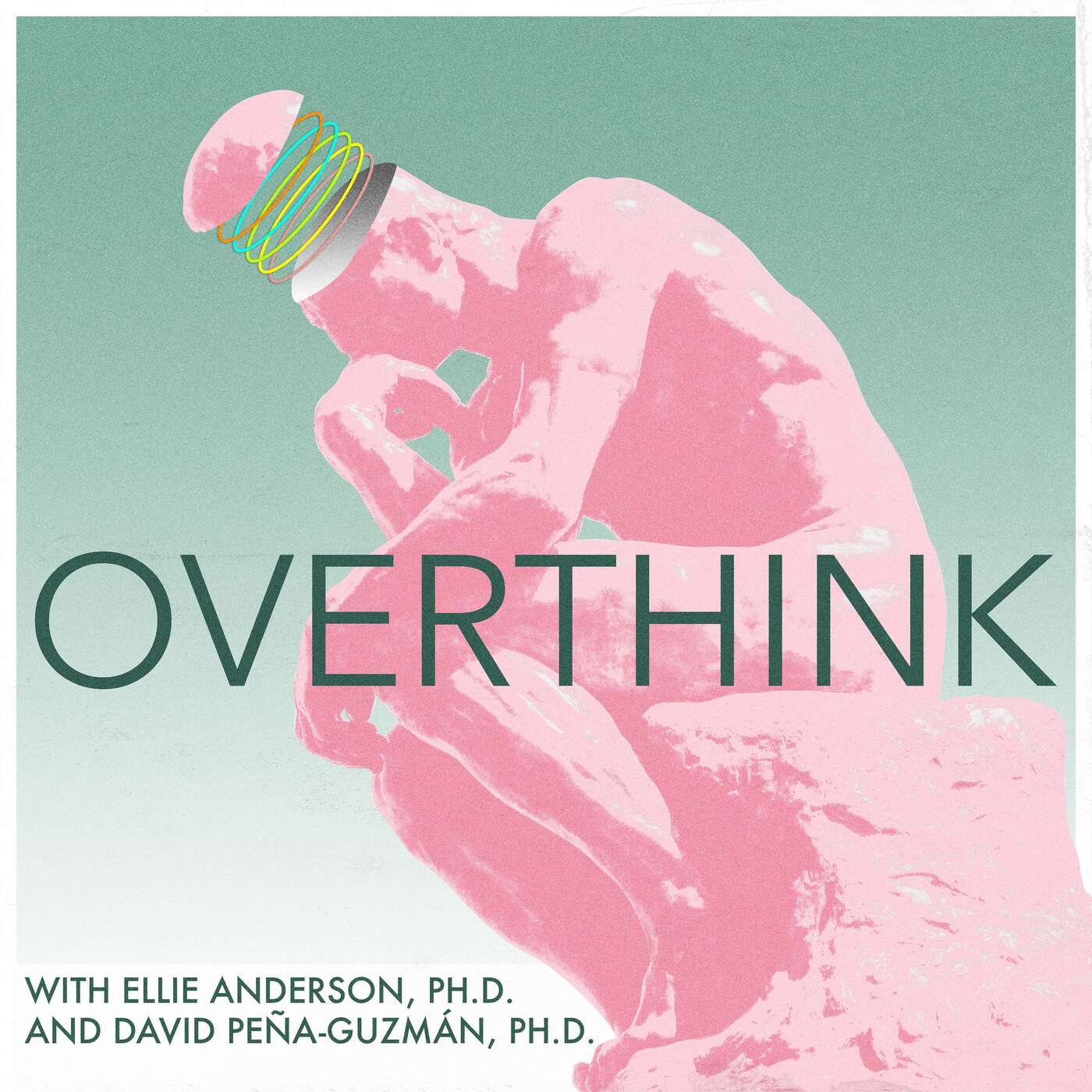
Overthink
Ellie Anderson, Ph.D. and David Peña-Guzmán, Ph.D.
Fréquence : 1 épisode/12j. Total Éps: 176

The best of all possible podcasts, Leibniz would say. Putting big ideas in dialogue with the everyday, Overthink offers accessible and fresh takes on philosophy from enthusiastic experts.
Hosted by professors Ellie Anderson (Pomona College) and David M. Peña-Guzmán (San Francisco State University).
Classements récents
Dernières positions dans les classements Apple Podcasts et Spotify.
Apple Podcasts
Aucun classement récent disponible
Spotify
Aucun classement récent disponible
Liens partagés entre épisodes et podcasts
Liens présents dans les descriptions d'épisodes et autres podcasts les utilisant également.
See all- https://www.overthinkpodcast.com/
282 partages
- https://www.givecampus.com/pnrdy5
281 partages
- https://overthinkpod.substack.com/
173 partages
- https://www.patreon.com/overthinkpodcast
281 partages
- https://patreon.com/overthinkpodcast
78 partages
- https://www.instagram.com/overthink_pod
281 partages
Qualité et score du flux RSS
Évaluation technique de la qualité et de la structure du flux RSS.
See allScore global : 63%
Historique des publications
Répartition mensuelle des publications d'épisodes au fil des années.
Natality with Jennifer Banks
mardi 7 octobre 2025 • Durée 52:43
Why does much of the history of philosophy neglect the topic of birth? In episode 142 of Overthink, Ellie and David chat with Jennifer Banks about her book Natality: Toward a Philosophy of Birth. They think through the debate between pronatalism and antinatalism, and consider alternatives to these positions. They also discuss Hannah Arendt’s account of natality and what Mary Shelley’s Frankenstein tells us about the relationship between birth and monstrosity. What is birth, and why does it seem to defy so many of our concepts and categories? What’s the difference between being-born and giving-birth? And how would our view of ourselves change if we saw ourselves through the lens of a “philosophy of birth” (as opposed to, say, “a philosophy of death”)? In the Substack bonus segment, your hosts dive further into Hannah Arendt’s works, focusing on the link between her concept of natality and her ideas about the public/private distinction.
Works Discussed:
Hannah Arendt, The Human Condition
Jennifer Banks, Natality: Toward a Philosophy of Birth
Alison Stone, Being Born: Birth and Philosophy
Dean Spears and Michael Geruso, After the Spike: Population, Progress, and the Case for People
Marjolein Oele, “The Dissolution of the Pregnant City: A Philosophical Account of Early Pregnancy Loss and Enigmatic Grief”
See Privacy Policy at https://art19.com/privacy and California Privacy Notice at https://art19.com/privacy#do-not-sell-my-info.
Femininity
mardi 30 septembre 2025 • Durée 59:35
Tradwives, the divine feminine, and “that girl” on social media. In episode 141 of Overthink, Ellie and David discuss femininity. They look to Simone de Beauvoir’s famous claim that one is not born but rather becomes a woman, and discuss how the process of feminization is crucial to this becoming. They explore the association between femininity, mystery, and docility. Is the return to traditional gender roles an attempt to move away from capitalism? How do contemporary beauty standards shape women’s self-understanding. And is there such thing as “feminine writing”? In the Substack bonus segment, your hosts discuss 90s cultural feminism and spirituality, and question whether it is possible to find liberation through the divine feminine image.
Works Discussed:
Sandra Bartky, “ Foucault, Femininity, and the Modernization of Patriarchal Power”
Pierre Bourdieu, La domination masculine
Simone de Beauvoir, The Second Sex
Hélène Cixous, “The Laugh of the Medusa”
Manon Garcia, We Are Not Born Submissive
Substack | overthinkpod.substack.com
Website | overthinkpodcast.com
Instagram & Twitter | @overthink_pod
Email | dearoverthink@gmail.com
YouTube | Overthink podcast
See Privacy Policy at https://art19.com/privacy and California Privacy Notice at https://art19.com/privacy#do-not-sell-my-info.
Earth
mardi 17 juin 2025 • Durée 42:09
This one’s going to rock your world. In episode 132 of Overthink, Ellie and David dig into the earth for the third part of their four-part series on the elements. They discuss everything from earthworms and carbon dating to the “solidity” of the earth. They look to Foucault, Freud, and Husserl for insights about how the earth can act as a metaphor for the mind and for the past. They also wonder: Is the earth inert matter or a living being? And why do so many creation myths present humans as “made” of earth/clay/mud? So, what is it that we actually mean when we talk about earth as an element? In the bonus, your hosts talk think through Heidegger’s notion of ground and horizon, and the Western association of land with earth.
Works Discussed:
Michel Foucault, The Archeology of Knowledge
Martin Heidegger, “ The Origin of the Work of Art”
Edmund Husserl, Crisis of the European Sciences
David Macauley, Elemental Philosophy: Earth, Air, Fire, and Water as Environmental Ideas
Thomas Nail, Theory of the Earth
James Lovelock, Gaia hypothesis
Dorian Sagan and Lynn Margulis, “God, Gaia, and Biophilia”
Substack | overthinkpod.substack.com
Website | overthinkpodcast.com
Instagram & Twitter | @overthink_pod
Email | dearoverthink@gmail.com
YouTube | Overthink podcast
See Privacy Policy at https://art19.com/privacy and California Privacy Notice at https://art19.com/privacy#do-not-sell-my-info.
Science Fiction (feat. Helen de Cruz)
mardi 4 janvier 2022 • Durée 55:35
Would you willingly plug yourself into an experience-simulating machine such as The Matrix? What would happen to society if robots suddenly became conscious? What would you do if, for some reason, you encountered an utterly alien life form? Many of us first ponder big philosophical questions such as these through exposure to science fiction stories in books or movies. In episode 42, Ellie and David explore the power of sci-fi. After considering the origins of this genre, they interview Dr. Helen De Cruz, an expert on the philosophy of science fiction, about how our brains process sci-fi stories differently than other speculative narratives, including philosophical thought experiments!
Works Discussed
Helen De Cruz, Johan De Smedt, and Eric Schwitzgebel, Philosophy Through Science Fiction Stories: Exploring the Boundaries of the Possible
Johan De Smedt and Helen De Cruz. "The Epistemic Value of Speculative Fiction"
Jean Baudrillard, Simulacra and Simulation
The Matrix Decoded: Le Nouvel Observateur Interview With Jean Baudrillard, 2004
Ted Chiang, "Story of Your Life"
Ursula K. Le Guin, The Dispossessed
Ursula K. Le Guin, The Left Hand of Darkness
Zhuangzi, The Inner Chapters
Mary Shelley, Frankenstein
Philip K. Dick, Do Androids Dream of Electric Sheep?
The Matrix (film)
Zenon, Girl of the Twenty-First Century (film)
Arrival (film)
Dune (film)
I, Robot (film)
Robert Nozick, “The Experience Machine"
Ruth Garrett Millikan, “On Swampkinds"
Substack | overthinkpod.substack.com
Website | overthinkpodcast.com
Instagram & Twitter | @overthink_pod
Email | dearoverthink@gmail.com
YouTube | Overthink podcast
See Privacy Policy at https://art19.com/privacy and California Privacy Notice at https://art19.com/privacy#do-not-sell-my-info.
Intoxication
mardi 21 décembre 2021 • Durée 59:08
Drunks, like children, always tell the truth. And after a night (or day) of drinking, everyone turns into a professional philosopher! What is it about intoxication that incites us to philosophize, to “wax poetic”? In episode 41, David and Ellie explore the theme of intoxication all the way from the wine-filled feasts of the ancient Greeks to contemporary debates about psychedelic drugs. They look at the fascinating “ergot hypothesis,” which holds that famous philosophers such as Plato, Socrates, and Aristotle came up with their most important metaphysical insights while tripping on an ancient psychedelic called “ergot.” And they consider what experiences of intoxication can teach us about power, privilege, and freedom.
Works Discussed
Carl Hart, Drug Use for Grown-Ups: Chasing Liberty in the Land of Fear
Plato, The Symposium
R. Gordon Wasson, Albert Hofmann, and Carl A. P. Ruck, The Road to Eleusis: Unveiling the Secret of the Mysteries
Michael Pollan, How to Change Your Mind
Evgenia Fotiou "The globalization of ayahuasca shamanism and the erasure of indigenous shamanism"
Marty Roth, Drunk the Night Before: An Anatomy of Intoxication
Jean-Luc Nancy, Intoxication
Immanuel Kant, The Metaphysics of Morals
Maggie Nelson, On Freedom
Jacques Derrida, Plato’s Pharmacy
Substack | overthinkpod.substack.com
Website | overthinkpodcast.com
Instagram & Twitter | @overthink_pod
Email | dearoverthink@gmail.com
YouTube | Overthink podcast
See Privacy Policy at https://art19.com/privacy and California Privacy Notice at https://art19.com/privacy#do-not-sell-my-info.
Christmas-Industrial Complex
mardi 7 décembre 2021 • Durée 54:57
Happy holidays! As Christmas approaches, the average American prepares to spend nearly $1,000 on presents, decorations, and family feasting. How did an originally religious festival become so caught up in capitalist consumption? What really defines Christmas in an increasingly secular America? This holiday season, David and Ellie try not to be scrooges as they explore the Christmas Industrial Complex. From Hallmark movies to Dickens’ A Christmas Carol, the stories we tell around Christmas can be incredibly varied. In looking at these narratives and more, Ellie and David discuss whether Christmas can be separated from the often heavily capitalist rituals around it. Episode 40.
Works Discussed
NewSong, “The Christmas Shoes”
Megan Garber, “The Cheesy Endurance of the Made-for-TV Holiday Movie”
A New York Christmas Wedding
Daniel J. Boorstin, The Image: A Guide to Pseudo-Events in America
Charles Dickens, A Christmas Carol
History.com, “Saturnalia”
Mari Ruti, Penis Envy and Other Bad Feelings
Jim Probasco, “Average Cost of American Holiday Spending”
Jonathan Berr, “Hallmark’s Christmas Movies Are Predictably Popular With Viewers”
Substack | overthinkpod.substack.com
Website | overthinkpodcast.com
Instagram & Twitter | @overthink_pod
Email | dearoverthink@gmail.com
YouTube | Overthink podcast
See Privacy Policy at https://art19.com/privacy and California Privacy Notice at https://art19.com/privacy#do-not-sell-my-info.
Secrets
mardi 23 novembre 2021 • Durée 59:33
What’s this episode about? Shh, it’s a secret. Just kidding! In episode 39, Ellie and David take a deep dive into the concepts of secrets and secrecy. Some thinkers have argued that keeping secrets is destructive for the self, while others say that keeping secrets lets us feel like we have something (alt: a space?) for ourselves, that isn’t shared with other people. Moreover, the telling of secrets is often a key to creating a sense of trust and intimacy between BFFs or romantic partners. However, keeping secrets also often raises an ethical question — is it ever morally right to disclose another person’s secret, and if so, when? Ellie and David conclude with a discussion of government secrecy and its implications for public trust; how much transparency is too much?
Works Discussed
Kwame Anthony Appiah, “Should I Tell My Friend’s Husband She’s Having an Affair?”
Sissela Bok, Secrets
James Edwin Mahon, “Secrets vs. Lies: Is There a Moral Asymmetry?”
Anne Dufourmontelle, In Defense of Secrets
Gilles Deleuze and Felix Guattari, A Thousand Plateaus
Jacques Derrida, “Répondre — du secret, 1991-2 seminar”
Georg Simmel, “The Sociology of Secrecy and Secret Societies”
Giovanna Borradori, “Between transparency and surveillance: Politics of the secret"
C. Thi Nguyễn, “Transparency is Surveillance”
Substack | overthinkpod.substack.com
Website | overthinkpodcast.com
Instagram & Twitter | @overthink_pod
Email | dearoverthink@gmail.com
YouTube | Overthink podcast
See Privacy Policy at https://art19.com/privacy and California Privacy Notice at https://art19.com/privacy#do-not-sell-my-info.
Disgust
mardi 9 novembre 2021 • Durée 59:24
Disgust is often assumed to be biological, but in what ways do cultural norms and personal preferences influence what disgusts us? Can we shape what we’re disgusted by over time? Ellie and David explore how disgust colors our interactions with food, art, and even sex, in episode 38. Given how disgust has helped enforce racism and homophobia, does it have any place in morality? And how does modern art's use of excrement, vomit, and blood change how we think about aesthetics?
Works Discussed
- Sianne Ngai, Ugly Feelings
- Charles Darwin, The Expression of Emotions in Man and Animals
- John Garcia, Donald J. Kimeldorf, and Robert A. Koelling, "Conditioned aversion to saccharin resulting from exposure to gamma radiation"
- Adam Smith, The Theory of Moral Sentiments
- Georges Bataille, Documents
- Georges Bataille, L’érotisme
- Downton Abbey, S3 E7
- Immanuel Kant, Critique of Judgement
- Christopher Ofili, The Holy Virgin Mary
- Julia Kristeva, Powers of Horror: An Essay on Abjection
Substack | overthinkpod.substack.com
Website | overthinkpodcast.com
Instagram & Twitter | @overthink_pod
Email | dearoverthink@gmail.com
YouTube | Overthink podcast
See Privacy Policy at https://art19.com/privacy and California Privacy Notice at https://art19.com/privacy#do-not-sell-my-info.
Living Your Truth (feat. Tamsin Kimoto)
mardi 26 octobre 2021 • Durée 59:26
Are you #LivingYourTruth? This buzzy catchphrase is all over Instagram, but might it actually justify selfish or irresponsible behavior? Alternatively, can it be a way of affirming marginalized identities--and perhaps even reveal the extent to which our lives are ultimately of our own making? Ellie and David speak with Dr. Tamsin Kimoto in episode 37 about how "living your truth" relates to transgender identity formation, "born this way" narratives of sexuality, and the idea of an authentic self. After the interview, David and Ellie suggest that existential authenticity is a way of "living your truth" without buying into the metaphysical idea of an inner self.
Works Discussed
Tamsin Kimoto, "Merleau-Ponty, Fanon, and Phenomenological Forays in Trans Life"
Michel Foucault, The History of Sexuality
Talia Mae Bettcher, “Trapped in the Wrong Theory: Rethinking Trans Oppression and Resistance”
Maurice Merleau-Ponty, The Phenomenology of Perception
Gayatri Chakravorty Spivak and Elizabeth Grosz, “Criticism, feminism and the institution: An interview with Gayatri Chakravorty Spivak”
Friedrich Nietzsche, “Schopenhauer as Educator”
Martin Heidegger, Being and Time
Theodor Adorno, The Jargon of Authenticity
Substack | overthinkpod.substack.com
Website | overthinkpodcast.com
Instagram & Twitter | @overthink_pod
Email | dearoverthink@gmail.com
YouTube | Overthink podcast
See Privacy Policy at https://art19.com/privacy and California Privacy Notice at https://art19.com/privacy#do-not-sell-my-info.
Art as Commodity
mardi 12 octobre 2021 • Durée 57:46
Today's art world is driven by multimillion-dollar auctions and fancy art fairs inaccessible to most Americans — Art Basel Miami, anyone? Those who do view art spend an average of just eight seconds per work, so it's not clear that we're even meaningfully experiencing those Monet water lilies. In episode 36, Ellie and David explore the way capitalism has turned art into a commodity. From Basquiat to Banksy, even street art seems to have been devoured by capitalism’s endless hunger for monetary exchange, selling aesthetics of revolution for millions of dollars at auction. How might intricate Tibetan sand paintings and even macaroni necklaces help us envision a future for art outside of commodification?
Works Discussed
John Dewey, Art as Experience
Walter Benjamin, “The Work of Art in the Age of Mechanical Reproduction”
Hito Steyerl, Duty Free Art
Theodor Adorno, The Culture Industry
Michael Baxandall, Painting and Experience
Diana Crane, “Reflections on the Global Art Market”
Cynthia Freeland, What is Art?
McKenzie Wark, “Digital Provenance and the Artwork as Derivative”
Sianne Ngai, Our Aesthetic Categories: Zany, Cute, Interesting
Banksy, Love is in the Bin
Karl Marx, 1844 Manuscripts
Christo and Jeanne-Claude, The Pont Neuf Wrapped
Substack | overthinkpod.substack.com
Website | overthinkpodcast.com
Instagram & Twitter | @overthink_pod
Email | dearoverthink@gmail.com
YouTube | Overthink podcast
See Privacy Policy at https://art19.com/privacy and California Privacy Notice at https://art19.com/privacy#do-not-sell-my-info.
Podcasts Similaires Basées sur le Contenu