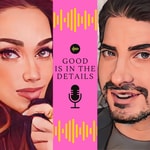
Good Is In The Details is an engaging philosophy and education podcast hosted by Gwendolyn Dolske, Ph.D., and Rudy Salo, exploring the ideas that shape how we think, learn, and live. Blending philosophy, higher education, books, ethics, culture, and critical thinking, the show invites listeners into thoughtful conversations with scholars, authors, and experts from a wide range of disciplines.
Each episode makes complex ideas accessible, connecting philosophy to everyday life, current events, human behavior, and the pursuit of meaning. From ethics and epistemology to history, sociology, and the philosophy of culture, Good Is In The Details helps listeners learn what they didn't know they didn't know while encouraging curiosity, intellectual growth, and deeper understanding.
Ideal for lifelong learners, students, educators, and anyone seeking a fun, engaging, and thoughtful learning experience, this podcast combines academic insight, real-world relevance, and lively conversation. Whether you're interested in philosophy, books, higher education, or developing critical thinking skills, Good Is In The Details offers meaningful dialogue, fresh perspectives, and wisdom you can carry into everyday life.
Site
RSS
Apple
Données mises à jour le 13/09/2026
Classements récents
Dernières positions dans les classements Apple Podcasts et Spotify.
Liens partagés entre épisodes et podcasts
Liens présents dans les descriptions d'épisodes et autres podcasts les utilisant également.
To Chill or Not To Chill: When Does Perseverance Become Toxic?
mardi 1 septembre 2026 • Durée 50:40
We're taught that perseverance is always a virtue, but what if the very trait we celebrate is quietly costing us our sense of meaning?
Michael Scarano, a healthcare veteran turned speaker and coach, joins us to unpack what he calls "toxic perseverance": pushing forward not from purpose, but from unexamined beliefs formed by trauma and unmet needs. We dig into the real difference between healthy resilience and burnout, how to tell if you're persevering toward something or just running from stopping, and what Aristotle's idea of eudaimonia, a genuinely flourishing life, not just a productive one, has to do with any of it.
The conversation also opens up into a candid discussion of ADHD, how the condition shapes the brain differently, and why it's finally getting more accurate attention in medicine and media.
Honest, True, or Authentic? (They're Not the Same Thing)
mercredi 19 août 2026 • Durée 48:33
Honesty might be the character trait we claim to value most, but what does it actually mean to be honest, and how is that different from simply telling the truth, or "being authentic"?
Philosopher Christian Miller, author of The Honesty Crisis, joins us to untangle these distinctions and make the case that honesty is eroding faster than we realize, from deepfakes and AI-written schoolwork to the quiet ways social media rewards dishonesty that flatters our own side.
We dig into virtue ethics and what it actually takes to be an honest person in practice, not just in principle, including a great real-world case study from Rudy's own world of contract law, where the professional "rule" is to draft every agreement in your client's favor while staying strictly honest. That tension opens up a bigger conversation about whether honesty is ever context-dependent, and what that means for how we behave online, where the rules, and the witnesses, are different.
Before the interview, Gwen and Rudy also talk through a few legal questions raised by the ongoing Lindsay Clancy trial, which has drawn significant public attention. It's less about the case itself and more about the exercise: using tools from past episodes on misinformation, conspiracy thinking, and justice to think more critically about how a case like this gets covered; which is, at its core, exactly what this podcast is for.
Cults, Conspiracy Theories & Critical Thinking: The History America Didn't Teach You
vendredi 31 juillet 2026 • Durée 41:06
What if the United States was never immune to cult thinking, but was built on it?
Journalist Jane Borden joins Gwendolyn and Rudy to unpack her book Cults Like Us: Why Doomsday Thinking Drives America, tracing a direct line from Puritan doomsday belief to modern conspiracy theories, self-help culture, and our national obsession with strongmen and influencers. We dig into how to actually define a cult (without being hyperbolic about it), the surprising overlap between cults and conspiracy theories, why doomsday predictions are so effective for cult leaders, and what role the justice system plays when belief crosses into control.
We also explore why cult stories captivate us the way true crime does and, most importantly, what actually happens in the moment someone's critical thinking finally breaks through the isolation a cult creates. A conversation about American history, critical thinking skills, and the psychology of belief that might change how you see the news, your feed, and the country itself.
Are You Living in an Echo Chamber? The Psychology of Misinformation & Critical Thinking | Matthew Facciani
jeudi 16 juillet 2026 • Durée 50:40
How do echo chambers influence our beliefs?
How do you know what is true on the internet?
Why does misinformation spread so quickly online? What is an echo chamber, and how does confirmation bias influence the way we evaluate information?
In this episode of Good Is In The Details, Gwendolyn Dolske and Rudy Salo welcome sociologist Matthew Facciani, author of Misguided: Where Misinformation Starts, How It Spreads, and What To Do About It, for an engaging conversation about the psychology and sociology of misinformation.
Together they explore:
• What misinformation is, and why it's so persuasive • Why our social identities often matter more than facts • How echo chambers and online communities reinforce existing beliefs • The role of confirmation bias in shaping what we think is true • Why intelligent people can still believe false information • Practical critical thinking strategies for evaluating claims and sources • How to recognize credible evidence and challenge your own assumptions • Ways to become a more thoughtful consumer of news, social media, and online information
Rather than simply asking what people believe, this conversation examines why we believe it. Drawing from sociology, psychology, philosophy, and critical thinking, Matthew Facciani explains how our need for belonging, identity, and certainty can make us vulnerable to misinformation, and what we can do to become better thinkers.
Whether you're interested in media literacy, critical thinking, online behavior, confirmation bias, or simply want to become more confident in evaluating information on the internet, this episode offers practical tools for navigating today's complex information landscape.
Rewind, Play, Repeat: Nicole Morrison on Music, Memory, Coming Out, and Memoir
mercredi 1 juillet 2026 • Durée 40:29
The mixtape structural metaphor ushers in a philosophical lens. Because a mixtape (as every Gen X person who ever made one knows) is a curated act of autobiography. It's how you tell someone the truth about yourself when you don't yet have the courage to say it out loud. It's the thing you hand to someone and say: here is who I am, track by track, in the order I chose. That is exactly what memoir does. And in this conversation, Nicole, Gwendolyn, and Rudy explore what it means to tell that truth, on the page, in a life, in a body that lived multiple lives inside one.
In this episode of Good Is In The Details, Gwendolyn Dolske and Rudy Salo sit down with Nicole Morrison , educator, author, founder of Nicole Morrison Strategies, and creator of The FoundHers Table, for a conversation that begins with music and ends somewhere much deeper: in the territory of what it costs to tell your own story, and what it gives you back.
What we explore in this episode:
The mixtape as a Gen X artifact: what making a mixtape actually was, why it mattered, and how that act of curation maps onto the act of writing a memoir
The role of music in memory and identity: how songs hold entire chapters of a life, and why Nicole structured her memoir around that experience of listening
What it means to write memoir as a form of subjective truth: not the objective facts of what happened, but the lived, felt, interior reality of what it was like to be inside a particular life at a particular moment. As Gwendolyn notes from her training in existentialism: the memoir is a philosophical act, a claim that the subjective experience of a life has value and deserves to be witnessed
How writing is a form of therapy, and how memoir specifically, as an act of articulating what you've lived, can help both the writer who tells the story and the reader who recognizes themselves in it.
Coming out — twice — and what that experience reveals about the relationship between identity, community, and the courage it takes to choose your truth when that truth might cost you everything
What it means to live multiple lives inside one body, and how the Gen X generation, raised in a world that was changing faster than it could protect its children, developed a particular relationship to reinvention, self-reliance, and the construction of identity
How To Critically Think About Career Choices: Hope for Unhappy Lawyers
mardi 16 juin 2026 • Durée 43:18
Gwendolyn Dolske and Rudy Salo welcome Casey Berman: former attorney, founder of Leave Law Behind (the leading coaching program helping attorneys transition into non-legal careers), multipreneur, strategy consultant, speaker, and author, for a discussion about work, identity, happiness, and the courage it takes to choose a different life.
Casey knows this territory from the inside. He lived it. And he has spent years helping thousands of attorneys find what he calls their Unique Genius, the specific intersection of talent and joy that, when aligned with their work, produces not just professional success but the deeper contentment that a career in law, for many, was never able to provide.
What we explore in this episode:
The reality of life inside the legal profession, the hours, the pace, the stress, the culture, and why so many attorneys feel trapped even when their career looks successful from the outside
What you can actually do with a law degree that doesn't involve practicing law, and why the answer is far broader and more interesting than most law students are ever told: consulting, compliance, legal technology, entrepreneurship, writing, business development, policy, education, coaching, and more than 100 documented alternatives
The specific steps Casey recommends for assessing whether your unhappiness is situational (the wrong firm, the wrong practice area, the wrong city) or fundamental (the wrong career entirely), and why getting that diagnosis right is the most important first step
How to get feedback from the people in your life, family, friends, colleagues, mentors, to identify what you are genuinely good at, what lights you up, and where your skills create value outside a courtroom or a contract review
Bertrand Russell and The Conquest of Happiness, and why Russell's argument that most human unhappiness is self-generated and rooted in the wrong relationship to work maps precisely onto what Casey has observed in the legal profession for over a decade
What Russell wrote about the sunk cost of identity: why we must be willing to let go of what we have invested in, emotionally, financially, intellectually, when it's clear it is not our talent or our strength, and why it is not only acceptable but necessary to grieve the self you thought you would be
How To Navigate The Homeless Crisis With Humanity and Reason
lundi 25 mai 2026 • Durée 40:29
In this episode of Good Is In The Details, Gwendolyn Dolske sits down with Karen Olson — founder and CEO emeritus of Family Promise, a national nonprofit organization dedicated to helping homeless and low-income families, whose organization has trained and mobilized over one million volunteers over the past thirty years to provide services to homeless families, and author of Meant for More: Following Your Heart and Finding Your Purpose, to have the conversation about homelessness that most people are too uncomfortable, too misinformed, or too distant to have.
The myths Karen dismantles in this conversation:
The homeless are lazy. The homeless are addicted and choose not to get help. Homelessness is an individual failure rather than a systemic one. The people on the street are strangers with no history and no future.
Karen has spent thirty years learning the truth. Family Promise has helped more than a quarter of a million people annually, and in that work Karen has come to know her clients the way most of us know our neighbors: by name, by story, by the specific combination of circumstances and choices and bad luck and systemic failure that brought them to where they are.
She calls them her friends. In a culture that speaks of homeless people as a mess to be cleaned up, as a problem to be managed, as a category rather than a collection of individuals with names and histories and futures, Karen Olson calls them her friends. And she means it.
What we explore in this episode:
Who is actually homeless in America, and why the answer will surprise you. Children. Veterans. Families. People who work full-time jobs that pay less than the cost of a roof over their head
The drug and alcohol addiction myth, what Karen has actually observed about addiction and homelessness, why addiction makes it harder for people to accept help, and the conditions under which she has watched people move away from it when genuine opportunity is offered
The policy dimension: how government decisions about mental health treatment, addiction services, affordable housing, and the minimum wage are not separate from the homelessness crisis, they are its architecture
The Good in Getting There: Thinking Critically About Your Career/Skills and The Meaning of Your Life's Work
vendredi 15 mai 2026 • Durée 51:58
Critical thinking, happiness, career goals, and...how we understand moving about our cities. What assumptions do we hold onto about our purpose?
In this episode of Good Is In The Details, Gwendolyn Dolske and Rudy Salo sit down with Paul Comfort — Senior Vice President at Modaxo Americas, former CEO of the Maryland Transit Administration and Transloc, host of the award-winning Transit Unplugged podcast, and author of the forthcoming book Find Your X Factor — for a conversation that moves seamlessly from Socratic self-knowledge to the engineering of communities, and argues that both are expressions of the same fundamental question: what does it mean to live well, together?
The episode begins where Paul's book begins, with the inward turn. Find Your X Factor is a guide to identifying your authentic skill set, your genuine talents, and the voice inside you that knows what kind of work would allow you to fully express who you are rather than chasing the career someone else told you to want. Gwendolyn hears in this an unmistakably Socratic echo: the ancient Greek philosopher who insisted that the examined life, the life turned inward toward honest self-knowledge, was the only foundation for genuine happiness. Paul Comfort, it turns out, has been teaching Socrates to transportation executives for years without using the word.
And then the conversation does something unexpected.
Because Paul's own story, the story of how he discovered his X Factor, leads directly to public transportation. To the buses, trains, metros, and ferries that move millions of people every day in ways that most of us take entirely for granted, or dismiss entirely, or never use at all. And once you understand public transit through a philosophical lens, you cannot see it the same way again.
What we explore in this episode:
What the X Factor actually is, and how the process of identifying your authentic skill set and inner voice connects directly to Aristotle's concept of eudaimonia and the Socratic imperative to know yourself before you can know anything else worth knowing
Why infrastructure is not a static reality but a designed choice and what it means philosophically and politically that we can choose differently
Encore: The Philosophy of Star Wars. Eastern Wisdom, Attachment, and the Search for Happiness
jeudi 30 avril 2026 • Durée 47:56
What can Star Wars teach us about happiness, attachment, and the search for meaning?
In this episode of Good Is In The Details, we explore the philosophy behind one of the most influential cultural phenomena of our time, Star Wars, through the lens of Eastern philosophy with Professor Noble (One With The Force: 18 Universal Truths in Star Wars).
From the Jedi's emphasis on detachment to the dangers of fear and desire, we examine how ideas rooted in Buddhist and Eastern thought shape the moral universe of Star Wars. At the heart of the conversation is a powerful insight: clinging to what is temporary can lead to suffering.
We discuss:
The connection between Eastern philosophy and Star Wars
Why attachment can lead to suffering and destructive choices
How fear, desire, and control shape human behavior
The philosophical meaning of balance and letting go
What Star Wars reveals about happiness and the human condition
This episode invites listeners to think more deeply about:
What is happiness?
Why do we cling to things that don't last?
How can philosophy help us live better lives?
By connecting pop culture with philosophical insight, this conversation shows how timeless ideas about suffering, impermanence, and self-awareness continue to resonate in modern storytelling.
🎧 Listen now to explore how Star Wars brings ancient philosophy into everyday life, and what it can teach us about letting go.
The Slow Death of Local News and Its Impact on Critical Thinking
mercredi 15 avril 2026 • Durée 41:14
What happens when local journalism disappears, and how does it affect democracy, critical thinking, and informed citizens?
Is local journalism disappearing, and what does that mean for democracy?
In this episode of Good Is In The Details, we speak with journalist Liz Farmer about the decline of local press, the economics of modern media, and why journalism is essential for an informed public.
As news consumption increasingly shifts toward national outlets, social media, and algorithm-driven content, many communities are losing access to local reporting. But what happens when citizens no longer have reliable information about their own cities, policies, and elected officials?
We explore:
The "death of local news" and its real-world impact
How journalism helps citizens understand public policy and government spending
Why local reporting is essential for informed voting and civic engagement
The role of journalism in developing critical thinking skills
How echo chambers and media consolidation narrow public understanding
What is lost when readers stop engaging deeply with information
Drawing from her work covering state and local fiscal policy, Liz Farmer explains how journalists translate complex issues—like budgets, taxes, and public spending—into accessible knowledge for everyday citizens.
This episode asks an urgent question: Can democracy function without a well-informed public?
If you've ever wondered:
Why is local journalism important?
What is happening to local news in the U.S.?
How does media affect democracy and voting?
Why is critical thinking declining?
How do we evaluate sources and credibility?
This conversation offers a powerful and timely perspective.
🎧 Listen now to understand why journalism, and the ability to think critically about information, matters more than ever.
If you enjoy conversations that encourage curiosity, evidence-based reasoning, and philosophy for everyday life, subscribe to Good Is In The Details and leave a review. Your support helps more listeners discover thoughtful conversations about ethics, psychology, science, education, and the ideas shaping our world.
The process of writing this book: how Nicole found the structure, how the vignette form emerged, what it means to write about people you love in ways that might hurt them, and how you decide what goes in and what stays out
What Nicole has learned from the act of telling her own story about the stories other people are carrying silently, and why she believes that giving people language for what they've been carrying alone is among the most important things a writer can do.
This episode is for the Gen X-er who made mixtapes for people who didn't fully understand them. For the person who came out late, or twice, or not yet. For anyone who has wondered whether the story they've been living is really theirs. And for everyone who has ever suspected that the most honest thing they could do, for themselves and for others, is to sit down and write the truth, finally, without apology.
It is June. Pride Month. The month when the books that tell the truth about queer lives are celebrated, recommended, shared, and pressed into the hands of people who need them. This book and this conversation belong in that tradition.
Guest: Nicole Morrison: educator, writer, coach, and author of Growing Up Happy in a Lonely World: A Mixtape Memoir. Founder of Nicole Morrison Strategies and creator of The FoundHers Table, where she helps people find clarity, courage, and purpose. She lives in North Dakota with her family, where she divides her time between teaching, coaching, writing, and dancing in the kitchen to 90s mixtape magic.
Rudy's perspective as a lawyer who stayed, and his advice for law students: do not let go of what makes you happy, because the time you spend on those things (screenwriting, acting, podcasting) will make you a better lawyer, not a worse one
Casey's thoughts on the role of AI in law, what this means for the profession and those going into law.
The philosophy of the examined career: what Socrates, Russell, and Casey Berman all agree on about the relationship between self-knowledge, honest feedback, and the possibility of genuine happiness in your work
Books Mentioned in this episode (with Amazon Affiliate link):
Guest:Casey Berman: founder of Leave Law Behind, the leading coaching program helping attorneys identify and transition into fulfilling non-legal careers. Multipreneur, strategy consultant, speaker, and storyteller. Former attorney. His work has been featured across major media and podcast platforms. Based in San Francisco.
Good Is In The Details is hosted by Gwendolyn Dolske, Ph.D. and Rudy Salo — a philosophy, books, and ideas podcast exploring the examined life in the spirit of Socrates.
Why the cost of living has outpaced income for entire categories of employment, and what that means for who ends up on the street
Why this book is not about guilt or moral obligation, it is a gentle but firm call to action, an invitation rather than an indictment, asking simply: what if the smallest acts of kindness aren't small at all?
Why kindness toward yourself is where the work of kindness toward others begins, and how that insight connects to the deepest traditions of moral philosophy
A deeper exploration of Kant's ethics and how they apply to homelessness, compassion, and our obligations to one another is coming to Patreon (exclusively for members of The Examined Life).
This book is about human connection. It is about recognizing the invisible and understanding that sometimes the smallest acts of kindness aren't small at all.
And it is about the most Socratic thing a person can do: stop, pay attention, learn someone's name, and let that moment change you.
Guest: Karen Olson — founder and CEO emeritus of Family Promise, a national nonprofit organization dedicated to helping homeless and low-income families, whose organization has trained and mobilized over one million volunteers over the past thirty years. Recipient of the 1992 Points of Light Award from President George H.W. Bush, the New Jersey Governor's Pride Award in Social Services, and the Jefferson Award from the American Institute for Public Service. Profiled by CBS News. Featured in Courage Is Contagious by Congressman John Kasich. Author of Meant for More: Following Your Heart and Finding Your Purpose.
Good Is In The Details is hosted by Gwendolyn Dolske, Ph.D. and Rudy Salo — a philosophy, books, and ideas podcast exploring the examined life in the spirit of Socrates.
💛 patreon.com/goodisinthedetails — The Examined Life: Kant's Ethics and the Philosophy of Compassion — coming soon, exclusively for paid members
How public transportation serves as a moving connection weaving people, places, and possibilities together, and why that vision of transit as civic infrastructure rather than welfare service changes the entire conversation about investment and access
The philosophy of access and independence: what it means for someone who cannot afford a car, or is too young, too old, or physically unable to drive, to have genuine mobility, and how the presence or absence of good transit determines whether those people can fully participate in the life of their community
Why better transit infrastructure produces measurable improvements in public health, from reduced traffic stress and car maintenance burden to the physical benefits of walking to a stop, to the cognitive benefits of time spent reading or thinking rather than driving
The argument that infrastructure investment is a moral argument, not just an economic one, and what philosophy says about a society's obligation to design its shared spaces for everyone, not just those with the most resources
Why public transit is not only for people who struggle, and how we lost the sense of wonder that children still feel when they board a train or a bus or a plane for the first time, and what it would mean to get it back
The engineering of awe: what it means to look at a subway system, a suspension bridge, or an airport terminal and feel genuine amazement at what human cooperation and ingenuity can accomplish, and why recovering that sense of wonder is itself a philosophical act
What Paul Comfort's career reveals about the relationship between personal purpose and public good, and how finding your X Factor might just lead you to work that makes the world more just, more connected, and more navigable for everyone in it
This is the episode for anyone who has ever felt stuck between who they are and what they're supposed to be, and anyone who has ever looked at a city and wondered whether it was built for people like them.
The answer to both questions, it turns out, begins in the same place.
Guest: Paul Comfort — Senior Vice President, Modaxo Americas. Former CEO, Maryland Transit Administration and Transloc. Host, Transit Unplugged podcast. Author of Find Your X Factor (forthcoming) and The Innovative Transit Leader: Drive Change and Organizational Excellence. A leading voice in the public transportation industry with deep executive and thought leadership credentials across transit systems in North America and globally.
Good Is In The Details is hosted by Gwendolyn Dolske, Ph.D. and Rudy Salo — a philosophy, books, and ideas podcast exploring the examined life in the spirit of Socrates.
Découvrez des podcasts liées à Good Is In The Details. Explorez des podcasts avec des thèmes, sujets, et formats similaires. Ces similarités sont calculées grâce à des données tangibles, pas d'extrapolations !