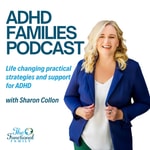
ADHD Families Podcast helps parents raising children with ADHD create a calmer, more functional family life.
Hosted by Sharon Collon, a PCC Credentialed ADHD Coach and Parenting Consultant and Founder of The Functional Family, this podcast shares practical strategies for parenting children with ADHD, supporting executive function development, reducing overwhelm and building systems that work with the ADHD brain.
If you are navigating ADHD meltdowns, routines that do not stick, challenges at home or school, or the mental load of supporting your family, you are in the right place.
Each episode offers practical family systems and real-life ADHD parenting support to help families build confidence, connection and ease.
Learn more at https://www.thefunctionalfamily.com/
Coaching and education support families with everyday life. They do not replace diagnosis or medical treatment.
Site
RSS
Apple
Données mises à jour le 05/10/2026
Classements récents
Dernières positions dans les classements Apple Podcasts et Spotify.
Liens partagés entre épisodes et podcasts
Liens présents dans les descriptions d'épisodes et autres podcasts les utilisant également.
Why does one child seem to know exactly how to push their sibling’s buttons, then keep going until the whole house explodes?
Sibling baiting is incredibly common in ADHD families. It can look small from the outside. Standing too close to a prized possession. Making a particular noise. Saying the one thing they know will get a reaction. But underneath that behaviour, there can be much more going on.
In this episode, Credentialed ADHD family Coach Sharon Collon is joined by registered Psychologist Jacquie Ward to unpack why ADHD sibling conflict can escalate so quickly and why focusing on who started it often makes things worse.
They explore boredom and low-arousal states, rejection sensitivity, fairness, emotional regulation and the role parents can unintentionally play when they step in as the referee.
Because when the same fights happen again and again, the answer is not another lecture about being nice to each other. It is understanding the predictable pattern and knowing what to do when it starts.
👀 In This Episode, Sharon Covers
✅ What sibling baiting and “rage baiting” actually look like
✅ Why an ADHD brain may seek stimulation by provoking a sibling
✅ How boredom and low-arousal states can contribute to conflict
✅ Why rejection sensitivity can turn a small interaction into a huge emotional reaction
✅ How asking “Who started it?” can intensify the conflict
✅ Why ADHD children’s strong sense of fairness can make arguments harder to resolve
✅ The difference between being the family referee and becoming the competent captain
✅ Why being steady is often more useful than trying to make everything fair
✅ How to recognise the predictable patterns behind recurring sibling fights
✅ Why having scripts ready matters when you are dysregulated too
The Real Problem With Sibling Conflict
The hardest part is often not the argument itself.
It is feeling like you are dealing with the same fight on repeat.
One child baits. The other reacts. Someone explodes. You step in and try to establish what happened. Everyone argues about what is fair. You become dysregulated too.
Then, the next day, it happens all over again.
In the heat of the moment, it can be incredibly difficult to remember the parenting strategy you intended to use. You might start gently, become stricter, raise your voice, separate everyone and then wonder afterwards what you could have done differently.
Sharon and Jacquie explain why the goal is not a home where siblings never fight.
The goal is to understand the pattern, know how to interrupt it and have a clear playbook for what to do next.
⏱️ Episode Timestamps
00:00 Sharon’s childhood sibling-baiting story 01:15 Why sibling baiting is so common in ADHD families 02:35 What is baiting and rage baiting? 03:37 What baiting looks like at home 04:46 Why the obvious trigger is not always the real problem 05:43 Rejection sensitivity and ADHD sibling conflict 06:44 Why a small poke can become a 40-minute meltdown 07:25 What happens when parents ask, “Who started it?” 08:13 The problem with becoming the family referee 09:12 The competent captain approach 10:39 Why steadiness matters more than perfect fairness 12:05 Staying regulated when your children are not 12:43 The two-day sibling conflict observation exercise 13:57 Identifying predictable problems 15:23 Why parents need practical scripts 15:59 What success with sibling conflict actually looks like 17:55 Advice for parents after a difficult day
🎯 Sibling Conflict Workshop
If you are constantly breaking up fights, figuring out who started it, or dealing with explosive reactions, join Sharon Collon and Jacquie Ward for the Managing Sibling Conflict & ADHD Workshop on 11 October, 1pm to 4pm AEDT. You’ll learn what is really driving the conflict, how to step out of the referee role, and get practical scripts and a clear playbook for handling sibling fights with more confidence, shortening the conflict and supporting better repair.
Book before 10pm AEDT Wednesday 7 October and you'll also get our Sibling Baiting and ADHD Scripts, eight scripts from Jacquie and me, valued at $197, free.
If screentime is another source of daily arguments, difficult transitions or emotional blow-ups in your family, join Sharon for the Screentime + ADHD Workshop on 13 October at 1pm.
Learn how to approach screentime with the ADHD brain in mind and walk away with practical strategies you can use at home.
Usually $197, now reduced to $97.
Join Sharon and turn another predictable family friction point into something you feel better equipped to handle.
Sharon Collon is a PCC Credentialed ADHD Coach and Parenting Consultant, Founder of The Functional Family and Host of the ADHD Families Podcast.
Through The Functional Family, Sharon has supported more than 40,000 families with practical strategies designed to work with the ADHD brain, not against it.
Her work helps families move away from daily chaos, overwhelm and survival mode and towards more connection, function and fun.
Build it for your worst day, not your best one.
You are too important to stay in survival mode.
Episode 90: You've Read Everything About ADHD. Nothing's Sticking.
How many tabs about ADHD do you have open right now?
On your phone, on your laptop. The one about dopamine. The one about demand avoidance. The routine chart someone swore by at 11pm.
You are not short on information about ADHD. You could probably explain executive function better than your GP can. And your Tuesday morning at 7:40am still falls apart.
That gap between everything you know and what actually happens in your house is not a knowledge problem. In this episode, Sharon Collon breaks down the two traps almost every ADHD family gets stuck in: knowledge farming, where you collect information you cannot implement, and system farming, where you buy the visual schedule, the magnetic chore chart and the beautiful Etsy printable, and it dies within a fortnight anyway.
She tells the story of two families who photographed the washing chart in her laundry, and why she already knew standing there that it would not work in their houses. Then she gives you the one shift that changes how you build anything at home from here: build the system for your worst day, not your best one.
👀 In This Episode, Sharon Covers:
Why you can know everything about ADHD and still not be able to run a Tuesday morning
Knowledge farming, and why information gives you the what but almost never the how
System farming, and why the chart you set up on Sunday is dead by the second week
What parents wrongly conclude about themselves when a routine falls over
Why a bought or copied system arrives with no household attached to it
The hidden 95% of decisions underneath any system that actually works
Why every household has its own physics, and why that breaks borrowed routines
The one shift: designing for a low capacity day instead of your most optimistic one
Why getting started, stopping something enjoyable and holding a three step instruction are all skills
How missing skills get mistaken for defiance, laziness and a child who does not care
🧭 The Three Questions to Run This Week
⏱️ Episode Timestamps
🚀 Ready to Map the Friction in Your Family?
🔗
💫 Ready to Go Further?
🔗
🔔 Next Steps & ADHD Resources
💛 Work With Sharon
Episode 89: Why Reward Charts Stop Working for Children With ADHD
Saison 4
lundi 24 août 2026 • Durée 17:30
Week one, the reward chart is magic.
Your child is racing to the fridge for their gold star. The school bag is actually being put away. Nobody is nagging. Nobody is arguing. And you think, finally, THIS is the thing that is going to change our family.
Then week two arrives.
The magnets are missing. The stickers are on the floor. Nobody cares about the chart anymore and another beautifully laminated parenting system gets shoved into the kitchen drawer where hope goes to die.
So, why do reward charts seem to work brilliantly for children with ADHD, until suddenly they don’t?
In this episode, Sharon explains why reward charts often clash with the way the ADHD brain experiences motivation, novelty and time, and why the answer isn't becoming more consistent, finding a bigger reward or buying an even fancier chart.
You'll also learn what works instead: designing simple systems and environments that make the behaviour you want the easiest, most obvious next step.
👀 In This Episode, Sharon Covers:
Why reward charts work brilliantly at first, then suddenly stop
How novelty drives motivation for the ADHD brain
Why delayed rewards often lose their motivational pull
Sharon's rule: "The ADHD brain pays in cash, not credit"
Why this isn't about laziness, willpower or parental consistency
The gap between knowing what to do and being able to do it
Why changing the environment can work better than adding another reward
How to make the behaviour you want easier and more obvious
Where rewards can still be useful for children with ADHD
How to start with one small friction point in your family
⏱️ Episode Timestamps
00:00 Why reward charts work, until they don't
02:30 Sharon's reward chart graveyard Why novelty motivates the ADHD brain The problem with delayed rewards The ADHD brain pays in cash, not credit Why this isn't a willpower problem Look at what already works in your family Why systems work better than reward charts Remove barriers and make the behaviour easier Where rewards still fit and what to try this week
🚀 Ready to Stop Managing Behaviour and Start Building Systems?
💫 Ready to Go Further?
🔗
🔔 Next Steps & ADHD Resources
💛 Work With Sharon
Episode 88: Angel at School, Falling Apart at Home: After-School Meltdowns Explained
Saison 4
lundi 17 août 2026 • Durée 12:59
They held it together all day.
The teacher says they were fine. Maybe they even had a great day.
Then they walk through the front door and within 10 minutes, everything falls apart. The bag gets thrown. There are tears over the wrong snack. A sibling looks at them the wrong way. Something tiny turns into a full meltdown that wipes out the entire evening.
So why does your child with ADHD manage all day at school — then completely unravel at home?
In this episode, Sharon explains after-school restraint collapse and why home is often the place where children finally release everything they’ve been holding together all day.
You’ll also learn why the first 30 minutes after school need their own system, what to do when your child is already dysregulated, and why planning for siblings, snacks, sensory input and your own capacity can completely change the afternoon.
👀 In This Episode, Sharon Covers:
Why ADHD children can hold it together at school and fall apart at home
What after-school restraint collapse actually is
The signs that “bad behaviour” may actually be dysregulation
Why the ADHD brain can arrive home completely out of fuel
How medication rebound may affect the after-school window
Why reasoning, consequences and explanations don’t work mid-meltdown
What to do instead when your child is emotionally flooded
Why the first 30 minutes after school matter so much
How to create an automatic decompression space
Why the first 20 minutes should be a low-demand window
How your first greeting can either lower or increase demand
Why siblings need their own after-school plan
How to design the 3–5pm window for the , not just the child with ADHD
⏱️ Episode Timestamps
🚀 Ready to Map the Friction in Your Family?
🔗
💫 Ready to Go Further?
🔗
🔔 Next Steps & ADHD Resources
💛 Work With Sharon
Episode 87: ADHD and Big Emotions: Why the Smallest Thing Sets Them Off
Saison 4
lundi 10 août 2026 • Durée 13:31
The toast was cut the wrong way.
That’s all it took.
Suddenly there are tears, slammed doors and an emotional reaction so huge you’re standing there wondering, how is THIS the hill we’re dying on today?
If your child with ADHD can go from zero to completely overwhelmed over something that seems tiny, this episode will help you understand why.
Sharon breaks down what’s really happening underneath ADHD emotional dysregulation, meltdowns and big emotional reactions and why the size of the reaction often has very little to do with the size of the trigger.
You’ll also learn why reasoning with your child in the middle of an emotional storm rarely works, what Rejection Sensitivity Dysphoria (RSD) can look like in everyday family life, and what to do instead.
👀 In This Episode, Sharon Covers:
Why small triggers can create enormous ADHD emotional reactions
How executive function affects emotional regulation
Why the “wrong toast” is rarely actually about the toast
What RSD is and why ordinary corrections can feel enormous
Why your child may hold it together all day and fall apart with you
Why explaining, reasoning and consequences don’t work mid-meltdown
How co-regulation helps your child come back online
Five practical things Sharon does during big emotions
Why the real teaching happens after the storm
The biggest takeaway?
Your calm is the tool. Everything else gets built on top of it.
⏱️ Episode Timestamps
00:00 — When the smallest thing triggers a huge emotional reaction — The kitchen sponge story: when the reaction doesn’t match the trigger — Why ADHD emotions can feel so big, so fast — Executive function, emotional regulation and the missing “pause” — Rejection Sensitivity Dysphoria (RSD) and why correction can hurt — How to correct with warmth without walking on eggshells — Why your child holds it together for everyone else — then falls apart with you — Co-regulation: why your nervous system matters — Five things to do during an ADHD emotional meltdown — What NOT to do when your child is emotionally flooded — Spotting your family’s predictable emotional flashpoints — The ADHD Family System and building your Friction Map
🚀
🔗
💫
🔗
🔔 Next Steps & ADHD Resources
💛 Work With Sharon
Episode 86: Why Your Child's Meltdowns Happen at the Same Time Every Day
Saison 4
lundi 3 août 2026 • Durée 16:55
Why does your child melt down at exactly 7:15am, 3:15pm and 8:45pm, like clockwork?
On the ADHD Families Podcast, Sharon Collon, PCC credentialed ADHD coach and founder of The Functional Family, explains why ADHD meltdowns aren't random. They run to a very tight timetable, and that timetable is the most useful information you've got.
Sharon unpacks the three windows where most ADHD families break (morning launch, after school landing and the bedtime encore), answers the question every parent asks her, and walks you through four practical moves to plan for the pattern instead of reacting to it. If you've been hunting for the trigger, this episode will change where you look.
✅ Why a meltdown is a capacity problem, not a decision ✅ The three daily windows where ADHD families break ✅ Why the trigger is never actually the cause ✅ "Is my child doing this on purpose?" and why the answer is no ✅ Why it lands on you, the safest person in the room ✅ Move #1: Map your flashpoints for one week ✅ Move #2: Lower demand at the spike, not all day ✅ Move #3: Build a rhythm into the hard window ✅ Move #4: Move the demand off the person and onto the system ✅ The school gate example, start to finish
⚠️ If you've ever stood at the school gate bracing for impact, this episode is for you.
⏱️ Episode Timestamps
00:00 – The meltdown you could set your clock by 01:00 – Sharon's own flashpoint: the school uniform collar 02:40 – Why it's not random: demand outruns capacity 04:10 – Window 1: The morning launch, 7 to 8am 05:10 – Window 2: The after school landing, 3 to 4pm 06:10 – Window 3: The bedtime encore, 8 to 9pm 07:10 – "Is my child doing this on purpose?" 08:50 – The question that changes how parents see afternoons 10:20 – The four moves to plan for the pattern 14:10 – The school gate example and your free next step
💫
Episode 85: My Teen with ADHD Won't Try Coaching. Now What?
Saison 4
lundi 27 juillet 2026 • Durée 31:37
You've found the support.
You've done the research.
You know your teenager could benefit from ADHD coaching...
But every time you bring it up, you're met with, "I'm fine." or "I don't need it."
If you're wondering how to help a reluctant teen without pushing them further away, this episode is for you.
In this episode of the ADHD Families Podcast, Sharon Collon is joined by ADHD Teen Coach Kimberley, who shares why so many teenagers resist support, what ADHD coaching actually looks like, and how parents can introduce help in a way that builds trust instead of resistance.
Together, they unpack why resistance isn't defiance—it's often protection—and why the right support, at the right time, can help teens build confidence, executive functioning skills and emotional resilience that lasts well beyond school.
👀 In This Episode, Sharon and Kimberley Covers
✔️ Why resistance to support is often a sign of protection—not defiance
✔️ How executive functioning challenges can be mistaken for laziness or lack of motivation
✔️ Why ADHD coaching is different from therapy
✔️ How to introduce coaching without pressure or conflict
✔️ What teenagers actually work on during ADHD coaching sessions
✔️ Why connection comes before strategy
✔️ How confidentiality works between coaches, teens and parents
🔔 Next Steps & Resources
Work With Sharon
Episode 84: School Camp and ADHD: What to Do Before, During and After
Saison 4
mardi 21 juillet 2026 • Durée 17:24
School camp can feel like a huge milestone… but for parents of children with ADHD, it often comes with a whole lot of worry.
Will they sleep?
Will they remember their medication?
Will they make friends?
Will they cope without me?
If you've ever found yourself staring at the camp permission slip while mentally preparing for every possible scenario, you're not alone.
In this episode of the ADHD Families Podcast,Sharon Collon shares practical, ADHD-friendly strategies to help your child prepare for school camp, manage the challenges while they're away, and recover well once they return home.
Drawing on her experience as a PCC Credentialed ADHD Coach, parenting expert, and mum of three children with ADHD, Sharon explains why camp can feel so overwhelming for the ADHD brain and how a little preparation can transform the experience for the whole family.
Rather than expecting your child to simply "cope," you'll learn how to build the right scaffolding so they can thrive with confidence.
⏱️ Episode Timestamps
00:00 – Why school camp feels so overwhelming for ADHD families
02:43 – Why camp is uniquely challenging for the ADHD brain
03:52 – Before camp: setting your child up for success
05:41 – Preparing teachers, medication and sleep
07:10 – Packing strategies that reduce overwhelm
In This Episode You'll Learn
🎁 Free ADHD Family Systems Workshop
☀️ As seen on The Morning Show
🔔 Next Steps & Resources
Work With Sharon
Episode 83: Why Kids with ADHD Swear (And What to Actually Do About It)
Saison 4
jeudi 18 juin 2026 • Durée 25:56
Has your child ever dropped the F-bomb at exactly the worst possible moment? Maybe it was at a family dinner, in the school pickup line, or right in front of Grandma. If so, you're definitely not alone.
In this episode of the ADHD Families Podcast, Sharon Collon, PCC Credentialed ADHD Family Coach, unpacks one of the most common challenges parents bring to coaching sessions: swearing. Sharon explains why swearing is often linked to ADHD impulsivity, emotional dysregulation, novelty-seeking behaviour, and dopamine-driven reactions, rather than disrespect or poor character.
You'll learn why traditional punishment approaches often fail, how to reduce the emotional charge around swear words, and practical strategies that help children develop better self-regulation and communication skills. Sharon shares real-life examples from her own family, along with simple tools parents can start using immediately to reduce conflict and create calmer family dynamics.
👀 In This Episode, Sharon Covers
✅ Why swearing is often a symptom of ADHD, not a behaviour problem
✅ How impulsivity affects a child's ability to filter language
✅ The link between emotional dysregulation and swearing
✅ Why novelty and strong reactions make swear words "sticky"
✅ How attention and dopamine can unintentionally reinforce swearing
✅ How to stay calm and avoid making swear words the main event
✅ The power of replacement words and modelling language
✅ Working "upstream" to reduce triggers and dysregulation
✅ Teaching contextual awareness about where certain language is appropriate
✅ Practical scripts parents can use immediately
👉
🔔 Next Steps & Resources
Work With Sharon
Episode 82: ADHD Money Hacks: Get Your Money Back!
Saison 4
samedi 6 juin 2026 • Durée 08:26
What if your ADHD habits were quietly costing your family thousands every single year — and you could start getting that money back this week? 💸
In this episode of the ADHD Families Podcast, host Sharon Collon shares practical, ADHD-friendly ways families can stop money leaks without restrictive budgeting, shame, or complicated spreadsheets. Sharon unpacks the real-life systems behind The Money Hunt, including subscription audits, bill renegotiation scripts, Medicare rebate redirects, and hidden cash sweeps that help families reclaim lost money fast.
After helping one client uncover $1,400 in savings during a quick school pickup line conversation, Sharon realised just how much “invisible money” families are losing to the ADHD tax. If you’re ready for simple systems that actually work for neurodivergent brains, this episode is packed with practical wins you can implement immediately.
👉 Join The Money Hunt and start finding hidden money in your household: The Money Hunt
👀 In This Episode, Sharon Covers:
✅ The hidden “ADHD tax” quietly draining family finances ✅ How one quick audit uncovered $1,400 in savings ✅ Why traditional budgeting often fails ADHD families ✅ The Medicare rebate savings trick that creates emergency buffers ✅ How to do a fast subscription audit without overwhelm ✅ Scripts to renegotiate bills and lower expenses ✅ Reviewing private health extras before EOFY ✅ The “hidden cash sweep” method for gift cards, rewards points, and returns ✅ Why barriers and automation work better than willpower for ADHD brains
⏱️ Timestamps
02:10 – The school pickup line money breakthrough 03:30 – Understanding the ADHD tax 05:10 – Medicare rebate redirect savings strategy 08:45 – Why barriers help ADHD brains save money 10:20 – Subscription audits made simple 12:15 – The accidental multiple subscription problem 13:40 – How to renegotiate bills successfully 15:00 – Reviewing private health extras before EOFY 16:20 – The hidden cash sweep strategy 18:10 – Gift cards, rewards points & unclaimed money 20:05 – Why implementation is the hardest part 21:15 – Inside The Money Hunt 22:30 – Final encouragement to reclaim your money
💛 Work With Sharon
Podcasts Similaires Basées sur le Contenu
Découvrez des podcasts liées à ADHD Families Podcast. Explorez des podcasts avec des thèmes, sujets, et formats similaires. Ces similarités sont calculées grâce à des données tangibles, pas d'extrapolations !
Kate’s story: how a Sunday that ran like a military operation became three steps done before lunch
Why “get ready for the week” is a category, not a job, and why that causes paralysis
Why one bad Sunday no longer takes Monday, Tuesday and Wednesday down with it
Why it is called The Functional Family, and what Sharon is actually building towards
Pick one thing you have been trying to make stick. Not all of them. One.
Does this work if I am not in the room? If it never will, what you have is not a system. It is a performance that needs you as the lead actor, and your child has not learned anything, because the thing doing the work is you.
Does this still work on a bad day? If it needs everyone calm, regulated and cooperative to function, it is not a system. It is a good mood.
What skill is actually missing for my child here? Name the missing skill and two things change. You stop taking it personally, and you stop building systems that punish a child for something they cannot do yet.
The biggest takeaway?
The system is not there to make a child comply. It is there to do the job your child’s brain cannot do yet, so they can practise the rest without failing every single day while they learn.
00:00 — How many ADHD tabs do you have open right now 01:15 — The gap between what you know and what happens at 7:40am 02:10 — Trap one: knowledge farming 04:00 — Trap two: system farming, and what you conclude when the chart fails 05:45 — The question Sharon wants you to answer for yourself 06:30 — The washing chart story: two families, two phones 08:45 — Why every household has its own physics 11:00 — The shift: build for your worst day, not your best one 12:45 — Question one: does it work when you are not in the room? 14:00 — Question two: does it work on a bad day? 15:00 — Question three: what skill is actually missing? 16:45 — Why getting started and stopping are skills, not attitude 18:15 — Kate’s story: getting Sunday back 21:00 — Why it is called The Functional Family 22:45 — The bridge between knowledge you cannot use and systems that will not hold 24:15 — “I think I need one to one coaching”, answered honestly 25:45 — What to do this week
As you have heard in this episode, the problem was never that you did not know enough. It is that information cannot tell you which friction point to fix first in your particular house.
That is exactly what we will do in my FREE ADHD Family System online workshop. In sixty minutes you will build your own one page Family Friction Map and see exactly where your house is losing time and energy.
100% free. No cost, no catch.
📅 1 September — 7pm AEST 📅 4 September — 1pm AEST 📅 8 September — 7pm AEST
If you are ready to turn what you have uncovered into practical change, The ADHD Family Questis my four-week, coaching-led experience designed to help you build systems that work with your ADHD family, not against it.
It is the unglamorous middle bit nobody sells you. The bridge between knowledge you cannot implement and systems that will not hold.
Inside the Quest you get a private 30 minute one to one onboarding call with me so you start on the right friction point, five checkpoint playbooks with the templates already built, videos under five minutes with one action step each, three monthly group coaching sessions with me for the days it wobbles, and three months of access to the app and every resource.
September Spotlight bonus: enrol by 10pm AEST on Monday 8 September and you also get the live Friction Map group coaching session with me on Thursday 10 September, where we map your household’s friction points together and decide what to do about them. The Quest is open all year. This bonus is not.
Because you were never supposed to be the system holding everything together.
Sharon Collon is a PCC Credentialed ADHD Coach and Parenting Consultant, Founder of The Functional Family and Host of the ADHD Families Podcast.
Through The Functional Family, Sharon has supported more than 40,000 families with practical strategies designed to work with the ADHD brain, not against it.
Her work helps families move away from daily chaos, overwhelm and survival mode and towards more connection, function and fun.
Build it for your worst day, not your best one.
You are too important to stay in survival mode.
03:45
05:30
06:30
09:15
11:00
12:30
14:15
17:00
If your house is full of abandoned charts, half used planners and systems that worked beautifully, until they didn't, this is exactly the work we're doing inside my FREE ADHD Family System online workshop.
We'll map the friction points in your family and start looking at how to change the environment around them, so daily life isn't dependent on everybody remembering, staying motivated and having a good day at exactly the same time.
Because you don't need another prettier chart.
You need a system that can hold your family on the hard days too.
If you’re ready to turn what you’ve uncovered into practical change, The ADHD Family Quest is my four-week, coaching-led experience designed to help you build systems that work with your ADHD family, not against it.
Because you were never supposed to be the system holding everything together.
Sharon Collon is a PCC Credentialed ADHD Coach and Parenting Consultant, Founder of The Functional Family and Host of the ADHD Families Podcast.
Through The Functional Family, Sharon has supported more than 40,000 families with practical strategies designed to work with the ADHD brain, not against it.
Her work helps families move away from daily chaos, overwhelm and survival mode and towards more connection, function and fun.
You do not need to spend more money on a better chart.
You need an environment that supports the action.
whole family
When worsening after-school meltdowns may be a sign that something else has shifted
The biggest takeaway?
After-school collapse isn’t random. It’s predictable. And predictable problems can be planned for.
00:00 — Why your child falls apart the moment they get home 01:20 — Why ADHD kids hold it together at school and release at home 02:30 — What after-school restraint collapse actually is 03:35 — When “bad behaviour” is actually dysregulation 04:20 — Why afternoons need a completely different system 05:15 — Medication rebound and the after-school window 06:00 — What to do when your child is already melting down 07:10 — Building the crucial first 30 minutes after school 08:15 — Decompression, no demands and the after-school handover 09:25 — Why siblings need an after-school plan too 10:15 — Designing the 3–5pm window for the whole family 11:20 — When worsening meltdowns are telling you something has shifted 12:05 — Put the 3pm crash on your family’s Friction Map
As you’ve heard in this episode, after-school meltdowns aren’t random, they’re predictable. And when we can see the patterns creating friction, we can start building systems that actually support the whole family.
That’s exactly what we’ll do in my FREE ADHD Family System online workshop. You’ll start creating your own Family Friction Map and identify where small changes could make family life feel a whole lot easier.
100% free. No cost, no catch.
📅 1 September — 7pm 📅 4 September — 1pm 📅 8 September — 7pm
If you’re ready to turn what you’ve uncovered into practical change, The ADHD Family Quest is my four-week, coaching-led experience designed to help you build systems that work with your ADHD family, not against it.
Because you were never supposed to be the system holding everything together.
Sharon Collon is a PCC Credentialed ADHD Coach and Parenting Consultant, Founder of The Functional Family and Host of the ADHD Families Podcast.
Through The Functional Family, Sharon has supported more than 40,000 families with practical strategies designed to work with the ADHD brain, not against it.
Her work helps families move away from daily chaos, overwhelm and survival mode and towards more connection, function and fun.
Predictable means mappable. And mappable means you can get ahead of it.
If your family keeps getting caught in the same meltdowns, transitions and daily battles, there’s probably a pattern underneath them.
In this free workshop, Sharon will help you identify your family’s biggest flashpoints and start building your Friction Map — so you can plan for difficult moments instead of constantly bracing for them.
100% free. No cost, no catch.
📅 1 September — 7pm 📅 4 September — 1pm 📅 8 September — 7pm
Sharon Collon is a PCC-credentialed ADHD coach and parenting expert who helps families move from survival mode to calmer, more connected and functional family life.
Her approach helps families understand ADHD, support emotional regulation, map predictable friction points and build ADHD-friendly systems that work on the hard days — not just the good ones.
Predictable means mappable. And mappable means you can get ahead of it.
In this free workshop, we map your family's flashpoints together and build the beginnings of your friction map, so you can plan for your week instead of bracing against it.
It isn't a webinar full of generic parenting advice. It isn't more reading. And it's definitely not another thing to add to your plate.
Sharon Collon supports ADHD families to move from survival mode to functional, calm and connected, using ADHD-friendly systems that honour how sensitive nervous systems actually work.
Working with Sharon, families:
Map the predictable friction points in their day
Lower demand where it counts, without walking on eggshells
Build rhythms that give energy back instead of draining it
Design systems that hold on low capacity days, not just good ones
Stop being surprised by a pattern they can see coming
Predictable means mappable. And mappable means you can get ahead of it.
You are too important to stay in survival mode.
✔️ What progress really looks like in ADHD coaching
✔️ Why confidence and self-awareness come before behaviour change
✔️ How coaching helps teenagers understand and work with their ADHD brain
⏱️ Episode Timestamps
00:00 – Why teens often refuse ADHD support
03:12 – Meet Kimberley: ADHD coach, educator and mum
05:34 – The executive functioning skills teens are missing
08:02 – Why your teen keeps saying "No"
11:03 – How to introduce ADHD coaching without creating resistance
12:54 – What ADHD coaching actually helps teenagers with
15:53 – Building trust, confidence and connection before strategies
20:44 – The biggest mistakes parents make when seeking support
27:49 – What success looks like when coaching starts to work
Looking for practical, strengths-based support for your teenager?
Kimberley is an ADDCA-trained ADHD Coach, former secondary teacher and mum of three children with ADHD. She specialises in helping teenagers build executive functioning skills, confidence, emotional regulation and practical strategies in a supportive, judgement-free environment.
Feeling like you're constantly reminding, nagging or putting out fires?
Join Sharon's FREE ADHD Family Systems Workshop to learn the simple systems that reduce daily overwhelm, lower family conflict and help your home run with less stress—and more connection.
We start first week of September. We would love to have you!
Sharon Collon helps ADHD families create calmer homes, stronger relationships, and practical systems that reduce overwhelm. Through her programs, resources, and podcast, Sharon shares compassionate, evidence-informed support for parents navigating the realities of ADHD family life.
Whether you’re struggling with emotional regulation, executive functioning, school stress, or family routines, Sharon’s work is designed to help parents feel supported — not judged.
10:03 – During camp: building regulation and support
12:22 – Managing social exhaustion and trusting the process
13:20 – The post-camp restraint collapse explained
15:21 – Your biggest takeaway as an ADHD parent
16:37 – Free ADHD Family Systems Workshop & final thoughts
✔️ Why school camp places extra demands on the ADHD brain
✔️ How to decide if your child is ready for an overnight camp
✔️ The conversations to have with teachers before camp begins
✔️ Medication and sleep strategies that reduce unnecessary stress
✔️ Practical packing systems that support executive functioning
✔️ Why one trusted adult at camp can make all the difference
✔️ How to create a simple emotional regulation plan before they leave
✔️ Why social exhaustion is often mistaken for behavioural problems
✔️ What restraint collapse looks like after camp—and how to respond
✔️ How to help your child recover emotionally and physically after camp
If you're tired of solving the same family challenges over and over again, join Sharon's FREE ADHD Family Systems Workshop.
You'll learn how to identify your family's biggest friction points and build ADHD-friendly systems that actually work—so life feels calmer, easier and more connected.
Sharon recently shared her simple CRC Method for reducing overwhelm in ADHD families—Get Curious, Get Regulated, Get Clear. Because the behaviour is the smoke, not the fire. When we stop trying to fix every behaviour and start understanding what's driving it, family life can become calmer, more connected and a whole lot easier.
Sharon Collon helps ADHD families create calmer homes, stronger relationships, and practical systems that reduce overwhelm. Through her programs, resources, and podcast, Sharon shares compassionate, evidence-informed support for parents navigating the realities of ADHD family life.
Whether you’re struggling with emotional regulation, executive functioning, school stress, or family routines, Sharon’s work is designed to help parents feel supported — not judged.
00:00 Introduction: Why ADHD and swearing is such a common family challenge
01:45 Why swearing is usually a symptom, not disrespect
04:00 ADHD impulsivity and the missing filter
07:00 Emotional dysregulation and why big feelings trigger big language
10:00 Novelty, reactions, and why swear words become sticky
12:30 Attention, dopamine, and reinforcement
14:30 Why punishment doesn't work for ADHD-related swearing
16:30 Strategy #1: Don't make the swear word the main event
18:30 Strategy #2: Teach and model replacement words
21:00 Strategy #3: Work upstream and reduce dysregulation
23:30 Strategy #4: Build contextual awareness
25:00 Final recap and encouragement
💰 Special Offer: The Money Hunt 2026
If you're raising a family with ADHD, you already know how easy it is for money to quietly leak out through forgotten subscriptions, unused services, unclaimed rebates, and everyday ADHD overwhelm.
The Money Hunt 2026 is a five-day live implementation event designed specifically for mums in ADHD families who want practical money wins without budgeting spreadsheets, spending diaries, restriction, or guilt.
Over five focused sessions, you'll uncover hidden savings, cancel forgotten subscriptions, claim rebates, negotiate bills, and build simple systems that keep money flowing back into your household long after the event ends.
🎯 Exclusive listener discount: Save $300 AUD and join for just $97 AUD.
Sharon Collon helps ADHD families create calmer homes, stronger relationships, and practical systems that reduce overwhelm. Through her programs, resources, and podcast, Sharon shares compassionate, evidence-informed support for parents navigating the realities of ADHD family life.
Whether you’re struggling with emotional regulation, executive functioning, school stress, or family routines, Sharon’s work is designed to help parents feel supported — not judged.
How much money is currently slipping through the cracks in your household without you even realising it?
The truth is, most ADHD families aren’t bad with money, they’re overwhelmed by systems that were never designed for neurodivergent brains. Forgotten subscriptions, unused gift cards, auto-renewals, rewards points, medical rebates, late fees, duplicated purchases… it all adds up. Fast.
That’s exactly why Sharon created The Money Hunt — a practical, ADHD-friendly experience designed to help you uncover hidden money, reduce financial stress, and build systems that actually stick.
Inside The Money Hunt, you’ll get:
✅ Step-by-step guided action sessions ✅ ADHD-friendly money systems with zero shame ✅ Scripts to renegotiate bills and lower expenses ✅ Subscription and hidden cash audits ✅ Accountability and community support ✅ A fun bingo-style challenge to keep momentum going ✅ Real strategies to help you reclaim money quickly
And the best part? Most families uncover far more than the cost of joining.
🎯 If you’re tired of the ADHD tax stealing your money, this is your chance to finally hunt it down and keep more cash in your family’s pocket.
Sharon Collon helps ADHD families create calmer homes, stronger systems, and more sustainable family life through practical neurodivergent-friendly strategies. Through coaching, resources, and programs like The Money Hunt, Sharon supports families to reduce overwhelm and build systems that actually work for ADHD brains.