Thinking In Psychiatry – Détails, épisodes et analyse
Détails du podcast
Informations techniques et générales issues du flux RSS du podcast.
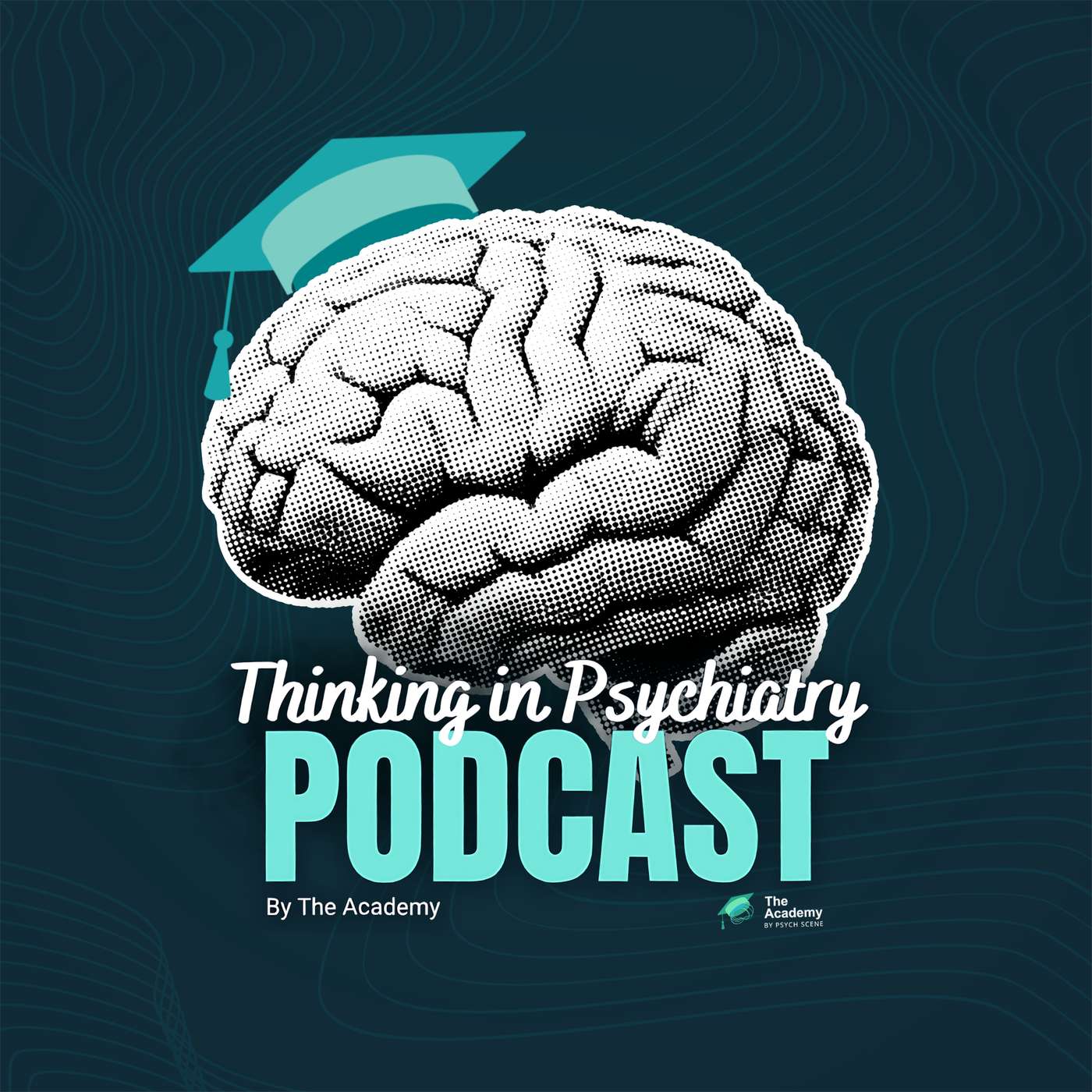
Thinking In Psychiatry
The Academy by Psych Scene
Fréquence : 1 épisode/13j. Total Éps: 7

Classements récents
Dernières positions dans les classements Apple Podcasts et Spotify.
Apple Podcasts
🇫🇷 France - medicine
28/03/2026#92🇫🇷 France - medicine
27/03/2026#61
Spotify
Aucun classement récent disponible
Liens partagés entre épisodes et podcasts
Liens présents dans les descriptions d'épisodes et autres podcasts les utilisant également.
See allQualité et score du flux RSS
Évaluation technique de la qualité et de la structure du flux RSS.
See allScore global : 63%
Historique des publications
Répartition mensuelle des publications d'épisodes au fil des années.
Have We Been Thinking About Sleep Wrong? (Motor Theory Explained)
Épisode 7
jeudi 19 février 2026 • Durée 09:20
Access the mentioned courses here:
Sleep And Psychiatry:
https://psychscene.co/46d0T09
ADHD and Sleep Dysfunction:
https://psychscene.co/4rrE9Cc
In this episode, Dr Sanil Rege explores the "how and why" of sleep by analysing a 2025 Neuron perspective paper (https://pubmed.ncbi.nlm.nih.gov/40961940/) detailing the interplay between sleep, motor circuits, and catecholamine biology.
The discussion unpacks the motor theory of sleep, in which sleep control is embedded within somatic and autonomic motor circuits, and the catecholamine hypothesis, which posits that a core biological function of sleep is the inactivation of dopamine, noradrenaline, and adrenaline.
This podcast provides clinicians with a neuroscientific framework for understanding sleep as an active state transition involving a global downshift of somatic and autonomic motor systems.
#Sleep #Neuropsychiatry #Insomnia
Do ADHD Stimulants ‘Cause’ Psychosis?
Épisode 6
jeudi 5 février 2026 • Durée 17:54
Access mentioned course here: https://psychscene.co/46iAaiI
In this episode, Consultant Psychiatrist, Dr Sanil Rege examines the complex relationship between ADHD pharmacotherapy and the emergence of psychotic symptoms.
By analysing synthesis data from The Lancet Psychiatry (https://www.thelancet.com/journals/lanpsy/article/PIIS2215-0366(25)00248-2/abstract), the podcast distinguishes between drug-induced events and baseline neurobiological vulnerabilities inherent in ADHD populations.
This podcast provides clinicians with a neuroscientific framework for differentiating between protopathic bias and true medication-induced psychotic phenomena, as well as a step-wise screening pathway for risk-guided prescribing using validated at-risk mental state (ARMS) triage tools.
To get access to the complete podcast catalog and material like this plus over 150 hours of interactive CPD education on psychiatry, check out The Academy using the link below:
https://psychscene.co/45M67jh
Did Ketamine 'Fail' or Are We Asking The Wrong Questions? *Full Study Review*
Épisode 5
jeudi 29 janvier 2026 • Durée 15:37
Access mentioned courses here:
Clinical Audit On Cognitive Aspects of Depression:
https://psychscene.co/3Z2EdvH
The Aggregation of Marginal Gains as a Philosophy of Clinical Care with Prof Michael Berk:
https://psychscene.co/4rqS62V
In this episode, Dr Sanil Rege examines the KARMA-Dep 2 trial, a randomised controlled trial comparing adjunctive serial ketamine infusions to midazolam for patients with Treatment-Resistant Depression (TRD) in an inpatient setting.
Based on a JAMA Psychiatry article titled “Serial Ketamine Infusions as Adjunctive Therapy to Inpatient Care for Depression,” the discussion explores why statistically insignificant differences between ketamine and psychoactive comparators necessitate a shift in how clinicians evaluate rapid-acting antidepressants, detailing the "wow effect" of early symptomatic drops and the subsequent plateauing of recovery curves.
This podcast provides clinicians with a clinical framework for differentiating between acute symptomatic response and long-term functional recovery in TRD.
Chapters:
00:22 - The KARMA-Dep 2 Trial Headlines
03:44 - Primary Outcomes: Ketamine vs. Midazolam Results
04:26 - Analysing the Curves: The "Wow Effect" vs. Sustained Recovery
08:50 - Neurobiology of Response vs. Neurobiology of Recovery
09:21 - Why Improvement Stalls: The Role of Neuroadaptation
10:47 - Clinical Implications for Inpatient Care
To get access to more materials like this plus over 150 hours of interactive CPD education on psychiatry, check out The Academy using the link below:
https://psychscene.co/4rl6pFV
The 3 Types of Hunger Clinicians Need to Know For Medication Side Effects
Épisode 4
jeudi 22 janvier 2026 • Durée 10:58
Access the mentioned course ‘Antipsychotic Induced Weight Gain and Metabolic Syndrome (MetS)’ here:
https://psychscene.co/4a62kQa
In this episode Consultant Psychiatrist, Dr Sanil Rege, explores the complex neurobiology of appetite regulation, diving deep into the nuances of the brain-gut-microbiome system.
Based on a recent New England Journal of Medicine (NEJM) review titled “The Physiology of Hunger,” the discussion examines hunger not as a matter of willpower, but as a sophisticated interaction between the brain, gut, and microbiome.
This podcast provides clinicians with a pathophysiological framework for differentiating between energy balance systems, reward-based drives, and microbial metabolites to better manage obesity, anorexia nervosa, and the cautious implementation of GLP-1 receptor agonists.
To get access to more material like this plus over 150 hours of interactive CPD education on psychiatry, check out The Academy using the link below:
https://psychscene.co/4t8d6gy
#HungerPhysiology #Neuroscience #MetabolicHealth
Why Pharmacotherapy Alone May 'Fail' in Complex TRD (Treatment-Resistant Depression)
Épisode 3
mercredi 14 janvier 2026 • Durée 14:09
To access the full episode and over 150+ hours of cutting-edge, interactive courses on Psychiatry subscribe to The Academy: https://psychscene.co/4qfNAny
In this episode, Consultant Psychiatrist, Dr Sanil Rege looks at treatment refractory mood disorders through a psychodynamic lens using a naturalistic study from the Austen Riggs Centre.
A subset of what most see as Treatment-Resistant Depression (TRD) isn't just pharmacological non-response; it's depression embedded within personality organisation, trauma-related aspects, attachment, and unconscious patterns.
This podcast provides clinicians with a psychodynamic perspective to understand how clinical refractoriness to standard pharmacotherapy can be sustained by meaning, defences, and relational patterns, not just neurotransmitters.
The How and Why of Sleep: Motor Theory and Catecholamine Hypothesis
Épisode 2
mercredi 3 décembre 2025 • Durée 09:54
To access all episodes plus 150+ hours of advanced psychiatric education, join the Academy today. Get access here:
https://www.academy.psychscene.com/
In this episode, we explore a groundbreaking 2025 Neuron paper that reframes how sleep is generated in the brain, and why we sleep at all.
Instead of a single “sleep centre,” sleep emerges from a distributed network embedded within motor and autonomic circuits. The authors also propose a unifying “catecholamine hypothesis” explaining sleep’s restorative functions across brain, immune, and metabolic systems.
We break down what this means for clinicians, how it updates classic models of sleep–wake regulation, and why dysfunction in these systems manifests across psychiatry.
To access all episodes of this podcast plus 150+ hours of advanced psychiatric education, join the Academy today. Get access here:
Why Alzheimer Disease Is More Common in Women
Épisode 1
dimanche 30 novembre 2025 • Durée 07:47
To access all episodes plus 150+ hours of advanced psychiatric education join the Academy today. Get access here: https://www.academy.psychscene.com/
Why is Alzheimer’s disease more common in women?
In this episode, we break down what current research reveals about sex differences in Alzheimer’s biology — including hormonal changes, tau progression, genetics, and how women often compensate on early cognitive testing, delaying diagnosis.
We also discuss how these differences shape clinical assessment, treatment responses to emerging anti-amyloid therapies, and why midlife risk modification is especially important.
Key Points
- Women show faster tau accumulation once amyloid appears.
- Cognitive compensation can lead to later diagnosis in women.
- Estrogen decline at menopause influences inflammation, synaptic resilience, and neuroprotection.
- APOE-ε4 confers greater Alzheimer’s risk in women.
- Sex-specific risk factors require tailored prevention and assessment.
To access all episodes plus 150+ hours of advanced psychiatric education join the Academy today. Get access here: https://www.academy.psychscene.com/
Podcasts Similaires Basées sur le Contenu