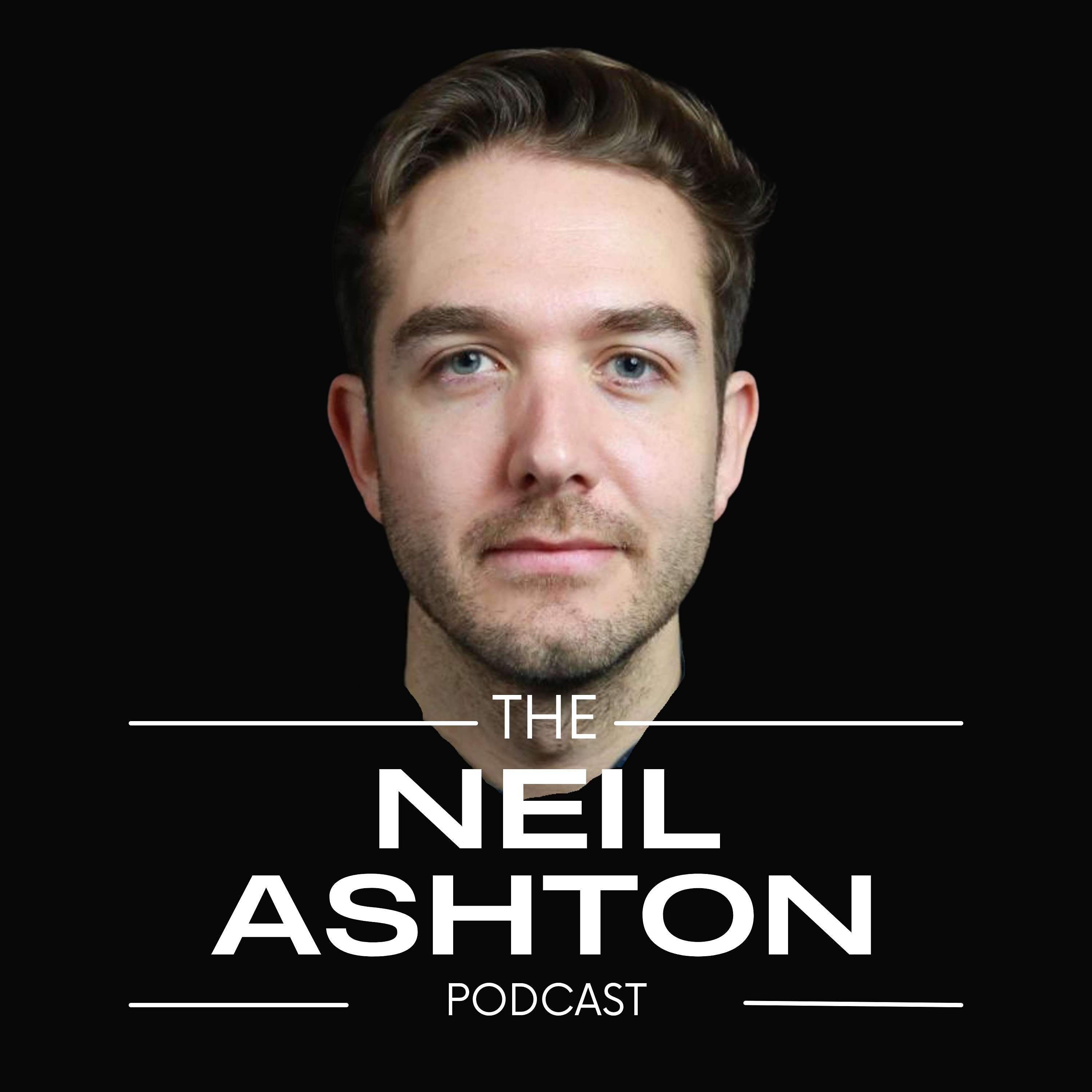
The Neil Ashton Podcast explores artificial intelligence, computational engineering, computational fluid dynamics, scientific machine learning, and high-performance computing. Hosted by Neil Ashton, a Distinguished Engineer at NVIDIA, it features conversations with leading researchers and engineers about technology, careers, and scientific discovery.
Site
RSS
Apple
Données mises à jour le 05/09/2026
Classements récents
Dernières positions dans les classements Apple Podcasts et Spotify.
Liens partagés entre épisodes et podcasts
Liens présents dans les descriptions d'épisodes et autres podcasts les utilisant également.
S4 EP7 - Should You Still Study Engineering in the Age of AI?
Saison 4 · Épisode 7
samedi 29 août 2026 • Durée 28:39
Should you still study engineering when AI can already write code, analyse data and automate parts of an engineer's job?
In this solo episode, Neil Ashton gives his view on engineering education and careers in the age of AI. His answer is yes—but the skill set is changing. Neil explains why engineering fundamentals still matter, where AI can act as an enabler, what students and early-career engineers should learn now, and why soft skills, projects and internships may become even more important.
Topics include:
- Why demand for engineers is likely to remain strong
- The engineering tasks most likely to change
- AI as an enabler for coding, CAD, CAE and automation
- Why domain knowledge is still essential for checking AI's work
- What practical AI fluency means beyond using a chat interface
- Advice for undergraduate, postgraduate and PhD students
- How projects, internships and soft skills can help you stand out
09:18 Why fundamentals and domain expertise still matter
11:59 AI fluency and the hiring market
16:41 Advice for students and researchers
20:05 What engineers should study now
22:11 Standing out: soft skills, projects and internships
25:41 Is engineering still worth it?
Resource mentioned:
- World Economic Forum, Future of Jobs Report 2025 — Skills outlook: https://www.weforum.org/publications/the-future-of-jobs-report-2025/in-full/3-skills-outlook/
Please note that this episode expresses my personal opinion and does not represent the views of NVIDIA.
S4 EP6 - Daniel Mira on Hydrogen Combustion Modelling and Future Propulsion
Saison 4 · Épisode 6
mardi 11 août 2026 • Durée 01:24:52
Hydrogen combustion, high-fidelity CFD and the future of aircraft propulsion are the focus of this conversation with Dr. Daniel Mira, Head of the Propulsion Technologies Group at the Barcelona Supercomputing Center. Neil and Dani discuss why reacting flows are so difficult to simulate, how hydrogen changes combustion and aircraft design, the limits of RANS, LES and DNS, GPU-native solvers, coding agents and AI surrogate models.
Why reacting flows are so computationally difficult
Hydrogen versus hydrocarbon combustion
When hydrogen could reach commercial aviation
How engines and aircraft must be redesigned
Industrial trust in high-fidelity combustion CFD
RANS, LES and DNS for reacting flows
Chemistry, load balancing and computational cost
Wall modelling in combustion LES
GPU acceleration and solver redesign
Coding agents for scientific software
AI surrogate models and digital engineering workflows
Selected resources
Daniel Mira and the Propulsion Technologies Group
https://ptg.bsc.es/?p=44
S4 EP5 - Prof. Nils Thuerey on Differentiable Physics and Foundation Models
Saison 4 · Épisode 5
jeudi 23 juillet 2026 • Durée 01:14:47
Differentiable physics, neural emulators and foundation models for PDEs are the focus of this conversation with Professor Nils Thuerey, head of the Physics-based Simulation group at TUM. Neil and Nils discuss PhiFlow, PICT, Tadpole, scalable 3D transformers, online synthetic data, open datasets, world models and agents that call physics simulators.
Differentiable physics and physics-based deep learning
PhiFlow and differentiable simulation across ML frameworks
When neural emulators can outperform their training data
Foundation models for PDEs and synthetic online training
Scalable 3D transformers and high-resolution simulations
LES, temporal data and correlated CFD datasets
Open-source tools, startups and physics-aware world models
AI agents that call physics simulators
Papers
Neural Emulator Superiority: When Machine Learning for PDEs Surpasses its Training Data
https://arxiv.org/abs/2510.23111
Tadpole: Autoencoders as Foundation Models for 3D PDEs with Online Learning
https://arxiv.org/abs/2605.15284
S4 EP4 - Prof. Paola Cinnella on AI for Science and Fluid Mechanics
Saison 4 · Épisode 4
jeudi 9 juillet 2026 • Durée 01:25:39
RANS uncertainty, data-driven turbulence modeling and AI for Science are the focus of this conversation with Professor Paola Cinnella, Professor of Fluid Mechanics at Sorbonne University and Director of SCAI. Neil and Paola discuss high-order methods, dense gases, Bayesian uncertainty, AirfRANS, surrogate modeling, scientific publishing and education in the AI era.
Dense gases, real-gas effects and expansion shockwaves
Uncertainty quantification and Bayesian methods
RANS turbulence-model uncertainty
AirfRANS and CFD datasets for machine learning
Turbulence modeling vs. surrogate modeling
Scientific publishing and ML-for-CFD standards
SCAI and AI for Science
Education, ChatGPT and centaur scientists
Papers
Quantification of model uncertainty in RANS simulations: A review — Heng Xiao, Paola Cinnella
https://doi.org/10.1016/j.paerosci.2018.10.001
Discovery of Algebraic Reynolds-Stress Models Using Sparse Symbolic Regression — Martin Schmelzer, Richard P. Dwight, Paola Cinnella
S4 EP3 - Prof. Ricardo Vinuesa on AI for Fluid Mechanics
Saison 4 · Épisode 3
jeudi 25 juin 2026 • Durée 01:05:48
Foundation models, explainable AI and autonomous discovery in fluid mechanics are the focus of this conversation with Professor Ricardo Vinuesa, Associate Chair for Research and Associate Professor of Aerospace Engineering at the University of Michigan. Neil and Ricardo discuss latent representations, turbulence, reduced-order modeling, flow control and whether AI can discover physical mechanisms that humans might miss.
Foundation models and latent representations for turbulent flows
Explainable AI, causality and identifying the mechanisms that matter
Why classical coherent structures may tell only part of the turbulence story
Physics-informed vs purely data-driven machine learning
Reduced-order modeling, autoencoders, transformers and nonlinear compression
Deep reinforcement learning for flow control and optimization
Agentic AI and autonomous scientific discovery in PDE-governed systems
How academia, computer science and engineering education must adapt to AI
Papers
Agentic Exploration of PDE Spaces using Latent Foundation Models for Parameterized Simulations — Abhijeet Vishwasrao et al.
https://arxiv.org/abs/2604.09584
S4 EP2 - Prof. Nathan Kutz on Physics-Informed AI and Data-Driven Modeling
Saison 4 · Épisode 2
jeudi 11 juin 2026 • Durée 01:17:23
Physics-informed AI, DMD, SINDy and data-driven engineering are the focus of this conversation with Professor J. Nathan Kutz, Director of Physics-Informed AI at Autodesk. Neil and Nathan trace machine learning’s evolution in engineering, the role of physics in trustworthy models, and the future of autonomous agents, design automation and human expertise.
Dynamic Mode Decomposition (DMD) and Sparse Identification of Nonlinear Dynamics (SINDy)
Physics-informed AI and reduced-order modeling
The debate between physics-based and data-driven models
The future of autonomous agents and their impact on industry
Papers
Flower discrimination by pollinators in a dynamic chemical environment — Jeffrey A. Riffell, Eli Shlizerman, Elischa Sanders, Leif Abrell, Billie Medina, Armin J. Hinterwirth, J. Nathan Kutz
https://doi.org/10.1126/science.1251041
Nathan’s early move into neuroscience and data-driven biological modeling.
Data assimilation and discrepancy modeling with shallow recurrent decoders — Yuxuan Bao, J. Nathan Kutz
https://arxiv.org/abs/2512.01170
Using ML to close the gap between simulation and reality.
S4 EP1 - Are AI Agents and Foundation Models About to Rewrite CAE?
Saison 4 · Épisode 1
lundi 1 juin 2026 • Durée 28:18
In this episode, Neil explores how agents, foundation models, and AI are set to transform the Computer-Aided Engineering (CAE) and Electronic Design Automation (EDA) landscapes. He shares a comprehensive historical perspective and predicts a near-future where AI-driven automation redefines engineering workflows, productivity, and innovation.
Main Topics:
The evolution of simulation codes from the 1960s to modern commercial software
The rise of cloud computing, GPUs, and their impact on CAE and EDA industries
The integration of AI, surrogate modeling, and foundation models into simulation workflows
The emergence of agentic AI systems capable of autonomously performing complex engineering tasks
The strategic responses of major software companies to AI and agent technologies
The potential democratization and automation of engineering design through AI agents
Critical questions on model ownership, transparency, and industry adoption
Timestamps:
00:00 - Podcast intro
00:40 - Introduction: How agents and foundation models will disrupt CAE & EDA
01:40 - Historical overview: From code writing in the 60s to commercial software
03:10 - Growth of aerospace and automotive industry codes and commercialization
04:40 - The impact of HPC, cloud computing, and hardware evolution
06:25 - Rise of cloud SaaS models and "sassification" of simulation tools
07:40 - Big tech entrance: AWS, Microsoft, and Google in CAE & EDA
S3 EP9 - Fluid Intelligence with Johannes Brandstetter and Siddhartha Mishra
Saison 3 · Épisode 9
mardi 2 décembre 2025 • Durée 01:24:54
In this conversation, Neil Ashton and Prof. Siddhartha Mishra, and Prof. Johannes Brandstetter discuss their recent paper on AI foundation models in computational fluid dynamics (CFD). They explore the backgrounds of the speakers, the journey to writing the paper, the role of AI in CFD, and the challenges of scaling laws and data generation. The discussion also covers model training costs, open questions, and future directions for research in this field.
Fluid Intelligence: A Forward Look on AI Foundation Models in Computational Fluid Dynamics : https://arxiv.org/abs/2511.20455v1
S3 EP8 - The Conference Connection (HPC, CAE, ML & Engineering)
Saison 3 · Épisode 8
samedi 1 novembre 2025 • Durée 22:37
In this episode, Neil Ashton discusses various conferences and workshops in the automotive, aerospace, and machine learning fields. He highlights the importance of these events for networking, education, and staying updated with industry trends. From the SAE and AIAA events to machine learning workshops, Neil provides insights into what attendees can expect and the value of participating in these gatherings.
In this episode of the Neil Ashton podcast, the host revisits key trends in Computational Fluid Dynamics (CFD) from the past year, focusing on the rise of GPUs, advancements in AI and machine learning, the shift to cloud computing, the increasing adoption of high fidelity methods, and ongoing mergers and acquisitions in the industry. Each trend is explored in depth, highlighting the implications for the future of engineering and technology
AI for Fluid Mechanics, Sustainability & XAI — Ricardo Vinuesa
https://www.youtube.com/watch?v=TOfwf4ffPnU
Modelling and controlling turbulent flows through deep learning — Ricardo Vinuesa
https://www.youtube.com/watch?v=0AOY_agZ8WM
Chapters
00:00 Podcast intro
03:20 The Evolution of Foundation Models in Fluid Dynamics
10:22 Understanding Explainable AI in Fluid Mechanics
15:34 Challenges in Data Fidelity for Foundation Models
20:29 Machine Learning vs. Reduced-Order Modeling
24:22 The Shift from Turbulence Modeling to Surrogate Models
29:48 Exploring Agentic Systems for Scientific Discovery
37:21 Exploring Latent Representations in Fluid Dynamics
40:40 The Role of AI in Autonomous Discovery
41:57 Bridging Fluid Mechanics and Computer Science
45:28 Data-Driven vs. Physics-Driven Models
51:34 The Role of Academia in AI and Fluid Mechanics
56:27 Optimization and Control in Machine Learning
01:00:28 The Future of AI in Fluid Dynamics: Beyond ChatGPT
Discovering governing equations from data by sparse identification of nonlinear dynamical systems — Steven L. Brunton, Joshua L. Proctor, J. Nathan Kutz
https://doi.org/10.1073/pnas.1517384113
The foundational paper introducing SINDy.
On Dynamic Mode Decomposition: Theory and Applications — Jonathan H. Tu, Clarence W. Rowley, Dirk M. Luchtenburg, Steven L. Brunton, J. Nathan Kutz
https://doi.org/10.3934/jcd.2014.1.391
A key reference for Dynamic Mode Decomposition.
Data-driven discovery of partial differential equations — Samuel H. Rudy, Steven L. Brunton, Joshua L. Proctor, J. Nathan Kutz
https://doi.org/10.1126/sciadv.1602614
Extends equation discovery to PDEs and physical systems.
Deep learning for universal linear embeddings of nonlinear dynamics — Bethany Lusch, J. Nathan Kutz, Steven L. Brunton
https://doi.org/10.1038/s41467-018-07210-0
Connects deep learning with Koopman theory.
Articraft: An Agentic System for Scalable Articulated 3D Asset Generation — Matt Zhou, Ruining Li, Xiaoyang Lyu, Zhaomou Song, Zhening Huang, Chuanxia Zheng, Christian Rupprecht, Andrea Vedaldi, Shangzhe Wu
https://arxiv.org/abs/2605.15187
A practical example of agentic AI for engineering design.
Links
Articraft project page
https://articraft3d.github.io/
Chapters
00:00 Podcast intro
00:40 Introduction to Episode
05:00 Welcoming Prof. Kutz
10:34 The Evolution of Data-Driven Modeling
16:13 Understanding the SINDy Algorithm and Its Implications
22:14 Comparing Reduced-Order Modeling and Modern Machine Learning
28:29 The Role of Data in Machine Learning and Physics
34:23 Challenges in Extrapolation and Real-World Applications
40:46 Insights from McLaren and Team Dynamics
46:07 The Shift from Academia to Industry
48:53 Collaboration and Innovation in Engineering
51:57 The Role of Human Expertise in Design
54:45 Leveraging AI in Formula One
57:32 The Future of AI and Workforce Dynamics
59:06 Navigating Career Choices in a Changing Landscape
01:03:02 The Evolution of Thought in Engineering
01:09:06 Preparing for the Future of Technology
01:14:04 Responsible Use of AI in Engineering
09:00 - GPU acceleration: Changed landscape in past three to four years
09:10 - The role of AI startups offering surrogate models and real-time simulation
10:40 - Industry consolidation: Mergers and acquisitions among software giants
11:40 - The emergence of foundation models and surrogate systems in simulation
13:00 - The significance of agents: Combining AI, models, and automation
14:10 - Capabilities of autonomous AI agents in complex engineering workflows
15:25 - Practical use cases: Running simulations, setting up experiments, and data analysis
16:10 - Questions about model ownership, open-source codes, and licensing
16:40 - How agent-driven automation could democratize engineering expertise
19:40 - The future of AI in engineering: Collaboration, transparency, and scientific rigor
21:25 - Final thoughts: Opportunities, challenges, and the transformative potential of AI
Please note that this episode expresses my personal opinion and does not represent the views of NVIDIA.
Découvrez des podcasts liées à The Neil Ashton Podcast. Explorez des podcasts avec des thèmes, sujets, et formats similaires. Ces similarités sont calculées grâce à des données tangibles, pas d'extrapolations !