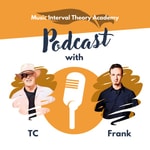
Many composers feel stuck writing the same old ideas, wondering why their music doesn’t sound as original as they want. Inside the Music Interval Theory Academy (MITA) and our community (The Circle of Interval Magicians), we reveal the deeper architecture behind music, the interval magic that helps you break free from the generic sound and step into your own creative power.
The truth is, the composers you admire weren’t born with secret gifts. They learned "spells." They trained their ears, sharpened their instincts, and discovered the hidden structures that shape emotional storytelling. And you can learn them, too.
If you’re the kind of composer who wants to tell powerful musical stories, confidently, clearly, and with your own unmistakable voice, then you already belong here.
You just need the right tools, the right guidance, and a way to finally see how music truly works beneath the surface.
Conventional theory often leaves composers confused or boxed in, and that’s why so many feel overwhelmed or stuck.
But inside our world, we approach music differently. We teach you the language of intervals: a transparent, proven methodology that gives you control, clarity, and creative freedom.
You’re not just learning theory.
You’re stepping into a circle — a circle of composers who believe music is both craft and magic, structure and intuition.
And this knowledge belongs to you just as much as it belongs to anyone else.
Welcome to the Music Interval Theory Podcast.
Welcome to the Circle.
Site
RSS
Apple
Données mises à jour le 04/07/2026
Classements récents
Dernières positions dans les classements Apple Podcasts et Spotify.
Liens partagés entre épisodes et podcasts
Liens présents dans les descriptions d'épisodes et autres podcasts les utilisant également.
Découvrez des podcasts liées à The Music Interval Theory Podcast. Explorez des podcasts avec des thèmes, sujets, et formats similaires. Ces similarités sont calculées grâce à des données tangibles, pas d'extrapolations !
https://www.skool.com/circle-of-interval-magicians/about
Learn Interval Magic and write music that truly stands out and is unique. Start your free 7-day trial today, and after that, it's less than one coffee per week!
If you're new here, my name is Frank, and I'm the co-founder of the Music Interval Theory Academy (MITA), which I've been running since 2015. I teach composers how to stop guessing and start creating music with real intention, using intervals as the foundation instead of chords.
How I got here...
** 1993: Heard the Jurassic Park score in the theater and was blown away.
** 2000: Started to compose and learned traditional theory. Quickly, I hit the same wall most composers hit: the music I wrote was technically correct but forgettable.
** 2005 onwards: Started scoring professionally for animation, film, documentaries, and video games (Disney, Mattel, theme parks, and many others). Built a library of 700+ tracks for production and sync.
** 2015: Everything changed. A workshop with Thomas Chase Jones (TC) flipped the way I think about music. It was all about intervals, and composition got cleaner, faster, and more original. That shift became a system. The system became MITA.
** Since then: hundreds of composers have gone through the Academy. My business partner TC has credits on approximately 1,800 TV shows (Scooby-Doo, Batman, Dexter's Lab, Tom and Jerry — look him up). Together, we teach what most music schools don't.
On this channel, I share the exact methods I use to help composers find their voice, work faster, and stop feeling stuck. If you've ever felt like your music sounds too generic, or like you understand theory but still can't quite control what you're creating, you're in the right place.
Never stop composing,
Frank
Why Composers Freeze at Bar 5
Saison 1 · Épisode 225
vendredi 26 juin 2026 • Durée 10:50
Start here: Free Flipbook — Five Spells Every Composer Needs:
https://musicintervaltheory.academy/spells/
Or join the community: Circle of Interval Magicians — $18/month:
https://www.skool.com/circle-of-interval-magicians/about/
If you're new here, my name is Frank Herrlinger. I'm the co-founder of the Music Interval Theory Academy (MITA), which I've been running since 2015.
I teach composers how to stop guessing and start creating music with real intention, using intervals as the foundation instead of chords.
How I got here...
** 1993: Heard the Jurassic Park score in the theater and was blown away.
** 2000: Started to compose and learned traditional theory. Quickly, I hit the same wall most composers hit: the music I wrote was technically correct but forgettable.
** 2005 onwards: Started scoring professionally for animation, film, documentaries, and video games (Disney, Mattel, theme parks, and many others). Built a library of 700+ tracks for production and sync.
** 2015: Everything changed. A workshop with Thomas Chase Jones (TC) flipped the way I think about music. It was all about intervals, and composition got cleaner, faster, and more original. That shift became a system. The system became MITA.
** Since then: hundreds of composers have gone through the Academy. My business partner TC has credits on approximately 1,800 TV shows (Scooby-Doo, Batman, Dexter's Lab, Tom and Jerry — look him up). Together, we teach what most music schools don't.
On this channel, I share the exact methods I use to help composers find their voice, work faster, and stop feeling stuck.
If you've ever felt like your music sounds too generic, or like you understand theory but still can't quite control what you're creating, you're in the right place.
Never stop composing,
Frank
The Secret Is Prediction, Not Talent
Saison 1 · Épisode 224
vendredi 19 juin 2026 • Durée 08:37
https://www.skool.com/circle-of-interval-magicians/about
There is a reason some composers always seem to know what to play next, and it is not what most people think. This episode gets into the quiet habit that builds real musical confidence from the inside out.
Fix the Score, Not the Knobs
Saison 1 · Épisode 223
vendredi 12 juin 2026 • Durée 04:29
https://www.skool.com/circle-of-interval-magicians/about
When something sounds wrong in your orchestration, the instinct is to reach for the controls. But what if the real problem is somewhere you have not looked yet?
Diatonic vs. Intervallic - Which One is Better
Saison 1 · Épisode 222
samedi 6 juin 2026 • Durée 12:15
https://musicintervaltheory.academy/interval/interval-quiz.html
Most composers never question the system they learned in. This video does.
Diatonic and intervallic thinking each have their own advantages, and knowing the difference can change how you compose. Watch to find out which approach fits where you are right now.
Take the free 4-minute quiz in the link above to find out where you are in your compositional journey.
5 Spells Every Composer Needs
Saison 1 · Épisode 221
vendredi 29 mai 2026 • Durée 02:03
https://musicintervaltheory.academy/spells/
Grab it! - It's free, and one of the best resources for composers available.
The Note Your Scale Won't Allow
Saison 1 · Épisode 220
mercredi 27 mai 2026 • Durée 06:32
https://www.skool.com/circle-of-interval-magicians/about
There's a question that trips up almost every composer trained in functional harmony. The answer most theory books give is complicated. Intervals make it simple.
The 48-Hour Composition Challenge
Saison 1 · Épisode 219
lundi 25 mai 2026 • Durée 04:45
https://www.skool.com/circle-of-interval-magicians/about
Most composers don't have a creativity problem. They have a completion problem. Frank talks about why that folder full of almost-finished pieces might be the thing quietly holding you back.
Color Doesn't Belong to a Genre
Saison 1 · Épisode 218
vendredi 22 mai 2026 • Durée 05:34
https://www.skool.com/circle-of-interval-magicians/about
You want richer harmony but every attempt starts sounding like jazz. Frank shares why color has nothing to do with genre, and what one small borrowed sound can do for your music.
When Lines Do What Chords Cannot
Saison 1 · Épisode 217
mercredi 20 mai 2026 • Durée 04:52
https://www.skool.com/circle-of-interval-magicians/about
There is a moment most composers know well: the melody feels right, but the harmony just won't cooperate. Frank shares what happened when he stopped thinking in chords and started thinking in lines instead.