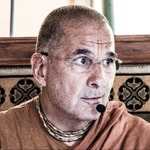
It is difficult to find someone from the West that both understands and can elegantly express the theory behind an Eastern mystical tradition. It is even more difficult to find a modern mystic. In Swami Tripurari we have both: a traditional mystic who can articulate the teachings of an ancient spiritual tradition. A compelling speaker, to hear him and be in his presence is itself a spiritual experience.
Swami Tripurari met his initiating guru, Srila A. C. Bhaktivedanta Swami Prabhupada, in the spring of 1972. He relates that he felt as though he had met a long-lost friend, as Srila Prabhupada blessed him with his all-knowing glance.
Over the years of service that followed, Srila Prabhupada showered him with affection and repeatedly expressed his appreciation for his selfless service and ability to inspire others. In 1974 Srila Prabhupada instructed him in a widely circulated letter, “So you organize freely. You are the incarnation of book distribution. Take the leadership and do the needful.” Accordingly, Swami Tripurari has set an example of one who is independently thoughtful and capable of making an insightful literary contribution to the world.
In 1975 Swami Tripurari was initiated by Srila Prabhupada into the renounced order of sannyasa.
Site
RSS
Apple
Données mises à jour le 14/07/2026
Classements récents
Dernières positions dans les classements Apple Podcasts et Spotify.
Liens partagés entre épisodes et podcasts
Liens présents dans les descriptions d'épisodes et autres podcasts les utilisant également.
Découvrez des podcasts liées à Swami B. V. Tripurari. Explorez des podcasts avec des thèmes, sujets, et formats similaires. Ces similarités sont calculées grâce à des données tangibles, pas d'extrapolations !
Swami Tripurari Swami B. V. Tripurari Live Q&A; June 21, 2026: The Pastimes of Sri Nimai Pandit
samedi 20 juin 2026 • Durée 47:22
Questions on today's Swami call:
In one of your classes, you mentioned that Bhaktivinoda Thakur sent letters to Western scholars in an effort to draw their attention to his ideas. You also said that finding those letters would be a real gem. Were those letters ever found? If so, could you share a little about them?
Gurumaharaj, during the years I lived in Mayapur, a question repeatedly arose in my heart. I have always been fascinated by how the spiritual atmosphere of Vṛndāvana, centered on Rādhā and Kṛṣṇa, came to take root and flourish so deeply in Bengal, a land with such a distinct cultural identity. From a historical perspective, how did this transmission take place? Who were the personalities, traditions, and historical developments that served as bridges between Vraja and Bengal? And considering that it was primarily through Śrī Caitanya Mahāprabhu and His followers that the divine mood of Vṛndāvana was widely disseminated and established in Bengal, what historical, cultural, and spiritual conditions prepared the ground for this message to be received so deeply and embraced so wholeheartedly?
Gurumaharaj, when you reflect upon the life and teachings of Śrī Caitanya Mahāprabhu, is there a particular pastime, teaching, or aspect of His personality that has taken on a special significance for you over the years and that you would like to share with us?
Dear Guru Maharaja, In the last Swami call you talked about Srila Prabhupada shakti avesa and about shakti avesa avatars in general. We accept this concept that Avatars of the Lord, the shakti avesas (the ones that are jivas and not Bhagavan himself, like Narada, Prthu or Prabhupada) can receive at one point different types of shaktis of the Lord. One could argue that it is the same concept that bhakti is not in the jiva and at some moment that jiva is invested with some type of Shakti. In this case those jivas invested with some type of svarupa shakti (in this case Bhava) would be called as Devotees or Bhava Bhaktas.
Jaya Guru Maharaja. Good morning. If a householder has to attend to other duties than bhakti, is that a distraction, or is it just bhakti mixed with karma?
Jaya Maharaja. Is it true that Gokula manifest in the material world is superior to Goloka in the spiritual world?
Swami B. V. Tripurari Live Q&A; June 14, 2026: The Awakening of Bhakti
samedi 13 juin 2026 • Durée 01:01:16
Questions on today’s Swami call:
Dandavats, Guru Maharaja. Please accept my humble obeisances. I have a question that has been on my mind. If Mahāprabhu spent much of His early life as Nimāi Paṇḍita, deeply engaged in nyāya, grammar, and scholarship in Navadvīpa, what was the transformative element in His meeting with Īśvara Purī that brought forth such profound ecstatic devotion? More specifically, what was present in Īśvara Purī—and in the line of Śrī Mādhavendra Purī—that revealed and nourished the intimate mood of Vraja within Mahāprabhu's līlā? I would be very grateful to hear your insights on this point.
Are there any earlier examples of madhurya-rasa in the Madhva-sampradaya?
Dandavat pranams, Guru Maharaja. At what stage does divine love cease to be something we consciously practice and reveal itself as our intrinsic nature?
In BG 7.28 Krsna says "all beings are born deluded, bewildered by the dualities arising from desire and hate." Is Krsna referring to the Jiva/soul or the material psycho-physical mechanism?
In the Purport of BG 8.22 you mention "Krsna is attained by unalloyed devotion, devoid of even the desire for liberation or one's own spiritual benefit." What kind of spiritual benefit is being indicated here? Thanks Guru Maharaja, my loving obeisances!
Pranams, Maharaja. Thanks to the work of Srila Bhaktikavi Atulananda, we have a large number of devotional songs available in Spanish. Personally, I find it very beneficial to sing in my native language, since I can better understand the meaning of the words and feel that I can connect with them more deeply on an emotional level. My question is this: Is there any loss or spiritual disadvantage in singing devotional songs in one's own language rather than in Sanskrit, Bengali, or Vrajabhasa? Is there any particular benefit that is preserved only when singing in the original languages?
Swami B. V. Tripurari Live Q&A; June 7, 2026: When Is the Right Time for Initiation?
dimanche 7 juin 2026 • Durée 01:03:25
Questions on today's Swami call:
Dandavat Pranams Guru Maharaja! Recently I came across Guru Gita from the Skanda Purana, and it made me wonder if we have any such texts in our tradition that comprehensively speak of the Glories of Sri Guru and explain the Guru Tattva that practitioners can read and meditate upon.
There is this discussion in Jaiva Dharma, chapter 9, that confuses me: Adwaita dasa says: " You have said that śakti is the embodiment of consciousness, that it possesses will, and that it is beyond the influence of the three qualities of material nature. This is correct, but only insofar as śakti operates fully under the support of a pure conscious entity, and is thus considered identical with that powerful entity. Desire and consciousness depend on the Supreme Being. Desire cannot exist in śakti; rather, śakti acts in accordance with the desire of the Supreme Being." This passage seems to say that śakti has a will but no desire, which is really confusing to me, as it would make her less "alive" than jiva who obviously has a will and has desires. Perhaps it is my English that clouds the meaning. Could Guru Maharaj clarify this thing more, please? Thank you.
I have been studying Gaudiya Vaishnavism and practicing in the tradition for a few years but have yet to take the leap into initiation. How does one know when the time is right? Is any decision made without any shadow of uncertainty? Or is uncertainty the only thing that is certain? Thank you.
You mentioned last time, that for your confirmation in the Catholic church you chose St Francis as a patron saint. That is amazing! If you like to share with us; how old were you, what exactly made you choose him from all the others and what did choosing a patron saint actually practically mean for your young life?
I would very much like to know what happened to Bhakti Ananda Sagara Maharaj.
Ultimately, what is the reason Arjuna decides to fight? Could it be said that he fights for the many reasons Krishna gives him throughout the Gita conversation, or does he ultimately do it for bhakti? I also wondered, based on several verses of the Gita and other scriptures, to what extent Bhakti, by aiming for the highest, ends up including the benefits of other processes in the resulting benefits of bhakti.
Swami B. V. Tripurari Live Q&A; May 31, 2026: Assisted Dying in Gaudiya Vaishnavism
samedi 30 mai 2026 • Durée 01:08:34
Questions on today's Swami call:
My question is a bit strange: what should one do in case onebecomes a target of an "attack" by someone who can utilize spirits/ghost entities or some kind of energetic influence or spells? I remember Bhaktivinoda Thakur used to read the Bhagavatam when he was attacked by the mistik who pretended to be Bhagavan. But for one whois far less eligible than Bhaktivinoda Thakur, what should one do?
I recently listened to a devotee podcast called „Nectar Talks“ (from Alachua) where mother Vegavati dasi mentioned that, back in the day, a Mexican-born devotee named Gilbert brought you, Swami Tripurari, to the devotees. Do you have any memories of Gilbert or Vegavati dasi that you would want to share with us? :)
(Follow up to first question) Is the Sri Narasimha Kavacha Mantra appropriate for this as well?
How is it possible that Mahā-Māyā covers the svarūpa of the conditioned soul, which is sat-cit-ānanda and directly related to the svarūpa-śakti of Kṛṣṇa?
How did Srila Jiva Goswami compose his teachings?
Is anything we do that is unrelated to Sri Krishna an offense?
A turned away jiva gets trapped by maya. Is it this entrapment that causes us to not go directly to Sri Krishna when we turn towards him?
How can a baddha-jiva offend Krsna if he has no real connection to svarupa-shakti in his anistha-stage of bhajana-kriya, or is it only figuratively spoken of as an offense?
Is it true that if you attain devotion to god in another way than Prema bhakti it takes longer for the soul to fully reach the spiritual realm?
Swami B. V. Tripurari Live Q&A; May 24, 2026: The Colors of Sri Krishna and His Feelings
samedi 23 mai 2026 • Durée 01:03:48
Questions on today's Swami call:
Jay Sri Radhe most respected dear Swamiji, deeply grateful to be able to reconnect with YOU like this. U might remember me under the NAME of MALATI. Much of the FAITH & STRENGH 4 BHAKTI YOU did implant into my SOUL - many years ago. I still remember WORD by WORD many of the Secrets & Divine treasures u told me 1993 in VRINDAVAN. My question please: HOW would u explain/ combine / see the DIFFERENT ASPECTS of the DIVINE FEMALE like DEVI LAKSMI, DEVI SARASVATI, DEVI DURGA, PARVATI, MAHA KALI DEVI in contest with SRI RADHA in terms of TATTVA & RASA please??? LUVING, RESPECTFUL PRANAMS from Austria. Ps. How is my dear friend VRINDARANYA?
Jay Guru Maharaj! Pranams! We are in the month of Purusottama. Could you speak a little about it?
Dandavats, dear Guru Maharaj. In Jiva Gosvavni's epistemology as presented in the Tattva Sandharbha, the ultimate pramana is śabda, which applies to the revealed Vedas and scriptures such as the Bhagvad Gita and the Srimad Bhagavatam. Although the knowledge from these scriptures is final for us, when I read them I wonder why they sometimes use rather imprecise language that allows for a rather broad interpretation. Leaving aside the apparent contradictions in these scriptures, the Sanskrit terms themselves can have many meanings. Take for example the word 'atma' which in some places in the Bhagavad Gita is translated by one Vaishnava commentator as jiva and by another as Paramatma or even mind. I wonder if this way of compiling the scriptures is intended to allow for a broad interpretation so that anyone can get from these scriptures what they desire or believe in, in accordance with the comparison of these scriptures in the Srimad Bhagavatam to the wish-fulfilling tree, nigama-kalpa-taror? However, it seems to me that it would be easier to accept the scriptures as the ultimate pramana if they used unambiguous and precise language, and thus we would avoid such polemics, for example about the nature of the self as we have today. So I'm curious what your opinion is on this, Guru Maharaj.
Dandavat Pranams, Guru Maharaj. We have different important shades and colours. Gaura and Shyam for example. Are there other prominent beautiful colours and complexions one should meditate on? Thank you!
Swami B. V. Tripurari Live Q&A; May 17, 2026: Overlapping Ideals in the Spiritual World
dimanche 17 mai 2026 • Durée 57:35
Dear Guru Maharaja, is it possibly an upset for Radharani to have Sri placed next to Krsna?
Are interfaith relations ultimately not meant to last, since the practitioners will attain different goals?
Where in Bhaktivinoda Thakura's writings are the theological points of Christianity and Vaishnavism you spoke of found in, Guru Maharaja?
Guru Maharaja mentioned recently that he says special prayers after waking up. If they are not something secret, could he share them with us, please?
Are lilas that constitute the goal of different traditions sometimes overlapping?
Maybe I'm not remembering everything but I think Srila Prabhupada spoke of the Aquarian Gospel telling about Jesus coming to Puri, so maybe there's an overlap there?
Are there mystical experiences of loving encounters with divinity that do not necessarily correspond to the aspiration of Gaudiya Vaishnavas?
Is there any verse we can meditate on that emphasizes the compassionate nature of Srimati Radharani?
If the conditioned souls who reach Krishna are said to be more dear to him because they overcome Maya, isn't this unfair in a way for those eternally liberated.
And can the eternally liberated choose to go through Maya and experience it and to choose Krishna again?
In your classes, you mentioned that the window the Goswamis gave us to enter Vrndāvana is the moment just before Krna leaves to kill Kamsa. Why is that particular moment emphasized?
Also, didn't Śrila Prabhupāda seem to enter through the picnic during the Brahma-vimohana-lilã? And wouldn't that still be within purva-răga?
Swami B. V. Tripurari Live Q&A; May 10, 2026: The Mother Is the First Guru
dimanche 10 mai 2026 • Durée 59:36
Questions on today’s Swami Call:
Bhaktivedanta Swami in his purport says in his purport to Bhagavad Gita 10.38: "Among the confidential activities of hearing, thinking and meditating, silence is most important because by silence one can make progress very quickly." These words sound very inspiring, could you comment on this?
Dandavats, dear Guru Maharaja. I have a question about the theodicy problem: Can the suffering of this world be justified by Krishna's need to engage maya shakti if the very existence of maya shakti is itself an expression of His will?
Good morning, Guru Maharaja. If there are jivas that will never be liberated, does that put in question the absoluteness of Bhagavan?
Hare Krsna, Guru Maharaja. If there was no Maya-sakti, could Bhagavan still be called omnipotent?
What does Srila Sridhara Maharaja mean by “the absolute is by itself and for itself”?
Can you please say some words to bless our bhakti-shastri course that we are offering?
Dandavats, Maharaja. On Mother’s Day, would you like to say some words about the divine feminine?
Why did Sri Caitanya Mahaprabhu take sannyasa from Keshava Bharati rather than Isvara Puri?
I would like to ask about Jaya and Vijaya. They played their roles really well. I`m wondering if they were acting under the influence of yoga maya when they became demons or did Narayan put them temporarily under the influence of maya śakti? Thank you.
Hare Krsna and dandavat pranama! For a baddha-jiva maya is the controling agent of their lives and reality, and for a devotee it is yogamaya. Does the individual move from the influence of one to the other through their sadhana and/or saranagati? If so, can we understand it as an instance of one's consciousness shaping one's reality? Dandavat pranama, Guru Maharaja.
Swami B. V. Tripurari Live Q&A; May 3, 2026: The Passing of Sriman Agnideva Prabhu
dimanche 3 mai 2026 • Durée 01:02:04
Can you share something about your relationship with Agnideva Prabhu who passed away recently?
What is the role of reason in the life of faith?
Dandavats Guru Maharaja. I want to know what how you felt after Srila Prabhupada’s disappearance. What did you think to be the right succession of leadership in Iskcon? Did the eleven zonal acharyas/gurus appoint themselves or were they chosen by Prabhupada or the GBC? And have you had the opportunity to read the room conversation from may 28and the July 9 letter about the appointment of the 11 ritviks by Prabhupada?
Radhe Radhe! Please accept my humble obeisances. I would like to ask: how do we know that the soul of a departed person has gone to the spiritual world, or somewhere else? I often hear that when a bhakta leaves this world, it is said that he or she has gone to Krishna. Who can truly know this, and how is it confirmed?
Swami B. V. Tripurari Q&A; April 26, 2026: The Gopis and Their Husbands All Belong to Sri Krishna
dimanche 26 avril 2026 • Durée 01:01:20
Questions on today’s Swami Call:
If Krishna's marriage to Radha and the young gopis happens during the gopi vasta harana lila, and is a legitimate form of marriage, then it seems the gopis' subsequent marriages to their "husbands" would be parakiya and their relationships to Krishna would be svakiya. Jiva Goswami says so I believe. Is this correct? Is this another case of wonderful inconceivable simultaneous difference and non-difference? Also, if all the young gopis are expansions of Srimati Radharani and all their "husbands" expansions of Krishna, or at least his parshads, may we think (as I like to) that their marriages were in fact very happy and satisfying and the gopis went to Krishna for rasa lila not out of any sense of dissatisfaction or cheating tendency but that in the sound of the flute and in Krishna's form they found a more concentrated manifestation of what they loved in their own husbands. Indeed, since we are discussing lila and not some ordinary event, is it possible that the gopis may not have left their husbands at all, but expanded themselves into two, with one staying at home and the other rushing off to be with Krishna?
I have some technical questions about bhakti. First, is there a difference between bhakti and bhakti yoga? I'd like to know if it's called bhakti yoga at a certain stage. In other words, do śuddha-bhaktas also practice bhakti yoga?
Another question is based on something you said in Chile. You cited a source, but I'm not sure if it was from the Śrī Sampradāya, where they differentiated between bhakti and śaraṇāgati, emphasizing that if you weren't qualified for bhakti, you could practice śaraṇāgati. I'd like to know if it's possible to elaborate on this a bit or add some perspectives. I found it very interesting.
In the Śrī Sampradāya, is śaraṇāgati a process or an attitude?
Has any acarya commented on the parallell between Lord Balarama returning to Vraja to console the Vraja-vasis and Lord Nityananda returning to Navadvipa to console the Navadvipa-vasis?
Swami B. V. Tripurari Q&A; April, 19 2026: Sri Gadadhara, the Best Friend of Sri Caitanya Mahaprabhu
dimanche 19 avril 2026 • Durée 59:45
Questions on today's Swami Call:
Hare Krishna, Guru Maharaja. Dandavat pranams. Is it okay to read the Sri Caitanya-Caritamta before completing the Srimad Bhagavatam? Also, what is your favorite book?
As Sri Krishna's mercy flows downward reaches the lowest places, is the best way to attain his mercy to lower and humble ourselves?
Does the topic of mercy and effort relate to the Bhagavad-gita verse where Sri Krishna says he is the source of both remembrance and forgetfulness?
Srila Sridhara Maharaja said, "Gadadhar Das represents the halo of Radharani, but Gadadhar Pandit represents Her mood, Her nature-Her heart." Can you explain this statement?
How are will and desire related?
How did Sri Radha feel during her wedding?
What is the significance of offering a ghee lamp to the source of all light, Sri Krishna?
Can you share any insights on Srila Bhaktivionoda Thakura's emphasis on the worship of Sri Sri Gaura Gadadhara?
Hare Krishna, Gurudeva! Could you share something about how Sikhism relates to Gaudiya Vaishnavism?
What is the significance of the depictions of Sri
Radha carrying Sri Krishna's flute?
For a while now, I have been wondering about how the personal process of realisation for Srila Prabhupada (and also Jesus and other messiahs) looked like. I think Srila Prabupada had famously said that there was never a time when he didn’t think about Krishna, right? But do you have perhaps insights into the „personal awakening“ of Srila Prabhupada to his divine mission on earth? Was he born „ready to go“ so to speak, or were there gradual moments of discovery of his own Shaktyavesh-ness and insights into his feelings - apart from the Jaladuta poem?
Pranams, Guru Maharaja. What will be the theme of your lecture series at the upcoming retreat in Poland?
Dandavats, Guru Maharaja. Do you have any thoughts on the importance of Tantra in Gaudiya Vaisnava lifestyle. I am asking this, as our reading group is currently reading "Rasa: Love Relationships in Transcendence,” and I thought it might help us all to know this.
My other question is somewhat related to this: Is bhakti limited to expressing itself only through the angas, or processes of bhakti? This relates to the initial point: if one studies the angas of bhakti, nowhere does it say "go and kill your relatives."
I say all this because some Vaishnava sects mock the "Vinod Parivar preaching campaigns" and other details that we could say differentiate us as a sect, but since some of these details aren't directly related to bhakti, they consider it a deviation.
The saktyavesa avatars who are souls who get certain energy of the Supreme inside of them, in what moment the divine energy enters the individual soul? When they get out of the womb or is it inside already part of them before birth?
Is there a place for assisted dying in Gaudiya Vaishnavism?
Is it appropriate for a devotee to practice not being afraid of death, or should one simply practice surrender as part of their sadhana and let fearlessness come as a byproduct?
When we deal with animals who suffer, we have the practice of having them euthanized, but this is not something they choose. For assisted dying, however, humans choose it for themselves. Can you comment on this?
Hare Krishna Maharaj, dandavats. In the Srimad Bhagavatam, we hear that Krishna appeared from Vasudeva and Devaki in an extraordinary way, first appearing in the mind and heart of Vasudeva and then passing into the mind and womb of Devaki. This process concluded with an aishvarya manifestation of the Supreme in his four-armed form, rather than a physical birth. However, we hear Srila Jiva Goswami and other acharyas, such as Srila Vishwanath Cakravarthi, reveal that Vrajendranandana Krishna (svayam-bhagavan) was actually born from Yasoda, who had twins. This leads to the question: Did Krishna manifest a process similar to that of Devaki and Vasudeva in Nanda and Yasoda, or, given his special relationship with his devotees in Vrindavan, was Krishna essentially born from Yasoda's body?
(follow up) Can the imprecise meanings of Sanskrit terms sometimes be the main cause of controversy even among Vaishnavas, for example, about the nature of the jiva, as we have today?
Hare Krishna Guru Maharaja. In Sri Caitanya Caritamrita Adi 1.3.65 it says: "In other incarnations the Lord descended with armies and weapons, but in this incarnation His soldiers are His plenary parts and associates." Guru Maharaj, can you share your explanation and perspective on this verse.
Thank you 🙏🙏🙏🙏
Dandavat Pranams Dear Gurudeva! While I understand fully that in order to make progress as a neophyte on the path of bhakti, I must associate with Vaishnavas. However, due to my withdrawn nature as an introvert as well as my experiences with others in all kinds of relationships I'm carrying so much hurt that I feel hesitant to reach out to devotees - due to the apprehension of being a waste of their time or for fear of rejection. What can I do? Thanks for your merciful and kind association!
Dandavats Guru Maharaja and devotees, this is a Vaishnava Pati Das from Chile. My eldest son, Arjuna, has been asking us for a few years now if it's possible for him to receive diksha from you. He is currently twelve years old, and since you began traveling to Chile, he has shown an interest in you.
My wife, Visnupriya, and I wanted to know your opinion on this matter, as we have seen many devotees who have pressured their children to receive initiation, and we don't want to force them into anything. However, Arjuna has a genuine interest, and on his last two visits, he has asked if he can receive diksha from you. My wife and I would be very grateful if you could share some thoughts with us so we can address this issue properly and also fulfill our duty as parents to provide our children with a balanced life.
Hare Krishna, dear Guru Maharaja and dear devotees. Pranaam! I have four questions all relating to the topic of writing. (1) I was wondering if you (GM) have developed a certain writing routine with all your books. like e.g. reciting special prayers before you write? (2) Did you ever experience writer's block and if yes, what did you do? (3) From a practical point of view, what tips would you give aspiring (spiritual) writers? (4) And a last question: Do you keep a daily journal, and would you recommend it for us as daily sadhana? Thank you so much.
How are we to reconcile the apparent fact that some real devotees are not allowed to have darshan of Lord Jagannatha while some non-devotees are allowed to?
What is Sri Isvara Puri’s identity in Krishna-lila? How does it relate to him being the diksa guru of Sri Caitanya Mahaprabhu?
For someone who is integrating into the Vaiṣṇava saṅgha, what do you recommend they begin studying, and in what order? And on the other hand, what does Gurumaharaj expect from his students?
(Reading of Caitanya-caritamrta Madhya Lila 15.16-19)
Sri Chaitanya Mahaprabhu instructed Raghunatha Dasa Gosvami: “You should not eat very palatable food, nor should you dress very nicely.” Raghunatha Dasa set a great example of renunciation by living very simply, and Mahaprabhu did the same. Jesus also led a materially poor life. Today, under the banner of preaching, service, or preserving the image of the tradition before society, it seems that the main representatives of spiritual traditions enjoy special material comfort: they eat sumptuously, dress opulently, travel in luxury cars, associate with the most privileged sectors of society, and so on.
I wanted to ask: if the six Gosvamis, Mahaprabhu, Jesus, and other great personalities set the example of living simply, why is that aspect not considered essential to emulate today for the benefit of devotion? Thank you.
Isn’t today GM’s 51st anniversary of taking sannyas in Vrindavan? Just wondering, if it’s okay or common to congratulate? If yes, happy „birthday“! Also I was wondering if GM would like to say a bit about the encounter he had with Yogi Bhajan in LA, as he briefly mentioned last week.