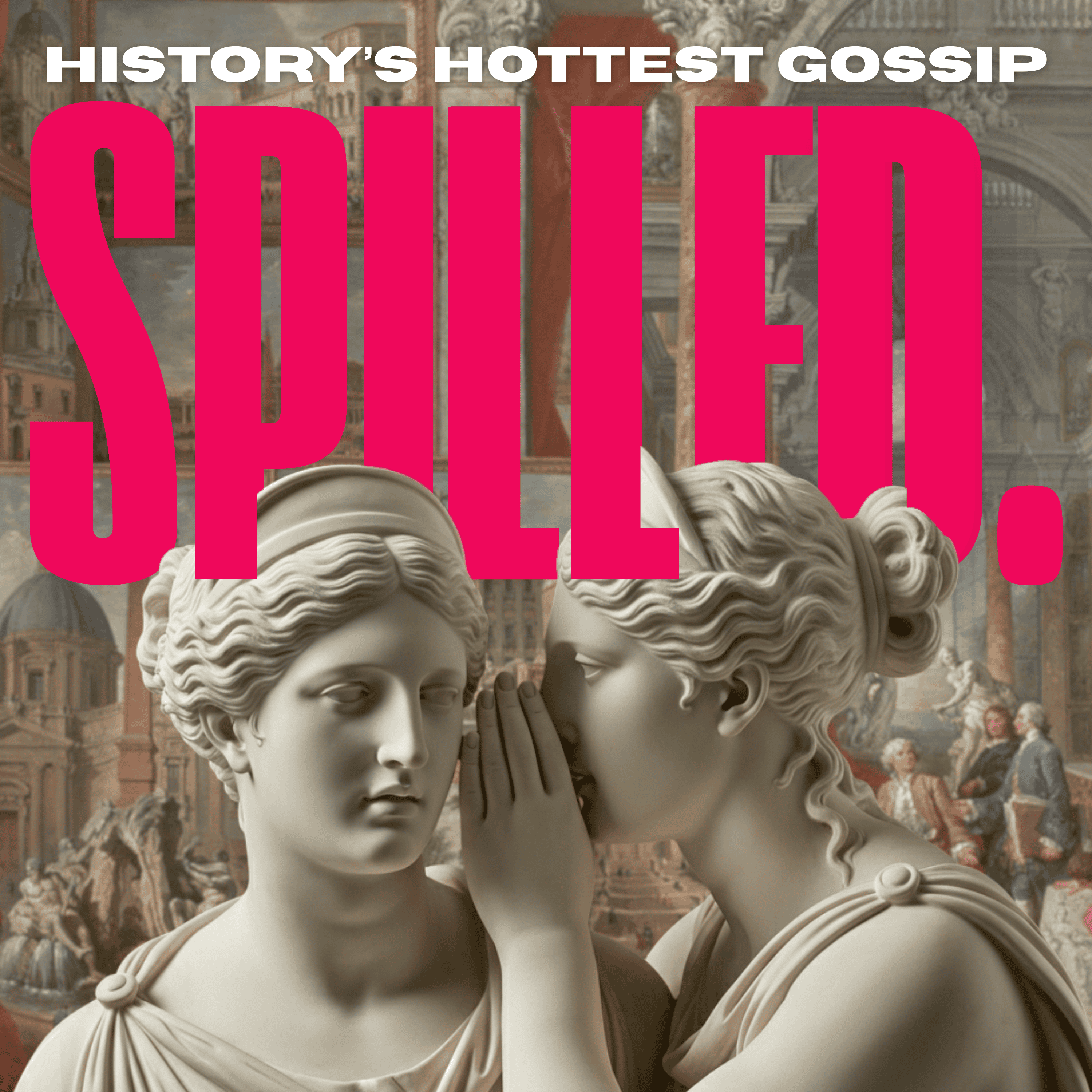
SPILLED. – Détails, épisodes et analyse
Détails du podcast
Informations techniques et générales issues du flux RSS du podcast.

SPILLED.
Delaney & Kendyl Florence
Fréquence : 1 épisode/14j. Total Éps: 22

Classements récents
Dernières positions dans les classements Apple Podcasts et Spotify.
Apple Podcasts
🇺🇸 États-Unis - history
23/04/2026#91🇨🇦 Canada - history
22/04/2026#83🇺🇸 États-Unis - history
22/04/2026#92🇨🇦 Canada - history
21/04/2026#60🇺🇸 États-Unis - history
21/04/2026#87🇨🇦 Canada - history
20/04/2026#54🇺🇸 États-Unis - history
20/04/2026#94🇨🇦 Canada - history
19/04/2026#48🇫🇷 France - history
10/02/2026#84🇩🇪 Allemagne - history
16/12/2025#95
Spotify
🇬🇧 Grande Bretagne - trending
28/09/2025#68↘🇬🇧 Grande Bretagne - trending
27/09/2025#49→🇬🇧 Grande Bretagne - trending
26/09/2025#49→🇬🇧 Grande Bretagne - trending
25/09/2025#49↗🇬🇧 Grande Bretagne - trending
24/09/2025#56↗🇬🇧 Grande Bretagne - trending
23/09/2025#83↗🇬🇧 Grande Bretagne - trending
22/09/2025#163→
Liens partagés entre épisodes et podcasts
Liens présents dans les descriptions d'épisodes et autres podcasts les utilisant également.
See allQualité et score du flux RSS
Évaluation technique de la qualité et de la structure du flux RSS.
See allScore global : 58%
Historique des publications
Répartition mensuelle des publications d'épisodes au fil des années.
Confessions of the Castrated Choir Boys
Épisode 6
mardi 9 septembre 2025 • Durée 56:14
This week we’re diving into the castrati, the choirboys who paid the ultimate price to hit the high notes. We cover how the church justified it, what actually went down in the procedure (spoiler: it’s grim), and why these singers were so popular. Of course, we can’t resist the scandals, the bedroom rumors, and all the messy ways castrati blurred gender and power. As always, there are way too many ball jokes and questionable accents, yet a surprising number of parallels to modern pop stars.
Sources:
Jenkins, John S. “Mozart and the Castrati.” The Musical Times, vol. 151, no. 1913, Winter 2010, pp. 55–68.
Jenkins, John S. "The Lost Voice: A History of the Castrato." Journal of Pediatric Endocrinology and Metabolism, vol. 13, no. 6 (suppl.), February 2000, pp. 1503–1508. Journal of Pediatric Endocrinology and Metabolism. DOI: 10.1515/jpem-2000-s625.
Melicow, M. M. “Castrati Singers and the Lost ‘Cords.’” Bulletin of the New York Academy of Medicine, vol. 59, no. 8, Oct. 1983, pp. 744–764.
Mount, H. “Treble Voices in English Choral Tradition.” Music & Letters, 1976.
Rosselli, John. “The Castrati as a Professional Group and a Social Phenomenon, 1550–1850.” Acta Musicologica, vol. 60, no. 2, May–Aug. 1988, pp. 143–179.
Sherr, Richard. “Guglielmo Gonzaga and the Castrati.” Renaissance Quarterly, vol. 33, 1980, pp. 33–56.
Taylor, Aaron. The Reception of the Castrati in Early-Eighteenth-Century London. Undergraduate dissertation, University of Bristol, 2013.
Lanzillotta, Lee. “What a Queer Institution Was the Castrati.” The Gay & Lesbian Review, July–Aug. 2024 issue, 1 July 2024, glreview.org/article/what-a-queer-institution-was-the-castrati/.
Should Men Farm and Women Fight? The Dahomey Amazon Warriors
Épisode 5
mardi 26 août 2025 • Durée 50:29
This week we’re talking about the Dahomey Amazons, the all-women military force from West Africa who had European colonizers absolutely terrified. We get into how their story has been twisted over time, what they tell us about gender roles, and why African history deserves way more credit than it usually gets. Along the way there are plenty of side tangents, questionable sex jokes, and a few moments that would definitely get us banned from giving guided tours at any respectable museum.
Sources:
Baëta, C. G. “Review: Olodumare: God in Yoruba Belief by E. Bolaji Idowu.” The Journal of African History, vol. 4, no. 1 (1963), pp. 134–135.
Law, Robin. “The ‘Amazons’ of Dahomey.” Paideuma, vol. 39 (1993), pp. 245–260.
Alpern, Stanley B. “On the Origins of the Amazons of Dahomey.” History in Africa, vol. 25 (1998), pp. 9–25.
Yoder, John C. “Fly and Elephant Parties: Political Polarization in Dahomey, 1840–1870.” The Journal of African History, vol. 18, no. 1 (1977), pp. 65–90.
Forbes, Frederick E. Dahomey and the Dahomans. 2 vols., London: Longman, Brown, Green, and Longmans, 1851.
Burton, Richard F. A Mission to Gelele, King of Dahome. 2 vols., London: Tinsley Brothers, 1864.
Was Ben Franklin a Zaddy?
Épisode 4
mardi 12 août 2025 • Durée 51:41
Before he was flying kites in storms or posing on the $100 bill, young Benjamin Franklin was stirring trouble—and hearts. In this episode, we sift through the flirtatious, scandalous, and occasionally eyebrow-raising side of America’s favorite Founding Father: from the cheeky Silence Dogood letters that charmed colonial Boston, to fathering a child out of wedlock, to his rumored Parisian romance with Madame Brillon. We’ll also unpack his essay “Fart Proudly” (yes, really) and his infamously unfiltered advice on choosing a mistress. Was Franklin a true 18th-century heartthrob or just history’s most charismatic chaos agent? Let’s gossip.
Sources:
"1776–1783: Diplomacy of the American Revolution." Office of the Historian, U.S. Department of State, 1997–2001 archive. Diplomacy is Our Mission, U.S. State Dept., https://1997-2001.state.gov/about_state/history/time1.html. Accessed 5 Aug. 2025.
“Fighting for Independence: An Alliance with France.” Diplomacy Is Our Mission, U.S. State Department, https://diplomacy.state.gov/online-exhibits/diplomacy-is-our-mission/security/fighting-for-independence-an-alliance-with-france/. Accessed 5 Aug. 2025.
“Benjamin Franklin in France.” The Americas, Cambridge University Press.
Boyd, Julian P. The Papers of Benjamin Franklin. Vol. 6, Yale University Press, 1963. JSTOR.
“Divided Loyalties: Benjamin and William Franklin.” Monticello, 21 Mar. 2021, www.monticello.org/research-education/blog/divided-loyalties-benjamin-and-william-franklin/. Accessed 5 Aug. 2025.
Copeland, Thomas W. “Franklin’s Mistress Letter: Satire or Sincerity?” The William and Mary Quarterly, vol. 28, no. 3, July 1971, pp. 421–437. JSTOR.
“Enlightenment Irony and Satirical Ethics.” American Quarterly, vol. 29, no. 1, Spring 1977, pp. 45–63. JSTOR.
“Fart Proudly.” Eighteenth-Century Studies, vol. 9, no. 2, Winter 1975, pp. 190–200. JSTOR.
Franklin, Benjamin. “Letter from Benjamin Franklin to a Royal Academy About Farting (1781).” Teaching American History, teachingamericanhistory.org/document/letter-to-a-royal-academy/. Accessed 5 Aug. 2025.
Goodman, Dena. “Sociability and Politeness in Enlightenment France.” Eighteenth-Century Studies, vol. 23, no. 3, Spring 1990, pp. 329–350. JSTOR.
Granger, Lester. “Franklin's Literary Satire.” Early American Literature, vol. 10, no. 3, Winter 1976, pp. 223–237. JSTOR.
“He Was a Founding Father. His Son Sided with the British.” National Geographic, 12 June 2024, www.nationalgeographic.com/history/article/founding-father-benjamin-franklin-son-sided-with-british. Accessed 5 Aug. 2025.
Lemay, J. A. Leo. “Franklin’s Autobiography and the American Dream.” The New England Quarterly, vol. 47, no. 2, June 1974, pp. 208–233. JSTOR.
Lopez, Claude-Anne. “Franklin and Madame Brillon: An Intimate Portrait.” The William and Mary Quarterly, vol. 41, no. 2, Apr. 1984, pp. 181–213. JSTOR.
Mulford, Carla. “Irony and Intimacy in Franklin’s Correspondence.” Early American Literature, vol. 14, no. 3, Winter 1979, pp. 267–284. JSTOR.
Oberg, Barbara B. “Sex and Satire in the Age of Franklin.” The Pennsylvania Magazine of History and Biography, vol. 99, no. 4, Oct. 1975, pp. 450–462. JSTOR.
Skemp, Sheila L. “William Franklin: Son of a Patriot, Servant of a King.” Journal of American Studies, vol. 24, no. 3, Dec. 1990, pp. 359–377. JSTOR.
“William Franklin.” American Battlefield Trust, www.battlefields.org/learn/biographies/william-franklin. Accessed 5 Aug. 2025.
The Truth Behind (some) Catholic Virgin Saints
Épisode 3
mardi 29 juillet 2025 • Durée 53:24
What do a beheaded music lover, a teenage runaway, a dragon-slayer, and a girl who just wanted to stay single have in common? They all became virgin saints — whether they asked for it or not.
In this episode, we unravel the lives (and afterlives) of St. Agnes of Rome, St. Cecilia, St. Margaret of Antioch, and St. Margaret of Cortona — four women whose stories were polished, rebranded, and passed down as holy templates of purity and pain.
There’s a lot of uncomfortable questions about control — especially over young women’s bodies, choices, and legacies. These weren’t passive martyrs - they were messy, complicated figures whose real power may have been in how inconvenient they were.
This week, we’re peeling back the gold leaf to ask: Who gets remembered as a saint — and what did it cost them?
Sources:
Elliott, Dyan. “The Bride of Christ and the Milk of the Virgin: An Example of Marginalia as a Source for Women’s History.” Signs, vol. 14, no. 2, 1989, pp. 252–268. JSTOR, www.jstor.org/stable/3174397.
Bitel, Lisa M. “Body of a Saint, Story of a Saint: Creating a Sacred Past.” History of Religions, vol. 30, no. 2, 1990, pp. 116–140. JSTOR, www.jstor.org/stable/1062951.
Lochrie, Karma. “Between Women: Imagining.” GLQ: A Journal of Lesbian and Gay Studies, vol. 4, no. 4, 1998, pp. 523–556. JSTOR, www.jstor.org/stable/41678197.
Hollywood, Amy. “Virginity and the Invention of Heterosexuality.” Journal of the History of Sexuality, vol. 10, no. 1, 2001, pp. 1–32. JSTOR, www.jstor.org/stable/3704550.
Petroff, Elizabeth Alvilda. “Women and Mysticism.” Mysticism and Spirituality, vol. 1, 1986, pp. 113–135. JSTOR, www.jstor.org/stable/40339263.
The Dark Lady of Doona: Ireland's Pirate Queen
Épisode 2
mardi 15 juillet 2025 • Durée 46:27
In this episode, we dive into the legend and legacy of Ireland’s Pirate Queen: from her wild childhood as “Grace the Bald” to the rumors she gave birth on a ship and went back to battle within the hour. We chart her rise through maritime conquests, clan warfare, and a jaw-dropping face-to-face with the English queen herself. Along the way, we unpack the geopolitical tug-of-war between England and Ireland, and how Grace used her femininity—not in spite of it—as a strategic force in a man’s world.
Sources:
Chambers, Anne. Granuaile: The Life and Times of Grace O'Malley. Gill & Macmillan, 2003.
Knox, H. T. “Grace O’Malley.” Journal of the Galway Archaeological and Historical Society, vol. 4, no. 2, 1905, pp. 65–72. JSTOR, http://www.jstor.org/stable/44973429. Accessed 25 June 2025.
Maguire, Conor. “Grace O’Malley: The Queen of the West.” Studies: An Irish Quarterly Review, vol. 32, no. 126, 1943, pp. 225–30. JSTOR, http://www.jstor.org/stable/30100558. Accessed 25 June 2025.
Ohlmeyer, Jane H. Making Ireland English: The Irish Aristocracy in the Seventeenth Century. Yale University Press, 2012.
Chambers, Anne. Granuaile: Ireland’s Pirate Queen. Gill Books, 2003.
Canny, Nicholas. Making Ireland British, 1580–1650. Oxford University Press, 2001.
McNeill, Mary. Grania: She-King of the Irish Seas. Irish University Press, 1972.
O’Dowd, Mary. A History of Women in Ireland, 1500–1800. Pearson Education, 2005.
Staton, Tracy. “Grace O’Malley: The Pirate Queen of Ireland.” Rebel Women, 1998.
Before Cleopatra: The Woman Who Ran Rome (and Antony)
Épisode 1
mardi 1 juillet 2025 • Durée 42:07
You know Cleopatra—the scandal, the eyeliner, the drama. But before she stepped onto the scene with Marc Antony, there was Fulvia: a Roman powerhouse, political strategist, and all-around boss. In this episode, we dig into the story of the woman who didn’t just love Antony—she leveraged him. From leading armies to stirring up civil war, Fulvia was making major moves long before Cleopatra made headlines. Let’s give credit where it's very overdue.
Episode 1 Sources:
Appian. The Civil Wars. Translated by Horace White, Loeb Classical Library, Harvard University Press, 1913.
Asconius. Commentary on Cicero’s Speeches. Translated by R.G. Lewis, Clarendon Press, 1990.
Babcock, Charles L. “The Early Career of Fulvia.” The American Journal of Philology, vol. 86, no. 1, 1965, pp. 1–32. JSTOR, https://www.jstor.org/stable/292619. Accessed 29 May 2025.
Cassius Dio. Roman History. Vol. 5, Book 48, translated by Earnest Cary, Loeb Classical Library, Harvard University Press, 1916.
Cicero, Marcus Tullius. The Philippics of Cicero. Translated by W. C. A. Ker, Harvard University Press, 1926.
Huzar, Eleanor G. “Mark Antony: Marriages vs. Careers.” The Classical Journal, vol. 81, no. 2, 1985, pp. 97–111. JSTOR, https://www.jstor.org/stable/3296739. Accessed 29 May 2025.
Levick, Barbara. Women in Roman Politics. Historical Review Publications, vol. 78, 2000, pp. 35–48.
Was Versailles Just Overcompensation? Insecurity, Bizarre Rules, and Freestyle Rapping
Épisode 7
mardi 23 septembre 2025 • Durée 57:24
Versailles wasn’t just a palace — it was Louis XIV’s ego on display. In this episode, we break down how the Sun King’s insecurity complex shaped court life, from the bizarre rituals around his daily routine to the rules designed to keep everyone competing for his attention. We also trace how these traditions turned Versailles into the most theatrical (and exhausting) place on earth. We also may or may not try to freestyle rap, so stick around till the end.
Sources:
Heltzel, Virgil B. “The Rules of Civility (1671) and Its French Source.” Modern Language Notes, vol. 43, no. 1, 1928, pp. 17–22. JSTOR, https://doi.org/10.2307/2914493. Accessed 15 Sept. 2025.
“Versailles and the Royal Court.” Palace of Versailles, en.chateauversailles.fr/discover/resources/versailles-and-royal-court. Accessed 15 Sept. 2025.
Château de Versailles. “History.” Palace of Versailles: Discover History. Accessed 16 Sept. 2025. https://en.chateauversailles.fr/discover/history
Château de Versailles. “Courtiers — Key Dates.” https://en.chateauversailles.fr/discover/history/key-dates/courtiers
Kronenberger, Louis. “Saint-Simon, Chronicler of Versailles.” The Kenyon Review, vol. 31, no. 2, 1969, pp. 237–54. JSTOR, http://www.jstor.org/stable/4334896. Accessed 16 Sept. 2025.
Kettering, Sharon. “Brokerage at the Court of Louis XIV.” The Historical Journal 36, no. 1 (1993): 69–87. JSTOR, http://www.jstor.org/stable/2639516.
“Anne of Austria.” EBSCO Research Starters. https://www.ebsco.com/research-starters/history/anne-austria
(JSTOR) Stable ID: https://www.jstor.org/stable/3257484
“The Frustrations of Being the Spare: Second Sons in the French Monarchy.” (JSTOR Stable ID: jj.1640541.12) https://www.jstor.org/stable/jj.1640541.12
Jenner, Greg. “Versailles: A Guide to Its Historical Accuracy.” BBC Two, May 2016. Accessed 13 Sept. 2025. https://www.bbc.co.uk/programmes/articles/5jPx75byxj2rptb50s5y5nC/versailles-a-guide-to-its-historical-accuracy
The Kings of France. “Versailles ‒ How to Behave at Versailles.” YouTube video, 11:23. Posted 18 Sept. 2021. https://www.youtube.com/watch?v=2lL8Dkvg-II
Weird History. “The Weirdest Rules of Royal French Etiquette.” YouTube video, 9:51. Posted 16 Apr. 2023. https://www.youtube.com/watch?v=rU-EdjjCSV4
ElleHistory. “French Historian Explains Versailles Season 1.” YouTube video, 29 Mar. 2024. https://www.youtube.com/watch?v=aeGwhKCjDJ0
ElleHistory. “French Historian Gives an Overview of Versailles Season 2.” YouTube video, 24 May 2024. https://youtu.be/VQLGmpO_exs?si=3BzioO8aTxBt4ghB
ElleHistory. “French Historian Reviews Versailles The TV Show.” YouTube video, 6 Oct. 2023. https://youtu.be/cIckIGV1veU?si=v8edyJ7mQBXm-V-h
Reddit, r/AskHistorians:
- “Was the French Ancien Régime an Absolutist, Centralized State or a Backwards, Feudal Patchwork?” (1 year ago).
- PMWeng, “Did They Poop in the Halls at Versailles?” (5 years ago).
- “Did People in Versailles Actually ‘Do Their Business’ in the Corners of the Palace? How Dirty Was It Really?” (2 years ago).
- BreaksFull, “How Filthy Was Versailles? Why Was It Allowed to Be So?” (12 years ago).
- SumpCrab, “I Am a Woman Attending a Party at the Palace of Versailles during the Reign of Louis XVI…” (11 years ago).
- “Is It True the Entire Court Would Watch Louis XIV Bathe, Dress, Eat, Have Sex, etc.?” (7 years ago).
- “Louis XIV Created in Versailles an Everyday Ceremony of Clothing of the King… Why Did He Do It? What Did the Nobility Think About It?” (7 years ago).
No Blood, No Sparkles — China’s Hopping Vampires
Épisode 9
mardi 21 octobre 2025 • Durée 01:01:21
A corpse that hops through the night in Qing dynasty robes—sounds fake, right? But the jiāngshī was once a very real fear. This week, we’re talking about China’s “hopping vampires,” and how they came from something way less supernatural: family obligations, burial delays, and the weird science of what happens to a body when you can’t lay it to rest.
We get into corpse-walking rituals, qi-stealing, peachwood talismans, and why people started sleeping with mirrors by their beds. We also compare the jiāngshī to the Western vampire—because spoiler: they’re not drinking blood, and they’re definitely not hot.
By the end, it’s not really a question of vampire or virus. It’s about what happens when death doesn’t go smoothly, and how communities turned anxiety into rules, rituals, and really good ghost stories. Works Cited
Works Cited
All About History Team. “Chinese Hopping Vampires: The Qing Dynasty Roots Behind the Jiangshi Legend.” All About History, 2 Dec. 2015, www.historyanswers.co.uk/ancient/two-new-bookazines-on-sale-today/ . Accessed 21 Oct. 2025.
Blair, John. Killing the Dead: Vampire Epidemics from Mesopotamia to the New World. Princeton University Press, 2025. https://doi.org/10.2307/jj.29075015 .
“Jiangshi: The Hopping Dead.” Fangoria, www.fangoria.com/jiangshi-the-hopping-dead/ . Accessed 21 Oct. 2025.
Francis, Sing-chen Lydia. “‘What Confucius Wouldn’t Talk About’: The Grotesque Body and Literati Identities in Yuan Mei’s ‘Zi Buyu.’” Chinese Literature: Essays, Articles, Reviews (CLEAR), vol. 24, 2002, pp. 129–60. https://doi.org/10.2307/823479 .
“[Google Books preview; book title unavailable].” Google Books, books.google.com/books?hl=en&lr=&id=xhJgEAAAQBAJ&oi=fnd&pg=PA146. Accessed 21 Oct. 2025.
Liu, Xiongfei, editor. “A Mystery in Western Hunan: Walking Corpse.” ChinaCulture.org, 5 Dec. 2011, en.chinaculture.org/chineseway/2011-12/05/content_426742.htm. Accessed 21 Oct. 2025.
Louie, Kam, and Louise Edwards. “Introduction.” Censored by Confucius: Ghost Stories by Yuan Mei, by Yuan Mei, M. E. Sharpe, 1996, pp. vii–xviii.
Radford, Benjamin. “Vampires: Fact, Fiction and Folklore.” Live Science, 22 Oct. 2014, www.livescience.com/24374-vampires-real-history.html . Accessed 21 Oct. 2025.
Tran, Nga. “Hopping Vampire – 僵尸 (Jiāngshī).” Chinese Popular Culture Terms, vol. 2, University of Houston Libraries, 2023, uhlibraries.pressbooks.pub/chin3343fa23/chapter/hoppingvampire/. Accessed 21 Oct. 2025.
Wood, S. A. “The Jiang Shi.” Medium, 10 Feb. 2020, medium.com/@shwnwd/the-jiang-shi-b97532e7e975. Accessed 21 Oct. 2025.
Yuan, Mei. Zibuyu, “What the Master Would Not Discuss,” According to Yuan Mei (1716–1798): A Collection of Supernatural Stories. Vol. 1, edited by Paolo Santangelo, in cooperation with Yan Beiwen, Brill, 2013.
How to Spot a Witch: The Origin of Witches, Witch Hunts, and…Demon Sex?
Épisode 8
mardi 7 octobre 2025 • Durée 01:16:51
Join Kendyl and Delaney as they explore the origins of witches and witch hunts across early modern Europe when bad weather, curdled milk, or a cranky neighbor could get you accused of serving the devil. We unpack what actually made someone a “witch,” who decided that, and how it all ties back to the social and religious stressors of the time.
Plus: Kendyl buys a spell off Etsy (for science) and learns that modern witchcraft… may not come with a money-back guarantee.
Sources:
Primary / Foundational The Bible:
Exodus 22:18; Deuteronomy 18:10–12; Leviticus 20:27; 1 Samuel 28 (Witch of Endor).
Kramer (Institoris), Heinrich, and Jacob Sprenger. Malleus Maleficarum (1486).
Boguet, Henri. Discours des sorciers (Lyon, 1610).
Alice Kyteler case (Ireland, 1324) — as summarized in the packet.
“Confession of Béatrice” — heretical/diabolic confession excerpts summarized in the packet.
Suzanne Gaudry (France, 1652) — trial narrative summarized in the packet.
Rebecca Lemp (Germany, 1590s) — coerced confession example summarized in the packet.
Secondary / Scholarship & Reference Bailey, Michael D. “The Meanings of Magic.” In Magic: The Basics, pp. 8–23. Abingdon & New York: Routledge, 2018.
Behringer, Wolfgang. “Weather, Hunger and Fear: Origins of the European Witch-Hunts in Climate, Society and Mentality.” German History 13, no. 1 (1995): 1–27.
Cole, Lucinda. “Rats, Witches, Miasma, and Early Modern Theories of Contagion.” In Imperfect Creatures: Vermin, Literature, and the Sciences of Life, 1600–1740, 24–48. Ann Arbor: University of Michigan Press, 2016. https://doi.org/10.2307/j.ctt1gk0873.5
Larsen, Aaron John Henry. “Darkest Forests and Highest Mountains: The Witches’ Sabbath and Landscapes of Fear in Early Modern Demonologies.” European Review of History 31, no. 1 (2023): 157–174. https://doi.org/10.1080/13507486.2023.2230591
Moore, R. I. The Formation of a Persecuting Society: Authority and Deviance in Western Europe, 950–1250. 2nd ed. Oxford: Blackwell. (esp. pp. 94–116 as flagged in notes)
Oster, Emily. “Witchcraft, Weather and Economic Growth in Renaissance Europe.” Journal of Economic Perspectives 18, no. 1 (2004): 215–228. http://www.jstor.org/stable/3216882
Winkler, Albert. “Judicial Murder: The Witch-Craze in Germany and Switzerland.” Swiss American Historical Society Review 59, no. 1 (2023). (BYU ScholarsArchive)
Berkeley Law — Robbins Collection. Witch Trials in Early Modern Europe and New England (exhibit/overview; legal developments & diabolical witchcraft framing).
Podcasts Similaires Basées sur le Contenu