Psychology of the Strange – Détails, épisodes et analyse
Détails du podcast
Informations techniques et générales issues du flux RSS du podcast.
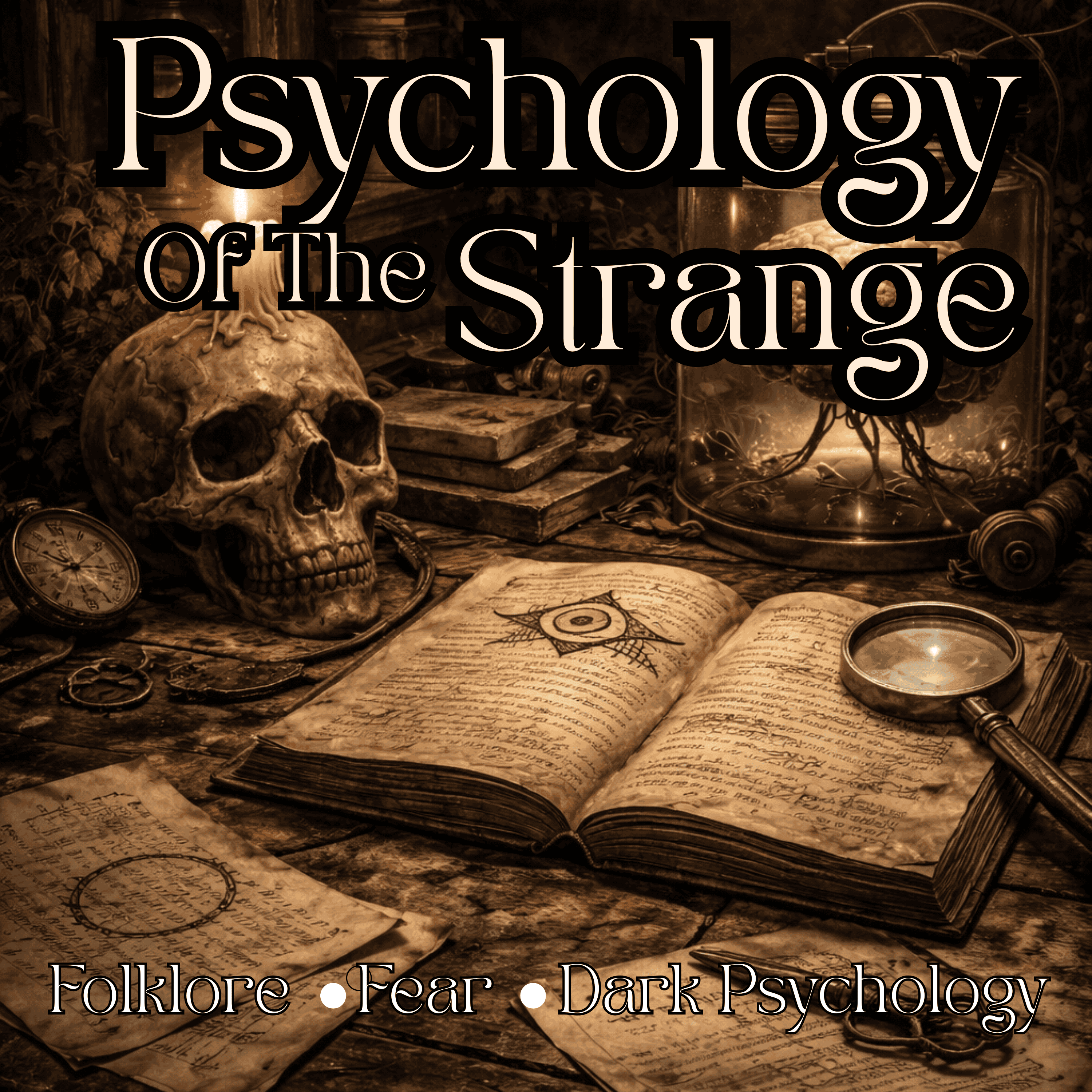
Psychology of the Strange
Tara Perreault
Fréquence : 1 épisode/25j. Total Éps: 44

Psychology of the Strange is a narrative psychology podcast that explores the eerie, the uncanny, and the deeply human. Every episode begins with an original atmospheric story rooted in dark folklore, superstition, or real events and then shifts into a psychological analysis that unpacks why these tales grip the human mind. From winter-born omens and skeletal visitors to fearlessness, moral ambiguity, and the monsters we create to explain uncertainty, this show lives in the spaces where folklore and psychology overlap.
If you like stories that linger… and explanations that cut deeper… you’re in the right place.
ABOUT THE HOST
Hosted by Tara Perreault, a doctoral student in psychology at the University of South Florida. Her research focuses on the darker edges of human nature: fearlessness, Dark Triad traits, moral ambiguity, recreational fear, and the meanings people draw from the strange and the supernatural. Tara blends academic insight with myth, atmosphere, and psychological storytelling. Her approach is part folklore study, part dark psychology, part narrative experiment. She has presented research at multiple conferences, published empirical work, and spent years studying how people make sense of fear — in haunted houses, on screen, and in the stories we pass down through generations. Psychology of the Strange is her creative extension of that work: a place where the uncanny becomes meaningful, and where every monster is really a metaphor for something we haven’t faced yet.
Hosted on Acast. See acast.com/privacy for more information.
Classements récents
Dernières positions dans les classements Apple Podcasts et Spotify.
Apple Podcasts
Aucun classement récent disponible
Spotify
Aucun classement récent disponible
Liens partagés entre épisodes et podcasts
Liens présents dans les descriptions d'épisodes et autres podcasts les utilisant également.
See all- https://amzn.to/4gFAuxU
1 partage
Qualité et score du flux RSS
Évaluation technique de la qualité et de la structure du flux RSS.
See allScore global : 73%
Historique des publications
Répartition mensuelle des publications d'épisodes au fil des années.
The Inverse Curse of the Modern Potion
Saison 3 · Épisode 44
mardi 23 juin 2026 • Durée 34:15
What happens when a medication designed to heal the physical body accidentally alters more than was prescribed?
On June 17, 2026, researchers at Rutgers University dropped a scientific bombshell in the journal Criminology, revealing a startling psychiatric byproduct of GLP-1 medications like Ozempic and Wegovy: a massive, unprecedented drop in impulsive, violent behavior and substance abuse.
While the rest of the media treats these synthetic hormones as a story about physical weight loss, we are pulling the conversation deep into the uncanny valley of human consciousness. In this episode, we step into the biological engine room of human behavior to connect this cutting-edge neuroscience to the body horror of Stephen King’s Thinner, ancient European folklore of the Changeling, and the modern internet paranoia surrounding celebrity clones.
If a weekly injection into the thigh can turn down human rage by over 60%, virtue ceases to be a moral achievement. It becomes a metabolic variable. Are we actually the independent captains of our own minds, or are we just passengers at the mercy of our digestive chemistry?
- The pipeline connecting high baseline impulsivity to physical violence was found to be 62% weaker in current GLP-1 users.
- The well-established link between alcohol abuse and violent outbursts was slashed by 52%.
- Neurological data suggests the medication functions as a form of "chemical CBT". Densely peppered GLP-1 receptors in the brain's ventral tegmental area cap the maximum voltage of dopamine pathways, physically widening the critical gap between a dark impulse and the physical action.
Inside the Episode
- Stephen King's Thinner and the primal horror of biological rebellion.
- How GLP-1 drugs quiet the "food noise," "rage noise," and the neuroscience of the mesolimbic dopamine pathway.
- Connecting the rapid physical and behavioral transformations of Hollywood to medieval fae superstitions and algorithmic "clone" conspiracy theories.
- Why a synthetic molecule designed to enforce the rules of polite society directly onto our neurotransmitters is weirder than any gothic hex.
- The Schopenhauer Paradox, if we can buy restraint at a pharmacy, does free will exist?
- A rational cushion on the sci-fi nightmare, where treatment ends, and the slippery slope of chemical compliance begins.
Referenced Works & Deep Dives
- The Study: Semenza, D., & Thomas, C. (June 17, 2026). Criminology. "GLP-1 Receptor Agonists and the Mitigation of Impulsive and Violent Behavior."
- Literature: Thinner by Stephen King (writing as Richard Bachman), 1984.
- Philosophy: Arthur Schopenhauer, Essays on the Freedom of the Will.
Support the Strange
If you want to wander deeper into the shadows of psychological research with me, join our community of intellectual anomalies:
- Substack: Subscribe to our paid tier for completely ad-free listening and access to this week's companion essay, where I pull out my full research notebook, explore the history of behavioral optimization, and dissect the psychology of the uncanny valley.
- Buymeacoffee: If you enjoyed the episode and what to send a special thanks, Buy me a coffee to fuel the research that goes into each episode
- Social Media: Follow the journey and join the conversation on Instagram, X, and TikTok @psychstrangepod.
Listener Note: “Man can do what he wills, but he cannot will what he wills.” What do you think? Is our morality a grand cathedral of the soul, or just a temporary tent pitched on the volatile swamp of our baseline metabolism? Slide into socials and let me know.
Hosted on Acast. See acast.com/privacy for more information.
Apocalypse Airlines and Elite Doomsday Bunkers
Épisode 43
mardi 16 juin 2026 • Durée 26:34
The Doomsday Clock is sitting at 85 seconds to midnight... the closest it has ever been to global catastrophe. Yet, the dominant cultural response isn’t panic; it’s a meme. Why do we treat existential threats as casual entertainment, and what happens when the people with the best information start quietly building their own escape hatches?
In this episode, we explore the eerie intersection of modern folklore and real-world survival infrastructure. We break down the enduring mysteries of Denver International Airport... from Blucifer and apocalyptic murals to the labyrinth of underground tunnels... and compare them to the very real, fully operational E-4B "Doomsday Plane".
Finally, we look at the psychological concept of psychic numbing. Why does human empathy fail at scale? And what does it mean for our collective future when the global elite stop trying to fix the world and start buying luxury missile silos instead?
What We Cover in This Episode:85 Seconds to Midnight: The reality of the modern Doomsday Clock and how our brains cope with chronic, existential dread.
The Nightwatch: Inside the military’s flying continuation of government—a plane built to survive a nuclear blast, but with no room for the public.
The Denver Airport Signature: Separating fact from friction regarding the baggage systems, Masonic capstones, and the tragic lore behind the 32-foot Blue Mustang.
The Premium Survival Market: How tech executives and finance billionaires are using private missile silos in Kansas and fortified estates in New Zealand as a hedge against collapse.
Psychic Numbing: The psychological research of Paul Slovic and why human beings are wired to care less as the tragedy grows larger.
Want to look closer backstage? Head over to our Substack to read this week's companion essay. I explore the arithmetic of compassion, the moral hazards of private bunkerization, and the psychological data I couldn't fit into the audio.
Join the Community & Read the Essay: https://open.substack.com/pub/psychstrangepod/p/apocalypse-airlines-and-elite-doomsday?r=4ajm1n&utm_campaign=post&utm_medium=web
Go Paid: Support the show as a paid subscriber to unlock premium deep-dives and enjoy completely ad-free listening.
Hosted on Acast. See acast.com/privacy for more information.
Rugaru Legend in the Bayou
Saison 3 · Épisode 34
mardi 14 avril 2026 • Durée 30:56
Deep in the Louisiana bayou, something moves through the cypress trees after dark. The rougarou (aka rugaru or rougaroux) is Louisiana's legendary swamp werewolf. It has haunted Cajun folklore for centuries, born from the French loup-garou legend and shaped by the fears of a displaced people trying to hold their world together in the dark.
In this episode of Psychology of the Strange, we trace the rougarou from its roots in medieval French werewolf mythology through the Acadian exile of 1755 and into the swamps of southern Louisiana, where it became something far more specific than a monster. We dig into the Catholic guilt and excommunication architecture baked into the curse, the psychology of folklore as social control, and why breaking your Lenten fast for seven consecutive years might be the last mistake you ever make. We explore terror management theory, moral disengagement, and institutional betrayal and why the only escape from a Church-built curse runs straight through Louisiana voodoo.
Plus: why the rougarou can't count to thirteen, what that has to do with Judas, and how a creature built to punish sinners became an unlikely guardian of the Louisiana wetlands and maybe something of a cryptid antihero for our current moment.
Grad school doesn't fund itself, and neither does late-night research into the rugarou, demonic mirrors, and the psychology of cults. If an episode got under your skin, sent you down your own rabbit hole, or made you text someone "you need to hear this", buying me a coffee keeps the strange alive.
https://buymeacoffee.com/psychstrangepod
Psychology of the Strange is part of the Dark Cast Network. Find me on Instagram and TikTok at @psychstrangepod.
Hosted on Acast. See acast.com/privacy for more information.
Medusa, the other version
Saison 3 · Épisode 33
mardi 7 avril 2026 • Durée 24:53
Trigger Warning: This episode contains detailed discussion of sexual assault, honor killings, and violence against women.
Medusa. You know the story. Monster. Snakes for hair. One look and you turn to stone. Hero with a mirrored shield, clean ending, everybody goes home. Except, that's not the whole story. In this episode of Psychology of the Strange, I'm pulling apart one of mythology's most recognizable villains and rebuilding her from the ground up. Because in Ovid's telling, Medusa wasn't born a monster. She was made into one. By a god who assaulted her. By a goddess who punished her for it. And by a hero who found her more useful dead than alive.
This episode explores the psychology of victim blaming, institutional betrayal, and the logic that turns survivors into threats. A logic that didn't stay in ancient Greece. From Iran's legal code to Pakistan to a 2025 honor killing in Syria filmed and posted online by the perpetrator, the pattern Ovid wrote down is still operational today.
Mythology. Psychology. The stories we tell to make the rules we live by.
Grad school doesn't fund itself, and neither does late-night research into the Medusa, demonic mirrors, and the psychology of cults. If an episode got under your skin, sent you down your own rabbit hole, or made you text someone "you need to hear this", buying me a coffee keeps the strange alive.
https://buymeacoffee.com/psychstrangepod
Sources and current events referenced in this episode:
- Rahaf Alwan, Syria, April 2025: https://stj-sy.org/en/syrias-transitional-phase-honor-killings-persist-amid-failing-protection-and-legal-response/
- Mobina Zeynivand, Iran: https://www.iranintl.com/en/202408284891
- Honor killings in Pakistan 2024: https://www.dawn.com/news/1881836
- Iran honor killings 2024 annual report: https://stophonorkillings.org/en/2025/01/03/fourth-quarterly-report-on-honor-killings-in-2024186-case-in-a-year/
- Human Rights Commission of Pakistan: https://www.aljazeera.com/news/2025/7/29/father-ex-husband-among-9-arrested-in-alleged-honour-killing-in-pakistan
Hosted on Acast. See acast.com/privacy for more information.
The Galactic Goddess- Amy Carlson and the Love Has Won Cult
Saison 3 · Épisode 32
mardi 31 mars 2026 • Durée 25:55
Love Has Won cult leader Amy Carlson, known as Mother God, was found mummified in a Colorado home in 2021, her body wrapped in Christmas lights, her skin turned permanently blue from years of colloidal silver ingestion, her followers still waiting for galactic beings led by Robin Williams to take them to another dimension. This true crime and cult psychology episode explores shared delusion, coercive control, and what happens when a group of people construct a reality so airtight that even death can't penetrate it.
Underneath the strange and visceral details is a question: what does it actually take for an entire group of people to surrender their grip on reality together and what does psychology tell us about how that process works? This episode explores folie à plusieurs (shared psychosis) and how social media and livestream culture created a new kind of cult isolation that doesn't need a compound to function. We look at what terror management theory, moral disengagement, and unfalsifiable belief systems can tell us about Love Has Won, and the haunting reversal at the heart of this story, where the followers became so invested in her divinity that they couldn't save her even when she asked them to.
If you're drawn to cult documentaries, dark psychology, paranormal belief, or the HBO documentary Love Has Won: The Cult of Mother God then this episode is for you.
Grad school doesn't fund itself, and neither does late-night research into the rugarou, demonic mirrors, and the psychology of cults. If an episode got under your skin, sent you down your own rabbit hole, or made you text someone "you need to hear this", buying me a coffee keeps the strange alive.
https://buymeacoffee.com/psychstrangepod
New episodes every week on all major platforms. Follow @psychstrangepod.
Hosted on Acast. See acast.com/privacy for more information.
The Necromantic Mirror of Floron: Vatican Secrets, Demonic Magic, and the Psychology of the Shadow Self
Saison 3 · Épisode 31
mardi 24 mars 2026 • Durée 30:39
A demon mirror hidden beneath the Vatican. A cursed object so dangerous that even looking into it required a ritual: a celibate blacksmith, a waxing moon, and a virgin boy as the only one permitted to see what it showed. The Necromantic Mirror of Floron is not just a Vatican conspiracy theory. It's a real artifact documented in a 15th century grimoire, and what it allegedly reveals is darker than any demon: the version of yourself you've spent your entire life arranging not to see.
In this episode of Psychology of the Strange, I dig into the documented history of the Mirror of Floron, pulled from the Munich Manual of Demonic Magic, one of the most significant surviving medieval grimoires and the legend that the physical mirror itself ended up locked in the Vatican's sealed vaults, retrieved by the Templars from communities torn apart by what it did to the people who looked into it. Then I break down the psychology underneath the story: why mirrors destabilize identity, what mirror-gazing actually does to the brain according to Giovanni Caputo's strange-face illusion research, how terror management theory explains why the mirror's particular brand of horror hits so deep, and why a 15th century magician built a child into the ritual as a buffer because he already knew direct exposure was something the adult mind couldn't survive intact.
This one sits at the crossroads of occult history, dark psychology, and Vatican conspiracy and by the end, you might find yourself avoiding your own reflection.
Grad school doesn't fund itself, and neither does late-night research into the rugarou, demonic mirrors, and the psychology of cults. If an episode got under your skin, sent you down your own rabbit hole, or made you text someone "you need to hear this", buying me a coffee keeps the strange alive.
https://buymeacoffee.com/psychstrangepod
For more strange between episodes make sure you follow me @psychstrangepod on socials
Topics covered: Vatican secrets | demon mirror | cursed mirror | shadow self | dark psychology | medieval grimoire | forbidden knowledge | occult history | mirror psychology | the Munich Manual of Demonic Magic | Necromantic Mirror of Floron | Psychology of the Strange
Hosted on Acast. See acast.com/privacy for more information.
Narcissists, Psychopaths, and Heroes, Oh My! The Boys
Saison 3 · Épisode 30
mardi 17 mars 2026 • Durée 24:55
Dark triad personality traits, narcissism, psychopathy, and Machiavellianism, may be the hidden ingredient of every superhero story you've ever loved. In this psychology deep dive, I'm using Amazon Prime's The Boys to explore what separates a hero from a monster and whether the answer is psychology, circumstance, or just really good branding.
Homelander is a clinical portrait of malignant narcissism and psychopathy wrapped in a cape. Billy Butcher is Machiavellianism with a vendetta. Soldier Boy is what happens when dark triad traits get a government contract and zero accountability. And Starlight and Hughie, you know the ones trying to stay decent, might be the most psychologically interesting characters of all.
I go deep on moral licensing, the neuroscience of why we can't look away from dangerous people, and what a dose of Compound V reveals about the difference between ends-justify-the-means thinking and actual ethics. Spoiler: it's not what we want it to be.
This is a psychology of evil episode, a superhero deconstruction, and an uncomfortable mirror all in one.
Grad school doesn't fund itself, and neither does late-night research into the supernatural, dark triad, and the psychology of cults. If an episode got under your skin, sent you down your own rabbit hole, or made you text someone "you need to hear this", buying me a coffee keeps the strange alive.
https://buymeacoffee.com/psychstrangepod
Make sure to find me on social media for more strange and psychology between episodes @psychstrangepod
Hosted on Acast. See acast.com/privacy for more information.
Baba Yaga- The witch in the forest
Saison 3 · Épisode 29
mardi 10 mars 2026 • Durée 24:41
This episode features three original folklore stories including a Baba Yaga tale exploring obsession, grief, and the true cost of a granted wish. Whether you're here for the dark folklore, the psychology, or both this one will stay with you.
Grad school doesn't fund itself, and neither does late-night research into the supernatural, demonic mirrors, and the psychology of cults. If an episode got under your skin, sent you down your own rabbit hole, or made you text someone "you need to hear this", buying me a coffee keeps the strange alive.
https://buymeacoffee.com/psychstrangepod
Psychology of the Strange is part of the Dark Cast Network. New episodes every week. Find me on Instagram and TikTok at @psychstrangepod.
Hosted on Acast. See acast.com/privacy for more information.
Modern Folklore- Urban Legends, Internet Horror, and Conspiracy Theories
Saison 3 · Épisode 28
jeudi 5 mars 2026 • Durée 18:58
Urban Legends, conspiracy theories, creepypasta, and internet horror explained through psychology because folklore isn't dead it just evolved. In this episode I explore why scary stories, modern myths, and online conspiracy theories spread. Long before the internet, people gathered around fires and told stories to make sense of a world they couldn't control. Today we do the same thing in the comment sections, Reddit threads, and TikTok videos. From Hookman to Slenderman, from Area 51 to the Russian Sleep Experiment every era builds the folklore it needs to survive fears. The monsters always change. The psychology never does.
This episode covers the psychology of urban legends and why they warn us about spaces that feel unsafe, how conspiracy theories function as modern folklore where the monster is power itself, why creepypasta is designed to blur the line between fiction and reality, how internet horror and ARGs create new kinds of participatory mythology and why folklore thrives specifically when certainty collapses and authority can't be trusted.
Whether you are a true believer, a skeptic, or somewhere in between...if you have ever read something online that made your stomach drop in a way you can't explain this episode is for you.
Grad school doesn't fund itself, and neither does late-night research into the supernatural, demonic mirrors, and the psychology of cults. If an episode got under your skin, sent you down your own rabbit hole, or made you text someone "you need to hear this", buying me a coffee keeps the strange alive.
https://buymeacoffee.com/psychstrangepod
Hosted on Acast. See acast.com/privacy for more information.
The Mask & the Jim Carrey Conspiracy
Saison 3 · Épisode 27
lundi 2 mars 2026 • Durée 14:35
After Jim Carrey’s recent public appearance at the César Awards in Paris, the internet did what the internet does best: zoomed in, compared old footage, and started asking questions. Almost immediately, conspiracy theories exploded online. Some people believe he’s simply changed. Others think cosmetic procedures altered his appearance. And some are convinced something much stranger is going on including theories connecting him to the late Val Kilmer.
But this episode isn’t really about whether any of those theories are true.
It’s about why moments like this hit such a nerve and why conspiracy theories spread so quickly when someone who once felt culturally familiar suddenly seems different. What happens psychologically when a celebrity who helped define an era no longer feels like the same person? Why do we struggle more with change than with impossible explanations?
In this shorter, current-events episode, I explore the psychology behind celebrity conspiracies, internet speculation, parasocial relationships, and modern folklore forming right in front of us. Because today’s urban legends don’t spread around campfires they spread through timelines, comment sections, and viral posts.
And sometimes the story we choose to believe says more about us than it does about the person at the center of it.
Grad school doesn't fund itself, and neither does late-night research into conspiracy theories, supernatural, and the psychology of cults. If an episode got under your skin, sent you down your own rabbit hole, or made you text someone "you need to hear this", buying me a coffee keeps the strange alive.
https://buymeacoffee.com/psychstrangepod
Hosted on Acast. See acast.com/privacy for more information.
Podcasts Similaires Basées sur le Contenu