Philosophy Playdate – Détails, épisodes et analyse
Détails du podcast
Informations techniques et générales issues du flux RSS du podcast.
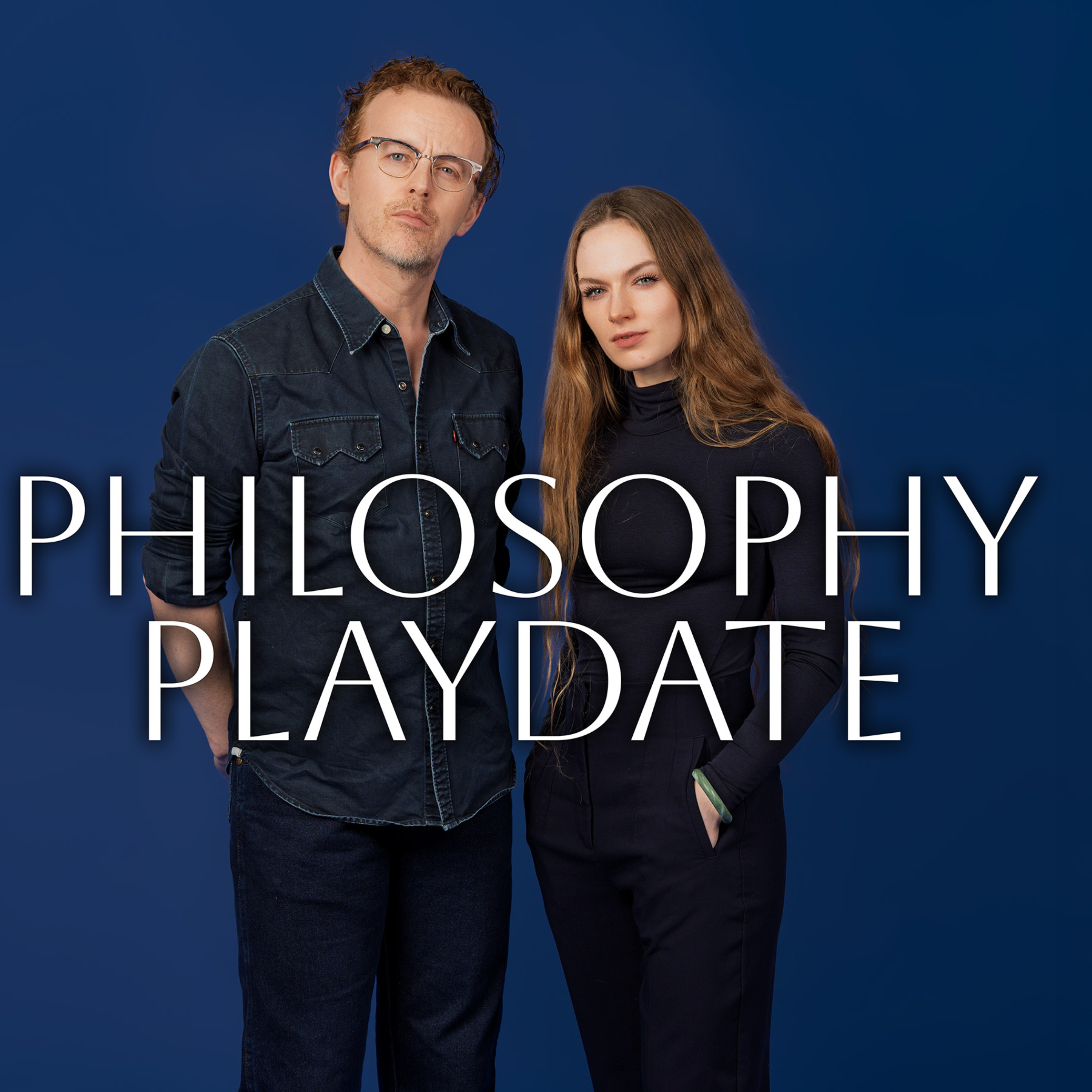
Philosophy Playdate
Clever Make Funny Productions Ltd
Fréquence : 1 épisode/6j. Total Éps: 14

Classements récents
Dernières positions dans les classements Apple Podcasts et Spotify.
Apple Podcasts
🇬🇧 Grande Bretagne - philosophy
07/06/2026#58🇬🇧 Grande Bretagne - philosophy
04/06/2026#78🇬🇧 Grande Bretagne - philosophy
24/05/2026#83🇬🇧 Grande Bretagne - philosophy
23/05/2026#69🇬🇧 Grande Bretagne - philosophy
19/05/2026#99🇬🇧 Grande Bretagne - philosophy
16/05/2026#80🇬🇧 Grande Bretagne - philosophy
09/05/2026#100🇬🇧 Grande Bretagne - philosophy
08/05/2026#59🇬🇧 Grande Bretagne - philosophy
06/05/2026#90🇬🇧 Grande Bretagne - philosophy
01/05/2026#96
Spotify
Aucun classement récent disponible
Liens partagés entre épisodes et podcasts
Liens présents dans les descriptions d'épisodes et autres podcasts les utilisant également.
See all- https://iszi.com/
21 partages



- https://drstevecross.squarespace.com/
13 partages
- https://drstevecross.squarespace.com
10 partages
Qualité et score du flux RSS
Évaluation technique de la qualité et de la structure du flux RSS.
See allScore global : 43%
Historique des publications
Répartition mensuelle des publications d'épisodes au fil des années.
Ep 1 - The Dog/Baby Switch
Saison 1 · Épisode 1
lundi 9 mars 2026 • Durée 48:42
For the very first episode of Philosophy Playdate, Steve and Christabel tackle a fresh new take on the trolley problem, provided by a 7-year-old nascent ethicist. Her question was: “If there was a switch that turned all dogs into human babies, and another switch that turned all human babies into dogs, and you had to push one, which would you push?” This ethical dilemma prompts a discussion of animal sentience and the problems we face when tasked with ranking different kinds of human and non-human consciousness, and whether such a ranking could ever justify the ‘speciesist’ conclusion that some lives are worth more than others. Christabel extolls the virtues of care ethics over the utilitarian aggregative calculus, and Steve extolls the virtues of vasectomies. Both oscillate between the two poles of pro- and antinatalism, considering the environmental, social and hedonistic factors that bear on the question as to when - if ever - it is morally permissible to bring life into the world.
As a rare treat for this inaugural episode, both hosts come to a definitive answer on this week’s question (though in a characteristically philosophical turn of events, they fail to meet an agreement).
Email us the impossible questions children ask you at philosophyplaydate@gmail.com
Find Steve at https://drstevecross.squarespace.com/
Philosophy Playdate theme by Piers Cane
Episode 2 - "What's the best favourite colour to have?"
jeudi 12 mars 2026 • Durée 51:03
This week Christabel is on a mission to convince us that navy blue is the objectively best colour. In her efforts to do this, she enlists the help of Immanuel Kant, and his distinction between things that are capital B Beautiful, and the merely agreeable. Kant relegates wine to the latter category, and Steve argues that the same is true of Queen (but makes a reasonable exception for Freddie Mercury). Christabel takes issue with both, drawing on Shen-Yi Liao’s characterisation of nostalgic food as art to argue that we have good reasons for widening our understanding of what counts as both Beautiful and high art.
We are then introduced to Samantha Matherne’s Kant scholarship, to which Christabel appeals in order to make the claim that if we squint at the Critique of Judgement in the right light, Kant might give us what we need to make the argument that individual shades and tones, when appreciated in a sufficiently abstract way, might be taken to count as the kinds of things about which proper aesthetic judgements can be made. We are invited to conclude that there may be a universally correct answer to this week’s question “What’s the best favourite colour to have?” (and that the answer is navy blue).
Email us the impossible questions children ask you at philosophyplaydate@gmail.com
Find Steve at https://drstevecross.squarespace.com/
Philosophy Playdate theme by Piers Cane
Episode 3 - "How long is a minute?"
Saison 1 · Épisode 3
lundi 16 mars 2026 • Durée 01:05:53
This week, Steve and Christabel try their best to avoid suffering the fate of John William Dunne, who was laughed out of metaphysics circles for proposing that time is an infinite layer cake. In fact, in answering this week’s question, “How long is a minute?”, both hosts are clear on one thing; that you cannot have your cake and eat (all of the temporal parts of) it too. In fact, Christabel argues that the project of destroying a whole cake is just as problematic as that of travelling back in time to kill your grandfather. But time travel isn’t found to be completely paradoxical, and the possibility of travelling back to your favourite minute of a Weird Al Yankovich concert is found to be broadly unobjectionable (at least as concerns logical consistency).
Christabel introduces us to distinctions between ecstatic, historical, personal, external, absolute and proper times, and makes the case for perdurantism; the theory that all objects that persist through time are four-dimensional spacetime worms, and that only small slices of these worms exist at any given time. Steve is more convinced by this view than the presentist’s denial of the existence of the past and future, which he likens to the philosophical commitments shared by babies and Beach Boys.
Read Christabel’s paper about time, as mentioned in the episode: https://discovery.ucl.ac.uk/id/eprint/10217604/1/10.1515_krt-2025-0022%20%281%29.pdf
Email us the impossible questions children ask you at philosophyplaydate@gmail.com
Find Steve at https://drstevecross.squarespace.com/
Philosophy Playdate theme by Piers Cane
Episode 4 - "Am I Too Perfect?"
lundi 23 mars 2026 • Durée 49:11
To answer this week’s question, “Am I too perfect?” Steve and Christabel begin with a brief survey of a selection of religious conceptions of human perfection. This takes them from the contemplation of fitra in Sufi Islam, to the concepts of ātman and puruṣa in the Nyāya-Vaiśeṣika and Sāṅkhya traditions of Hinduism. They weigh in on the Pelagian-Augustinian debate on whether spontaneously conceived babies are on the hook for Adam’s crimes against apples – or St Augustine of Hippo’s crimes against pears – according to the Christian doctrine of original sin (noting that IVF babies might have found the perfect theological loophole).
Discussion then turns to the question as to whether perfection is even a logically coherent concept. Divine perfection seems problematic, given that it seems to entail that God could create a rock so heavy that no being could lift it, and then immediately do so. Christabel explores the process theist’s rejection of the classical, monopolar view of God as existing within Boethian eternity. She begins to expound upon the idea that time is a wheel, and that according to this dogma, though good times pass away, so do the bad. It’s considered that mutability is our tragedy, but also our hope; that the worst of times - like the best - are always passing away. Steve simply replies: “I know”.
Email us the impossible questions children ask you at philosophyplaydate@gmail.com
Find Steve at https://drstevecross.squarespace.com/
Philosophy Playdate theme by Piers Cane
Episode 6 - "When will I die?
Saison 1 · Épisode 6
lundi 6 avril 2026 • Durée 01:18:58
Content note: extensive discussion of death, mortality and loss.
This week’s episode is an existential crisis courtesy of Steve's daughter, who asks “When will I die?”. This triggers a brief discussion of the chic continental philosophers you might expect to find theorising about mortality (most likely while wearing berets and smoking Gitanes outside a Parisian café). Steve and Christabel take us from Pascal’s divertissement, to Heidegger’s emphasis on finitude, to Jean Paul Sartre’s nausea.
However, rather than succumbing to a dark night of the soul, Christabel turns to what she knows best, which is (as faithful listeners will know) a worm-based metaphysics of time. This is the kind of philosophy practiced by philosophers whose invites to hip gatherings on the continent always seem to get lost in the mail.
As a result, the duo turn from contemplation of the cool and angsty philosophers to the practical question of how your philosophy of time should affect your view of death. Steve is delighted to have presentism between his crosshairs again, as Christabel compares presentist, eternalist and growing block-theoretic conceptions of the end. Natalja Deng’s assessment of Robin Le Poidevin’s claim that eternalists shouldn’t feel existential dread is examined, as is Daniel Story’s reassurance that worm theorists shouldn’t ever worry that their time is growing short.
Steve chastises contemporary philosophers Harry S. Silverstein and Thomas Nagel for their critique of Epicurus, arguing that these modern thinkers should pick on someone who’s still around to defend themselves. Christabel replies that Epicurus is still kicking about somewhere in the spacetime manifold, it’s just that he can’t respond (and probably has more pleasurable things to be doing, anyway).
Find our merch at https://drstevecross.squarespace.com/podcast
Email us the impossible questions children ask you at philosophyplaydate@gmail.com
Find Steve at https://drstevecross.squarespace.com
Philosophy Playdate theme by Piers Cane
Episode 5 - "Why do people make the same bad choice again and again?"
lundi 30 mars 2026 • Durée 56:30
In this episode, Steve and Christabel smash through Marxian false consciousness as they answer this week’s question: “Why do people make the same bad choice again and again?”. The duo embark on a heroes’ journey through a landscape of determinisms, exploring the lush valleys of nominative, environmental and physical determinism, and braving the arid wasteland of phrenology, eugenics, and other junk theory that coalesces around biological determinism. The villains of the piece are Cesare Lombroso, Laplace’s demon and gentle parenting. The heroes are bell hooks, Pierre Bourdieu and Susan Wolf. Steve asserts his free will but can’t decide whether he wants to be a berserker, a brigand or Friedrich Engels’ sugar baby. Christabel wonders if dedicating oneself to any of these vocations would exemplify Jean Paul Sartre’s bad faith. It is concluded that as in the case of butter, many philosophical positions are best enjoyed soft.
Email us the impossible questions children ask you at philosophyplaydate@gmail.com
Find Steve at https://drstevecross.squarespace.com
Philosophy Playdate theme by Piers Cane
Episode 7 - "Is my brain a separate thing that tells my body what to do?"
lundi 13 avril 2026 • Durée 57:58
This episode sees Steve and Christabel explore a topic that has fascinated philosophers for centuries in their attempt to answer Steve’s daughter's question “Is your brain a separate thing that tells you to do things?”.
To gain insight into the nature of a person’s relationship with their brain, mind or thoughts, the two begin by consulting Plato, Akṣapāda Gautama and the Cārvākamaterialist school of thought.
Rather than answering our original question, this foray into the ancient world only serves to generate more, including “Does the mind have parts?”, “Are mental states physical?” and “Where does our agency originate from?” To answer the first question, Margret Cavendish’s argument for mental disunity is pitted against René Descartes insistence that the mind is indivisible. The winner of this particular bout is clear to anyone who’s stayed at the pub for one more round, knowing they have work early next morning.
In considering the second question, Steve and Christabel wonder what the Cartesians would have made of the unfortunate case of Phineas Gage, who had a rod pass through his brain whilst working on the railroad.
The third question is answered pretty definitively by way of David Hume’s slogan that ‘reason is the slave of the passions’. The two finish with a (fierce, but wholly unphilosophical) debate as to which of them would better endure Bernard Williams’ torture thought experiment (it’s Christabel).
Email us the impossible questions children ask you at philosophyplaydate@gmail.com
Find Steve at https://drstevecross.squarespace.com
Philosophy Playdate theme by Piers Cane
Episode 9 - "Can we be in the same family again next time?"
Saison 1 · Épisode 9
lundi 27 avril 2026 • Durée 01:03:51
Can we be in the same family again?
This week’s question was posed by Ralph, who – after losing a beloved family dog – asked if he, his pet and his parents could ever be born into the same family again. Casting around for answers, Christabel returns to the wheel of reincarnation known in Indian philosophy as saṃsāra. Caraka, an ayervedic physician and the author of the Caraka-Saṃhitā is consulted, after which Christabel lowers the tone, diverting conversation to the significance of past-life recognition in popular culture. The two gossip over Madeline Miller’s portrayal of the relationship between famous ‘good pals and roommates’ Achilles and Patroclus in her novel The Song of Achilles, and Christabel extolls the philosophical merits of asking your partner whether they would love you if you were a worm. Steve gives some terrible romantic advice but redeems himself by offering the listener a set of comprehensive directions for earthwormhusbandry.
Discussion then turns to Friedrich Nietzsche. Christabel takes us on a whistlestop tour of his theory of infinite return, and how the Nietzsche scholars Kathleen Higgins, Neil Sinhababu, Ivan Soll and Phillip Kain (no relation) have interpreted him. Steve, like a true übermensch, demands justice on behalf of albatrosses, and treats us to a stunningly accurate portrayal of how Nietzsche would have featured as a guest star on an episode of The Golden Girls. However, try as they might, neither host seems ready to embrace Nietzschean amor fati, even according to Béatrice Han-Pile’s agapic prescription for loving one’s fate.
Special thanks to Jack Moar for exquisite performance in his new role as the podcast’s official Nietzsche consultant.
Email us the impossible questions children ask you at philosophyplaydate@gmail.com
Find Steve at https://drstevecross.squarespace.com
Philosophy Playdate theme by Piers Cane
Episode 8 - "Why do I have to wear a bike helmet but you don't?"
Saison 1 · Épisode 8
lundi 20 avril 2026 • Durée 01:16:51
Usually when Steve’s daughter asks why she has to wear a bike helmet whilst he doesn’t (tut tut), Steve responds “Because your head is important, and mine is not.” However, over the course of this episode, Steve’s head is filled with political theory that will help him to explain why liberal democracies tend to extend rights associated with self-governance to adults whilst refusing to let children exercise the same sovereignty over their own lives.
Christabel leads us over John Stewart Mill’s (wife’s) rickety bridge thought experiment and helps Steve avoid the fate of Joseph Raz’s man in a pit example. Steve talks us through his favourite DnD-informed strategies for escaping pits, and makes an inappropriate Silence of The Lambs reference. Christabel only dials up the horror when she brings up Robert Nozick’s libertarianism and the school of thought known as child liberationism.
However, antipaternalism isn’t dismissed outright, and the arguments of Roger Griffin andRonald Dworkin are presented as reasons for thinking that adults should be allowed to act unwisely if their doing so doesn’t cause harm to others. But as Thomas Douglas points out, this doesn’t commit us to thinking that the same is true of children who lack the capacity for autonomous decision-making. Christabel leaps at the opportunity to cover Kat Jennings’ account of what exactly this capacity consists in, and under which circumstances it must be respected.
Special thanks to Kat Jennings for their absolutely invaluable assistance in the research for this episode.
Email us the impossible questions children ask you at philosophyplaydate@gmail.com
Find Steve at https://drstevecross.squarespace.com
Philosophy Playdate theme by Piers Cane
Episode 10 - "Why don't people just say what they mean the first time?"
Saison 1 · Épisode 10
lundi 4 mai 2026 • Durée 01:15:53
This week, Steve and Christabel take irony, malapropisms and poetry to task in their quest to find the meaning of meaning. To begin, they survey a couple of naïve theories; the reference theory, and John Locke’s idea theory of meaning. Steve takes this opportunity to remind us of the first rules of philosophy; do NOT die, and don’t let young upstarts relabel your theory as naïve. Christabel draws on Ludwig Wittgenstein, Bertrand Russell and William Lycan (though she doesn’t get much further than the first sentence of the first chapter of Lycan’s contemporary introduction to the philosophy of language – it’s admittedly a very good sentence).
The discussion settles upon Paul Grice and his conversational maxims. Christabel explains that for Grice, the purposes of conversation are very important. She then fulfils what she deems to be the purpose of every conversation, and launches into a tangent about David Lewis’ theory of possible worlds. Steve flouts Saul Kripke’s law of the necessity of identity, and considers a parallel world in which David Lewis and Lois Lane switch places. He then pursues his own conversational purpose, reopening an old argument he’d had with his English teacher over Phillip Larkin’s ‘This Be The Verse’.
Steve and Christabel establish two things: the first being that the official podcast position is strongly pro-multiverse, and the second being a conversational maxim of their own. Steve decrees that we are allowed to be linguistic pedants if (and only if) it serves comedic purposes. Christabel grudgingly agrees, on the condition that she is still allowed to point outthe kind of semantic ambiguity that typifies corporate pharmaceutical messaging.
But will the duo accomplish the pragmatic ambitions of this week’s conversation, or will they fade away into Bolivian? Listen to find out!
Email us the impossible questions children ask you at philosophyplaydate@gmail.com
Find Steve at https://drstevecross.squarespace.com
Philosophy Playdate theme by Piers Cane
Podcasts Similaires Basées sur le Contenu