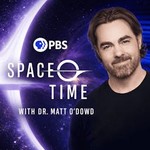
Space Time explores the outer reaches of space, the craziness of astrophysics, the possibilities of sci-fi, and anything else you can think of beyond Planet Earth with our astrophysicist host: Matthew O’Dowd.
For all business inquiries and sponsorship opportunities please reach out to: pbsspacetime@lighthouseagents.com
Matt O'Dowd spends his time studying the universe, especially really far-away things like quasars, super-massive black holes, and evolving galaxies. He uses telescopes in space to do it. Matt completed his Ph.D. at NASA's Space Telescope Science Institute, followed by work at the University of Melbourne and Columbia University. He's now a professor at the City University of New York's Lehman College and an Associate at the American Museum of Natural History's Hayden Planetarium.
Previous host Gabe Perez-Giz is an astrophysicist who studies black hole physics. He received his Ph.D. from Columbia University and also hosted PBS Infinite Series.
patreon.com/pbsspacetime
RSS
Apple
Données mises à jour le 19/10/2026
Classements récents
Dernières positions dans les classements Apple Podcasts et Spotify.
Liens partagés entre épisodes et podcasts
Liens présents dans les descriptions d'épisodes et autres podcasts les utilisant également.
The Physics of Life (ft. It's Okay to be Smart & PBS Eons!)
lundi 19 octobre 2026 • Durée 16:25
Viewers like you help make PBS (Thank you 😃) . Support your local PBS Member Station here: https://to.pbs.org/DonateSPACEUploaded 11-04-18It's OK to be Smart - Where Did Life Come From? https://youtu.be/_uAJY1mqtw4Eons - What Was the Ancestor of Everything? https://youtu.be/pk213XSSktQOur universe is prone to increasing disorder and chaos. So how did it generate the extreme complexity we see in life? Actually, the laws of physics themselves may demand it.You can further support us on Patreon at https://www.patreon.com/pbsspacetimeGet your own Space Time t-shirt at http://bit.ly/1QlzoBiTweet at us! @pbsspacetimeFacebook: facebook.com/pbsspacetimeEmail us! pbsspacetime [at] gmail [dot] comComment on Reddit: http://www.reddit.com/r/pbsspacetimeHelp translate our videos!https://www.youtube.com/timedtext_cs_panel?tab=2&c=UC7_gcs09iThXybpVgjHZ_7gPrevious Episode:The Unruh Effecthttps://www.youtube.com/watch?v=7cj6oiFDEXcHow did life begin? We can seek the answer in the chemistry of the early earth, or in the biology of the first cell. In fact our friends at PBS Eons and It’s OK to be Smart will do just that in companion videos to this one. But we all know that chemistry and biology are just applied physics. So can we approach the question of the origin and the very nature of life from the point of view of physics? We’re sure going to try.Hosted and written by Matt O'DowdProduced by Rusty WardGraphics by Grayson BlackmonAssistant Editing and Sound Design by Mike Petrow and Linda HuangMade by Kornhaber Brown (www.kornhaberbrown.com)Special thanks to our Patreon Big Bang, Quasar and Hypernova Supporters: Big BangCoolAsCatsDavid NicklasAnton LifshitsJoey RednerQuasarTambe BarsbayMayank M. MehrotaMars YenturMark RosenthalDean FuquaRoman PinchukColeslawPurdieHypernovaEdmund FokschanerMatthew O’ConnorEugene LawsonBarry HatfieldMartha HuntJoseph SalomoneChuck ZegarJordan YoungRatfeastJohn HofmannCraig PetersonThanks to our Patreon Gamma Ray Burst Supporters: James HughesFabian OlesenKris FernetJane MeyersJames FlowersGreg AllenTJMadisonDenys IvanovNick VirtueAlexey EromenkoNicholas RoseScott GossettMark VasilePatrick MurraySultan AlkhulaifiAlex SetoMichal-Peanut KarmiErik SteinKevin WarneJJ BagnellJ RejcAvi GoldfingerJohn PettitFlorian StinglmayrBenoit Pagé-GuitardNathan LenizBrandon LabonteDavid CraneGreg Weiss Learn more about your ad choices. Visit megaphone.fm/adchoices
Learn more about your ad choices. Visit megaphone.fm/adchoices
Mapping the Multiverse
lundi 19 octobre 2026 • Durée 20:26
PBS Member Stations rely on viewers like you. To support your local station, go to: http://to.pbs.org/DonateSPACE↓ More info below ↓Uploaded 18-05-20Sign Up on Patreon to get access to the Space Time Discord! https://www.patreon.com/pbsspacetimeCheck out the Space Time Merch Storehttps://pbsspacetime.com/Sign up for the mailing list to get episode notifications and hear special announcements!https://mailchi.mp/1a6eb8f2717d/spacetimeThis is a map of the multiverse. Or in physics-ese, it’s the maximally extended Penrose diagram of a Kerr spacetime. And in english: when you solve Einstein’s equations of general relativity for a rotating black hole, the universe does not come to an abrupt halt at the bottom of the gravitational pit. Instead, a path can be traced out again but you do not end up in the universe that you started in. Like I said, it’s a map of the multiverse.Hosted by Matt O'DowdWritten by Matt O'DowdGraphics by Leonardo Scholzer, Yago Ballarini, and Pedro OsinskiDirected by: Andrew KornhaberCamera Operator: Bahaar GholipourExecutive Producers: Eric Brown and Andrew KornhaberEnd Credits Music by J.R.S. Schattenberg: https://www.youtube.com/channel/UCRl6-nb4iOnsij-vnpAjp0Q#space #astrophysics #multiverseSpecial Thanks to Our Patreon SupportersBig Bang SupportersAlexander TamasDavid NicklasFabrice EapJuan BenetMorgan HoughRadu NegulescuQuasar SupportersChristina OegrenMark HeisingVinnie FalcoHypernova Supporterswilliam bryanchuck zegarDanton SpiveyDonal BotkinEdmund FokschanerHank SJohn HofmannJohn PollockJohn R. SlavikJordan YoungJoseph SalomoneJulian TyackeMathewMatthew O'ConnorSyed AnsarTimothy McCullochGamma Ray Burst SupportersA GAdrian HatchAlecZeroAndreas NautschAndrew RichmondBradley JenkinsBrandon labonteBrandon LattinBrian BlanchardCass CostelloCraig StonahaDan WarrenDaniel LyonsDavid BethalaDavid HughesDFaulkEric KieblerFrederic SimonGeoffrey ShortGraydon GossGreg SmithJennifer CrosleyJohn FunaiJohn RobinsonJosh ThomasJustin WatersKevin LeeKevin WarneKyle HoferMalte UblMark Daniel CohenMichael ConroyMirik GogriNick VirtueNick WrightNickolas Andrew FreemanOliver and Kiersten ThammPatrick SuttonPaul RoseProtius ProtiusRobert IlardiScott GossettSean WarniahaShane CalimlimSimon OliphantSteve BradshawTatiana VorovchenkoTim StephaniTonyfaceTybie FitzhughYannick WeynsYurii Konovaliuk Learn more about your ad choices. Visit megaphone.fm/adchoices
Learn more about your ad choices. Visit megaphone.fm/adchoices
How to Communicate Across the Quantum Multiverse
lundi 19 octobre 2026 • Durée 22:45
Check Out Megawow on PBS Kids: https://youtu.be/meU4f31gqYI Uploaded 10-08-21In the Many Worlds interpretation of quantum mechanics, the universal wavefunction is the reality, encompassing all possible histories and futures and all exist. But we are only sensitive to a slice of the wavefunction corresponding to our “world”, and due to the superposition principle our world can happily do its thing unperturbed by other parts of the wavefunction - other “ripples,” or worlds. And while it may seem like it would be physically impossible to have any connection between worlds, it may turn out to be entirely possible to communicate between them. More About Steven Weinberg: https://www.scientificamerican.com/article/learning-to-live-in-steven-weinbergs-pointless-universe/Sign Up on Patreon to get access to the Space Time Discord!https://www.patreon.com/pbsspacetimeCheck out the Space Time Merch Storehttps://www.pbsspacetime.com/shopSign up for the mailing list to get episode notifications and hear special announcements!https://mailchi.mp/1a6eb8f2717d/spacetimeHosted by Matt O'DowdWritten by Matt O'Dowd Graphics by Leonardo Scholzer, Yago Ballarini, Pedro Osinski, Adriano Leal and Stephanie FariaDirected by Andrew KornhaberAssistant Producer: Setare GholipourExecutive Producers: Eric Brown and Andrew KornhaberEnd Credits Music by J.R.S. Schattenberg: https://www.youtube.com/user/MultiDroidekaSpecial Thanks to Our Patreon SupportersBIg Bang SponsorsKyle BullochAnanth RaoCharlieMrs. Tiffany PoindexterLeo KoguanSandy WuMatthew MillerScott GrayAhmad JodehAlexander TamasMorgan HoughJuan BenetVinnie FalcoFabrice EapMark RosenthalDavid NicklasQuasar SupportersEthan CohenStephen WilcoxChristina OegrenMark HeisingHank SHypernova Supporterswilliam bryanKaci ParkerdrollereJoe MoreiraMarc ArmstrongElizabeth SmithScott GorlickNick BerardPaul Stehr-GreenMuON MarketingRussell PopeBen DeloNicholas NewlinDrJYouАнтон КочковJohn R. SlavikMathewDanton SpiveyDonal BotkinJohn PollockEdmund FokschanerJoseph SalomoneMatthew O'Connorchuck zegarJordan Youngm0nkJohn HofmannDaniel MuzquizTimothy McCullochGamma Ray Burst SupportersAndre StechertRoss BohnerFarhan WaliPaul WoodKent Durhamjim bartoshNubbleChris NavridesScott R CalkinsCarl ScaggsG MackThe Mad MechanicEllis HallJohn H. Austin, Jr.Diana SBen CampbellLawrence Tholl, DVMFaraz KhanAlmog CohenAlex EdwardsÁdám KettingerMD3Endre PechDaniel JenningsCameron SampsonPratik MukherjeeGeoffrey ClarionNateAdrian PosorDarren DuncanRuss CreechJeremy ReedEric WebsterSteven SartoreDavid JohnstonJ. KingMichael BartonChristopher BarronJames RamseyJustin JermynMr TAndrew MannJeremiah JohnsonPeter MertzIsaac SuttellDevon RosenthalOliver FlanaganBleys GoodsonRobert WalterBruce BIsmael MontecelSimon OliphantMirik GogriMark Daniel CohenBrandon LattinNickolas Andrew FreemanProtius ProtiusShane CalimlimTybie FitzhughRobert IlardiEric KieblerCraig StonahaMartin SkansMichael ConroyGraydon GossFrederic SimonTonyfaceJohn RobinsonA GKevin LeeAdrian HatchYurii KonovaliukJohn FunaiCass CostelloTristan DelocheBradley JenkinsKyle HoferDaniel StříbrnýLuaanAlecZeroVlad ShipulinCodyMalte UblKing ZeckendorffNick VirtueScott GossettDan WarrenPatrick SuttonJohn GriffithDaniel LyonsJulien DuboisDFaulkGrowingVioletKevin WarneAndreas NautschBrandon labonte Learn more about your ad choices. Visit megaphone.fm/adchoices
Learn more about your ad choices. Visit megaphone.fm/adchoices
Understanding the Uncertainty Principle with Quantum Fourier Series | Space Time
lundi 19 octobre 2026 • Durée 17:33
Viewers like you help make PBS (Thank you 😃) . Support your local PBS Member Station here: https://to.pbs.org/DonateSPACEUploaded 06-12-17Sometimes intuitive, large-scale phenomena can give us incredible insights into the extremely unintuitive world of quantum mechanics. Sign up for your free trial of The Great Courses Plus at http://ow.ly/HAvT30beNAjToday the humble sound wave is going to open the door to really understanding Heisenberg’s uncertainty principle, and, ultimately quantum fields and Hawking radiation.You can further support us on Patreon at https://www.patreon.com/pbsspacetimeGet your own Space Time tshirt at http://bit.ly/1QlzoBiTweet at us! @pbsspacetimeFacebook: facebook.com/pbsspacetimeEmail us! pbsspacetime [at] gmail [dot] comComment on Reddit: http://www.reddit.com/r/pbsspacetimeHelp translate our videos!https://www.youtube.com/timedtext_cs_panel?tab=2&c=UC7_gcs09iThXybpVgjHZ_7gPrevious Episode:Citizen Science + Zero-Point Challenge Answer | Space Timehttps://www.youtube.com/watch?v=tFB8MsizvBcOne of the most difficult ideas to swallow in quantum mechanics is Werner Heisenberg’s famous uncertainty principle. It expresses the fundamental limit on the knowability of our universe. We’ve discussed it in our early videos on quantum mechanics, but it’s time we looked a little deeper. See, the apparent weirdness of the uncertainty principle hints at the even weirder underlying reality that gives rise to it. The universe we experience seems to be constructed of singular particles with well-defined properties. But this intuitive, mechanical reality is emergent from underlying reality in which the particles that form matter arise from of the combination of an infinity of possible properties. And forget matter - the vacuum itself is the sum of infinite possible particles. If we fully unravel this idea we’ll be on the verge of tackling things like Hawking radiation. But as you’ll see today, in that unraveling we are led, unavoidably, to Heisenberg’s uncertainty principle.Hosted by Matt O'DowdWritten by Graeme Gossel and Matt O'DowdProduced by Rusty WardGraphics by Kurt RossAssistant Editing and Sound Design by Mike PetrowMade by Kornhaber Brown (www.kornhaberbrown.com)Special thanks to our Patreon Big Bang, Quasar and Hypernova Supporters: Big BangCoolAsCatsDavid NicklasWilliam James SidisQuasarTambe BarsbayMayank M. MehrotaMars YenturMark RosenthalDean FuquaY2Justin LloydTambe BarsbayHypernovaEdmund FokschanerMax LevineMatthew O’ConnorEugene LawsonMartha HuntJoseph SalomoneChuck ZegarJordan YoungRatfeastJohn HofmannThanks to our Patreon Gamma Ray Burst Supporters: Mechanically CrypticDenys IvanovNick VirtueAlexey EromenkoNicholas RoseScott GossettMark DykstraChris HicksMark VasilePatrick MurraySultan AlkhulaifiAlex SetoMichal-Peanut KarmiErik SteinDaniel LyonsKevin WarneJJ BagnellJ RejcAmy JieAvi GoldfingerJohn PettitShannan CatalanoFlorian StiglmayrBenoit Pagé-GuitardNathan LenizJessica FraleyLoro LukicBrandon LabonteDavid CraneGreg WeissThe Great Courses Plus is currently available to watch through a web browser to almost anyone in the world and optimized for the US market. The Great Courses Plus is currently working to both optimize the product globally and accept credit card payments globally. Learn more about your ad choices. Visit megaphone.fm/adchoices
Learn more about your ad choices. Visit megaphone.fm/adchoices
Viewers like you help make PBS (Thank you 😃) . Support your local PBS Member Station here: https://to.pbs.org/DonateSPACEUploaded 04-10-17So what happens when two Super Massive Black Holes collide? We may be about to find out, because astronomers have spotted a pair of them in a close binary orbit for the very first time. This episode of Space Time Journal Club discusses:"A candidate sub-parsec binary black hole in the Seyfert galaxy NGC 7674", Kharb, Lal and Merritt 2017https://arxiv.org/abs/1709.06258You can further support us on Patreon at https://www.patreon.com/pbsspacetimeGet your own Space Time tshirt at http://bit.ly/1QlzoBiTweet at us! @pbsspacetimeFacebook: facebook.com/pbsspacetimeEmail us! pbsspacetime [at] gmail [dot] comComment on Reddit: http://www.reddit.com/r/pbsspacetimeHelp translate our videos! https://www.youtube.com/timedtext_cs_panel?tab=2&c=UC7_gcs09iThXybpVgjHZ_7gPrevious Episode:Are the Fundamental Constants changing?https://www.youtube.com/watch?v=YJzoelANL_Y&t=8sRelated Episodes:How to Build a Black Holehttps://www.youtube.com/watch?v=xx4562gesw0Why Quasars are so Awesomehttps://www.youtube.com/watch?v=3TZEp_n3eIcLinks to Comments Response:Nevermindhttps://www.youtube.com/watch?v=YJzoelANL_Y&lc=z223hpipuozhh1qbj04t1aokgn5pfpqlq0zgbnrilm5obk0h00410Lutra Nereishttps://www.youtube.com/watch?v=YJzoelANL_Y&lc=z22cwtzjvv3ojx0ucacdp430ixcyhmpsu1ahlosnyedw03c010cArnaldo Castrohttps://www.youtube.com/watch?v=YJzoelANL_Y&lc=z22txnyo1lnwh1j03acdp430bunzm5m4x3xf5jwx0xxw03c010c0xFFF1https://www.youtube.com/watch?v=YJzoelANL_Y&lc=z23sjnwjrwnljxe3macdp434i1lxdqjdsvf2ovd3r41w03c010cWispXLegendhttps://www.youtube.com/watch?v=YJzoelANL_Y&lc=z22rivtz4oz2db4kmacdp431v2mactt0223icalvag1w03c010cRubbergnomehttps://www.youtube.com/watch?v=YJzoelANL_Y&lc=z22phdvhwsyehtjxe04t1aokg3gkri0vdluvsttfuju0bk0h00410In this video, we discuss the reports about the detection of a pair of supermassive black holes orbiting only one light year apart from each other. Studying the dance of these giants should tell us a ton about how black holes grow. This paper was just published in Nature Astronomy by Preeti Kharb and Dharam Vir Lal from India’s National Center for Radio Astrophysics, and David Merritt from the Rochester Institute of Technology.Written and Hosted by Matt O'DowdProduced by Rusty WardGraphics by Kurt RossAssistant Editing and Sound Design by Mike PetrowMade by Kornhaber Brown (www.kornhaberbrown.com)Special thanks to our Patreon Big Bang, Quasar and Hypernova Supporters: Big BangBITISMCoolAsCatsDavid NicklasRichard SenegorQuasarTambe BarsbayMayank M. MehrotaMars YenturMark RosenthalDean FuquaY2Justin LloydHypernovaEdmund FokschanerMax LevineMatthew O’ConnorEugene LawsonBarry HatfieldMartha HuntJoseph SalomoneChuck ZegarCraig PetersonJordan YoungRatfeastJohn HofmannThanks to our Patreon Gamma Ray Burst Supporters: Nick VirtueAlexey EromenkoNicholas RoseScott GossettMark DykstraPeter DurocherMichael KersChris HicksMark VasilePatrick MurraySultan AlkhulaifiAlex SetoMichal-Peanut KarmiErik SteinDaniel LyonsKevin WarneJJ BagnellJ RejcAmy JieAvi GoldfingerJohn PettitShannan CatalanoFlorian StinglmayrYubo DuBenoit Pagé-GuitardNathan LenizJessica FraleyLoro LukicBrandon LabonteDavid CraneGreg Weiss Learn more about your ad choices. Visit megaphone.fm/adchoices
Learn more about your ad choices. Visit megaphone.fm/adchoices
PBS Member Stations rely on viewers like you. To support your local station, go to: http://to.pbs.org/DonateSPACE↓ More info below ↓Uploaded 05-10-20Check Out Overview of PBS Terra: https://bit.ly/33otrUnIf you rank the most habitable places in our solar system Venus lands pretty low, with surface temperatures hot enough to melt lead and sulphuric acid rain. And yet it may have just jumped to the front of the pack. In fact, we may have detected the signature of alien life - Venusian life -for the first time.Sign Up on Patreon to get access to the Space Time Discord! https://www.patreon.com/pbsspacetimeCheck out the Space Time Merch Storehttps://pbsspacetime.com/Sign up for the mailing list to get episode notifications and hear special announcements!https://mailchi.mp/1a6eb8f2717d/spacetimeHosted by Matt O'DowdWritten by Matt O'DowdGraphics by Leonardo Scholzer, Yago Ballarini, and Pedro OsinskiDirected by: Andrew KornhaberCamera Operator: Setare GholipourExecutive Producers: Eric Brown and Andrew KornhaberEnd Credits Music by J.R.S. Schattenberg: https://www.youtube.com/channel/UCRl6-nb4iOnsij-vnpAjp0QSpecial Thanks to All our Supporters on Patreon!Big BangBrodie RaoScott GrayRobert DoxtatorAhmad JodehCaed AldwychRadu NegulescuAlexander TamasMorgan HoughJuan BenetFabrice EapMark RosenthalDavid NicklasQuasarAlec S-LChristina OegrenMark HeisingVinnie FalcoHypernovaLucas MorganWilliam BryanMark Matthew BoskoJustin JermynJason FinnАнтон КочковJulian TyackeSyed AnsarJohn R. SlavikMathewDanton SpiveyDonal BotkinJohn PollockEdmund FokschanerJoseph SalomoneMatthew O'ConnorChuck ZegarJordan YoungHank SJohn HofmannTimothy McCullochGamma Ray BurstSean WarniahaTonyfaceJohn RobinsonA GKevin LeeAdrian HatchYurii KonovaliukJohn FunaiCass CostelloGeoffrey ShortBradley JenkinsKyle HoferTim StephaniLuaanAlecZeroMalte UblNick VirtueScott GossettDavid BethalaDan WarrenPatrick SuttonJohn GriffithDaniel LyonsJosh ThomasDFaulkKevin WarneAndreas NautschBrandon labonteLucas Morgan Learn more about your ad choices. Visit megaphone.fm/adchoices
Learn more about your ad choices. Visit megaphone.fm/adchoices
Why Is 1/137 One of the Biggest Unsolved Mysteries In Physics?
Découvrez des podcasts liées à PBS Space Time. Explorez des podcasts avec des thèmes, sujets, et formats similaires. Ces similarités sont calculées grâce à des données tangibles, pas d'extrapolations !