Particles of Thought – Détails, épisodes et analyse
Détails du podcast
Informations techniques et générales issues du flux RSS du podcast.
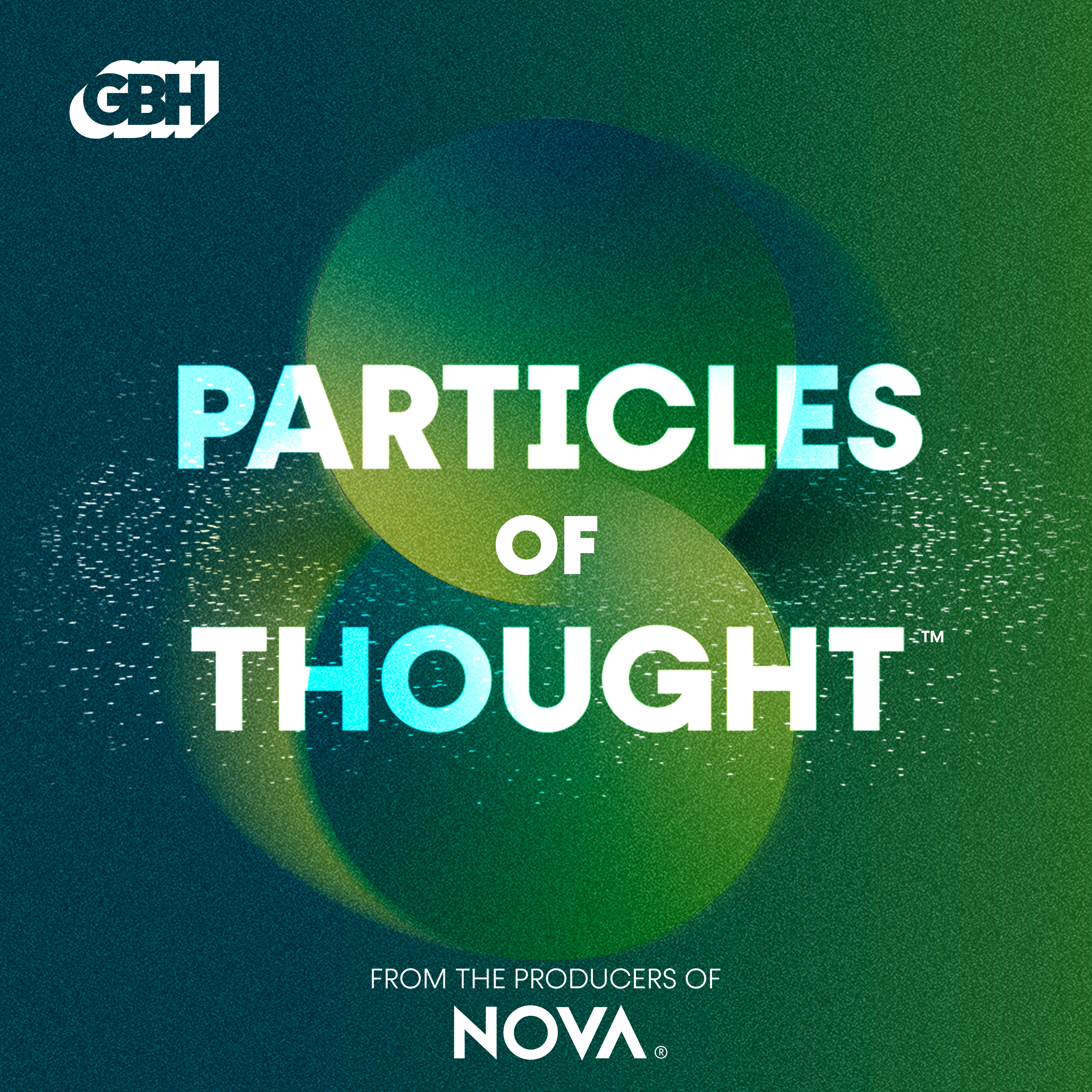

Particles of Thought from the producers of NOVA unleashes the universe's biggest questions through the lens of astrophysicist Hakeem Oluseyi and the world's most brilliant scientific minds. Should we resurrect extinct species? Are we blind to a fundamental force of nature? What secrets do ancient fossils reveal about humanity's destiny? Across 10 mind-bending episodes, each conversation dives deep into the discoveries that shatter assumptions, spark wonder, and completely transform how you understand reality.
Classements récents
Dernières positions dans les classements Apple Podcasts et Spotify.
Apple Podcasts
🇺🇸 États-Unis - science
02/05/2026#96🇺🇸 États-Unis - science
01/05/2026#90🇺🇸 États-Unis - science
06/02/2026#99🇺🇸 États-Unis - science
05/02/2026#83🇨🇦 Canada - science
08/01/2026#84🇺🇸 États-Unis - science
25/12/2025#95🇺🇸 États-Unis - science
23/12/2025#85🇺🇸 États-Unis - science
22/12/2025#88🇺🇸 États-Unis - science
21/12/2025#74🇨🇦 Canada - science
20/12/2025#93
Spotify
Aucun classement récent disponible
Liens partagés entre épisodes et podcasts
Liens présents dans les descriptions d'épisodes et autres podcasts les utilisant également.
See all- https://www.pbs.org/wgbh/nova/
129 partages

Qualité et score du flux RSS
Évaluation technique de la qualité et de la structure du flux RSS.
See allScore global : 84%
Historique des publications
Répartition mensuelle des publications d'épisodes au fil des années.
Introducing Particles of Thought
Saison 4
mardi 12 août 2025 • Durée 01:35
What happens when brilliant minds collide? In Particles of Thought, astrophysicist Hakeem Oluseyi is obsessed with understanding not just what the world's greatest scientists know, but how they think. From quantum mechanics clashing with general relativity to fossil memories written in ancient rocks, each conversation captures those electrifying moments when curiosity sparks new understanding. Join Hakeem as he explores the downright bizarre, the subatomic, and the furthest reaches of the universe through the minds that dare to question everything.
Subscribe to our YouTube channel for more content and exclusive videos.
Deepfake Detection and the Future of AI with Hany Farid
Saison 4 · Épisode 2
mardi 26 août 2025 • Durée 01:24:20
In a world flooded with fake images, manipulated videos, and AI-generated voices, how do we know what’s real anymore? Hany Farid has made it his mission to find out. A leading voice in AI research and digital forensics, Hany works to authenticate digital media and expose the fakes. In this episode, Hakeem and Hany dive into how we got here. How does AI really work? How are deepfakes detected? And what does the future hold for truth in the digital age? Plus, Hakeem puts Hany to the test: can he tell the difference between real and AI-generated headlines? And can Hakeem tell a deepfake version of Hany from the real thing?
Subscribe to our YouTube channel for more content and exclusive videos.
--------------------------
Guest Bio:
Hany Farid is a Professor at the UC Berkeley School of Information. In addition to teaching at UC Berkeley, Hany is Chief Science Officer at GetReal Security, a company that focuses on the authentication of digital media. His research focuses on digital forensics, forensic science, misinformation, image analysis, and human perception. He has published dozens of papers on how humans relate to AI and technology.
Timestamps
(00:00:00) Introduction
(00:06:06) What is Artificial Intelligence?
(00:11:47) What are Deepfakes and How Are They Made?
(00:19:30) Can You Detect a Deepfake?
(00:38:51) Will AI Take Away Our Jobs?
(00:52:00) The Concerns of AI
(01:08:19) What Does the Future of AI Look Like?
(01:25:03) Credits
Fossil Hunting, Sinkholes, and Paleobotany with Kirk Johnson
Saison 4 · Épisode 1
mardi 26 août 2025 • Durée 01:36:35
What do fossilized leaves, an asteroid, and Florida sinkholes have in common? Dr. Kirk Johnson oversees one of the largest natural history collections on the planet, and he has the answers. He’s spent his career digging into the story of life on Earth across millions (and billions) of years. In this episode, Hakeem and Kirk explore the science of “deep time,” how fossils actually form, and the surprising origins of Earth’s oceans. Plus, Kirk shares some hot tips on fossil hunting and how to count the number of leaves on a tree … because you never know when you might need these skills.
Subscribe to our YouTube channel for more content and exclusive videos.
--------------------------
Guest Bio:
Dr. Kirk Johnson is Sant Director at the Smithsonian Institution, National Museum of Natural History, home to one of the largest natural history collections in the world. A paleobotanist by training, his research explores ancient climates and extinct ecosystems through the study of fossil plants. He has authored more than a dozen books on paleontology and natural history and has traveled extensively in search of fossils on every continent. As a science communicator, Dr. Johnson has brought the natural world to millions through hosting acclaimed NOVA documentaries such as Polar Extremes and Making North America, blending deep scientific expertise with an engaging, accessible storytelling style.
Timestamps
(0:00:00) Introduction
(00:01:32) What is Paleobotany?
(00:03:36) How Do Fossils Form?
(00:10:02) The Bennu Asteroid Sample
(00:17:57) Early Earth: Evolution and Extinction
(00:41:58) Trees and Fossil Leaves
(01:06:53) Fossil Reefs and Sinkhole Formation
(01:15:53) Excavating Teen Rex
(01:25:46) What Does the Future of Earth Look Like?
(01:37:19) Credits
A Missing Law of Nature with Bob Hazen and Mike Wong
Saison 4 · Épisode 4
mardi 23 septembre 2025 • Durée 01:10:44
The universe loves making things complicated. From minerals and microbes to languages and societies, complexity keeps showing up — but why? Astrobiologist Mike Wong and mineralogist Bob Hazen think we’re missing a law of nature to explain this phenomenon. Hakeem sits down with them to understand – and kick the tires on – their bold new idea: what they call a Law of Increasing Functional Information. They break down how it works, why it matters, and how it could reshape our understanding of everything from life to language to the universe itself.
Learn more about NOVA and subscribe to our YouTube channel.
--------------------------
Guest Bios:
Robert Hazen is a mineralogist and astrobiologist at Carnegie Science and George Mason University. His pioneering research explores the origins of life and the evolving diversity of minerals on Earth. A prolific author and public communicator, Hazen has written widely on science, complexity, and the deep connections between the physical and biological worlds.
Mike Wong is an astrobiologist and planetary scientist at Carnegie Science whose work focuses on how life begins and evolves on worlds like our own. He is also a science communicator, hosting the podcast Strange New Worlds, where he brings complex cosmic ideas to broad audiences. Wong’s research and outreach bridge cutting-edge science with big-picture questions about life in the universe.
Their new book Time's Second Arrow: Evolution, Order, and a New Law of Nature will be available in February 2026.
Timestamps
(00:00:00) Introduction
(00:05:28) Laying Out the "Law of Increasing Functional Information"
(00:22:50) Functional Information: Explained
(00:30:17) What is Selection? Discussing the Law
(00:51:34) Testing the New Law
(01:11:24) Credits
Black Holes and Quantum Weirdness with Janna Levin
Saison 4 · Épisode 3
mardi 9 septembre 2025 • Durée 01:19:12
Black holes get a bad rap. They’ve been cast as the monsters of the cosmos — gobbling up stars and stretching anything that gets too close into cosmic spaghetti. But Black Hole expert Janna Levin has spent her career decoding these mysterious objects, and she thinks they’re just misunderstood. In this episode, she dives into the strange physics of black holes: what they are, what they sound like, what happens if you fall into one, and how there’s a lighter side to every black hole. Janna shares why black holes might not be the end of everything — but the beginning of something even weirder.
Learn more about NOVA and subscribe to our YouTube channel.
--------------------------
Guest Bio:
Janna Levin is a professor of physics and astronomy at Barnard College of Columbia University, where she explores the profound mysteries of black holes, cosmology, and the nature of the universe. She is also the founding scientific director of Pioneer Works, a nonprofit cultural center in Brooklyn that fosters collaboration across science, art, and education. An award-winning author and renowned science communicator, Levin has written several acclaimed books, including Black Hole Blues and Other Songs from Outer Space, and has spent her career making the strange and beautiful realities of the cosmos accessible to a wide audience. She is host of NOVA’s two-part special Black Hole Apocalypse.
Timestamps
(00:00:00) Introduction
(00:04:12) Black Holes Get a Bad Rap
(00:09:08) Gravity and Free Fall
(00:12:04) Black Holes 101
(00:14:48) Warping Space Time
(00:21:25) Is the Universe a Black Hole?
(00:23:33) This Is the Century for Black Hole Discoveries
(00:25:53) Ligo & Gravitational Waves
(00:39:55) Black Holes Are Hairless
(00:47:50) 2 Truths & a Lie, Black Hole Edition
(00:52:35) Hawking Radiation
(00:58:11) Black Holes Can Be Bigger on the Inside Than the Outside
(01:01:15) Holography and Black Hole Information Paradox
(01:04:57) Quantum Entanglement
(01:12:30) Black Holes Helping to Understand Fundamental Laws of the Universe
(01:16:27) Extra Dimensions
(01:20:01) Credits
Neuroscience of Consciousness, Personality, and Creativity with Heather Berlin
Saison 4 · Épisode 5
mardi 7 octobre 2025 • Durée 01:28:09
Your brain does all kinds of strange things — and neuroscientist Heather Berlin wants to explain how it works. In this episode, she joins Hakeem to explore the mysteries of the mind: how consciousness works, how your brain constructs reality, and how you might be able to hack it to live a better life. They dive into the effects of psychedelics and meditation, and explore the future of thought in a world shaped by AI. This episode is no placebo – it really will expand your mind.
Learn more about NOVA and subscribe to our YouTube channel.
--------------------------
Guest Bio:
Heather Berlin is a neuroscientist, clinical psychologist, and associate clinical professor of psychiatry and neuroscience at the Icahn School of Medicine at Mount Sinai in New York. She is interested in how consciousness and creativity work within the brain and is also the host of NOVA’s "Your Brain" two-part special.
Timestamps
(00:00:00) What is Consciousness?
(00:09:38) Perception Box
(00:22:18) What's My Brain Doing? Deja Vu, Goosebumps & More
(00:34:45) Cognitive Behavioral Therapy & Ketamine Treatment
(00:44:55) Thoughts and Creative Flow States
(00:58:02) Aversive Conditioning: Addiction, Anxiety, and Behavior
(01:08:06) Fame & Fulfillment
(01:18:02) The Future of Neuroscience
(01:29:09) Credits
Bird Song and the Evolution of Language with Erich Jarvis
Saison 4 · Épisode 6
mardi 21 octobre 2025 • Durée 01:03:01
Talking, singing, even dancing — they all trace back to a rare superpower: vocal learning. But humans aren’t the only animals that have it. Neuroscientist Erich Jarvis has spent his career decoding the mysterious ability to imitate sounds, a key ingredient in spoken language. In this episode, he joins Hakeem to explore why only a handful of species — like parrots, dolphins, and bats — can do it, how it evolved, and what it reveals about the brain, consciousness, and culture. Plus, Erich shares how AI is helping decode animal communication and why engineering our pets to talk might actually be possible… but could fundamentally change the way they think.
Learn more about NOVA and subscribe to our YouTube channel.
—————————
Guest Bio:
Erich Jarvis is a neuroscientist investigating the mysteries of speech and vocal learning through groundbreaking research on birdsong and brain evolution. As a professor at The Rockefeller University and head of the Jarvis Lab, he explores how complex behaviors like human language arise from brain circuits and genetic pathways. Jarvis was also profiled in NOVA Wonders: What are Animals Saying.
Timestamps
(00:00:00) Language in Animals vs. Humans
(00:10:37) Music and Vocal Learning
(00:20:15) Can You Genetically Engineer Animals to Speak?
(00:27:48) How Did Speech Evolve?
(00:36:09) Can We Translate Animal Language?
(00:42:27) Brain Size and Speech
(00:48:14) Writing & Symbolic Communication
(00:57:00) Conclusion
(01:04:02) Credits
Extremophiles, the Deep Sea, and Alien Life with Peter Girguis
Saison 4 · Épisode 7
lundi 3 novembre 2025 • Durée 01:10:26
What do deep-sea microbes and Martian “leopard spots” have in common? Marine biologist Peter Girguis thinks they might both hold clues to finding life beyond Earth. In this episode, he joins Hakeem for a journey from the ocean floor to outer space, sharing stories from his dives aboard the Alvin submersible and exploring how Earth’s most extreme lifeforms could help us find the first ETs. Along the way, he explains how Earth is truly a microbial planet — teeming with enough microbes to stretch across the galaxy – reshaping how we think about life, both here and out there.
Learn more about NOVA and subscribe to our YouTube channel.
—————————
Guest Bio:
Peter Girguis is a professor of Organismic and Evolutionary Biology at Harvard University. His research focuses on marine organisms, and how they adapt to extreme environments. He also works on developing novel technologies like deep sea autonomous laboratories and microbial fuel cells. Girguis appears in NOVA’s Ancient Earth series
Timestamps
(00:00:00) Microbes Rule the Planet
(00:13:45) Deep Ocean Exploration
(00:36:30) Signs of Life on Mars
(00:54:18) Other Life in Outer Space
(01:01:23) Two Truths and a Lie: Science Headlines
(01:07:00) The Future of Working With Microbes
(01:11:22) Credits
How to Detect Deepfakes: Recognizing AI-Generated Content | Hany Farid
Saison 4
mercredi 5 novembre 2025 • Durée 13:42
In a world flooded with fake videos and voice recordings that seem real, how can you detect deepfakes? Turns out, there are some aspects of the physical world that are not yet known to artificial intelligence - and those gaps are the key. Expert Hany Farid reveals techniques that can be used to detect AI-generated media.
For more, check out the extended interview with Hany Farid.
Sinkholes in Florida Reveal Amazing Fossils | Kirk Johnson
Saison 4
jeudi 6 novembre 2025 • Durée 07:10
A sinkhole can become a time capsule full of skeletons - layers upon layers of beasts that once walked the Earth - and Florida’s landscape is full of them. Discover the surprising science of how Florida’s sinkholes form, what they really are, and what can be found inside them. Come along with Dr. Kirk Johnson, Sant Director of the Smithsonian Institution National Museum of Natural History, as he describes what he calls "the best sinkhole experience
For more, check out the extended interview with Kirk Johnson.
Podcasts Similaires Basées sur le Contenu