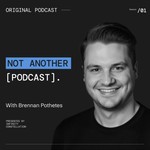
Hey, I’m Brennan Pothetes. I’ve raised millions, burned out hard, and learned that most startup advice is toxic BS. Hustle culture isn’t a superpower. It’s a fast track to burnout.
So I’m starting Not Another Podcast. Each episode, I’m doing something fun, like building Legos or cooking spaghetti, while having raw, honest convos with founders.
It’s part therapy, part teardown. All real talk.
If you’re done with the hype and want sustainable success, this is for you.
Site
RSS
Apple
Données mises à jour le 14/07/2026
Classements récents
Dernières positions dans les classements Apple Podcasts et Spotify.
Liens partagés entre épisodes et podcasts
Liens présents dans les descriptions d'épisodes et autres podcasts les utilisant également.
Découvrez des podcasts liées à Not Another Podcast. Explorez des podcasts avec des thèmes, sujets, et formats similaires. Ces similarités sont calculées grâce à des données tangibles, pas d'extrapolations !
Building for Humans in a World Obsessed with Data with Nathan Stoll
mardi 17 février 2026 • Durée 01:14:42
Nathan Stoll helped build the modern internet. Literally. He was an early product manager at Google before the IPO. He worked on the systems that powered Google’s ad revenue. He helped scale Google News globally. He even launched Google Suggest: the autocomplete feature billions of people use every day.
And yet… this conversation wasn’t really about tech.
Nathan has built and sold two companies (to Google and Walmart), led product at places like Strava and Handshake, and advised founders for decades. But what he’s thinking about now is deeply counter-cultural in Silicon Valley:
Why emotions, intuition, and human connection matter more than dashboards, models, and optimization.
In this episode of Not Another Podcast, we go deep on the human side of building, the part most founders feel but rarely talk about.
We talk about:
• Why feelings often beat data when making the hardest decisions
• How human networks compound faster than code
• What elite athletics taught Nathan about burnout, pacing, and long-term performance
• Why some of the best founders choose to be less public, not more
• How AI is accelerating faster than our ability to emotionally process it
• The difference between optimizing for conversion vs. optimizing for fulfillment
• Why listening is still the most underrated leadership skill
Nathan also shares deeply personal stories about mentorship, small acts of kindness that changed his life, parenting while building, and why being a “whole human” makes you a better founder.
This is a conversation about building things that last without losing yourself in the process.
🎧 Listen now wherever you get your podcasts.
What Founders Get Wrong About Attention, Press, and Power with Alex Konrad @ Upstarts
mardi 3 février 2026 • Durée 01:05:34
After 12 years at Forbes, Alex Konrad walked away from one of the most prestigious seats in tech journalism. He ran the Midas List. Co-created the Cloud 100. Wrote cover stories on the biggest names in tech.
And then he left… to build his own media company from scratch.
In this episode, Alex joins me to talk about what happens when you go from covering founders to being one. We get honest about entrepreneurship, attention, media, and why so much of what we glorify in startup culture doesn’t line up with reality.
This conversation isn’t about hype cycles or hot takes. It’s about the actual work.
We talk about why the word “founder” is often over-romanticized, why running a small business deserves more respect than it gets, and why most people misunderstand how press, attention, and storytelling really work. Alex also breaks down what founders consistently get wrong when pitching media, why “nobody cares” is the correct starting assumption, and how to reverse-engineer coverage that actually leads to real outcomes.
If you’re building something in public, thinking about your relationship with attention, or trying to create work that actually holds weight over time, this episode will reframe how you think about all of it.
We cover:• Why entrepreneurship is wildly over-glamorized and what the job actually is• The difference between being a “startup founder” and running a real business• Why “nobody cares” is the most useful mindset for founders and creators• How to think about press strategically instead of emotionally• Why talking to Bloomberg vs an independent outlet leads to completely different outcomes• The real reason founders think journalists are “out to get them”• How AI and content slop are forcing a return to quality and trust• Why some of the best stories look boring right before they look obvious
Why Smart Founders Still End Up Miserable, with Evan Walden
mardi 27 janvier 2026 • Durée 01:33:13
Most founders spend years asking the wrong questions. “How fast can this grow? How big could this be? What’s the smartest next move?”
But the questions that actually shape your life usually come much later… often after you’re already exhausted, anxious, or stuck on a path that doesn’t feel right anymore.
In this episode of Not Another Podcast, Brennan sits down with Evan Walden, CEO and co-founder of Getro (recently acquired by Findem), for a grounded, deeply human conversation about what it really means to build something over the long term.
Evan has spent nearly a decade building companies, mentoring founders, and watching smart, capable people quietly struggle. This isn’t because they weren’t talented, but because they never stopped to ask what they were actually trying to build for themselves.
This episode explores:
• Why companies don’t really die when they run out of money • The difference between keeping something alive through force and building something sustainable• How self-doubt shows up uniquely for entrepreneurs who are creating something from nothing•Why people-pleasing and external validation quietly sabotage founders• The hidden cost of hustle culture and seven-days-a-week thinking• Why taking time off is a signal of strength, not weakness• How values act as a decision-making system when everything feels ambiguous• The idea that every business starts as an art project and the moment when you have to decide what it’s becoming• How to zoom out and ask: Is this still the right thing for me to be working on?
They also talk openly about mental health, therapy, leadership, culture, and the fear many founders carry that if they step away, everything will fall apart. This conversation isn’t about one “right” way to build.
It’s about choosing a game you actually want to play and building something that fits who you are, not just who you think you’re supposed to be.
The Physical AI Revolution: Why Robots Will Matter More Than Chatbots with Anto Patrex
mardi 20 janvier 2026 • Durée 53:11
Most of the AI world is obsessed with chatbots, agents, and software abstractions. Anto Patrex thinks that’s a distraction.
Anto is the founder and CEO of CosmicBrain AI, a former NASA robotics engineer, and an early member of Elon Musk’s xAI team where he helped build Grok. In this episode of Not Another Podcast, Anto makes the case that the real AI revolution won’t live on your screen. It will walk, lift, build, and fight in the physical world. We’re talking humanoid robots today.
In this episode, we talk about why Anto left one of the most coveted roles in AI to bet on humanoid robots, why “physical AI” is advancing faster than most people realize, and how his now-viral Robot Fight Club events ended up convincing skeptical investors and enterprise leaders that robots are far more capable than they thought.
This conversation goes deep into the mechanics and implications of robotics: how robots learn by watching humans, why data and manufacturing matter more than flashy demos, and why China is currently ahead of the U.S. in the robotics race. We also unpack the long-term consequences for jobs, labor markets, national security, and why Anto believes optimism about technology is not naïve, but essential.
If you’re curious where AI is actually headed next, this episode will stretch your imagination and reset your mental model.
In this episode, we cover:
• Why physical AI is a bigger opportunity than chatbots and agents• Anto’s journey from NASA → xAI → founding CosmicBrain• What Elon Musk taught him about constraints, speed, and belief• Why Robot Fight Club wasn’t a gimmick and actually accelerated adoption• The U.S. vs China robotics race and what’s at stake• Why robots won’t kill jobs, but will radically reshape them• How humanoid robots learn skills by watching humans• What the next 5–10 years of robotics could look like
🎙️ Listen now and rethink what “AI” actually means.
Why Building a Startup Will Expose Everything You Haven’t Dealt With
And if you’re struggling, the assumption is simple: you’re not cut out for it.
In this solo Q&A episode of Not Another Podcast, Brennan Pothetes flips that narrative on its head.
After months of thoughtful DMs from founders, operators, and investors, Brennan sits down to answer the questions people usually whisper in private but rarely say out loud. Questions about anxiety, burnout, family tradeoffs, AI, ambition, and what it actually costs to build something meaningful.
This isn’t motivational fluff or hustle porn. It’s a grounded, honest conversation about what happens when you put yourself into high-pressure environments, take investor money, and try to build something that matters while still being a human.
Brennan shares personal stories from his own journey as a repeat founder, including moments he wishes he could take back, hard tradeoffs he refuses to repeat, and the frameworks he now uses to stay present, stable, and effective.
If you’ve ever wondered whether something is “wrong” with you for finding startup life hard, this episode is for you.
In this episode, Brennan covers:
• Whether startup culture creates mental illness or simply exposes what’s already there• How anxiety shows up differently in normal jobs vs hypergrowth environments• Why flow state matters more than hours worked• The real cost founders’ families quietly absorb• How to prioritize your partner and kids without tanking the business• Why stability is an underrated competitive advantage• Whether AI is making founders lazy or finally giving them leverage• The biggest mistakes Brennan would’ve avoided if today’s AI tools existed earlier• How to manage chronic anxiety without losing your edge as a founder
Why Founders Should Stop Trying to Please Everyone, with Serial Entrepreneur Dane Atkinson
mardi 6 janvier 2026 • Durée 45:11
Dane Atkinson has lived just about every version of the founder story.
He started his first company at 18. He’s been the CEO of Squarespace in its early years. He’s founded and exited multiple companies, including SumAll. He’s raised roughly $750 million across his career. He’s built businesses that employed thousands of people and created billions in equity value.
And about half of his companies didn’t work. That’s what makes this conversation different.
In this episode of Not Another Podcast, Dane and I talk about the part of founding that almost never gets discussed honestly: the psychological weight founders put on themselves, and how that weight quietly distorts decision-making, relationships, and even mental health.
We get into the illusion of obligation. The feeling that you owe investors, employees, family, or the “story” you sold an outcome you may not actually control. Dane shares deeply personal stories from early failures, from companies that raised tens of millions of dollars and struggled, and from moments where he spent years trying to “make things right” for others, only to realize how much of that pressure existed only in his own head.
In this episode, we cover:• Why founders often overestimate how much they owe investors and how that guilt hurts decision-making
• The “obligation trap” and how it keeps founders stuck on paths that no longer make sense
• How claiming product-market fit too early can socially lock you into the wrong future• What Dane learned from losing friends-and-family money early in his career• Why failure is the real education founders never get taught• How boards actually exert power, and how founders can reframe that dynamic• The role of anxiety, ADHD, and imposter syndrome in founder behavior• How nearly dying reshaped Dane’s view on ownership, leadership, and what actually mattersThis isn’t a hype episode. It’s a perspective episode. And it’s one every long-term founder should hear.
The Anti-Hype Founder: How Brandon Arvanaghi Built Meow
mardi 16 décembre 2025 • Durée 55:45
While other fintechs raised huge rounds, hired armies, and announced half-baked features, Brandon Arvanaghi built Meow into a billion-dollar business with ~12 people, no hype cycles, no vanity metrics, and a culture so high-ownership that one wrong hire can collapse the whole org.
This is not another “sort of intense” founder interview. This is a blueprint for anyone who actually wants to build a durable company and stop LARPing as a founder.
In this conversation, Brandon breaks down:
• Why one B-player can mathematically tank your entire org• How Meow out-executed much better-funded competitors by staying microscopic and savage• Why founders who rely on hype destroy their own ability to ship• How the 24-Hour No Hype Rule keeps Meow honest, fast, and impossible to ignore• Why most startup incentives mimic bureaucracy• How to build a team that works weekends voluntarily because they care, not because you demand it• Why “distribution-first” founders plateau (and “product-first” founders build empires)• How founders should think about intensity, discipline, and personal sustainability when the business takes off
If you’re tired of founder cosplay and want to hear from someone who actually executes, this episode will snap your head straight.
⏱️ TIMESTAMPS
02:18 — “We didn’t try to build a bank… but customers forced us into one.”
03:40 — The pain of building in a regulated industry
05:25 — What founders get wrong about pivots
09:03 — Why Brandon always knew Meow would be his only company
13:12 — Hiring A-players vs B-players: how one wrong hire breaks the company
How Founders Self-Sabotage: Dave Blakely on Truth, Pressure, and Leading Without Losing Yourself
mardi 9 décembre 2025 • Durée 53:53
Dave Blakely is one of the most quietly influential operators in Silicon Valley. He’s the kind of operator that founders don’t realize they’re learning from because his fingerprints are on so many iconic products, teams, and innovation programs.
For decades he helped lead IDEO, the most legendary design and innovation firm on the planet. His work there shaped billions of dollars in enterprise value and produced six patents. After IDEO, he became an Executive VP at Mach49, where he helped Global 1000 companies incubate ventures, spin out new startups, and build real innovation engines instead of theater.
Today he advises deeptech founders, Fortune 100 executives, and governments on robotics, energy systems, emerging markets, and the psychology of leadership.
And in this conversation, he dismantles one misconception after another.
A few highlights:
• Why founders fail long before the product does• How Dave spots a leader who believes their vision vs. one who’s faking conviction• Why attention, not capital, is the rarest resource in 2025• The “Five P Pyramid” he’s used to evaluate ventures for decades• How to know when you’re selling ahead vs. lying• Why some CEOs crumble at the first real setback• How great founders build real advisory circles instead of ego-stroking support groups• Why non-confrontational cultures quietly destroy companies• What meditation and boredom do for creativity in a high-velocity market• Leadership lessons from interviewing violent extremists and studying Mandela in South Africa
This episode is founder therapy disguised as a masterclass. If you’re building something ambitious, feeling pressure from your board, wrestling with anxiety, or unsure when to trust your instincts, this conversation will recalibrate you.
Timestamps
00:00 Intro: the lies founders tell
04:00 Why external validation destroys judgment
The Founder Identity Crisis: Jess Mah on Losing Everything and Starting Again
mardi 2 décembre 2025 • Durée 01:18:13
Jess Mah has one of the wildest founder journeys in Silicon Valley.
She taught herself to code at 10. Launched her first company at 11. Got into Berkeley at 16. Joined Y Combinator at 19. Landed magazine covers. Raised money. Built a company people said would “change everything.”
And then it all collapsed.
Jess ran out of money. Laid off her entire team. Fell into a long, brutal burnout that forced her to confront who she was when the hype disappeared. Most founders never talk about these moments. Jess does. Openly, fearlessly, and with a level of honesty you rarely hear from anyone who’s been placed on a pedestal that young.
And that’s what makes this conversation special.
This episode is raw, honest, energizing, and full of the kind of clarity that only comes from someone who’s lived through hype, collapse, reinvention, and purpose-driven building. Jess is one of the most multidimensional entrepreneurs I know, and I’m excited for you to hear this one.
⏱️ Timestamps
00:00 – The 996 debate and the myth of “hustle harder”
03:00 – How burnout really shows up
05:00 – Presence vs. productivity
06:00 – Meaning, fulfillment, and what we want at the end of life
08:00 – Why in-person connection still matters
09:00 – Vibes, energy, and choosing the right people
Why Patience > Funding: Lessons From Alex Matjanec, a Serial Bootstrapper
mardi 18 novembre 2025 • Durée 01:26:57
Everyone in tech talks about raising. Almost no one talks about owning.
In this episode of Not Another Podcast, Brennan Pothetes sits down with Alex Matjanec, a serial founder who built and sold multiple companies without a dollar of venture funding, to unpack what it really takes to build wealth, freedom, and meaning in a world addicted to speed.
Alex built his first startup during the 2008 financial crisis, launched a top-ranked mobile agency during the App Store boom, and now runs Wysh, a fully licensed life-insurance carrier redefining what “financial protection” means.
They get brutally honest about:
• The trade-offs of raising vs. bootstrapping• How to build a company while working full-time (without getting sued)•What it actually costs (in time and sanity) to start an insurance company• How AI is rewriting the creative and agency world• The terrifying accuracy of actuarial math (yes, insurers really can predict when you’ll die)• Why patience, timing, and ownership beat hype every time• If you’ve ever wondered how to build something real in a bubble full of noise — this episode is for you.
Timestamps
00:00 – Intro: Brennan on fatherhood and building
02:00 – Running a company while raising twins
06:00 – How fintech evolved from 2008 to now
09:00 – Crypto, smart contracts, and the insurance opportunity
13:00 – Life insurance as the most human business in finance
Listen to the full episode and let us know what resonated.
And if you enjoyed this one, subscribe for more honest conversations about building, pressure, and the unsexy parts of doing meaningful work.
This episode is a reminder that you don’t need to suffer to build something great.
You need clarity, presence, and the ability to regulate yourself under pressure.
Timestamps
00:01 – Making and losing hundreds of millions as a founder
03:10 – Early failure, friends-and-family money, and lasting shame
06:18 – The product-market fit trap and getting socially stuck
10:25 – Anxiety, ADHD, and founder neurology
14:53 – Imposter syndrome and the need to over-control
22:01 – Parenthood, mortality, and letting go of ownership
36:09 – Saying no to massive channel deals at Squarespace
44:26 – What founders actually owe investors (and what they don’t)
17:32 — Work ethic, ownership, and why 9–5 mindsets don’t survive early-stage startups
18:58 — Why B-players multiply—and how to eliminate them early
21:00 — The reality of 7-day founder workweeks (and why Meow isn’t performative about it)
23:45 — Why founders must feel customer pain themselves
31:52 — The insane expectations VCs used to have around headcount
36:17 — How founders stay sharp: routines, workouts, discipline, leverage
47:07 — The “No Hype Rule” that built Meow
50:00 — Why Meow plays a 10-year game, not a 10-week game
55:03 — Why product, not distribution, builds generational companies
58:12 — Where to find Brandon
08:30 Resilience and believing your own vision
10:30 The self-insight needed to pivot
12:00 Dave’s “truth circle” framework
18:00 The Five P Pyramid
20:00 Why POV > product
31:00 Fixing inauthentic cultures
38:00 Radical honesty in hiring
50:00 Meditation, anxiety, and creativity
53:00 Lessons from violent extremism research
55:00 Traits of world-class leaders
57:00 Closing
10:00 – Negativity, insecurity, and online projection
12:00 – Are we living through a once-in-a-generation moment
13:30 – Biotech, BCI, and the future of being human
15:00 – Emotional health, identity, and finding love
17:00 – Hobbies, flow states, and building a life outside work
19:00 – How Jess avoided being typecast as a founder
22:00 – Why mentorship is a lifelong process
24:00 – Meeting your heroes and learning from people “five levels up”
27:00 – Tough businesses and why biotech is brutal
29:00 – Reinvention and multi-industry curiosity
31:00 – Fertility, health, and the next wave of physical-world innovation
33:00 – Rare diseases, orphan drugs, and what Jess is building next
35:00 – Cancer research and “normalizing” tumors
38:00 – Longevity, clean living, microplastics
41:00 – Can humans live to 500
43:00 – China’s edge in AI and energy
45:00 – Aviation, rockets, and supersonic dreams
47:00 – Identity, judgment, and founder pressure
51:00 – Personal growth and generational trauma
54:00 – Parenting, boundaries, and becoming a better CEO
58:00 – The founder’s true journey: becoming a different version of yourself
1:02:00 – The future of education and AI tutors
1:06:00 – Nonprofits, AI leverage, and impact at scale