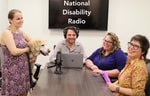
An insightful podcast by the National Disability Rights Network offering advocacy tools, heartfelt storytelling, and real-world policy insights—accessible whether you’re an advocate in the field or just someone who cares deeply about disability rights.
Site
RSS
Apple
Données mises à jour le 31/08/2026
Classements récents
Dernières positions dans les classements Apple Podcasts et Spotify.
Liens partagés entre épisodes et podcasts
Liens présents dans les descriptions d'épisodes et autres podcasts les utilisant également.
Découvrez des podcasts liées à National Disability Radio. Explorez des podcasts avec des thèmes, sujets, et formats similaires. Ces similarités sont calculées grâce à des données tangibles, pas d'extrapolations !
“I Identify as Blind” disability pride, music and unmasking with Lachi
jeudi 5 mars 2026 • Durée 42:23
On this episode of National Disability Radio, we sit down with award-winning recording artist, advocate, and author Lachi for a powerful conversation about disability pride, music, and unmasking.
Lachi shares her journey, from navigating the music industry as a blind artist, to founding RAMPD, a coalition amplifying disability culture across the industry. We talk about what it means to say “I identify as blind,” move beyond the medical and social models of disability into a cultural model rooted in identity and joy, and remind listeners that no one can defeat someone who hasn’t given up.
From glam canes to Grammy stages, this episode is about claiming space, rejecting internalized ableism, and turning perceived flaws into flexes.
Transcript:
Alden Blevins:
It’s Lachi? I feel very-
Lachi:
Lachi like Versace.
Alden Blevins:
Lachi like… Oh, I love that.
Michelle Bishop:
That is the best way to explain it.
Lachi:
I mean, but you know what I’m saying? Come on.
Alden Blevins:
Well, we’re really excited about having you today because we’re all music lovers in this group here.
Michelle Bishop:
Yes.
Alden Blevins:
We talk about music all the time.
Michelle Bishop:
So much.
Lachi:
Good, good, good, good, good, good, good. I’m in the right place.
Michelle Bishop:
Hi everyone. Welcome back to National Disability Radio, the official podcast of the National Disability Rights Network. I am Michelle Bishop, 1/3 of your podcast hosting team.
Stephanie Flynt McEben:
And I’m Stephanie Flynt McEben, public policy analyst here at NDRN.
Alden Blevins:
I am Alden. I am a communication specialist at NDRN and I am so excited today, like I mentioned, we’re all lovers of music, so we got a guest that I’m really excited about. Lachi is an award-winning recording artist and a recording Academy Grammy’s national trustee. She’s also a disability advocate who’s been breaking barriers in the music industry and beyond. She’s the founder of RAMPD, which by the way, is such a fun play name. I really love that. And the author of the upcoming book, I Identify as Blind. So without further ado, Michelle, you’ve got some questions to kick us off, I think.
Michelle Bishop:
Yes. We’re so excited to have you with us. As Alden said, we are. We’re huge music lovers. I’m pretty sure we spend most of our meetings where we allegedly plan this podcast just talking about music. So you’re absolutely in the right place today, but to get us started, I mean, you’ve been open about the fact, and I’m just really interested in this as a disability rights podcast. You’ve been really open about the fact that it took you some time to really embrace your identity as a blind and disabled woman, especially in the industry that you’re in that often really rewards conformity. Can you tell us a little bit more about that journey for you, both as an artist and as someone navigating just the world with a disability?
Lachi:
Okay. Yeah, for sure. Hey, everybody. Lachi here, Lachi like Versace. I am a Black woman with cornrows, chilling here in New York in my studio. I also identify as blind, I identify as neurodivergent, and I identify as an Aries. So do with that what you will.
Michelle Bishop:
All the important points right there.
Lachi:
All the important points like name, age, sign. Thank you. Okay. Yeah, but I’m really glad to be here. And thank you for that question, and thank you for having me. So music has always been a very integral part of my life of growing up. Where other babies would kick in the womb, when she was pregnant with me, I was playing the piano in the womb. I don’t know how she got a piano in there, but she’s not a liar, so I’m going to take her word for it. When I was super-duper young, I didn’t really have a lot of friends, especially because of the fact that I had differences and this and that. And so I would take to music to, I guess, understand the world better and have the world understand me better. I just knew how to express myself through song and it just said the things I needed to say. It was the prayer I needed.
And because of music, I started to find confidence in how to speak and how to behave and how to act. And as I got older, when I was growing up, disability was not necessarily a thing people talked about a lot in schools and teachers didn’t know what to do. My parents didn’t really know what to do. And so I would always just turn to music. It’s actually right now I’m working on a children’s album because I think that kids need to hear music that has to do with disability and neurodivergence, as well as their parents as they grow up. When I got into college, I started wanting to do music, but I studied business and finance because when I told my parents I wanted to do music, they were like, “That’s not how you spell doctor.” because they are Nigerian immigrants and everybody else in my family went to either med school and blah, blah, blah. And I was like, “No, I want to do music.” But I did get a day job after school, after college, and didn’t love it because this girl is not going to exist behind a desk.
So I ended up going to South by Southwest and I got signed actually from playing the guitar at a hole in the wall spot that nobody was at, except for this A&R apparently. So we got signed to an imprint under EMI, which was a major label back then, and we started touring and music then became my life. Now today, why wouldn’t I pay my respects back to music? I mean, it’s because of music that I was able to really lean into who I am, my disability, my confidence, et cetera. So because of that, because of how much music has given to me in my life, I’m here using music to give back to other people with disabilities. Now, your question was essentially, how do you sit here and try to bring about change for disability in an industry that is not only about conformity, but also about like, “Hey, pick me to exploit.” is essentially what the music industry is. You’re raising your hand to be exploited and that’s what kind of authenticity is that?
But at the end of the day, music is some of the truest forms of storytelling. And I think to myself, just the way that hip hop has amplified Black culture and the way that country music has amplified rural culture and the way that different global musics have represented different global cultures. I want to use music to amplify disability culture. I want to use music to amplify disability stories and feelings that are difficult to put words to, that are words of the soul, which is essentially what music is. And so I started going to studios and realizing things weren’t as accessible as they should be. I started speaking with organizations and realizing things weren’t as inclusive as they should be. And the response I kept getting was like, “Oh, well, there’s nobody with a disability in the music industry, so why would we make these measures?”
And so I have made it my life’s goal through RAMPD, which by the way, the best thing we ever accomplished was our acronym, not us working with the Grammys to get sign language on the red carpet, not us getting these partnerships with title, Live Nation, Spotify. I mean, we’ve done so much, not just for artists, but also for professionals. And we’ve started to realize something really interesting with the work we’ve done with RAMPD. We are getting people joining our membership who are director level folks, who are label owners, who are like the big wigs that write the checks, and they’re like, “I’m neurodivergent. I’m actually hard of hearing. I have a TBI.” And so when I originally set out, they said, “We don’t do disability inclusion because nobody’s disabled.” That was three years ago. Now I’m like, not only are there neurodivergent and disabled music professionals out here, but we all are. So really to conclude, it’s just that everyone is navigating trying to make it out in this world, but everyone’s masking.
Everyone feels that they have to change some part of themselves to be as close as they can to what success looks like, be as close as they can to what “beauty” looks like, what winning looks like. But really all it is internalized ableism. And I say, as soon as we drop that internalized ableism and we really start to sit in who we truly are and we start to recognize our perceived flaws as flexes, that’s when we truly start to win. And so that’s what we’re finding out with RAMPD, that people are like, “You know what? I’m tired of navigating this difficult industry with the added layer of having to mask.” And so that’s why I do what I do.
Michelle Bishop:
Yes. And honestly, as ridiculous as it sounds that they say to you, “Oh, there aren’t any people with disabilities.” When I tell you, we see that in everything that we do. I do voting work at NDRN and we’ll have elections officials tell us, “This polling place isn’t accessible, but there aren’t any people with disabilities that vote here.” And it’s like, “What? You realize we’re everywhere and we do all sorts of things.” Maybe the reason they think there’s no people with disabilities here is because they’re stuck outside and they can’t get in because you didn’t make it accessible, just a thought. But I mean, it sounds like coming up against all that is really, correct me if I’m wrong, helped you to develop that identity and that disability pride in the industry. When did you first say, “I identify as blind.” and what did that mean for you?
Lachi:
Well, so when I first came into really doing the disability thing, really leaning in, I wanted to find out more influencers or thought leaders and such with disabilities. I didn’t really know that many people. This is pre COVID, 2018, 2019, that kind of thing. And so I came across an influencer, her name is Molly Burke, and we’re great friends now, but I didn’t know her back then. I had just seen her tagline and it had said, “I’m Molly Burke and I’m a YouTuber who happens to be blind.” And for some reason I was like, “I don’t know if I love the happens to be blind thing.” I was like, “Well, I’m proud of being blind. Blindness is part of my identity. I don’t just happen to be a woman. I don’t just happen to be a Nigerian. I don’t just happen to be all of the things I am.” And so I would go to… I was touring… We’re always touring and every time I tour and do a show, I do a comedic open where I just introduce myself, I do a quick self-description, et cetera.
And in my self-description, I would say, and I don’t just happen to be blind. My blindness is part of my identity, has given me all of the opportunities I have, and it’s really made me a deeper blah, blah, blah. It was just too long. So I had punched it up to be, “My name is Lachi like Versace. She, her, I’m a Black woman with cornrows and I identify as blind.” And the interesting thing about that is people took onto it. They were like, “Oh, that’s cool, nice and punchy.” But whenever I would say it in front of a large crowd or like I’ve said it on interviews or during commercials, I would get this weird, I don’t know, pushback of like, you can’t identify as blind. Blindness is an identity. It’s a medical condition. Or they’ll be like, “Do you read braille or not?”
Or they’ll be like, “We don’t want people to think trans blindness is a thing where you just have a blind identity.” And then you can be like, “Well, I’m blind today, so that’s my identity.” And I thought that was really fun. I was like, “Look, everybody’s upset. They’re talking about blindness though.” So I really leaned all the way into it. And I have to say, I am super proud of my disability identity. Was it music that brought me there? I think in a sense and in a way, like today I have a few songs, you guys are music lovers, I have a few songs out that really talk about my disability pride. I think that a lot of the times as we navigate the world, masking our disability, masking our chronic condition, our difference or whatever, we end up overcompensating. We end up building up this really, really thick problem solving muscle or this really, really thick how to get around things muscle and we overcompensate.
When we’re finally accommodated, when we finally get to a place where we’re accommodated or we have the tools we need, we’re coming in like bulk as hell. We’re coming in with problem solving muscles. We’re coming in with all of these things that we had to build up because of navigating the world differently, because of every day working through this very difficult maze that is living a life unaccommodated, then when we finally are accommodated, then we are killing it and crushing it. And how could you not be proud of that? How can that not give you a sense of pride? So the songs that I would love for you guys to check out that are mine is I have a song called Life on Hard, which has gone viral several times on Instagram. I’m known as an Instagram rapper, which is like, what? Hello, I do disability advocacy. Look at that stuff.
But anyway, so I have a song called Life on Hard, which is essentially about just winning the game of life, playing it on the hardest setting out here while people are still trying to consult the manual. I have another song called Professional, which is oftentimes when I walk on the stage, people see the cane and they’re like, “Aw, she’s going to do a song for us. Is this from Make a Wish Foundation?” And then I bust out these raps or I hop on the piano and I go ape on this piano and then they’re like, “Oh, snap. What? Okay.” And I’m like, “Bro, I’m a professional artist. I’m not object for pity to make you feel good because you felt weird on a Monday and you didn’t feel like getting up for work, but it’s like, she could do it. So can I.”
I’m like, “No, I can do it. You most likely probably just can’t.” So that’s what that song’s about. And then there’s The Bag, and The Bag is just essentially like, I’ve been told no so much like, “No, you can’t. No, you’re not good enough. No, we don’t want you.” And I’m like, “You know what? Yes, I am good enough and I deserve everything. So I’m going to throw everything I deserve in the bag, which is everything.” I don’t know. I would not be the person I am if I didn’t love all parts of myself. And that includes my disabilities, that includes my neurodivergences and all of the other wacky, weird body jazz that I bring with me everywhere I go.
Michelle Bishop:
Lachi, can we maybe, do you and I just FaceTime each other every morning and hype each other up?
Stephanie Flynt McEben:
I was literally about to say the same thing. I would like in on a true call.
Michelle Bishop:
I don’t know if you know. Actually, I want to say quickly, I know some of those songs actually from social media, but they’re real. They’re so real. So people haven’t heard music, go check it out. I don’t know if you know one of our co-hosts, Stephanie is blind. You’re speaking directly to her soul right now.
Stephanie Flynt McEben:
I literally just texted them in our podcast group text and I was like, she’s totally speaking to my soul RN, but of course I don’t want to interrupt anything.
Michelle Bishop:
No, I know you’re dying to talk to her about the book, Stephanie, and take it away.
Stephanie Flynt McEben:
Yeah, no, absolutely, for sure. And as somebody who is blind and who also identifies as a blind person and definitely does not identify with the medical model of disability, clearly gotten to more of a social model. But yeah, in terms of going through that journey of accepting all of who you are and everything about yourself, for me, I mean, it took a minute, especially when you’re talking about your experiences as a child and I totally feel that. I was that girl playing the harmonica on the jungle gym by herself. Anyway, this is about you. This is not about me, but I’m just saying that I totally relate to you on a spiritual level. And given that, I would love to know, were there any particular moments when it came to writing the book that were particularly hard or healing? Because I mean, I think that we all know that it’s not always a linear journey. Some days are going to be harder than others. And so would love to get your perspective on that. And I think that our listeners would be interested.
Lachi:
Yeah, absolutely. The journey for me has been one of constantly unwrapping this amazing gift. I always try to use that as the visual, if you will, of you have this big present and you get to unwrap it and then you just keep getting something cooler inside and then you get to unwrap that and you get something cooler inside and you just keep unwrapping this beautiful gift that is yourself. But you don’t realize that when you first get the box, the amazing stuff that’s going on inside, and it takes time to get to it. So a lot of times growing up, I would kick myself in the butt of, I wish I had come to this when I was so much younger. I wish there were people out there when I was younger, role models that I could look up to when I was eight years old and pointing on the TV and saying like, “Okay, well, I mean, I understand that Ray Charles existed, but that’s not going to…”
Stephanie Flynt McEben:
Stevie Wonder is here, Ray Charles is here, but we need more of us. Hello.
Lachi:
We need more of us. Hello. Exactly. And so this time and place where I am right now is where I needed to be for this to work. So I can’t really kick myself in the butt of like, “I wish I had this. I wish I knew this so much earlier. I would’ve been so much further.” That kind of thing. You have to be where you got to be where you need to be. Even right now, this conversation we’re having right now is going to have been necessary for the next thing that is happening in our lives. And just the other day, I was hanging out with Queen Herby, who’s been one of my favorite more modern rappers. I just did a thing with Apl.de.ap. I have done some stuff with Black Caviar. Folks that I’ve looked up to, I’m having the opportunity to Snoop Dogg.
I’m having the opportunity to work with these days because of the fact that I am here at the right time now. So when I was writing my book, we were peeling back all the layers. I’m a generally very positive and energetic, social butterfly type of person today. But it’s interesting, I wasn’t always this person and I had to unpack all the layers to get there. One of the biggest things that happens to me, so I’ve always been low vision. So I was born with relatively low vision and it stayed the same throughout my teens and early 20s. But one day I woke up and my sight was just gone. Boom. So the interesting thing is anybody listening would be like, “Oh my God, if I woke up and my sight was gone, I would just die or I would not know what to do. My life would be over.”
Stephanie Flynt McEben:
Yep. Heard that a million times. Yes.
Lachi:
But for me, it was weird because I was already low vision, so I was going from level one to the underwater level or whatever. So it wasn’t like that life changing of a thing. I was already using screen readers or Zoom text. I was already doing stuff of that nature. So I wake up blind and I’m just like, “Okay, I guess this is it. This is the day that they told me was coming.” What had ended up happening was my corneas had erupted. And so I went to the doctor and he was like, “You’re going to become completely blind. You’re going to go from this much worse vision than you’ve had to complete blindness over the course of time.” So here you go, here’s a coupon. Bye.” or whatever. So I’m like, all right. So I had decided at that moment that I wanted to start a bucket list.
So I was like, okay, what are all the things I’ve always wanted to do before completely going completely blind? So I was like, let me go skydiving, let me go spolunking, let me go meet with people, meet with celebrities and just do all of the things I’ve always wanted to do before I lose my vision. So I went out and I did it. This is still me doing it. This is still me doing it. And so I say that because to people who say if I ever went blind, I would just die. Well, when I went blind, it made me want to live. And that’s what opened me up into being this person that I am today.
Stephanie Flynt McEben:
That is amazing. I genuinely love that.
Lachi:
We talk about charity model and propping disabled folks up as tools of pity. We talk about medical model, which is really just waiting around for cure, making the cure the hero. We talk about social model, which is a really good place to live in the sense of things are impairing if they’re not accessible. Society is impairing if it’s not inclusive. But honestly, if I have all of the things, like if I have all my tools, if I have all that I need and if folks are inclusive, then I’m still blind, but I’m not impaired. But I like to go a little step further into what is the cultural model.
And so the cultural model is it’s not just a discussion of what society should and shouldn’t do. It’s actually a celebration of what you gain as a person who identifies with their disability or their neurodivergence, the things they need to overcompensate because they’re navigating the world a little differently, leaning into that. So let’s say for instance, deaf culture, sign language, and the fact that folks can have complete discussions outside of what we’re talking about, there is so much deaf pride out in these streets, that is a celebration of culture that comes out of disability.
And for me, let’s say for instance, I have ADHD and it powers my one million and counting ideas. I have diagnosed OCD, which helps me carry out all those one million and counting ideas. I have diagnosed general anxiety disorder, which gives me my empathy and my excitement. And then I am blind, which when I have the tools I need, it gives me drive. It keeps me determined, it keeps me focused, and it gives me my dope ass glam canes. There was a girl and her mom, and she came up to me after a show and she was like, “Oh my God, your music was great.” I was like, thank you. She’s like, “Mommy, can I get one of those canes?” And then her mom was like, “Ugh, well, you have to be blind.” And I’m like, “Yeah, girl, you better want to be me.”
Stephanie Flynt McEben:
Yeah. We drive sticks. Anyway, sorry.
Lachi:
Yes. You know what? I speak softly and I carry a big old stick. Thank you.
Stephanie Flynt McEben:
Yes. Amen to that. Exactly. As somebody who considers themself a lifelong disability advocate, I never really thought about it in the sense of going beyond the social into the cultural. So thank you so, so much. We all learn something new every single day on this podcast, but I’d love to know a little bit more about, obviously you were very, very, very good at talking through these experiences in such a way that they are very relatable and easy to understand and that thing. So I’d love to pick your brain about the intended audience of your book. Who did you write it for? Other blind folks? Did you write it for, was it written for multiple audiences?
Lachi:
Yeah, honestly, I wrote it for the person who is masking. I wrote it for anyone who is tired of… Listen, let me put it like this. Let’s face it, disability is boring, a lot of the time it’s sad and it’s compliancy. We have to go the extra mile to make it fun because the actual truth of it is that the only reason it’s boring, sad, and compliancy is because society has kept it that way through its collective internalized ableism. And so my book is actually a humor book. It’s a pop culture book. It’s a comedy book. In fact, when we were talking to the publisher, it’s like, we should be putting this up against other comedic books, not necessarily disability books because it’s a book. I got so many jokes. I have dad jokes, they’re corny jokes, I have rap bars. I rap in a lot of the book just because I was like, “Hey, this rhymes.” I’m going to say it like a rap. We’re doing the audiobook right now, so I actually get to wrap it, which is really fun.
Stephanie Flynt McEben:
Oh, that is so cool. Oh my gosh.
Lachi:
Which is really, really fun. But really, honestly, what the book is what everything I do is it is using joy, soul, pop culture, jokes, humor, fashion, and just a really good time to celebrate disability, as well as community. So what you’ll find in this book is my story through my story, through historical deep dives, through interviews with some really, really cool popular figures and a really big deep dose of disability joy. And so a lot of folks who have disabilities, they will read this book and they’ll be energized. It’ll be like, “This is really great. I’m glad that I finally get to read a book that talks about disability in a positive way.”
For blind specific folks, they might relate to a few of my stories because I talk about the day I woke up blind, I talk about when I went skydiving blind, I talk about just some of my interesting blind moments. But then I also talk about how I would go to red carpets and not know how to talk to anybody. So I’m in this amazing room with all these celebrities I can’t see and I’m just sitting on the wall. So I talk about some of the hard times too as well. But at the end of the day, really what the book is is an invitation in for somebody who feels a little different, a little awkward, has to mask, and just needed that invite in to talk about disability in a fun, joyful, celebratory way, to recognize that yes, that thing in you that’s different, that thing in you that society has told you you should view as a weakness and hide, you should be proud of.
And I say this to people all the time. I say it in the industry, I say it to all my friends, I say it to anyone who will listen. I say it to my local barista and they come back and they say things like, “Oh my God, I’m so glad you said it that way. It turns out I have a titanium hip and I’ve never told anybody about that.” And that’s the vibe. The vibe is someone who was like, “I really needed this to be said to me this way, and now I am able to step all the way into my disability identity.”
Alden Blevins:
I love, especially what you said about joy. I feel like for me as an autistic person, my experience in the arts is that it is really a space where people who maybe don’t belong in other spaces or don’t feel like they belong in other spaces or are made to feel like they don’t belong in other spaces. I think that a lot of them really do find a safe space in music, in the arts, in theater. And I just wanted to ask, why do you think the music space is such a special one for you and why do you think it’s a place where other people with disabilities seem to flock together as well?
Lachi:
I mean, you hit the nail on the head. Counterculture, I mean, music often rewards counterculture. And then it eventually becomes mainstream and then we got to rebel against that. So music is a place where your soul can speak. And I think a lot of the times with disabilities, especially autism for me, I’m ADHD, OCD, a different neurodivergence situation, but a lot of the issue is communication. We don’t know how to say exactly what we need or whoever we’re talking to just doesn’t know how to hear what we’re saying. And so I think that what music does is it allows a soul to speak to a soul. A lot of the times music does this thing where you’ll be listening to a song and you’ll just be like, “That, that right there. That’s what I it me. That’s the thing I’m feeling.” type deal. Music has the ability to do that.
And so for me, right now, this children’s album that I’m working on, the kids’ album, which is an album that is essentially R&B, pop, electronic, sort of the genres that I dance in for kids centered on disability and neurodivergence. Because what I want to do is be able to say, “Hey, I want you to point at that and say, that’s me.” And I think the easiest and quickest way to point at something and say, “That’s me also.” has been music. And so it’s why it’s been my strongest medium. Again, it’s not my only medium. I’m talking to folks through the book, I’m talking to folks through fashion, et cetera, et cetera.
But again, music has been just the quickest, easiest point A to point B conversation easer, if you will, about disability. Another thing I also love to use is humor and comedy. So I make jokes all the time. They’re all bad. They’re all very not good jokes. I need to probably get a joke writer, but the fact that I’m having such a good time telling the jokes, I think I think is all that really matters. So I think both music and humor are just really, really great spaces for two people to get to relate to something that may be difficult to talk about.
Stephanie Flynt McEben:
Yo, if you need a joke writer, I’m your girl. I actually do a joke every single episode of this podcast.
Michelle Bishop:
Her jokes are not better than yours, Lachi. Don’t hire her.
Stephanie Flynt McEben:
My jokes are pretty bad. They’re worse than dad’s jokes. They’re like granddad jokes.
Alden Blevins:
Yeah. Stephanie is the queen of the jokes on our podcast. She always brings one through. Didn’t know that you were working on a children’s music album, and I think that’s really interesting. I actually used to be a teacher, so children’s music is something that’s near and dear to my heart. So I just wanted to ask, what would you want to tell to younger people with disabilities, younger disabled creatives about claiming space and being able to tell their own stories?
Lachi:
Well, one thing that I heard from someone else, I don’t remember who it was. I think it was-
Michelle Bishop:
Jordan?
Lachi:
Yes, Jordan. He’s the one that said this.
Michelle Bishop:
I love him.
Lachi:
Yeah, he’s so funny. I met him at a… What did I meet him at? The Webby Awards or something. But anyway, no one can ever defeat someone who hasn’t given up. And for some reason that hit me, and I don’t even think he was trying to say it that deep. He was just saying a joke or something. But I took that and it was like, no one can ever defeat someone who hasn’t given up. So at the end of the day, you are really the only one who can end whatever you’re trying to get. Because as long as you are still going for it, it is still still there. It’s like a Schrodinger’s cat. It’s like as long as you’re still running for it, that opportunity is still there for you to have. The opportunity is never lost as long as you’re still going for it.
And people can tell you, people can take your shoulders and tell you to go right. People can take your shoulders and tell you to go left. But until you take your own shoulders and go in the direction that your heart, your soul, your passion, your fire, desires, that is when you truly begin to live. And so I say personally, lean into that. I hear from a lot of younger, especially creators with disabilities. I mentor a lot of folks, tons and tons of folks. It’s one of the things I love to do the most. But what I love to tell folks is you are going to be the best you. And that you is going to include all of the different parts of who you are, but it is especially going to include you leaning in to the things that make you different and unique as unique selling points.
Earlier I talked about how people try so hard to be the “definition of beauty”, definition of success, definition of whatever. Everyone’s trying to be this reference man. Everyone’s trying to be as close as they can to the reference man. And if I’m as close as I can to the reference man, then I’ll be successful or then I’ll get this job or then I’ll get this gig. But the truth of the matter is when we look at all of the people that are doing all of the big things, they’re “eccentric”. They’re “weird”. They did some big different idea that no one was thinking about and everybody fell into their trend.
The further away you are from the reference man, that is when you start to win. That is when you’ll start to see success. That is when you’ll start to feel much better about yourself. That is when you can wake up in the morning, look in the mirror and say, “I am fine.” When you are able to accept all of those different freckles of yourself that are as far away from the reference man as possible, because guess what? There is room outside of the barrel for everyone to win if they are all being their unique self and running their unique purpose. That’s what I would tell to young disabled creators.
Michelle Bishop:
That’s amazing. Almost feel like we should stop there, but I have so many follow-up questions.
Lachi:
Listen, I’m here to drop as many mics as they will let me keep breaking.
Michelle Bishop:
I was wondering how you see the conversation around disability and inclusion and evolving these days. And a lot of our listeners are people with disabilities or people who have other even multiple intersecting identities in which they experience barriers as well. What does allyship look like to you?
Lachi:
This is one of my favorite questions. So yes, we have folks with disabilities and we have folks who want to work with people with disabilities, want to help a friend with a disability, want to make sure they don’t say the wrong thing to a person with a disability, neurodivergence, chronic condition, mental health condition. That’s not an ally. Wanting to help a person with a disability is not an ally. To me, wanting to support someone with a disability, that’s an ally in the very basic definition of allyship. Here’s what I think an ally is. To answer the question, I got to do two things. One, talk about the disability umbrella. So the disability umbrella encompasses so many forms of disability. It is neurodivergence, which is ADHD, dyslexia, OCD. It is mental health conditions like anxiety, depression, bipolar. It is someone who learns a little differently.
It is someone who has explosive situations like anger management. It is someone who has substance abuse disorder, maybe somebody who drinks too much or uses different substances. It is chronic back pain. You know what I’m saying? It is asthma. It is EDS. It’s POTS. It is long COVID. It is different complications that you gain after pregnancy. It is different complications that you gain as you age. It is different complications you gain through menopause. It is temporary. It is breaking your arm and wearing a cast. It is seasonal depression. There is nobody on this earth that is not within the disability umbrella. And I don’t mean that you’re going to grow into it. I don’t mean in the future. I mean right now. Whether you identify as a person with a disability or not, you have disability identity because you have experience in your body disability. And when you figure that out, then you’re an ally. Allyship is seeing yourself through the other person because you can’t look through someone else’s eyes unless you can see yourself in them. And you can’t see yourself in disability until you recognize the disability identity within yourself.
All of a sudden, and I say this and people are like, “What? I say this, but I’ve seen this. I’ve seen it happen. I’ve seen people who did not associate themselves with any form of disability or anything and they’re just like, Oh, them. Oh, I’ll help them. We have a conversation and then we have a follow-up conversation and then we’re drinking and then all of a sudden they’re telling me all their disabilities and then they’re walking a little different when they encounter disability. It’s no longer a them thing. And so that’s what an ally is. People with disabilities are also allies. I am an ally to the deaf community because I recognize though I’m not deaf, I see the having to navigate the world differently in you of myself. So that’s how I define an ally. An ally is someone who understands their own disability identity and can see it in others.
Michelle Bishop:
Don’t mind me over here just taking notes.
Stephanie Flynt McEben:
Literally. Oh my gosh. Lachi, thank you so, so, so much for being with us and taking time. I know that your website, lachimusic.com is one of the places where folks can stay up to date on all of the latest and greatest things that you’re up to. Is there anything else in particular you would like to plug for our listeners?
Lachi:
Like you said, LACHI, L-A-C-H-I M-U-S-I-C. I’m on the internets everywhere. Instagram, Spotify, check out the old music. If you’re a creator, a music creator or professional with a disability, check us out at RAMPD, R-A-M-P-D.org. Or if you want to donate or if you want to partner with us over at RAMPD, please do. If you are a cane user, whether you’re a blind cane user or you use Mobility Cane, check out glamcanes.com, get your canes bejeweled. I Identify as Blind, our book is out on Penguin Random House, imprint called Tiny Reparations by Phoebe Robinson, who is also a comedian. So we’re out here all writing very funny books. So please check it out. And lastly, listen, try to find moments in your day of disability joy. And when you find that moment, take a picture of it or write it down so that you can go back to it and live for those moments. So thank you guys so much for having me on this podcast. It’s really been a blast getting to talk at you about all things I identify as blind.
Alden Blevins:
I love it. I was over here taking notes too because I just found so much of myself in what you were saying and so many things were poignant and empowering. I, as an autistic person, try to be an ally to other parts of the disability community myself. And that’s something where I’m always trying to put myself in the shoes of another person and what they might experience. So I think that’s really powerful. We were so grateful to be able to connect and learn more about you, Lachi.
Lachi:
Yes, yes, yes. So honored to be here, guys.
Michelle Bishop:
Before you head out, Lachi, do you want to hear one of Stephanie’s grandpa jokes?
Lachi:
I was going to say, I was like, “Let’s hear one of these granddad jokes.” Let me see.
Stephanie Flynt McEben:
Okay. This might be-
Michelle Bishop:
Okay, do it.
Stephanie Flynt McEben:
… a granddad joke. Okay. Where do spiders like to get their information?
Lachi:
The web?
Michelle Bishop:
That would be something to do with web.
Stephanie Flynt McEben:
But what kind of web?
Lachi:
Wow. Really? You are fired from being my comedy writer. You are fired to be my comedy writer. I was rooting for you too. I was like, let’s just… Please.
Stephanie Flynt McEben:
I wouldn’t even get to the punchline yet.
Michelle Bishop:
Worldwide web?
Stephanie Flynt McEben:
It is the worldwide web.
Michelle Bishop:
Oh.
Stephanie Flynt McEben:
It’s fine. It’s fine. My wife warned me not to tell that joke this month and I didn’t lose it.
Michelle Bishop:
Oh my gosh. I’m so glad you stuck around for that part.
Lachi:
As I live and breathe. Thank you guys so, so much. This has been so much fun and I will see who else I can tell that joke to. And go ahead and just to help you out, Stephanie, I’ll go ahead and embarrass myself by telling that joke to others.
Stephanie Flynt McEben:
Not my best work, but that is allyship. Yes.
Michelle Bishop:
Oh my gosh, Lachi, thank you so much. And everyone, please lachimusic.com. Check it out. Listen to the music, read the book.
Alden Blevins:
Speaking of the worldwide web, this has been National Disability Radio. We celebrate stories, leadership, and talent of people with disabilities. If you enjoyed this episode, be sure to subscribe, share, and continue the conversation with us on that worldwide web at ndrn.org or anywhere you get your favorite podcasts. Thanks for listening and until next time.
Stephanie Flynt McEben:
Bye.
“I Identify as Blind” – disability pride, music and unmasking with Lachi
jeudi 5 mars 2026 • Durée 42:23
On this episode of National Disability Radio, we sit down with award-winning recording artist, advocate, and author Lachi for a powerful conversation about disability pride, music, and unmasking.
Lachi shares her journey, from navigating the music industry as a blind artist, to founding RAMPD, a coalition amplifying disability culture across the industry. We talk about what it means to say “I identify as blind,” move beyond the medical and social models of disability into a cultural model rooted in identity and joy, and remind listeners that no one can defeat someone who hasn’t given up.
From glam canes to Grammy stages, this episode is about claiming space, rejecting internalized ableism, and turning perceived flaws into flexes.
Transcript:
Alden Blevins:
It’s Lachi? I feel very-
Lachi:
Lachi like Versace.
Alden Blevins:
Lachi like… Oh, I love that.
Michelle Bishop:
That is the best way to explain it.
Lachi:
I mean, but you know what I’m saying? Come on.
Alden Blevins:
Well, we’re really excited about having you today because we’re all music lovers in this group here.
Michelle Bishop:
Yes.
Alden Blevins:
We talk about music all the time.
Michelle Bishop:
So much.
Lachi:
Good, good, good, good, good, good, good. I’m in the right place.
Michelle Bishop:
Hi everyone. Welcome back to National Disability Radio, the official podcast of the National Disability Rights Network. I am Michelle Bishop, 1/3 of your podcast hosting team.
Stephanie Flynt McEben:
And I’m Stephanie Flynt McEben, public policy analyst here at NDRN.
National Disability Radio: Alden’s AuDHD Journey
vendredi 14 novembre 2025 • Durée
Alden Blevins, the newest host of National Disability Radio, has a personal journey with autism and ADHD that has shaped her perspective on disability rights and advocacy. Alden was misdiagnosed with anxiety and depression as a child, and did not receive the correct diagnosis of autism and ADHD until her late 20s. Alden describes her experience navigating the workplace and healthcare systems as an autistic individual, emphasizing the challenges of “passing” as neurotypical and the importance of self-accommodating.
We also discuss the evolving public perception and representation of autism, noting that while awareness has increased, the diversity of the autistic experience is often overlooked. When it comes to policy and advocacy, Alden highlights the need for greater autistic representation and input, as the perspectives of those with high support needs or who use augmentative communication are often left out of importangt onversations
To recharge and find joy, the PodSquad turns to their interests, particularly music and pop culture, which play an important role in ever important their self-advocate self-care regime.
To view or download the full transcript, click here.
Michelle Bishop:
How could we not talk about Taylor getting engaged and dropping a new album?
Stephanie Flynt McEben:
Yes. Oh my gosh.
Michelle Bishop:
Taylor, she understood the assignment and she was like, “The world needs me to bring them joy right now.”
Stephanie Flynt McEben:
Yes.
Alden Blevins:
Oh, absolutely. I’ve been totally enjoying some good escapism by entering into the Taylor verse, and that’s been helpful for my mental health as of late, so.
Michelle Bishop:
Maybe we should do our podcast.
Stephanie Flynt McEben:
Welcome to National Disability Radio.
National Disability Radio: And Then There Were 2
mercredi 10 septembre 2025 • Durée 31:48
Jack is going off to law school. So the gang sits down to reminisce on his time at NDRN, share a few stories from behind the scenes, and hear a joke from Stephanie that gets a good laugh out of us.
Like we have any sort of agenda for today, so just sort of going to get what I get. Turn that into a podcast, I guess.
Stephanie Flynt McEben:
Sure.
Michelle Bishop:
And that’s different from any other episode because…
Jack Rosen:
It’s not, it genuinely, I guess is not, I suppose at some point we’d have a guest and questions we thought we should ask them.
Michelle Bishop:
Oh.
Stephanie Flynt McEben:
I’m the guest and I have the questions. I don’t know.
Jack Rosen:
I’m pretty sure you’re not the guest.
Michelle Bishop:
It’s fine.
Stephanie Flynt McEben:
I’m pretty sure Jack is the guest.
Jack Rosen:
I’m sort of the guest.
Stephanie Flynt McEben:
What?
Michelle Bishop:
Wait what?
Stephanie Flynt McEben:
National Disability Radio: Senator Tom Harkin
jeudi 24 juillet 2025 • Durée 47:59
We wrap up our series on the battle for the passage of the ADA with none other than Senator Tom Harkin. Senator Harkin was the lead sponsor of the ADA in the Senate and has spent his career being a steadfast ally to the disability community. In this interview we talk to him about what that was like, where we need to go from here, and he even stumps us with a bit of disability rights trivia.
Full transcript available at: https://www.ndrn.org/resource/ndr-harkin/
Michelle Bishop:
Welcome back to another episode of National Disability Radio. This is the final in our series on the anniversary of the ADA. So before we jump into a very special guest that we have for you this episode, I am one of your podcast hosts, Michelle Bishop, the voter access and engagement manager at NDRN.
Stephanie Flynt McEben:
And I’m Stephanie Flynt McEben, public policy analyst here at NDRN, and another host, or one of our other hosts, for our podcast today.
Michelle Bishop:
Okay. Clearly taking his side, Stephanie. Clearly taking his side.
Stephanie Flynt McEben:
Okay. Okay. But Jack has proven that he is worthy of host,
Michelle Bishop:
Producer and pro host extraordinaire, please introduce yourself.
Jack Rosen:
Thank you, Stephanie. I appreciate the support. Hi, producer and host, Jack Rosen, here. Really excited about today’s episode. This guest has been at the top of our wish list for a while now, and we are so thrilled to have him on. So I suppose we want to just get into it. Michelle, why don’t you tell the folks that we have on today?
Michelle Bishop:
We’re really excited today to be talking to the honorable Senator Tom Harkin, who was so instrumental in so much of the early disability rights movement and passage of the ADA. In 1974, Tom Harkin was elected to Congress from Iowa’s 5th Congressional District. In 1984, after serving 10 years in the US House of Representatives, Senator Harkin was elected to the Senate and reelected in 1990, 1996, 2002, and 2008. He retired from the US Senate in January of 2015.
National Disability Radio: Jim Dickson
jeudi 17 juillet 2025 • Durée 31:15
On part two of our series commemorating the fight for the passage of the ADA, we have on long time activist Jim Dickson. Jim talks with us about the challenges they faced in getting the ADA passed, what changes he’d still like to see, and surprises us with a fun story about a former guest and friend of the podcast.
You know, Michelle, we feel like this part of your life is more mysterious. What was living in St. Louis like?
Okay, started that wrong. I’m trying to just get you to give us some St. Louis trivia. Mysterious was the wrong choice of word there.
Michelle Bishop:
Mysterious? Is it the biscuit?
Jack Rosen:
I wanted you to talk about the spaghetti and chili. That’s what I’m trying to get to, and I didn’t know how to get there.
Michelle Bishop:
I don’t know anything about that. I don’t even know what you’re referring to.
I do know there’s definitely fish fries every Friday, and it’s always fried catfish with a side of spaghetti, if that’s what you’re thinking of.
And we invented toasted ravioli, and most things that matter, like ice cream cones were invented at the 1904 World’s Fair in St. Louis.
And there’s St. Louis-style pizza, but it doesn’t have mozzarella on it. It has Provel cheese, which is I’m pretty sure only exists in St. Louis.
And pretty much everyone has some sort of connection to Nelly or Nelly’s mom. That’s about it.
Jack Rosen:
You know what? I was thinking of Cincinnati.
Michelle Bishop:
National Disability Radio: Curt Decker
jeudi 10 juillet 2025 • Durée 46:49
To kick off our series highlighting the fight for the passage of the Americans with Disabilities Act we have on NDRN’s founder and former Executive Director Curt Decker. Curt tells us about how the disability community came together to make sure no one was left out of the protections of the ADA and warns us about the downsides of helping getting major legislation passed in summertime in DC.
I don’t know. I guess someone has to kick it off, right?
Michelle Bishop:
One of us should definitely be talking. How long have we been recording?
Stephanie Flynt McEben:
Like four seconds? I don’t know. It’s raining outside, y’all. It’s gross.
Michelle Bishop:
Are we just sitting here not recording?
Jack Rosen:
We’re recording.
Stephanie Flynt McEben:
No, we’re sitting here recording. We’re just not speaking.
Michelle Bishop:
Sitting here recording nothing?
Jack Rosen:
I guess-
Michelle Bishop:
We can’t put out dead air.
Jack Rosen:
We could. We could do a more experimental-
Stephanie Flynt McEben:
[inaudible 00:00:24] nothing and it’d be fine.
Michelle Bishop:
National Disability Radio: We Finally Did a Sports Episode
vendredi 27 juin 2025 • Durée
After three years, Jack has finally gotten Stephanie and Michelle to do an episode about sports. And not just any sport, but golf. In this episode we sit down with Josh Basile, Andrew Mitchell, and Kate Strickland to talk about AdapTee Golf, what it means to reclaim sports as a person with a disability, and how to play the ninth hole at Sligo Creek Golf Course.
So either of you watched the US Open this weekend?
Stephanie Flynt McEben:
No.
Michelle Bishop:
I did not.
Jack Rosen:
Well, that is an anticlimactic way to kick off this one then. For those who are interested in golf, J.J. Spaun won. It was his first major win. He sunk the putt on the last hole to be the only person over or under par at Oakmont. So that was very cool. And our guests on this episode would be interested in that and maybe no one else. Hopefully at least two of our listeners.
Michelle Bishop:
Jack, you open this episode talking about a golf tournament, you know full and well me and Stephanie don’t know anything about golf.
Stephanie Flynt McEben:
Where’s the cricket sound? I-
Jack Rosen:
National Disability Radio: Spilling the Tea on All Things
jeudi 29 mai 2025 • Durée 36:31
Congress? The budget? What’s the whole deal there? You asked, we brought someone on who answered! NDRN’s Deputy Executive Director for Public Policy Eric Buehlmann came on the podcast to explain what’s going on with the budget and how it impacts the funding NDRN and the Protection and Advocacy network receives.
Are we recording? I’m totally sending a text message. Okay. Okay, I’m ready.
Stephanie Flynt McEben:
Well, now we have our whole… Blah. Now we have our cold open.
Michelle Bishop:
Of course we do work on these. We somehow put out an episode every month. Okay. Wait, wait, wait. Are we doing the opening for the whole episode or are we just getting our conversation with Eric started?
Stephanie Flynt McEben:
I thought we were doing the conversation with… Wait, I don’t care.
Jack Rosen:
I guess just with Eric. If we have time at the end, we’ll do an open and close, but here, I think I can-
Michelle Bishop:
I know, but I don’t know how to frame what this conversation is. It might be-
Stephanie Flynt McEben:
Like spilling the tea on all things. I don’t know.
National Disability Radio: Should Stephanie Get a Cat?
lundi 31 mars 2025 • Durée 28:54
This episode we had on Taylor Easley for Social Work Month. Taylor talks about her experiences earning a social work degree and how social work overlaps with the disability rights movement.
I’m not usually the recorder, so God knows. We’ll just start having a conversation and nothing will be recording. Jack, do not put this in the episode. That’s going to be in the episode. All right. Stephanie, do you want to get us started?
Stephanie Flynt McEben:
Sorry. Apparently Quinn found a cat on the side of the road that looks lonely and now they want to bring it home. Pray for me.
Michelle Bishop:
That’s your cat now, just so you know.
Stephanie Flynt McEben:
No.
Michelle Bishop:
This is how you get a cat. Nobody goes and buys a cat. A cat finds you. That’s how it works.
Stephanie Flynt McEben:
I know, and Quinn called me and is like, “I need to get it.” My wife, by the way, just for some context, Taylor. I’m like, “No, no, no. I mean, I guess if the cat looks lonely, you can bring the cat, but I don’t know.” I’m like, “Okay.”
Michelle Bishop:
Oh my gosh. Congratulations on your new cat, Stephanie.
Alden Blevins:
I am Alden. I am a communication specialist at NDRN and I am so excited today, like I mentioned, we’re all lovers of music, so we got a guest that I’m really excited about. Lachi is an award-winning recording artist and a recording Academy Grammy’s national trustee. She’s also a disability advocate who’s been breaking barriers in the music industry and beyond. She’s the founder of RAMPD, which by the way, is such a fun play name. I really love that. And the author of the upcoming book, I Identify as Blind. So without further ado, Michelle, you’ve got some questions to kick us off, I think.
Michelle Bishop:
Yes. We’re so excited to have you with us. As Alden said, we are. We’re huge music lovers. I’m pretty sure we spend most of our meetings where we allegedly plan this podcast just talking about music. So you’re absolutely in the right place today, but to get us started, I mean, you’ve been open about the fact, and I’m just really interested in this as a disability rights podcast. You’ve been really open about the fact that it took you some time to really embrace your identity as a blind and disabled woman, especially in the industry that you’re in that often really rewards conformity. Can you tell us a little bit more about that journey for you, both as an artist and as someone navigating just the world with a disability?
Lachi:
Okay. Yeah, for sure. Hey, everybody. Lachi here, Lachi like Versace. I am a Black woman with cornrows, chilling here in New York in my studio. I also identify as blind, I identify as neurodivergent, and I identify as an Aries. So do with that what you will.
Michelle Bishop:
All the important points right there.
Lachi:
All the important points like name, age, sign. Thank you. Okay. Yeah, but I’m really glad to be here. And thank you for that question, and thank you for having me. So music has always been a very integral part of my life of growing up. Where other babies would kick in the womb, when she was pregnant with me, I was playing the piano in the womb. I don’t know how she got a piano in there, but she’s not a liar, so I’m going to take her word for it. When I was super-duper young, I didn’t really have a lot of friends, especially because of the fact that I had differences and this and that. And so I would take to music to, I guess, understand the world better and have the world understand me better. I just knew how to express myself through song and it just said the things I needed to say. It was the prayer I needed.
And because of music, I started to find confidence in how to speak and how to behave and how to act. And as I got older, when I was growing up, disability was not necessarily a thing people talked about a lot in schools and teachers didn’t know what to do. My parents didn’t really know what to do. And so I would always just turn to music. It’s actually right now I’m working on a children’s album because I think that kids need to hear music that has to do with disability and neurodivergence, as well as their parents as they grow up. When I got into college, I started wanting to do music, but I studied business and finance because when I told my parents I wanted to do music, they were like, “That’s not how you spell doctor.” because they are Nigerian immigrants and everybody else in my family went to either med school and blah, blah, blah. And I was like, “No, I want to do music.” But I did get a day job after school, after college, and didn’t love it because this girl is not going to exist behind a desk.
So I ended up going to South by Southwest and I got signed actually from playing the guitar at a hole in the wall spot that nobody was at, except for this A&R apparently. So we got signed to an imprint under EMI, which was a major label back then, and we started touring and music then became my life. Now today, why wouldn’t I pay my respects back to music? I mean, it’s because of music that I was able to really lean into who I am, my disability, my confidence, et cetera. So because of that, because of how much music has given to me in my life, I’m here using music to give back to other people with disabilities. Now, your question was essentially, how do you sit here and try to bring about change for disability in an industry that is not only about conformity, but also about like, “Hey, pick me to exploit.” is essentially what the music industry is. You’re raising your hand to be exploited and that’s what kind of authenticity is that?
But at the end of the day, music is some of the truest forms of storytelling. And I think to myself, just the way that hip hop has amplified Black culture and the way that country music has amplified rural culture and the way that different global musics have represented different global cultures. I want to use music to amplify disability culture. I want to use music to amplify disability stories and feelings that are difficult to put words to, that are words of the soul, which is essentially what music is. And so I started going to studios and realizing things weren’t as accessible as they should be. I started speaking with organizations and realizing things weren’t as inclusive as they should be. And the response I kept getting was like, “Oh, well, there’s nobody with a disability in the music industry, so why would we make these measures?”
And so I have made it my life’s goal through RAMPD, which by the way, the best thing we ever accomplished was our acronym, not us working with the Grammys to get sign language on the red carpet, not us getting these partnerships with title, Live Nation, Spotify. I mean, we’ve done so much, not just for artists, but also for professionals. And we’ve started to realize something really interesting with the work we’ve done with RAMPD. We are getting people joining our membership who are director level folks, who are label owners, who are like the big wigs that write the checks, and they’re like, “I’m neurodivergent. I’m actually hard of hearing. I have a TBI.” And so when I originally set out, they said, “We don’t do disability inclusion because nobody’s disabled.” That was three years ago. Now I’m like, not only are there neurodivergent and disabled music professionals out here, but we all are. So really to conclude, it’s just that everyone is navigating trying to make it out in this world, but everyone’s masking.
Everyone feels that they have to change some part of themselves to be as close as they can to what success looks like, be as close as they can to what “beauty” looks like, what winning looks like. But really all it is internalized ableism. And I say, as soon as we drop that internalized ableism and we really start to sit in who we truly are and we start to recognize our perceived flaws as flexes, that’s when we truly start to win. And so that’s what we’re finding out with RAMPD, that people are like, “You know what? I’m tired of navigating this difficult industry with the added layer of having to mask.” And so that’s why I do what I do.
Michelle Bishop:
Yes. And honestly, as ridiculous as it sounds that they say to you, “Oh, there aren’t any people with disabilities.” When I tell you, we see that in everything that we do. I do voting work at NDRN and we’ll have elections officials tell us, “This polling place isn’t accessible, but there aren’t any people with disabilities that vote here.” And it’s like, “What? You realize we’re everywhere and we do all sorts of things.” Maybe the reason they think there’s no people with disabilities here is because they’re stuck outside and they can’t get in because you didn’t make it accessible, just a thought. But I mean, it sounds like coming up against all that is really, correct me if I’m wrong, helped you to develop that identity and that disability pride in the industry. When did you first say, “I identify as blind.” and what did that mean for you?
Lachi:
Well, so when I first came into really doing the disability thing, really leaning in, I wanted to find out more influencers or thought leaders and such with disabilities. I didn’t really know that many people. This is pre COVID, 2018, 2019, that kind of thing. And so I came across an influencer, her name is Molly Burke, and we’re great friends now, but I didn’t know her back then. I had just seen her tagline and it had said, “I’m Molly Burke and I’m a YouTuber who happens to be blind.” And for some reason I was like, “I don’t know if I love the happens to be blind thing.” I was like, “Well, I’m proud of being blind. Blindness is part of my identity. I don’t just happen to be a woman. I don’t just happen to be a Nigerian. I don’t just happen to be all of the things I am.” And so I would go to… I was touring… We’re always touring and every time I tour and do a show, I do a comedic open where I just introduce myself, I do a quick self-description, et cetera.
And in my self-description, I would say, and I don’t just happen to be blind. My blindness is part of my identity, has given me all of the opportunities I have, and it’s really made me a deeper blah, blah, blah. It was just too long. So I had punched it up to be, “My name is Lachi like Versace. She, her, I’m a Black woman with cornrows and I identify as blind.” And the interesting thing about that is people took onto it. They were like, “Oh, that’s cool, nice and punchy.” But whenever I would say it in front of a large crowd or like I’ve said it on interviews or during commercials, I would get this weird, I don’t know, pushback of like, you can’t identify as blind. Blindness is an identity. It’s a medical condition. Or they’ll be like, “Do you read braille or not?”
Or they’ll be like, “We don’t want people to think trans blindness is a thing where you just have a blind identity.” And then you can be like, “Well, I’m blind today, so that’s my identity.” And I thought that was really fun. I was like, “Look, everybody’s upset. They’re talking about blindness though.” So I really leaned all the way into it. And I have to say, I am super proud of my disability identity. Was it music that brought me there? I think in a sense and in a way, like today I have a few songs, you guys are music lovers, I have a few songs out that really talk about my disability pride. I think that a lot of the times as we navigate the world, masking our disability, masking our chronic condition, our difference or whatever, we end up overcompensating. We end up building up this really, really thick problem solving muscle or this really, really thick how to get around things muscle and we overcompensate.
When we’re finally accommodated, when we finally get to a place where we’re accommodated or we have the tools we need, we’re coming in like bulk as hell. We’re coming in with problem solving muscles. We’re coming in with all of these things that we had to build up because of navigating the world differently, because of every day working through this very difficult maze that is living a life unaccommodated, then when we finally are accommodated, then we are killing it and crushing it. And how could you not be proud of that? How can that not give you a sense of pride? So the songs that I would love for you guys to check out that are mine is I have a song called Life on Hard, which has gone viral several times on Instagram. I’m known as an Instagram rapper, which is like, what? Hello, I do disability advocacy. Look at that stuff.
But anyway, so I have a song called Life on Hard, which is essentially about just winning the game of life, playing it on the hardest setting out here while people are still trying to consult the manual. I have another song called Professional, which is oftentimes when I walk on the stage, people see the cane and they’re like, “Aw, she’s going to do a song for us. Is this from Make a Wish Foundation?” And then I bust out these raps or I hop on the piano and I go ape on this piano and then they’re like, “Oh, snap. What? Okay.” And I’m like, “Bro, I’m a professional artist. I’m not object for pity to make you feel good because you felt weird on a Monday and you didn’t feel like getting up for work, but it’s like, she could do it. So can I.”
I’m like, “No, I can do it. You most likely probably just can’t.” So that’s what that song’s about. And then there’s The Bag, and The Bag is just essentially like, I’ve been told no so much like, “No, you can’t. No, you’re not good enough. No, we don’t want you.” And I’m like, “You know what? Yes, I am good enough and I deserve everything. So I’m going to throw everything I deserve in the bag, which is everything.” I don’t know. I would not be the person I am if I didn’t love all parts of myself. And that includes my disabilities, that includes my neurodivergences and all of the other wacky, weird body jazz that I bring with me everywhere I go.
Michelle Bishop:
Lachi, can we maybe, do you and I just FaceTime each other every morning and hype each other up?
Stephanie Flynt McEben:
I was literally about to say the same thing. I would like in on a true call.
Michelle Bishop:
I don’t know if you know. Actually, I want to say quickly, I know some of those songs actually from social media, but they’re real. They’re so real. So people haven’t heard music, go check it out. I don’t know if you know one of our co-hosts, Stephanie is blind. You’re speaking directly to her soul right now.
Stephanie Flynt McEben:
I literally just texted them in our podcast group text and I was like, she’s totally speaking to my soul RN, but of course I don’t want to interrupt anything.
Michelle Bishop:
No, I know you’re dying to talk to her about the book, Stephanie, and take it away.
Stephanie Flynt McEben:
Yeah, no, absolutely, for sure. And as somebody who is blind and who also identifies as a blind person and definitely does not identify with the medical model of disability, clearly gotten to more of a social model. But yeah, in terms of going through that journey of accepting all of who you are and everything about yourself, for me, I mean, it took a minute, especially when you’re talking about your experiences as a child and I totally feel that. I was that girl playing the harmonica on the jungle gym by herself. Anyway, this is about you. This is not about me, but I’m just saying that I totally relate to you on a spiritual level. And given that, I would love to know, were there any particular moments when it came to writing the book that were particularly hard or healing? Because I mean, I think that we all know that it’s not always a linear journey. Some days are going to be harder than others. And so would love to get your perspective on that. And I think that our listeners would be interested.
Lachi:
Yeah, absolutely. The journey for me has been one of constantly unwrapping this amazing gift. I always try to use that as the visual, if you will, of you have this big present and you get to unwrap it and then you just keep getting something cooler inside and then you get to unwrap that and you get something cooler inside and you just keep unwrapping this beautiful gift that is yourself. But you don’t realize that when you first get the box, the amazing stuff that’s going on inside, and it takes time to get to it. So a lot of times growing up, I would kick myself in the butt of, I wish I had come to this when I was so much younger. I wish there were people out there when I was younger, role models that I could look up to when I was eight years old and pointing on the TV and saying like, “Okay, well, I mean, I understand that Ray Charles existed, but that’s not going to…”
Stephanie Flynt McEben:
Stevie Wonder is here, Ray Charles is here, but we need more of us. Hello.
Lachi:
We need more of us. Hello. Exactly. And so this time and place where I am right now is where I needed to be for this to work. So I can’t really kick myself in the butt of like, “I wish I had this. I wish I knew this so much earlier. I would’ve been so much further.” That kind of thing. You have to be where you got to be where you need to be. Even right now, this conversation we’re having right now is going to have been necessary for the next thing that is happening in our lives. And just the other day, I was hanging out with Queen Herby, who’s been one of my favorite more modern rappers. I just did a thing with Apl.de.ap. I have done some stuff with Black Caviar. Folks that I’ve looked up to, I’m having the opportunity to Snoop Dogg.
I’m having the opportunity to work with these days because of the fact that I am here at the right time now. So when I was writing my book, we were peeling back all the layers. I’m a generally very positive and energetic, social butterfly type of person today. But it’s interesting, I wasn’t always this person and I had to unpack all the layers to get there. One of the biggest things that happens to me, so I’ve always been low vision. So I was born with relatively low vision and it stayed the same throughout my teens and early 20s. But one day I woke up and my sight was just gone. Boom. So the interesting thing is anybody listening would be like, “Oh my God, if I woke up and my sight was gone, I would just die or I would not know what to do. My life would be over.”
Stephanie Flynt McEben:
Yep. Heard that a million times. Yes.
Lachi:
But for me, it was weird because I was already low vision, so I was going from level one to the underwater level or whatever. So it wasn’t like that life changing of a thing. I was already using screen readers or Zoom text. I was already doing stuff of that nature. So I wake up blind and I’m just like, “Okay, I guess this is it. This is the day that they told me was coming.” What had ended up happening was my corneas had erupted. And so I went to the doctor and he was like, “You’re going to become completely blind. You’re going to go from this much worse vision than you’ve had to complete blindness over the course of time.” So here you go, here’s a coupon. Bye.” or whatever. So I’m like, all right. So I had decided at that moment that I wanted to start a bucket list.
So I was like, okay, what are all the things I’ve always wanted to do before completely going completely blind? So I was like, let me go skydiving, let me go spolunking, let me go meet with people, meet with celebrities and just do all of the things I’ve always wanted to do before I lose my vision. So I went out and I did it. This is still me doing it. This is still me doing it. And so I say that because to people who say if I ever went blind, I would just die. Well, when I went blind, it made me want to live. And that’s what opened me up into being this person that I am today.
Stephanie Flynt McEben:
That is amazing. I genuinely love that.
Lachi:
We talk about charity model and propping disabled folks up as tools of pity. We talk about medical model, which is really just waiting around for cure, making the cure the hero. We talk about social model, which is a really good place to live in the sense of things are impairing if they’re not accessible. Society is impairing if it’s not inclusive. But honestly, if I have all of the things, like if I have all my tools, if I have all that I need and if folks are inclusive, then I’m still blind, but I’m not impaired. But I like to go a little step further into what is the cultural model.
And so the cultural model is it’s not just a discussion of what society should and shouldn’t do. It’s actually a celebration of what you gain as a person who identifies with their disability or their neurodivergence, the things they need to overcompensate because they’re navigating the world a little differently, leaning into that. So let’s say for instance, deaf culture, sign language, and the fact that folks can have complete discussions outside of what we’re talking about, there is so much deaf pride out in these streets, that is a celebration of culture that comes out of disability.
And for me, let’s say for instance, I have ADHD and it powers my one million and counting ideas. I have diagnosed OCD, which helps me carry out all those one million and counting ideas. I have diagnosed general anxiety disorder, which gives me my empathy and my excitement. And then I am blind, which when I have the tools I need, it gives me drive. It keeps me determined, it keeps me focused, and it gives me my dope ass glam canes. There was a girl and her mom, and she came up to me after a show and she was like, “Oh my God, your music was great.” I was like, thank you. She’s like, “Mommy, can I get one of those canes?” And then her mom was like, “Ugh, well, you have to be blind.” And I’m like, “Yeah, girl, you better want to be me.”
Stephanie Flynt McEben:
Yeah. We drive sticks. Anyway, sorry.
Lachi:
Yes. You know what? I speak softly and I carry a big old stick. Thank you.
Stephanie Flynt McEben:
Yes. Amen to that. Exactly. As somebody who considers themself a lifelong disability advocate, I never really thought about it in the sense of going beyond the social into the cultural. So thank you so, so much. We all learn something new every single day on this podcast, but I’d love to know a little bit more about, obviously you were very, very, very good at talking through these experiences in such a way that they are very relatable and easy to understand and that thing. So I’d love to pick your brain about the intended audience of your book. Who did you write it for? Other blind folks? Did you write it for, was it written for multiple audiences?
Lachi:
Yeah, honestly, I wrote it for the person who is masking. I wrote it for anyone who is tired of… Listen, let me put it like this. Let’s face it, disability is boring, a lot of the time it’s sad and it’s compliancy. We have to go the extra mile to make it fun because the actual truth of it is that the only reason it’s boring, sad, and compliancy is because society has kept it that way through its collective internalized ableism. And so my book is actually a humor book. It’s a pop culture book. It’s a comedy book. In fact, when we were talking to the publisher, it’s like, we should be putting this up against other comedic books, not necessarily disability books because it’s a book. I got so many jokes. I have dad jokes, they’re corny jokes, I have rap bars. I rap in a lot of the book just because I was like, “Hey, this rhymes.” I’m going to say it like a rap. We’re doing the audiobook right now, so I actually get to wrap it, which is really fun.
Stephanie Flynt McEben:
Oh, that is so cool. Oh my gosh.
Lachi:
Which is really, really fun. But really, honestly, what the book is what everything I do is it is using joy, soul, pop culture, jokes, humor, fashion, and just a really good time to celebrate disability, as well as community. So what you’ll find in this book is my story through my story, through historical deep dives, through interviews with some really, really cool popular figures and a really big deep dose of disability joy. And so a lot of folks who have disabilities, they will read this book and they’ll be energized. It’ll be like, “This is really great. I’m glad that I finally get to read a book that talks about disability in a positive way.”
For blind specific folks, they might relate to a few of my stories because I talk about the day I woke up blind, I talk about when I went skydiving blind, I talk about just some of my interesting blind moments. But then I also talk about how I would go to red carpets and not know how to talk to anybody. So I’m in this amazing room with all these celebrities I can’t see and I’m just sitting on the wall. So I talk about some of the hard times too as well. But at the end of the day, really what the book is is an invitation in for somebody who feels a little different, a little awkward, has to mask, and just needed that invite in to talk about disability in a fun, joyful, celebratory way, to recognize that yes, that thing in you that’s different, that thing in you that society has told you you should view as a weakness and hide, you should be proud of.
And I say this to people all the time. I say it in the industry, I say it to all my friends, I say it to anyone who will listen. I say it to my local barista and they come back and they say things like, “Oh my God, I’m so glad you said it that way. It turns out I have a titanium hip and I’ve never told anybody about that.” And that’s the vibe. The vibe is someone who was like, “I really needed this to be said to me this way, and now I am able to step all the way into my disability identity.”
Alden Blevins:
I love, especially what you said about joy. I feel like for me as an autistic person, my experience in the arts is that it is really a space where people who maybe don’t belong in other spaces or don’t feel like they belong in other spaces or are made to feel like they don’t belong in other spaces. I think that a lot of them really do find a safe space in music, in the arts, in theater. And I just wanted to ask, why do you think the music space is such a special one for you and why do you think it’s a place where other people with disabilities seem to flock together as well?
Lachi:
I mean, you hit the nail on the head. Counterculture, I mean, music often rewards counterculture. And then it eventually becomes mainstream and then we got to rebel against that. So music is a place where your soul can speak. And I think a lot of the times with disabilities, especially autism for me, I’m ADHD, OCD, a different neurodivergence situation, but a lot of the issue is communication. We don’t know how to say exactly what we need or whoever we’re talking to just doesn’t know how to hear what we’re saying. And so I think that what music does is it allows a soul to speak to a soul. A lot of the times music does this thing where you’ll be listening to a song and you’ll just be like, “That, that right there. That’s what I it me. That’s the thing I’m feeling.” type deal. Music has the ability to do that.
And so for me, right now, this children’s album that I’m working on, the kids’ album, which is an album that is essentially R&B, pop, electronic, sort of the genres that I dance in for kids centered on disability and neurodivergence. Because what I want to do is be able to say, “Hey, I want you to point at that and say, that’s me.” And I think the easiest and quickest way to point at something and say, “That’s me also.” has been music. And so it’s why it’s been my strongest medium. Again, it’s not my only medium. I’m talking to folks through the book, I’m talking to folks through fashion, et cetera, et cetera.
But again, music has been just the quickest, easiest point A to point B conversation easer, if you will, about disability. Another thing I also love to use is humor and comedy. So I make jokes all the time. They’re all bad. They’re all very not good jokes. I need to probably get a joke writer, but the fact that I’m having such a good time telling the jokes, I think I think is all that really matters. So I think both music and humor are just really, really great spaces for two people to get to relate to something that may be difficult to talk about.
Stephanie Flynt McEben:
Yo, if you need a joke writer, I’m your girl. I actually do a joke every single episode of this podcast.
Michelle Bishop:
Her jokes are not better than yours, Lachi. Don’t hire her.
Stephanie Flynt McEben:
My jokes are pretty bad. They’re worse than dad’s jokes. They’re like granddad jokes.
Alden Blevins:
Yeah. Stephanie is the queen of the jokes on our podcast. She always brings one through. Didn’t know that you were working on a children’s music album, and I think that’s really interesting. I actually used to be a teacher, so children’s music is something that’s near and dear to my heart. So I just wanted to ask, what would you want to tell to younger people with disabilities, younger disabled creatives about claiming space and being able to tell their own stories?
Lachi:
Well, one thing that I heard from someone else, I don’t remember who it was. I think it was-
Michelle Bishop:
Jordan?
Lachi:
Yes, Jordan. He’s the one that said this.
Michelle Bishop:
I love him.
Lachi:
Yeah, he’s so funny. I met him at a… What did I meet him at? The Webby Awards or something. But anyway, no one can ever defeat someone who hasn’t given up. And for some reason that hit me, and I don’t even think he was trying to say it that deep. He was just saying a joke or something. But I took that and it was like, no one can ever defeat someone who hasn’t given up. So at the end of the day, you are really the only one who can end whatever you’re trying to get. Because as long as you are still going for it, it is still still there. It’s like a Schrodinger’s cat. It’s like as long as you’re still running for it, that opportunity is still there for you to have. The opportunity is never lost as long as you’re still going for it.
And people can tell you, people can take your shoulders and tell you to go right. People can take your shoulders and tell you to go left. But until you take your own shoulders and go in the direction that your heart, your soul, your passion, your fire, desires, that is when you truly begin to live. And so I say personally, lean into that. I hear from a lot of younger, especially creators with disabilities. I mentor a lot of folks, tons and tons of folks. It’s one of the things I love to do the most. But what I love to tell folks is you are going to be the best you. And that you is going to include all of the different parts of who you are, but it is especially going to include you leaning in to the things that make you different and unique as unique selling points.
Earlier I talked about how people try so hard to be the “definition of beauty”, definition of success, definition of whatever. Everyone’s trying to be this reference man. Everyone’s trying to be as close as they can to the reference man. And if I’m as close as I can to the reference man, then I’ll be successful or then I’ll get this job or then I’ll get this gig. But the truth of the matter is when we look at all of the people that are doing all of the big things, they’re “eccentric”. They’re “weird”. They did some big different idea that no one was thinking about and everybody fell into their trend.
The further away you are from the reference man, that is when you start to win. That is when you’ll start to see success. That is when you’ll start to feel much better about yourself. That is when you can wake up in the morning, look in the mirror and say, “I am fine.” When you are able to accept all of those different freckles of yourself that are as far away from the reference man as possible, because guess what? There is room outside of the barrel for everyone to win if they are all being their unique self and running their unique purpose. That’s what I would tell to young disabled creators.
Michelle Bishop:
That’s amazing. Almost feel like we should stop there, but I have so many follow-up questions.
Lachi:
Listen, I’m here to drop as many mics as they will let me keep breaking.
Michelle Bishop:
I was wondering how you see the conversation around disability and inclusion and evolving these days. And a lot of our listeners are people with disabilities or people who have other even multiple intersecting identities in which they experience barriers as well. What does allyship look like to you?
Lachi:
This is one of my favorite questions. So yes, we have folks with disabilities and we have folks who want to work with people with disabilities, want to help a friend with a disability, want to make sure they don’t say the wrong thing to a person with a disability, neurodivergence, chronic condition, mental health condition. That’s not an ally. Wanting to help a person with a disability is not an ally. To me, wanting to support someone with a disability, that’s an ally in the very basic definition of allyship. Here’s what I think an ally is. To answer the question, I got to do two things. One, talk about the disability umbrella. So the disability umbrella encompasses so many forms of disability. It is neurodivergence, which is ADHD, dyslexia, OCD. It is mental health conditions like anxiety, depression, bipolar. It is someone who learns a little differently.
It is someone who has explosive situations like anger management. It is someone who has substance abuse disorder, maybe somebody who drinks too much or uses different substances. It is chronic back pain. You know what I’m saying? It is asthma. It is EDS. It’s POTS. It is long COVID. It is different complications that you gain after pregnancy. It is different complications that you gain as you age. It is different complications you gain through menopause. It is temporary. It is breaking your arm and wearing a cast. It is seasonal depression. There is nobody on this earth that is not within the disability umbrella. And I don’t mean that you’re going to grow into it. I don’t mean in the future. I mean right now. Whether you identify as a person with a disability or not, you have disability identity because you have experience in your body disability. And when you figure that out, then you’re an ally. Allyship is seeing yourself through the other person because you can’t look through someone else’s eyes unless you can see yourself in them. And you can’t see yourself in disability until you recognize the disability identity within yourself.
All of a sudden, and I say this and people are like, “What? I say this, but I’ve seen this. I’ve seen it happen. I’ve seen people who did not associate themselves with any form of disability or anything and they’re just like, Oh, them. Oh, I’ll help them. We have a conversation and then we have a follow-up conversation and then we’re drinking and then all of a sudden they’re telling me all their disabilities and then they’re walking a little different when they encounter disability. It’s no longer a them thing. And so that’s what an ally is. People with disabilities are also allies. I am an ally to the deaf community because I recognize though I’m not deaf, I see the having to navigate the world differently in you of myself. So that’s how I define an ally. An ally is someone who understands their own disability identity and can see it in others.
Michelle Bishop:
Don’t mind me over here just taking notes.
Stephanie Flynt McEben:
Literally. Oh my gosh. Lachi, thank you so, so, so much for being with us and taking time. I know that your website, lachimusic.com is one of the places where folks can stay up to date on all of the latest and greatest things that you’re up to. Is there anything else in particular you would like to plug for our listeners?
Lachi:
Like you said, LACHI, L-A-C-H-I M-U-S-I-C. I’m on the internets everywhere. Instagram, Spotify, check out the old music. If you’re a creator, a music creator or professional with a disability, check us out at RAMPD, R-A-M-P-D.org. Or if you want to donate or if you want to partner with us over at RAMPD, please do. If you are a cane user, whether you’re a blind cane user or you use Mobility Cane, check out glamcanes.com, get your canes bejeweled. I Identify as Blind, our book is out on Penguin Random House, imprint called Tiny Reparations by Phoebe Robinson, who is also a comedian. So we’re out here all writing very funny books. So please check it out. And lastly, listen, try to find moments in your day of disability joy. And when you find that moment, take a picture of it or write it down so that you can go back to it and live for those moments. So thank you guys so much for having me on this podcast. It’s really been a blast getting to talk at you about all things I identify as blind.
Alden Blevins:
I love it. I was over here taking notes too because I just found so much of myself in what you were saying and so many things were poignant and empowering. I, as an autistic person, try to be an ally to other parts of the disability community myself. And that’s something where I’m always trying to put myself in the shoes of another person and what they might experience. So I think that’s really powerful. We were so grateful to be able to connect and learn more about you, Lachi.
Lachi:
Yes, yes, yes. So honored to be here, guys.
Michelle Bishop:
Before you head out, Lachi, do you want to hear one of Stephanie’s grandpa jokes?
Lachi:
I was going to say, I was like, “Let’s hear one of these granddad jokes.” Let me see.
Stephanie Flynt McEben:
Okay. This might be-
Michelle Bishop:
Okay, do it.
Stephanie Flynt McEben:
… a granddad joke. Okay. Where do spiders like to get their information?
Lachi:
The web?
Michelle Bishop:
That would be something to do with web.
Stephanie Flynt McEben:
But what kind of web?
Lachi:
Wow. Really? You are fired from being my comedy writer. You are fired to be my comedy writer. I was rooting for you too. I was like, let’s just… Please.
Stephanie Flynt McEben:
I wouldn’t even get to the punchline yet.
Michelle Bishop:
Worldwide web?
Stephanie Flynt McEben:
It is the worldwide web.
Michelle Bishop:
Oh.
Stephanie Flynt McEben:
It’s fine. It’s fine. My wife warned me not to tell that joke this month and I didn’t lose it.
Michelle Bishop:
Oh my gosh. I’m so glad you stuck around for that part.
Lachi:
As I live and breathe. Thank you guys so, so much. This has been so much fun and I will see who else I can tell that joke to. And go ahead and just to help you out, Stephanie, I’ll go ahead and embarrass myself by telling that joke to others.
Stephanie Flynt McEben:
Not my best work, but that is allyship. Yes.
Michelle Bishop:
Oh my gosh, Lachi, thank you so much. And everyone, please lachimusic.com. Check it out. Listen to the music, read the book.
Alden Blevins:
Speaking of the worldwide web, this has been National Disability Radio. We celebrate stories, leadership, and talent of people with disabilities. If you enjoyed this episode, be sure to subscribe, share, and continue the conversation with us on that worldwide web at ndrn.org or anywhere you get your favorite podcasts. Thanks for listening and until next time.
Stephanie Flynt McEben:
Bye.
Alden Blevins:
Let’s go ahead and do that. So I’m the newbie here in the mix today.
Stephanie Flynt McEben:
Yay.
Alden Blevins:
Yes. But I will welcome everybody to National Disability Radio and introduce myself and say that I am Alden Blevins. I am a new addition to the NDRN team. I started last year around November. Before that, I happened to work at the Virginia Protection and Advocacy organization, disAbility Law Center of Virginia for two years. So I have learned a lot from the PNAs in the disability community, and I’m super stoked to be here today.
Michelle Bishop:
Love it. Welcome.
Alden Blevins:
Yeah.
Michelle Bishop:
Stephanie, were you going to introduce yourself?
Stephanie Flynt McEben:
I was just going to say, Alden, we are super excited to have you as a producer and host. So yeah, we are super excited to have you with us on our pod squad team. But yeah, I’m Stephanie Flynt McEben and I am NDRN’s public policy analyst and I guess it’s one third now, one third of your podcast hosts.
Michelle Bishop:
One third, one third. I’m Michelle Bishop. I’m the manager for voter access and engagement, and I usually have to introduce myself first every single episode, so looking-
Alden Blevins:
Oh, wow. I didn’t mean to steal your thunder. I just wanted us to get into the mix.
Michelle Bishop:
And I know you’ve got hella professional experience, but also one of the things we highlight on National Disability Radio is also the lived experience of having a disability and why that is also as important and as valid and useful as the professional experience and data and that sort of thing.
Alden Blevins:
Absolutely. So I have my own experience with disabilities. I identify, as the kids say, AuDHD, meaning I both have autism and ADHD, and that has shaped so much about how I moved through the world. Other than that, some more lived experience I have is that I started my career out working in public education, which just happened to teach me a lot about the systems and the barriers that everyday people face. And in addition to my own lived experience with disability, my mom is also a power chair user. Sometimes she uses a walker. She uses various mobility aids. She’s had a disability for most of my life growing up, so while I bring my own perspective, I’ve also got a lot of experience with a different type of disability through my experiences growing up with my mom.
Michelle Bishop:
I’m sorry, did you call it AuDHD? I’ve never heard that before. That’s amazing.
Alden Blevins:
Yes. AuDHD. A-U-D-H-D.
Michelle Bishop:
Yes. I love it, I love it. We’re already learning new things. This episode is about you as our new pro host. So back us all the way up. Let’s let our listeners get to know you a little bit. Can you talk about your journey to joining NDRN?
Alden Blevins:
Yeah, absolutely. So like I mentioned, I did start out working in public education and from there I moved into nonprofit work first with the National Alliance on Mental Illness of Virginia. And then again with the Virginia PNA, the disAbility Law Center of Virginia. I feel like each step to getting to NCRN has been a new layer of experiencing how disability rights touches every aspect of our lives. I feel like I’ve really learned a ton. And today I see the world through the lens of ableism, and I want to be in a world where people with disabilities, whether visible or invisible, are valued for who they are. At its core, I believe people like me deserve to exist and know that we are valid to show up however we show up.
Stephanie Flynt McEben:
Alden, I know that you’ve talked a little bit about your experience and what interested you in joining NDRN and the network. Can you talk a little bit more about what disability rights work means to you personally? I know that for me, that’s just something that we automatically connect to. I know for me as a multiply disabled person, that’s definitely something that I take with me when it comes to doing my work from the day-to-day. And I imagine that you’ve got similar points, but would love to hear you expand a little bit more on that.
Alden Blevins:
Yeah, absolutely. Again, I see everything through that lens of ableism because of my own personal lived experiences. I have my own things that have happened to me through the lens of employment, through the lens of healthcare that are related to my own disabilities. So when I hear stories of other people struggling with some of the same instances of ableism or the same barriers that I struggled with, I’m able to really empathize with them and put myself in their shoes. So I think that my own disability identity has definitely helped me understand better what the world of disability rights means and why people maybe have more pride or try to cultivate that self-acceptance in their disability identities because I think that’s what feels the best and the most affirming to me. And I try to bring that to my work here at NDRN.
Michelle Bishop:
100%. Absolutely. Disability, we talk about it all day every day in this work that we do on this podcast, but it’s not this abstract thing. Disability and disability rights are very real. It’s something that we live every day. It shapes so much about our lives, our personal lives and our work. Can you walk us through that journey for you? You talked about how it impacted your education, you and the workplace, healthcare advocacy. Can we take it back to, tell me about young Alden? Did you know you had AuDHD at the time when you were in school? And how did that impact you?
Alden Blevins:
I definitely did not know that I had autism and ADHD. I went through some processes of misdiagnosis. When I was really small, I was diagnosed with anxiety and depression at age 10 due to extreme fluctuations in behavior and my ability to cope. They were interpreted by my family as dramatic moods or tantrums, but what I was actually experiencing were autistic meltdowns. But because clinicians in the ’90s didn’t really see me or any young girls for that matter as autistic, they missed the root causes of my behavior. I began taking anxiety meds and I continued with that all throughout high school and early college, but there were still a lot of other sensory and social things that the diagnosis just didn’t explain. I always knew there was something different about me. I remember feeling like an alien as a very little kid, and I did continue to struggle a lot with meltdowns and mood regulation through early adulthood.
Alden Blevins:
I was misdiagnosed with that anxiety and depression for years. Later, I eventually acquired another misdiagnosis of bipolar. The clinicians just generally lacked knowledge about how autism presents in women and girls throughout the 90s and 2000s. And especially because I had already made it to adulthood without the diagnosis, they didn’t necessarily have the knowledge to interpret what do these symptoms look like on an adult woman. I get the comment a lot of like, “You’re nothing like my 8-year-old nephew who loves trains.” And I’m like, “I am a 32-year-old woman, so I am different from your 8-year-old nephew.” And sometimes people don’t necessarily realize what that diagnosis can look like kind of on different people.
Alden Blevins:
But once I finally did get my diagnosis of autism and ADHD, I began self-accommodating. The diagnosis really gave me the confidence to claim my place in the disability community. And I began starting thinking about myself as a member of the disability community. But before that I didn’t, which is honestly a little silly because under my old diagnoses of anxiety and depression, I was struggling just as much, but that didn’t feel like to me a valid enough explanation for everything or a reason to need extra help. These labels fit me better, that they were really helpful for me in contextualizing what were the root causes of some of the things I was experiencing. So no, little Alden did not know at all, and she did not find out fully until she was 29 years old. So it’s been a journey.
Stephanie Flynt McEben:
I can only imagine that is… Oh my goodness, definitely been there, done that. I know that I had a similar journey with my own mental health disabilities. There’s just so much stigma that surrounds different mental health disabilities. So it’s understandable that there’s just this worry of identifying with the disability community in that sense. And I’m really glad that I feel like we’re getting to a point where we’re seeing folks more or less identify with the disability community when it comes to mental health conditions. Because I feel like, it’s just like you said, it really does affect people just as much as other disabilities. And I’m glad that we’re at a point where we’re seeing that. Would love to know what barriers you encountered during those points, but also too, how you overcame them and how you’ve overcome different barriers knowing that you were a part of the AuDHD community.
Alden Blevins:
Yeah, absolutely. So I would say for me, the key places where barriers seemed most likely to manifest were at work and in healthcare. And for me, I am somebody who can quote-unquote, “Pass” as neurotypical where you wouldn’t necessarily know I was autistic just from your first interaction with me. And that could have pros and cons because it means that I’m able to access better career opportunities, it means that I’m able to protect myself in spaces that feel ableist or unsafe by maybe going a little bit more under the radar, but it also means that I wasn’t really accommodating myself or thinking about myself as a person with a disability.
Alden Blevins:
And it means that sometimes when you are in those situations where you’re having to mask or having to put a certain face on your behavior to get people to take you seriously in the workplace, it means that sometimes I would run into situations where I was falling in people’s uncanny valley, if that makes sense, where they knew something was up with me and that I wasn’t communicating in a way that they would normally expect, but they didn’t have context or understanding for why that might be.
Alden Blevins:
And I found that that was really challenging for me in the workplace. People would misinterpret my need for clarity and asking lots of questions as, say, challenging their authority, or people would interpret bluntness as me being rude, or people would, say, interpret my focus on little details as being pedantic and not just the way that my mind works. And I find that when I do lead with some honesty about where I am and who I am and what I bring to the table, that people are just generally more compassionate and willing to meet me where I am. So that’s been part of the self-accommodation process.
Alden Blevins:
But also, especially in the workplace, I think finding a job that is really suited to your strengths and your weaknesses for that matter is something that can be really helpful to autistic people. I know that there are autistic people who find a lot of refuge in, say, the coding community because they are known for loving rules or needing to pay attention to detail or noticing things other people miss. That makes them accepted and is considered a norm within the coding community. I also find that careers like the arts or the disability service space tend to be a little bit more accepting of people with disabilities.
Alden Blevins:
So I’ve been very lucky to find opportunities within the disability service space so that I was able to better accommodate myself at work. Unfortunately, when I was teaching in the public schools, there was just not a lot of room or flexibility to be able to accommodate myself, and it was really, really challenging for me to be able to work full-time. So changing the way I viewed things and forcing myself to look for opportunities that really met my own needs were something that really helped me with encountering those barriers in the workplace.
Michelle Bishop:
You mentioned the healthcare system too, and I’m really glad that you did. And you talked also about getting a late diagnosis and being misdiagnosed. And I think all that’s really important because we’re hearing so much these days about the number of people with autism is increasing. Why is autism on the rise? And I’m like, “Is it increasing or are we just actually correctly diagnosing people these days?” Were they just going undiagnosed in the past and people though, like you said, that they were maybe just be rude or something like that if someone was a little too blunt? I think of it the same way, I think it was like a bunch of combat soldiers didn’t suddenly start getting PTSD. That was always happening, we just didn’t call it that and we didn’t know what it was. And we didn’t ever talk about it and we didn’t do anything to help them when they came home.
Michelle Bishop:
Sometimes the numbers go up because we start paying attention to and speaking about something that we’ve been ignoring for a long time. And I think that in my mind, school us on this, Alden, but in my mind, I think that’s really true in the healthcare system right now and how autism is being addressed. Can you talk a little bit about that, what it feels like maybe being mislabeled or misunderstood in the system?
Alden Blevins:
Yeah, so absolutely. For me, it definitely feels like we are just now getting to the point where the information that clinicians have is up to date and where the stigma around autism has decreased enough that people are willing to publicly claim their identities and to talk about their experiences more openly. I know that there’s a lot of fear in the autistic community at times with self-disclosing, especially in our current climate. And I think that part of the reason that it appears that diagnoses are rising is simply because there is less stigma and there is more increased information.
Alden Blevins:
So more people are willing to take the risk of getting their child labeled with something like autism if they think it means that their child’s going to be better able to act access services and supports instead of it just being something that is a label that hinders their child’s journey or stigmatizes them in some way. And I know from teaching, speaking with parents who I was very frank with about my own mental health experiences and my own experience with disability, that there is still fear of labels and what that means and what does that mean for your child’s future.
Alden Blevins:
So I think that overall a lot of the attitudes around autism are changing. We have shows like Love on the Spectrum. There’s a lot more autistic community that’s available in online spaces and public for the world to see. And I think that those kind of spaces that make autism more visible has definitely made a lot more people think to themselves, “Could I be autistic? My parents always behaved in this way.” Thinking about the traits in their families and things like that, I think it’s all really contributed to that feeling as if the cases are rising.
Alden Blevins:
Another thing that I do want to mention just from a historical point of view is that the diagnosis of autism is fairly new and has gone through some diagnostic changes over the course of developing the Diagnostic Statistical Manual 5, which is what they use to diagnose people with today. There was a point in history where autism was categorized either as being feeble-minded or as childhood schizophrenia. So there is periods in history where people were not being diagnosed with autism at all, and of course that makes the, “Rise”, quote-unquote, that’s happening now appear more stark.
Alden Blevins:
So just to have that historical context as another example, in the DSM-4, Asperger and Sensory Processing Disorder or SPD were all separate diagnoses. Whereas in the DSM-5, all of those things have been folded into autism. So it really is a case of kind of a confluence of factors making it appear that the numbers are going up. When in reality, in my mind, I feel as though autistic people have always been here. You can hear examples of us in people throughout history. You can hear whispers of autism and descriptions of Michelangelo or Albert Einstein.
Alden Blevins:
So I think we’ve always been here and it’s just a matter of it being more labeled and discussed now that really is having people feel like there’s some sort of epidemic or major change. When in reality, I think we’ve gotten a lot better at understanding what autism actually is and what it looks like.
Michelle Bishop:
I love historical and pop culture references in that, yes. Love on the spectrum, now all I’m thinking about is we have to get Tanner on the show.
Alden Blevins:
Ugh, I love him.
Michelle Bishop:
Tanner, if you’re hearing this, please come on our podcast. We are fans. We just want to chill with you and maybe record an episode. It’s true, I think there’s a lot to the idea of disability identity and disability pride and identifying with a disability community. That’s a journey for everyone. And I think especially if you have a disability that is somewhat invisible, I think it’s really different than going through life using a wheelchair where everyone knows, everyone knows, versus having unseen disabilities and really owning that and having a sense of identity and pride in that. I think that’s really cool. And I agree. I think we’re having more mainstream conversations about autism these days. The kind of discourse we’re seeing around autism now, does it reflect your experience? Do you think it’s accurate in telling the story of the autistic community?
Alden Blevins:
Not really. I, like I mentioned, am what people would call a high masker. So on the outside, I look like I’m fine, but on the inside, I’m really doing a lot of behind the scenes work to function or appear as normal or neurotypical. So contrary to popular belief, I can write poems, I can pay my taxes, I can do more than most people in a lot of ways, but I am still very much autistic and I still need supports in ways that other people don’t. Furthermore, I think I honestly have more in common with someone who can’t do those things than a lot of other people might realize or recognize. Our sensory struggles look the same. Our struggles with mood regulation look the same. And I want to emphasize that people who can’t necessarily put pen to page or quote-unquote, “Contribute effectively to society” are still valid, they’re still entitled to their life, their autonomy and their happiness, whether or not they can do those things.
Alden Blevins:
So I think that as a whole, we don’t really seem to understand well that autism is a spectrum. Something that I’ve heard over and over again is if you’ve met one person with autism, you’ve met one person with autism. And I think that that really resonates true for me. And I think that there are a lot of other people as well who probably don’t feel like they’re represented in the public perception or the public conversations around autism, either because they’re a high masker like me, or I think sometimes there’s an opposite end of the autistic experience that isn’t as represented in the media. What is it like to look like someone who doesn’t speak, who instead uses something like AAC, augmented communication device, to be able to communicate with their peers? I think that those perspectives of autism are also often left out of the conversation.
Alden Blevins:
So I think it’s getting better, but I do think we still have a long way to go in terms of autistic representation and really thinking and knowing and understanding what the totality of the autistic community looks like.
Michelle Bishop:
That’s really interesting. As someone who probably knows half of what I know about autistic people from what I see in pop culture and the other half from people I know, that’s interesting to think through, and now I’m wondering… Because I think that’s what a lot of people know about autism is how they see it represented on television. How does that translate into public policy? Is what we’re seeing in terms of policy reflective of who autistic people are and what they need and want to see? If not, this podcast mostly goes out to the PNAs, like what role can we play in making systems work better for autistic people?
Alden Blevins:
Yeah. I would say that a lot of times autistic people are left out of those conversations and perhaps not intentionally, not maliciously, but there’s this double-edged sword where in the autism community, if you are someone who has a lot of support needs, then you are denied autonomy, you are denied agency, you are denied your point of view about what’s happening to you and what’s happening to autistic people is valid or trustworthy. So that happens to people who have a lot of support needs. And then on the flip side, for someone like me who maybe has fewer support needs, you’re often denied supports or the conversation is, “You don’t need that, you can get along just as well as everybody else.” So there’s this push and pull between no matter what end of the spectrum you’re on, you’re dismissed for being able to represent your experience.
Alden Blevins:
A lot of times there’s this push and pull between the caretaker community and autistic adults. And I think that they see someone like me who can use their words, who is able to get opportunities. And there’s a resistance to someone like me speaking or using their voice and them feeling like it’s on behalf of their child who does not necessarily have the same experience as me. So I would just say that a wider breadth of autistic representation so that both people like me and people who have a totally different experience with autism are still seen in the diagnosis and understood that that’s what they’re experiencing.
Alden Blevins:
I think a lot of times people have one person as their frame of reference. And again, that’s one person with autism. So I think meet more autistic people, talk to people you know, think critically about some of the representation that you see on TV and in movies. Surrounding myself more with those perspectives helped me be able to see what the reality is in terms of the diversity of the autistic community and how many different points of view we really represent.
Stephanie Flynt McEben:
I loved that. Thank you so, so, so much for sharing that. And that’s one thing that I feel like we don’t think about as much subconsciously. When we’re consuming media, a lot of the time when it comes to the disability community, that’s where people get that representation, like Michelle was saying, and like you pointed out. When speaking about your experiences, media really can and does have an effect on the way that individuals with disabilities are seen and the way that autistic people are seen. So thank you for spotlighting that. Oh my goodness, I could get on a soapbox about media and disability and the various representations that I’ve seen that have been good and not so good. So yeah, oh my goodness.
Stephanie Flynt McEben:
But yeah, we have definitely talked a lot about lived experience, putting those lived experiences into policy change. And clearly there is so much going on in the world. Would love to know how you like to unwind, how do you take care of yourself in doing this work? Because we all know we cannot do this work unless we take care of ourselves and fill our own cups. So would love to know how you do that.
Michelle Bishop:
Yes, retweet, the important questions.
Alden Blevins:
So something else that’s really special to me about being an autistic person, and I think that’s like one of the most beloved or most thought of aspects of our community, is that we have what are called special interests. And special interests are just a topic that we focus really intensely on and go for both depth and breadth. I’ve experienced students whose special interest was taking apart speakers and putting them back together. I’ve experienced students whose special interests are One Direction, their favorite boy band, something that looks like very natural for a teenage girl to be interested in. I’ve seen all sorts of special interests. The 32-year-old dungeon master who will talk your ear off about his favorite MMA fighters. That’s another way that special interests could look.
Alden Blevins:
So when I am really trying to recharge myself, I dive into my special interests. I love music, I love pop music, I love studying the billboard charts, I love playing music and songwriting. And those are the things, those kind of creative outlets are what I turn to when I’m really needing to fill my cup. Experiencing those interests in community is another thing that really helps me fill my cup, so going to a concert with some friends in the real world or some people go to conventions and things like that to dive deep into their special interests. So those are some things that really help me recharge myself and feel ready to tackle the day and whatever’s coming at us next in the realm of disability advocacy.
Michelle Bishop:
I felt that a little too hard, I’m not going to lie. Speaking of autism being a spectrum and everyone falling on that spectrum somewhere, I’m definitely a special interest queen. I become obsessed with things and learn everything about them. So I feel very seen right now, Alden, thank you.
Michelle Bishop:
Anything else that we need to know about you as our new feels leader of National Disability Radio, the important stuff like things that bring you joy?
Alden Blevins:
We talked about it a little bit earlier, but something that’s bringing me a lot of joy right now is just obsessing over Taylor Swift and what’s going to happen with this new album. I’m ready for a new era, baby. I’m ready.
Stephanie Flynt McEben:
We are ready for it.
Michelle Bishop:
We are all going into our show girl era.
Alden Blevins:
Yes.
Michelle Bishop:
The swifter hood. We’re going to start getting emails to the podcast email that are like, “You have to stop talking about Taylor Swift and start talking about disability rights.”
Alden Blevins:
Yeah.
Stephanie Flynt McEben:
Haters are going to hate.
Alden Blevins:
As the queen herself said, haters are going to hate.
Stephanie Flynt McEben:
Right. Exactly.
Michelle Bishop:
Before we wrap up today, first, Alden, oh my gosh, thank you so much for just sharing all about you and jumping right in and talking all about autism and lived experience and policy and everything under the sun. That was amazing. And I’m sure you’ve heard the podcast before, so I’m sure you know that before we wrap up, Stephanie has a joke for us, I’m sure.
Stephanie Flynt McEben:
I will say this. I’ve gotten some constructive criticism that my jokes have been a little too hard lately. So I think this one’s going to be easier, but yeah. So what is a tree’s least favorite month? There are only 12 options.
Michelle Bishop:
I feel like December when they all get chopped down and decorated.
Stephanie Flynt McEben:
That’s a good one, but no.
Michelle Bishop:
Alden, what you got? See, these are still hard.
Alden Blevins:
I truly have no idea. I am sitting here reciting the months to myself like an elementary schooler and have not yet found the right answer.
Stephanie Flynt McEben:
My goodness. Okay. No more guesses?
Alden Blevins:
Okay. Oh, what is it?
Stephanie Flynt McEben:
September.
Alden Blevins:
Oh my gosh.
Michelle Bishop:
[inaudible 00:28:27].
Stephanie Flynt McEben:
Oh my gosh, I’m so proud of myself.
Michelle Bishop:
Look, you’re winning me over.
Stephanie Flynt McEben:
Y’all heard it here first, folks.
Michelle Bishop:
It’s about time. We’ve actually been friends for years. It’s probably like me and Jack, they probably think we hate each other.
Stephanie Flynt McEben:
Yes.
Michelle Bishop:
Stephanie is the most wonderful person ever. She’s the nicest person you could ever meet.
Stephanie Flynt McEben:
Oh, thank you.
Michelle Bishop:
It’s all love on this podcast, guys. It’s all love. Other important business before we wrap up, I hear Alden does some songwriting and we totally need a new theme song for this podcast.
Stephanie Flynt McEben:
Yes.
Alden Blevins:
Ooh, okay.
Stephanie Flynt McEben:
I can help with piano composition if you want, Alden, and then we can help with lyrics. I actually do some songwriting also, so we should definitely connect.
Alden Blevins:
Okay, yeah, absolutely. We need a jingle.
Stephanie Flynt McEben:
Yes, yes. Jack has been pushing for this for a while and life has been life-ing, and so I haven’t had a chance, so we should totally do that.
Alden Blevins:
That would be awesome.
Michelle Bishop:
I’m into it. Look, we had a good joke, we had a good conversation. Alden, can you tell the people where they can follow us?
Alden Blevins:
Yes, we are actually now available on all of the platforms where you get your podcasts. You should be able to look up National Disability Radio on iHeartRadio, on Apple Podcasts, on Pandora Music, on YouTube Music, and be able to find us in any of those places. If you cannot find us somewhere, you can always go ahead and check out our website. Under the resources tab, you’ll be able to find a button that says National Disability Radio where you can find a full feed of all of our episodes.
Stephanie Flynt McEben:
Wonderful, wonderful. Thank you so much, Alden. And again, welcome, welcome, welcome. We are so excited to have you as our pro host, but until next time, folks, bye.
This episode is for Jack, isn’t it?
Jack Rosen:
It would be very funny if we just made it the Stephanie episode, even though we’ve done like two of those.
Stephanie Flynt McEben:
No. That would make me feel like such a bad chicken nugget.
Jack Rosen:
Even though we’ve already done-
Stephanie Flynt McEben:
This is all about you.
Michelle Bishop:
We already did a Stephanie wedding episode.
Jack Rosen:
We did a whole one about you getting married.
Stephanie Flynt McEben:
We’ve already done a bunch of episodes about me doing chicken-nuggety things like, come on.
Michelle Bishop:
Oh, that reminds me. My mom wants to hear about the legally blind Uber driver.
Stephanie Flynt McEben:
I forgot that I slipped that into an episode.
Michelle Bishop:
Yeah, she’s still listening and she has some follow-up questions.
Stephanie Flynt McEben:
I love this.
Michelle Bishop:
Well pack might have to address that at some point.
Jack Rosen:
Well, Stephanie, do you want to address it? I mean, let’s give the people what they want, I guess.
Stephanie Flynt McEben:
Yeah, I guess we can give the people what they want.
Michelle Bishop:
Yeah, we have one listener, so we should probably follow up on that for her.
Stephanie Flynt McEben:
Yeah, no, that makes sense. And Carol, thank you so much for being a dedicated, loyal listener to this wonderful podcast. So I will give a slighter Cliff Notes version just so it doesn’t take up the whole hour. So I am waiting for a car outside of, I can’t remember which Metro stop it was, but I had to go get something, and so I just figured I’d take an Uber home from the Metro because that particular Metro was a lot easier to get a car and it would only be a 20-minute ride. Okay, fine. This is what I’ll do. And so I get out of the Metro station, I’m trying to find my driver or whatever, yada, yada, and I can’t even remember his name. Maybe we should just call him Bob for anonymity. I am bad at saying that too. But yeah, so Bob pulls up in some sort of Toyota of some sort and I get in the car and we start driving and I noticed that I’m hearing a lot more horns, but I’m just not thinking about it because it’s rush hour DC traffic.
And then we started, he was like, “You know, I’ll be honest with you, I’m legally blind. I can only see out of one eye.” And I was like, “Oh, okay.” And I’m just trying to think of some of the things that he said, but he said different things that were essentially low vision, blind hacks or what have you. I’m trying to remember the specific hacks, but honestly, when he said, “I’m legally blind,” I was kind of like, “Huh, Jesus, take the wheel. Please get me home safe.” So it was a wild ride. No, that was not an intended pun but we can make it a pun.
Jack Rosen:
So you’re saying he might’ve had limited vision in the one eye?
Stephanie Flynt McEben:
Yeah, potentially. But, he said that he was only legally blind, he was legally blind or totally blind out of one eye, and then he could see out of the other eye just fine.
Jack Rosen:
You don’t sound convinced he could see just fine out of the other eye.
Stephanie Flynt McEben:
I’m not.
I don’t want to say it. Jack has to say it.
Jack Rosen:
I don’t want to say it. Michelle, kick us off as always.
Stephanie Flynt McEben:
Yeah, Michelle, you do that. Yeah.
Michelle Bishop:
Why is it always me? Okay.
Stephanie Flynt McEben:
Because you’re such a good public speaker and I’m really sad right now.
Jack Rosen:
We’re already dealing with enough change. I don’t want to deal with more. Could you please kick us off?
Michelle Bishop:
On this very special episode of National Disability Radio, we say goodbye to our pro-host extraordinaire, Jack Rosen, who is leaving NDRN to go to law school. Yay, Jack. We need an applause. We’ve never had an applause. Can we-
Stephanie Flynt McEben:
I know I keep saying that. Oh my gosh. But seriously, Jack, we’re going to miss you so, so, so much. And you have been an amazing pro-host with the most.
Jack Rosen:
I also have bad news. I definitely did not have enough time left to add in the applause, but…
Stephanie Flynt McEben:
Clap, clap, clap, clap, clap, clap clap, there. I’m trying not to, oh man. That made me sound facetious. I might have to-
Jack Rosen:
No, we’re keeping that in.
Michelle Bishop:
That’s definitely staying in. The part where Stephanie was very salty with you is definitely staying in. This is still the most professional podcast in the business.
Stephanie Flynt McEben:
Yes, it is.
Michelle Bishop:
We pay the big money for the good effects.
Stephanie Flynt McEben:
Yes.
Jack Rosen:
But thank you Michelle. I am sad to be leaving NDRN. It’s been five years here. I started back, for those who don’t know, I started back in 2020. It was actually pretty early COVID. It was May the fourth, because I’ll always remember it’s Star Wars Day.
Michelle Bishop:
Yes. You started-
Stephanie Flynt McEben:
May the fourth be with you.
Jack Rosen:
And it’s funny, NDRN was pretty much the last job interview I had at the start of COVID because nowhere else in the world was hiring. And I interviewed with Michelle and David Hutt and our former ED for a position on the voting team, and I told them at the time like, “Hey, my background is really in politics and comms. I’m a person with a disability. I have ADHD. And I’ve received services throughout my life for it, but I don’t know a ton about the disability rights movement, but I’m willing to learn.” And I got lucky enough that they decided to take a chance on me.
And so for the first two years I was here, I worked for Michelle helping get out the vote in the role that our friend Monica is in now. Then about three years ago, I switched over to the communications team, and one of my first projects there was that we had this podcast they wanted to restart and for, God, yeah, three years now since, we have been putting this out together, meeting once a month, usually meeting twice a month because we’re disorganized and what we do is create a podcast episode and then every time forget to do the intro and outro to it. A little behind the scenes, we have never recorded one of those in the same time we’ve recorded the interview.
Michelle Bishop:
They have to know because sometimes one of us just isn’t .there
Stephanie Flynt McEben:
Or is sick or something. Thank you-
Michelle Bishop:
For part of the episode, how come Stephanie was in the interview, but she wasn’t there when they did the intro?
Stephanie Flynt McEben:
Right. They have questions.
Michelle Bishop:
We’re super good at this.
Stephanie Flynt McEben:
We have all the questions. We are sorry guys. Sometimes we have migraines, sometimes things happen in life.
Michelle Bishop:
Also, Stephanie made us start the podcast.
Stephanie Flynt McEben:
I did not.
Michelle Bishop:
That was 100% Stephanie. I was the only host that was left, Justice and Erica were already gone. And Stephanie was like, “I want to host a podcast. We need to do this podcast.” And then they were like, “I guess Jack has to do it and produce it.”
Stephanie Flynt McEben:
So what you’re saying is that I made Jack and you do this against your will.
Michelle Bishop:
Yes.
Stephanie Flynt McEben:
No.
Jack Rosen:
You definitely added a significant chunk of my workload. This is one of my core responsibilities.
Stephanie Flynt McEben:
I’m sorry.
Michelle Bishop:
We remember it the same way. It was totally Stephanie.
Stephanie Flynt McEben:
It was not.
Jack Rosen:
I kind of think it was you Stephanie.
Stephanie Flynt McEben:
Lies, slander, blasphemy.
Jack Rosen:
I know Michelle did not want to start doing this again.
Michelle Bishop:
Another episode.
Stephanie Flynt McEben:
I kind of made it worth it with my awesome jokes, right, yeah?
Michelle Bishop:
Oh, um…
Stephanie Flynt McEben:
No?
Jack Rosen:
I’ve enjoyed Michelle’s reaction to them a lot. When did we, now I’m wondering when we started adding the puns. I think it was-
Michelle Bishop:
From the beginning.
Jack Rosen:
It wasn’t the first episode. I’m looking right now. It was the second one Stephanie.
Stephanie Flynt McEben:
It only took me one episode.
Jack Rosen:
It took you one episode, and then on the third one we added, I believe Stephanie’s iconic sound.
Stephanie Flynt McEben:
Yes.
Michelle Bishop:
For Stephanie’s Joke of the Month. Everyone else needs to know what we are living with over here with Stephanie and the puns.
Stephanie Flynt McEben:
I’m sorry that you guys have been personally victimized by me for almost four years now.
Jack Rosen:
So yeah, after five years here, I decided it was time to make a little bit of a career change and I decided to go to law school. I decided, I’ll say hopefully a career change, but not necessarily a field change. The law school I picked out is one that has a disability law clinic and a strong focus on public interest. It’s sort of funny. It all comes full circle that I can remember five years ago telling you guys, I don’t know a lot about this, but I’d like the opportunity. And it was something I always vaguely wanted to do, disability rights, but I thought it would be like, oh, after I’ve had a corporate or a politics career, maybe I could give back that way.
And even then it was just vaguely I’ll do something to help people with disabilities, it wasn’t, I want to get into legally-based disability advocacy. And five years later I’m like, oh, when I’m looking at these law schools, I need to find one where I can go further in this field and expand my skill set and be able to do more here. So I don’t know, I’m sad to be leaving. I’m also grateful to you, Michelle, because it definitely changed my career trajectory in a way I never expected. And it is bittersweet. But we have shared probably too much of our personal lives on this podcast for three years now. So we figured really no other way to end it than with the podcast.
Michelle Bishop:
And we are three of the least interesting people.
Stephanie Flynt McEben:
Hey, rude. Everybody thinks I’m interesting.
Michelle Bishop:
No, Jack, we’re going to miss you.
Stephanie Flynt McEben:
Yeah we are.
Michelle Bishop:
It has been a pleasure to work with you all this time. I’m glad we converted you into a full-blown lifelong disability rights advocate.
Stephanie Flynt McEben:
Yes.
Michelle Bishop:
[inaudible 00:10:09] on you when you were young, scrappy and hungry.
Stephanie Flynt McEben:
We did not throw away our shot as NDRN.
Michelle Bishop:
I’m going to quote Hamilton in this episode until we get sued because we have to get sued at least once.
Stephanie Flynt McEben:
We have to get sued for Jack’s last episode.
Michelle Bishop:
We have to get sued at least once before Jack leaves.
Stephanie Flynt McEben:
Lawsuit, lawsuit.
Jack Rosen:
It’s been my entire goal while producing this podcast has been to get us sued. I’ve tried by-
Michelle Bishop:
We’ve tried everything. How many copyrights can we violate?
Jack Rosen:
We’ve tried to get Taylor to sue us. We’ve tried to get the cast of Hamilton. We didn’t do Disney. We’re scared of them.
Stephanie Flynt McEben:
I thought we did do Disney. Remember, we sang Let It Go?
Michelle Bishop:
We sang Let It Go?
Jack Rosen:
You know what, yes, we did do Disney.
Michelle Bishop:
I thought Jay-Z was going to sue us when I didn’t put him in my Top Five on the live episode.
Stephanie Flynt McEben:
Oh, on the live episode. I was like, wait, is going, how is Mississippi, Michelle?
Michelle Bishop:
It’s raining.
Stephanie Flynt McEben:
The rain in Mississippi is annoying. It’s like extra humid.
Michelle Bishop:
Totally. All the time. Oh yeah. It’s humid. I’m not built for this.
Stephanie Flynt McEben:
No, it’s extra humid.
Michelle Bishop:
It’s stormy. The whole time. So I haven’t really gotten to see the glory of your home state.
Stephanie Flynt McEben:
Oh, so sad. Yeah. Nope. You got to go to Keefer’s and Bulldog.
Michelle Bishop:
Okay, I’ll work on that.
Jack Rosen:
What is Bulldog?
Stephanie Flynt McEben:
But Jack, seriously, we are very much going to miss you, and I just can’t thank you enough for being such a good coworker, colleague, friend, and confidant during my time at NDRN. And I know that you won’t be far, but yeah, it’s been amazing working with you. Whether we’re coming up with tweets or I’m bothering you with puns or all that good stuff. Oh, or that one thing that happened last year at annual conference], the getting kicked out of the bar thing, which probably should be.
Michelle Bishop:
That’s why-
Jack Rosen:
In our defense, and we’re not going to say which bar, they were being kind of ableist.
Stephanie Flynt McEben:
They were totally being ableist.
Jack Rosen:
Can we tell the story on the pod?
Michelle Bishop:
Don’t name the bar. That’s definitely how-
Jack Rosen:
We’re not going to name the bar.
Stephanie Flynt McEben:
Is it bad that I can’t even remember what the name of that bar was?
Michelle Bishop:
Where was I even when this was happening?
Jack Rosen:
I think you must have been asleep. Wait, we can’t say where we were either, Stephanie.
Michelle Bishop:
Did you just call me old in the middle of a podcast episode. Where was I when you guys were at the bar?
Stephanie Flynt McEben:
Asleep, Michelle, you’re ancient.
Jack Rosen:
You were invited. Yeah, but I think we were there at like 11:30 at night.
Michelle Bishop:
Okay. That’s worse. Could you tell people it was like 2:00 A.M. or something?
Jack Rosen:
Yeah. Stephanie and I were out, we were at the club. It was 3:00 A.M.
Stephanie Flynt McEben:
Everybody in the club getting, okay, I’m done. Anyway, it was 3:00 A.M. We were at the club in Nowhereville.
Michelle Bishop:
It’s 11:30, you know your Gen X bedtime does not allow you to be up past 10:00.
Stephanie Flynt McEben:
Low key. I go to bed at nine o’clock on the rag.
Michelle Bishop:
We need older people on this podcast.
Stephanie Flynt McEben:
Oh, come on. I go to bed at nine o’clock. I’m basically an oldish person now.
Jack Rosen:
I’m pretty sure your new producer is going to be my age, I’m pretty sure.
Michelle Bishop:
But if we’re getting the producer, I think we’re getting, she is a Swifty, so now it’s just going to be an all Swifty crew. So we look forward to the next episode of this podcast where it’s all about people with disabilities who love Taylor Swift.
Jack Rosen:
I may have warned her when I was telling her how to produce the podcast. I’m like, so for the first 20 minutes they usually talk about Taylor and then I turn the recording on after, so I don’t have to go through all of that because eventually we’ll just get to the podcast. But you got to let them go through talking about Taylor Swift first.
Stephanie Flynt McEben:
<< Don’t say that I didn’t warn you >>
Michelle Bishop:
Nice.
Stephanie Flynt McEben:
I’m over here-
Michelle Bishop:
You don’t need to hear all my theories about when Rep TV was going to be dropped since it’s apparently never coming. So that’s fine. I have a little embarrassment.
Jack Rosen:
You have been predicting it for years.
Michelle Bishop:
I mean, some of the evidence was convincing, okay. Never mind. It’s fine. It’s fine. It’s fine.
Jack Rosen:
Is she not now that she owns her catalog? I thought she would anyway.
Michelle Bishop:
She never actually recorded it, so…
Jack Rosen:
Really?
Michelle Bishop:
Yeah, she’s only recorded like a quarter of it, so I’m thinking it’s a no. There’s going to be Vault Tracks though, Stephanie Vault Tracks. We still have things to look forward to.
Stephanie Flynt McEben:
I love the Vault Tracks, honestly.
Michelle Bishop:
Right?
Stephanie Flynt McEben:
Nothing New is like my jam.
Michelle Bishop:
You know I saw that Live with Phoebe Bridgers.
Stephanie Flynt McEben:
I am-
Michelle Bishop:
Oh, this is already transitioning into a Taylor Swift podcast and Jack is still here.
Stephanie Flynt McEben:
Right? God bless it. I’m still so jealous that you got to see Phoebe and Taylor and you got to see Taylor three times.
Michelle Bishop:
Okay. Jack Antonoff also came out that night and Ice Spice. Anyway.
Stephanie Flynt McEben:
Hair flip.
Michelle Bishop:
We should probably talk about Jack or at least disability rights or something.
Jack Rosen:
At least the podcast, maybe?
Michelle Bishop:
The podcast.
Stephanie Flynt McEben:
No. Let’s talk about Jack. This is the Jack episode.
Jack Rosen:
Okay. I guess we’ll do a couple stories from my time at NDRN.
Michelle Bishop:
Yeah, we need your favorite stories from your time at NDRN. Yes.
Stephanie Flynt McEben:
Don’t let either of us jack the episode from you.
Michelle Bishop:
Nothing illegal.
Jack Rosen:
Oh, come on Stephanie, that one was lazy.
Michelle Bishop:
Stephanie, did you really just say that?
Jack Rosen:
I have heard that-
Stephanie Flynt McEben:
Don’t let any of us jack the, oh, come on. That was fun.
Jack Rosen:
Not giving you that one.
Michelle Bishop:
I don’t don’t know if I’m disappointed or proud of that one.
Stephanie Flynt McEben:
You should be disproud-pointed.
Michelle Bishop:
It’s like 50/50. Anyway Jack, no illegal stories, please.
Jack Rosen:
No.
Stephanie Flynt McEben:
We don’t want to get sued for that reason.
Jack Rosen:
Okay.
Michelle Bishop:
Yeah, there’s certain things we want to be sued for and certain things we should avoid.
Stephanie Flynt McEben:
What are some of the funniest stories from your time at NDRN?
Jack Rosen:
Let’s think. I mean, yeah, as we alluded to, there was the time, Stephanie and I, at one of our annual conferences, we were out at an undisclosed location. It was very late. Michelle was in fact there earlier partying it up, but then she was like, “Hey, it’s 3:45 A.M. I got to get out of here before sunrise.”
Michelle Bishop:
Thank you.
Jack Rosen:
Yes. But no, they double charged Stephanie at this bar. They were claiming the credit card transaction wouldn’t go through, it was bad. They just kept trying to talk to me and show me the receipt and I’m like, A, I’m not dealing with this. You guys figure it out, and B, you are just being wildly ableist to us right now.
Stephanie Flynt McEben:
So ridiculous.
Jack Rosen:
But let’s see, what else? That one was wild just because I did not ever think in my years of working here, I would be not quite asked to leave, but certainly not asked to come back.
Michelle Bishop:
You did also ride in a self-driving car.
Jack Rosen:
We did-
Stephanie Flynt McEben:
Oh yeah.
Jack Rosen:
We did record an episode from a self-driving car. That was when Raquel was on the pod. It was me, her and Marcia.
Stephanie Flynt McEben:
I think I was also leaving a bar if I’m correct.
Jack Rosen:
That one was. That was after when we all went out to a Mexican restaurant at the Phoenix conference and Marcia just, we ordered it and Marcia just sort of volunteered. She’s like, “Okay, I wanna come along and see this.” I’m like, “Okay, but you’re on the podcast.”
Stephanie Flynt McEben:
That is the trade-off.
Jack Rosen:
Yes.
Michelle Bishop:
I also wasn’t there. I’m never there when these things happen.
Jack Rosen:
I don’t know why you weren’t there for that.
Michelle Bishop:
Am I always sleeping?
Stephanie Flynt McEben:
No.
Jack Rosen:
I feel like both of you weren’t there for the self-driving car one.
Stephanie Flynt McEben:
Yeah, I wasn’t there because I had, we were doing a public policy team dinner, so that’s why I wasn’t there.
Michelle Bishop:
It was supposed to be for Stephanie, because-
Stephanie Flynt McEben:
I know and I never got to ride-
Michelle Bishop:
Because it was supposed to be about self-driving cars for blind people.
Stephanie Flynt McEben:
I know. I never got to ride in it.
Jack Rosen:
Stephanie, they’re coming to DC.
Stephanie Flynt McEben:
I know. I’m so excited. Quinn on the other hand is not.
Michelle Bishop:
I’m pretty sure I saw one already.
Stephanie Flynt McEben:
Yeah, they were doing test laps around our building.
Jack Rosen:
Yeah, they’re testing a ton out in my neighborhood. I don’t fully trust them, but I’m not going to lie, they’re cheap and convenient and I’ve had some bad Uber drivers in DC.
Stephanie Flynt McEben:
Oh Lord boy, do we.
Jack Rosen:
Let’s see. What’s another appropriate NDRN story we could tell?
Stephanie Flynt McEben:
Appropriate.
Jack Rosen:
Really appropriate.
Stephanie Flynt McEben:
Any stories from traveling for the documentary?
Michelle Bishop:
That’s why I’m not here for any of them. I might only be there for the stories that are inappropriate.
Jack Rosen:
I mean, with the documentary, this was funny. So we’re there and we’re getting towards the last day of our travel in, so yeah, we were in South Carolina. It was me, Monica, and a third person who helped make the documentary who’s a little more private, but shout out them. They helped a ton with it and taught me a lot about filming.
But anyway, so the three of us, we discovered early on that week that our last night there Katt Williams was going to perform and we wanted to go. We all wanted to go really bad, but as the director, I had to keep being the bad guy and being like, “Okay, Monica, we will, if we don’t have any interviews scheduled that day, and we have all these people we need to interview before we can leave South Carolina, we can’t blow any off to,” she didn’t want to blow any off, but I had to be, as I often am at NDRN the last few years, the person who says no to things, and I don’t know if that’s feasible.
Stephanie Flynt McEben:
You guys don’t don’t know what kind of a bummer Jack is on a regular basis, y’all.
Jack Rosen:
And finally we got the last interview scheduled and we were so hyped. We all just went out to see Katt Williams together and it was the perfect way to end having worked together and been on the road for two weeks, traveling, filming, doing 10-hour days interviewing people.
Stephanie Flynt McEben:
And it probably saved your friendship with Monica.
Jack Rosen:
Oh yeah. Even if she’ll never forgive me for the fact I didn’t invite her to a music festival with my friends. That’s a joke.
Michelle Bishop:
She’s still trying to get into that with you though, right?
Jack Rosen:
What?
Stephanie Flynt McEben:
Daily.
Michelle Bishop:
Into that festival, or is this a different one?
Jack Rosen:
She what?
Stephanie Flynt McEben:
It’s a different one. There’s been two incidents.
Michelle Bishop:
There’s been two. Okay.
Jack Rosen:
Both times that I went to a music festival in Los Angeles I did not invite her to. It’s okay. You know I love you Monica, and we’ll go to the next one.
Michelle Bishop:
I do have a very special announcement to make for the After Hours Jack’s Goodbye episode. I have to say, you’ve been our producer for a couple of years now. We have frequently referred to as our pro host since you’re our producer, you’re our Gelman, if you will. Our producer who gets to talk during the episodes, not so much a silent partner as you first began. And so I want to say before you go, Jack, you are a host of the podcast.
Stephanie Flynt McEben:
See, finally.
Jack Rosen:
I’m genuinely a little touched.
Stephanie Flynt McEben:
We finally, we finally got you to admit it, Michelle.
Jack Rosen:
Finally.
Michelle Bishop:
That’s a very bad hatchet.
Jack Rosen:
After hosting episodes you haven’t been on.
Stephanie Flynt McEben:
Wait, Jack, are you crying?
Jack Rosen:
No.
Michelle Bishop:
No, but that’s how we’re going to tell the story, and then Jack cried. Also, the people need to know that we don’t actually hate each other.
Jack Rosen:
No. Michelle is like my mentor, she’s a friend, and she has been a mentor to me as I’ve entered a career in disability rights.
Michelle Bishop:
I’m like the sarcastic persona on this show, and I’m pretty sure everyone thinks that I’m mean, and I hate you guys, but we actually all get along quite well despite the fact that I’m apparently never there when anyone goes to the bar. But other than that…
Stephanie Flynt McEben:
We’ll make sure you’re there for the next one.
Michelle Bishop:
Thank you. I’ll probably be too tired, but I appreciate the thought.
Jack Rosen:
It’ll be funny. You’ll just miss my goodbye Happy Hour.
Michelle Bishop:
Oh.
Stephanie Flynt McEben:
I was going to say, are you going to miss that? Hopefully no.
Michelle Bishop:
No, I’m going to be there. I am, but that’s happy hour. That’s early enough so I can still get to bed on time.
Jack Rosen:
But thank you, Michelle. I appreciate that.
Michelle Bishop:
You do intros, you do outros, you help interview guests. Sometimes we make you read the guest bios because me and Stephanie just didn’t prepare, so I feel like at some point I have to let this go. We have to call you a podcast host.
Stephanie Flynt McEben:
Yes, and Jack is always the first one to come up with questions if me and Michelle are like, ugh, blank canvas stares.
Michelle Bishop:
I don’t want to say me and Stephanie never prepare, but…
Stephanie Flynt McEben:
But… Jack holds us together.
Michelle Bishop:
Yeah, yeah. It’s all him.
Stephanie Flynt McEben:
We’re going to miss that.
Jack Rosen:
My job is to wrangle everything together for the podcast.
Stephanie Flynt McEben:
Yeah. If you recorded all of the behind the scenes conversations, I’m pretty sure the podcast would be an entire Taylor Swift album and more.
Michelle Bishop:
Honestly-
Jack Rosen:
It used to, remember the podcast used to be an hour long and after the first year. I just said, “I am not doing that anymore. I am spending like 15 hours a month on this podcast.”
Michelle Bishop:
I’m also pretty sure that’s why no one was listening. Who wants to listen to an hour-long podcast?
Stephanie Flynt McEben:
I don’t know. I listen to hour-long podcasts all the time.
Michelle Bishop:
Oh, I can’t listen to podcasts. I don’t even listen to our podcast. I can’t listen to disembodied voices.
Jack Rosen:
I got to be honest, I still don’t know other than your mom who listens to our podcast.
Michelle Bishop:
I have no idea.
Jack Rosen:
Please, if you listen, write in at podcast@NDRN.org and tell me why you do. I have never quite been able to figure it out.
Stephanie Flynt McEben:
Oh my gosh. Yes, please. We need encouragement. Or maybe not encouragement, if people are like, oh my gosh, get these ding dongs out of my newsfeed. I don’t know.
Michelle Bishop:
Yes, there’s a good chance. There’s a good chance that could be the responses. It’s been a tough year, guys. Maybe just the good stuff. Thanks. Podcast@NDRN.org.
Stephanie Flynt McEben:
Yes. Retweet.
Michelle Bishop:
Also, Jack, if you just do a outtakes and bloopers episode and just go rogue and drop it on your last day so no one can do anything about it, I respect that.
Stephanie Flynt McEben:
I would totally respect that. That would be so fun.
Jack Rosen:
Pretty much-
Michelle Bishop:
How about all the outtakes of Southern Belle Stephanie cussing?
Jack Rosen:
Yeah, yeah.
Stephanie Flynt McEben:
Where are you going to find those?
Michelle Bishop:
Like one time that happened, probably.
Stephanie Flynt McEben:
I try not to curse on the recordings.
Michelle Bishop:
Or in real life, you say chicken nugget.
Stephanie Flynt McEben:
I know, but this year is a change in me. I don’t know. Look, I’m not trying to jack the episode away.
Jack Rosen:
Okay. A second time is lazy. This is like when you and Claire get all that mileage out of, I didn’t see you there.
Stephanie Flynt McEben:
Oh, come on.
Michelle Bishop:
That one never gets old.
Stephanie Flynt McEben:
That one never gets old. Claire and I would bump into each other and we would literally go, “Oh, I didn’t say you there. Oh, neither did I.”
Jack Rosen:
No. You know what? That might be my favorite NDRN story that Claire once did that to me twice in a day though, and the first time I was like, okay, that’s hilarious. And the second time it was still funny, but I’m like, damn, you are using this line every time you bump into someone, aren’t you?
Stephanie Flynt McEben:
Honestly, it’s really funny when you’re out in public and you say it just to random passersby because they don’t know how to take it. Usually there are some folks that are like, “Okay.” And then of course there are the folks that it seems like they’re gobsmacked when they hear, “I didn’t see you there.” And then they realize that it was a blind person who ran into them, and then here comes the end of the world. << It’s the end of the world as we know it, and I feel fine >>
Michelle Bishop:
Oh, R.E.M can sue us.
Stephanie Flynt McEben:
Yeah.
Jack Rosen:
You are really going for it on this one, Stephanie.
Stephanie Flynt McEben:
I am.
Jack Rosen:
I appreciate it. This is the send off I wanted. I can’t wait to be named in the lawsuit.
Stephanie Flynt McEben:
Oh my gosh.
Jack Rosen:
Oh wait. No, crap. Wait. No. I guess it’s okay because I’m doing this still as an NDRN employee, they can’t sue me personally. If I do come back as a guest, it can’t be one where I get sued. That’ll be a problem. Then they can go after me.
Stephanie Flynt McEben:
Fair enough.
Michelle Bishop:
We’re going to have you as a guest and just violate 30 different copyrights on that episode.
Stephanie Flynt McEben:
Just so that we can sing 80s music and Santana. I know Santana is not 80s, but I know that that was something I could never live down.
Michelle Bishop:
It is still too soon to talk about how you thought Smooth Criminal was a Santana song.
Jack Rosen:
Oh my God. That was still, just confidently telling that pun. Folks, if you go back and listen to, I don’t know which episode, but if you, let’s see if this will work. Can you find it? This one. Yes. If you Google Stephanie Flynt, Smoothie Criminal.
Stephanie Flynt McEben:
Wait, what? For real?
Jack Rosen:
Yes.
Michelle Bishop:
You can Google that?
Jack Rosen:
Everything’s transcribed for accessibility, so yeah, Google captures all of it.
Michelle Bishop:
Guys. We made it. We made it.
Stephanie Flynt McEben:
Man.
Jack Rosen:
In fact, if you google Stephanie Flynt, the fifth result is our recent episode. Should Stephanie get a Cat?
Stephanie Flynt McEben:
And the answer is still no. Thank you for checking.
Michelle Bishop:
Oh, that reminds me. Tell Quinn, there’s this stray cat that keeps laying on my patio. I’m going to get a carrier and snag her and bring her over for you guys.
Stephanie Flynt McEben:
Oh gosh.
Michelle Bishop:
Yeah. I got a cat for you.
Stephanie Flynt McEben:
Don’t bring it to Quinn at our happy hour on Tuesday.
Michelle Bishop:
Okay. I’m bringing a cat.
Jack Rosen:
Michelle, you got to bring a cat to the happy hour.
Michelle Bishop:
Right?
Jack Rosen:
Stephanie, I think it’s like a Godfather situation. Stephanie can’t refuse to take that cat on the day of my Goodbye Happy Hour.
Stephanie Flynt McEben:
Well, of course not. That would be inhumane.
Jack Rosen:
Okay. That was a good one. I’ll give you that one.
Michelle Bishop:
That was pretty good. That was pretty good. Can’t lie. I’m impressed today and I kind of like all the puns with Jack’s name. I don’t know why he’s so salty about it. Probably because he’s been hearing them for like 30 years, but whatever.
Stephanie Flynt McEben:
Probably so. I wonder how many puns ChatGPT has. I’ll have to figure that one out and send that to you, y’all. I do have a fun joke.
Michelle Bishop:
I was going to say, how do we end this episode? This has been an episode of nothingness. There has to be a way to wrap it up, but I guess if there’s a joke…
Stephanie Flynt McEben:
There is always a joke. Okay. This is not an original. I actually got this one from Ms. Pencils Away, which if y’all like my jokes, you would absolutely love her. Oh my gosh, she’s so funny. And here we go. So what is Beethoven’s favorite fruit?
Jack Rosen:
What?
Stephanie Flynt McEben:
Y’all got to guess first?
Jack Rosen:
Okay, let’s think Michelle. Beethoven’s favorite fruit. Do you want to hop on? My girlfriend’s sitting next to me and she thinks she figured it out.
Michelle Bishop:
Okay. what is it?
Stephanie Flynt McEben:
Yes.
Speaker 4:
Peaches? Like an ear of something? A slice of something?
Jack Rosen:
No. You’re thinking of…
Speaker 4:
Mozart?
Jack Rosen:
No. You’re thinking of the painter who cut his ear off.
Stephanie Flynt McEben:
No.
Jack Rosen:
Okay. What is Beethoven’s favorite fruit? I am stumped. Michelle, do you have anything here?
Michelle Bishop:
I got nothing.
Stephanie Flynt McEben:
For real? Both of you?
Jack Rosen:
You think…
Michelle Bishop:
Nothing.
Jack Rosen:
Was a conductor, A composer.
Stephanie Flynt McEben:
Okay. Do you want me to put you all out of your misery? Wait, you have a guess?
Jack Rosen:
No, I got nothing. You stumped me.
Michelle Bishop:
Absolutely nothing.
Stephanie Flynt McEben:
Okay. What is Beethoven’s favorite fruit? Ba-na-na-nas, ba-na-nas. No?
Jack Rosen:
Oh, that was good.
Stephanie Flynt McEben:
Did y’all get it?
Michelle Bishop:
I can’t decide if that was amazing or awful.
Jack Rosen:
My girlfriend just walked away, just experiencing too many emotions from that.
Stephanie Flynt McEben:
Oh, I’m sorry.
Michelle Bishop:
You broke her.
Jack Rosen:
I really, really liked that one.
Stephanie Flynt McEben:
I’m glad you like it.
Michelle Bishop:
It’s good. This is Jack’s episode, so it’s good that it was one that brought him joy.
Stephanie Flynt McEben:
That was my hope. I’ve been saving this one for like a month. Because I heard it and I was like, “Ooh.” I’m kind of shocked none of you said kiwi, because that was my first thought.
Jack Rosen:
Why Kiwi?
Michelle Bishop:
Yeah. Why kiwi? What?
Stephanie Flynt McEben:
Ki-wi? Ki, Beethoven.
Michelle Bishop:
That is such a stretch.
Jack Rosen:
I’m not getting it.
Michelle Bishop:
The key, like the key of.
Jack Rosen:
Oh, the key.
Michelle Bishop:
The key, like the key of.
Stephanie Flynt McEben:
Yeah, like a key. A, B, C, D, E, F, G.
Jack Rosen:
Well, I guess I have a joke.
Stephanie Flynt McEben:
Yes. I’m so excited.
Jack Rosen:
I’m thinking how to phrase this. Let me think.
Stephanie Flynt McEben:
Michelle, you got to come up with one too now.
Michelle Bishop:
No, I did my cat tuna fish library joke. And you guys didn’t like it, it was a classic. I used my best material on you guys.
Jack Rosen:
Oh, I think I know.
Stephanie Flynt McEben:
What is it?
Michelle Bishop:
Okay.
Jack Rosen:
What do you call putting out my Goodbye podcast two months after I’ve actually left NDRN? Incredibly on brand for us.
Stephanie Flynt McEben:
It really is though.
Michelle Bishop:
That’s fair.
Jack Rosen:
Yeah. Sorry folks. If you’re hearing this, I’m already gone and I am possibly wondering, oh my God, how am I going to make it through law school? What did I do? Or, I’m having the time of my life. We’ll find out. I’ll be back sometime in the future to let you know.
Michelle Bishop:
So sorry folks. He’s gone. You’re too late to say goodbye to Jack. But, if you want to be the new producer/pro host of our podcast, email podcast@NDRN.org, and we’ll consider your application. Jack, one last time since you’re no longer here. Do you want to tell the people where they can follow us on social?
Jack Rosen:
You can follow us on Facebook, Instagram, LinkedIn, Bluesky, Threads. If anyone actually uses Threads, I don’t know who does, but we’re on it. We’re on Twitter. I’m still calling it Twitter. I think we are maybe going to make a TikTok at some point, but-
Stephanie Flynt McEben:
Oh yeah, don’t we use that?
Jack Rosen:
But that is no longer my problem. So the other member of the comms team, that is their problem. But if we’re on TikTok by the time this episode is out, Alden, if you’re listening, you should add it to the show notes.
Stephanie Flynt McEben:
Alrighty. Well, until next time folks, this is not goodbye. This is see you later.
Michelle Bishop:
For Michelle and Stephanie because Jack’s already gone. Bye guys.
Stephanie Flynt McEben:
Bye.
I use the term retired loosely. He is still very active in the movement. As a young senator, Tom was tapped by Senator Ted Kennedy to craft legislation to protect the civil rights of millions of Americans with physical and mental disabilities. He knew firsthand about the challenges facing people with disabilities from his late brother Frank, who was deaf from an early age. What emerged from that process would later become his signature legislative achievement, the Americans with Disabilities Act.
In September 2009, following the death of Senator Ted Kennedy, Senator Harkin became chairman of the Senate Health Education, Labor and Pensions, or as we know it, HELP Committee. Senator Harkin believed that to serve in this capacity was to carry on the legacy which helped lead to the passage of the Affordable Care Act. In 2015, Senator Harkin and Ruth Harkin establish the Harkin Institute for Public Policy and Citizen Engagement at Drake University in Des Moines, Iowa to inform citizens, inspire creative cooperation, and catalyze change on issues of social justice, fairness, and opportunity. The institute works to improve the lives of all Americans by giving policymakers access to high quality information and engaging citizens as active participants in the formation of public policy. Senator Harkin, thank you so much for joining us today.
Jack Rosen:
So we’re sitting here today with Senator Tom Harkin for our series commemorating the 35th Anniversary of the passage of the ADA. This is Producer Jack Rosen. I am joined by my co-hosts, Michelle Bishop and Stephanie Flynt. And to kick things off, we wanted to ask you, one thing we’ve found when talking to some of the folks who were involved in the passage of the ADA is that they recalled that was quite a fight to get people with HIV, AIDS and mental illness, as well as substance use disorders covered at the time, especially being 1990 and there was a lot of stigmatization of people with HIV, AIDS. Could you talk a little bit about that fight and why it was important for you to make sure those groups were included?
Senator Harkin:
Well, yes, because we didn’t want to leave any element of a disability group out of the coverage of the bill, want to be comprehensive. You start carving out one group, then there’s somebody else will carve out somebody else and the thing falls apart. The HIV, AIDS thing came up because there was so much misinformation about AIDS and how people got it. And a lot of it, let’s face it, was based on homophobia at that time. And we had some purveyors in the country and in the Senate of that kind of discrimination. Former Senator Jesse Helms of North Carolina is predominant among that.
And so they tried to do whatever they could to carve out that portion of our populace. Well, we were successful in the Senate in keeping it out, but the House at the last minute added what was called the Chapman Amendment. Chapman was a congressman from Texas. I think that’s right, from Texas. And at the last minute they added the Chapman Amendment to preclude coverage of the ADA for anybody with HIV or AIDS. It wasn’t just AIDS, it was HIV too, a huge populace.
Well, as we pointed out at the time, everyone thought well, you only got HIV if you were practicing unsafe, same-sex. But we knew from medical studies and stuff that that just wasn’t so, it was absolutely not so at all. Well, Chapman Amendment came on at the last minute. Now keep this in mind, it’s a little bit in the weeds here on legislation. But we had passed our bill in September of 1989. It went to the House, got stuck in the House all winter until we had what was called the Capitol Crawl in March. After that, it began to get loosened up and we got it through the House, but not until the last minute the Chapman Amendment was at.
And so when we went to conference… Okay, so the Senate had one bill, the House had another bill. When we went to conference, the Senate voted to instruct conferees as did the house, to instruct conferees to accept the Chapman Amendment. Well, of course, I’m the head of the subcommittee. I’m the person leading the charge on this and negotiating with the house. And we met with the disability community. And basically, I’ll tell you, the disability committee held together. They said, “If they’re out, we’re out. We won’t have a bill.” They had worked for so long and so hard to get this done.
Well, so here’s what happened. We enlisted a person who had been sort of with us all along, but sort of dragged along kicking and screaming, and that was Senator Orrin Hatch of Utah. And finally, the disability community came to him and some people he knew in Utah and said, “Look, we can’t afford to let this bill die. We got to save this bill.” And so a few people came to meet with Senator Hatch and convinced him to have a substitute for the Chapman Amendment that basically said that in disregard of HIV, AIDS, et cetera, that we would rely upon the latest and best medical and scientific studies and results in order to determine the further course of action.
Anyway, it was just… got rid of the Chapman Amendment and substituted this language of we’ll take the latest scientific… And we sold it on that basis. We sold it to the Senate, even though they instructed them to accept the Chapman Amendment. We went back to them and said, “Look, this is a great compromise. Who can argue that we shouldn’t use the best scientific and medical information and data?” And that’s what we did, and that was the end of it. And so then the House went back and they passed it and it came back to the Senate and we substituted our bill, because we had some different things in it. So we took my bill, the bill we’d drafted and made it the final bill and sent it to the White House. That’s a long story, but it was very involved.
Michelle Bishop:
It’s actually one of my favorite stories, though, I have to say, Senator, about the passage of the ADA. It was such a moment in time and the way that the disability rights community really stood together-
Senator Harkin:
Yeah, you did.
Michelle Bishop:
… in a business where it would be very easy to say, “Okay, we’ll cut these folks out and we’ll get this for the rest of us.” The way the community really stood together and the way that you released stood your ground as well for what was right for people with disabilities.
Senator Harkin:
Well, I’ll tell you a little story that happened before, before the Chapman Amendment, but it was right about that same time. We still had some people in the disability community that were just… They wanted this, they wanted that, and I understood that. So I got Pat Wright and some others too from California. Who am I thinking of? I just lost the name in my… Anyway, Pat Wright was there from Oakland. Who am I thinking of? The Ed Roberts Center?
Michelle Bishop:
Yes. It’s actually the original independent living center in Berkeley, the Ed Roberts and the Rolling Quads and…
Senator Harkin:
What’s it called? It was called… There’s just been a disconnect between my brain and my vocal cords.
Michelle Bishop:
Sir, that happens to me frequently.
Stephanie Flynt McEben:
Yeah, same.
Senator Harkin:
Okay, back up. So Pat Wright, who had been with us from the very beginning, fighting for this from the outside, so I got Pat and I said, “Look, bring together as many in the disability community you can, and we’re going to meet in that big hearing room in the Dirksen building that I had jurisdiction over.” And it was like five o’clock in the afternoon and it was packed. Everyone was there. National Federation of the Blind, National Association of the Deaf, Cerebral Palsy, on and on and on and on and on and on. They were all there. And I had Bobby Silverstein with me. And Bobby was my staff director who really, really probably single-handedly was more responsible for the ADA than any other single person. So I said to Bobby, I said, “Look, get all these people together.” I said, “I’m going to lay the law down to them.” He said, “Okay.”
He didn’t really know what I was going to do. So we got all these people in the room and I said, “Look, we’ve been through a long fight. We’ve held together, but there’s some people that are holding out that haven’t quite got on board yet.” I said, “Look, I’m about to bring this bell out on the floor, but,” I said, “I’m not going to do it unless you all agree. Unless everybody here agrees and they’re not going to be sniping in the back about this isn’t in and that is.” I said, “Now look, it’s a little after five o’clock, I have to go attend to something. I’m going to leave Bobby Silverstein here in charge. And I’m going to come back, I’ll be back in about an hour and we’ll see. If you agree on what I’ve just laid out, I’ll be on the floor tomorrow with the bill. If you don’t agree, we’ll all go home and that’s the end of it. So I’ll see you in about an hour.” And I walked out. I left Bobby holding the bag.
Stephanie Flynt McEben:
Oh my God.
Senator Harkin:
But he was good. He was great. And so I did. I came back in about an hour and one by one, all these different groups were on board. “No, we’re not going to try to do anything in the back round. Yes, we’re…” And that was it. And then I got to take the bill on the floor.
Michelle Bishop:
That’s incredible. Well, our thanks to Bobby as well then for that work.
Senator Harkin:
Right.
Michelle Bishop:
Before we switched the mic on we were talking about all the unsung heroes of the ADA, and especially the people who do the drafting. Right?
Senator Harkin:
Yeah.
Michelle Bishop:
Somebody sits down and writes the language.
Senator Harkin:
Right.
Michelle Bishop:
And one of the things that strikes me about the ADA, in addition to being this really powerful moment in time for our movement, is that as folks who work in the disability rights movement now, the ADA itself is such an incredible piece of legislation. It was really built on, in my mind, a very clear record of discrimination against people with disabilities. And the bill itself I think is clear and specific and detailed in what it asks of us. It doesn’t just say, “You can’t discriminate. It has to be accessible.” It tells you what that means.
It charges agencies like the Access Board with creating regulations that are incredibly clear. And so for those of us who are doing the work these days, who rely so much on everything that the ADA lays out, and it’s certainly in an era of courts that really maybe look to limit its power somewhat, to me, the clarity and the specificity of the ADA is something that is really unique for a landmark piece of civil rights legislation. And I was wondering if at the time that you were doing this work, did you know how important that was and how unique this bill was? Or what is it to you that makes the ADA stand the test of time?
Senator Harkin:
Yes, we knew. We knew we were doing something that was both kind of profound, but also that we put in language that we thought would tell the courts what we really wanted to do. And of course, as you know, much of the provisions of the ADA are based on Section 504 of the Rehabilitation Act of 1973. Is that right?
Stephanie Flynt McEben:
Yes.
Senator Harkin:
Yes. 1973, right. And so we lifted a lot of language from that. And we had the help of person who had been involved with 504. Well, I’m sorry, I just lost a name. I see him in my mind’s eye. I mean, he’s still alive. I mean like me, we’re old and we can’t remember our names. So he was still there, and he came in and was very helpful on the language and putting it together with Bobby Silverstein, who was my staffer, a lawyer. Heifelblum, another lawyer, she was at Georgetown at the time. Arlene Meyerson, another lawyer out in San Francisco or Oakland there. DREDF, that’s the name of it. The Disability Rights and Education Defense Fund.
Michelle Bishop:
Yes.
Stephanie Flynt McEben:
Yes.
Senator Harkin:
That’s who Pat Wright was with, and that was sort of our organization on the outside.
Michelle Bishop:
I used to work for Robert Funk, who’s a disability rights attorney back at the time, who was part of the founding of DREDF as well. Yeah.
Senator Harkin:
But, he was with DREDF.
Michelle Bishop:
Yeah, yeah.
Senator Harkin:
So, yes, we knew we wanted to be more specific in the language, and we thought we were pretty specific. Again, we had different people meet with different senators and different staffs. And well, it worked out fine. Now, again, I must tell you that it came to quite a surprise to us in 1999, 9 years later, when the Supreme Court decided those three cases, we call it the Sutton Trilogy. There were three cases that decided in one day that just tore apart the ADA in terms of employment.
We were, I thought, quite specific in our findings. I remember I was at the Supreme Court the day they handed down the decision. I was there with Bob Dole, who was also a big supporter of ours and getting the ADA through. And I remember we walked out and met the press, and I remember Bob Dole saying, “Well, they said we didn’t have enough…” I think it was Scalia, maybe I forget who it was, said, well, we didn’t have enough data to support this or something. And Dole said, “Well…” Now again, don’t hold me to this figure. But he said, “We had like 200 specific instances of these violations. Now I wish they had’ve told us do they need 210? Do they need 220?”
Stephanie Flynt McEben:
227.
Senator Harkin:
So he was really poking fun at the Supreme Court. Well, because of that decision, it held up employment. Because the employers really didn’t know what to do and the people with disabilities who wanted to be employed didn’t really know what to do. I can get into that more if you want, but it’s kind of in the weeds. But it had to do with whether you self-identified as someone with a disability. If you did, were you still covered by the ADA?
It took us another almost nine years to get it corrected, and we worked through those years. And the second Bush came to office, he didn’t hold us up, but everybody got involved in 9/11 and the war in Iraq, and just one thing after another. But finally in 2008, his last year in office, we got it through, and that was the ADA Act Amendments of 2008, which told the Supreme Court, “Here’s what we meet,” basically.
Michelle Bishop:
Right.
Senator Harkin:
And so we redrafted some portions of the ADA to make it quite clear what it is we meant. And since that time, we’ve had a clear course on this whole idea of employment. That’s one of the reasons why employment was set back so far. I mean, we went for… Well, you figure that was 2009, that’d be 19 years? 2008, so 18 years. Am I right? Yes, that’s’ right, 2008.
Michelle Bishop:
Yes. I had to think about it too.
Senator Harkin:
So we basically went 18 years without really having a clear delineation and upholding of court decisions on employment. Just held us. We did all right on transportation. We did okay on an independent living with the Olmstead Decision and other things like that, but employment was held up back… And in 18… that was ’08, by the time we got the new rules drafted, you’re talking about 2010. So it set us back about 20 years on employment.
Michelle Bishop:
I know Stephanie asked something she wants to ask you about, but I got to jump in real quick. I just wanted to say quickly, I’m so glad you mentioned Senator Dole because we often find that really champions of disability rights issues come from both sides of the aisle.
Senator Harkin:
That’s true.
Michelle Bishop:
That it’s not so much a partisan issue as it is if you are a person with a disability or you love someone with a disability, you see how it impacts people’s lives and you just get it.
Senator Harkin:
Right.
Michelle Bishop:
And that’s been, to me, something that just makes disability rights such a unique space to work in.
Senator Harkin:
Yeah.
Stephanie Flynt McEben:
And just to add on to that, disability is the characteristic that affects one in four Americans. And also anyone can become a member of the disability community at any time. It intersects with every single minority group. I know I’m preaching to the choir here, but that’s definitely something.
Senator Harkin:
Right, yeah. Yes, exactly right. You can become a member of the disability community at any point in time. And as some of us grow older and we can’t hear worth a darn, now we’re finding out that we have to lean on a lot of things for closed captioning and things like that.
Stephanie Flynt McEben:
Yeah. No, for sure. For sure.
Senator Harkin:
I have to give you another little bit of a thing. I know you’re talking about the ADA.
Michelle Bishop:
Yeah.
Senator Harkin:
Before the ADA passed, I got another bill through. Now people always say I’m the author of the ADA and all that, but I don’t say that. People say that, but I don’t say that. I always say the author of the ADA were the many thousands of people with disabilities that marched, that laid under the wheels of the Greyhound buses, that got arrested and thrown in jail, and then the staff and everybody. Did I have a hand in it? Yeah. I’m the lead sponsor, so I was the person that brought it through legislatively and got it passed. Okay, fine. I accept that. But there was one bill that I was the author of and got it through my committee and got it through the Senate and the House and got it signed by the president, that really changed a lot. And no one knows I ever did it. It was called the Television Decoder and Circuitry Act. I bet you’ve never heard of it?
Michelle Bishop:
No.
Jack Rosen:
I don’t think I have.
Michelle Bishop:
I was like, “He’s not going to stump us. We do this for a living.”
Stephanie Flynt McEben:
Yes.
Michelle Bishop:
And then you did.
Senator Harkin:
You can look it up. I forget the public law number of it. But the Television Decoder and Circuitry Act, I had hearings on it. Here’s what happened. I had a brother who’s deaf, and so I got involved in the late ’70s and early ’80s in establishing the National Captioning Institute out in Alexandria, Virginia. And while I was only peripheral to the other aspect of the television stations’ networks making agreements to have certain programs captioned, in order to get the captions you had to buy a box. There was a big set top box, like a VCR you put on your television. You hooked it up.
Stephanie Flynt McEben:
Oh wow.
Senator Harkin:
And if the program had been re-recorded, then you could see the captions. Well, so I got the first TV decoder like that, was delivered to Jimmy Carter in the White House by me and Senator Jennings Randolph of West Virginia. Okay, so I got my brother one and put on the TV out in Iowa, and he could now watch programs. Some of the early programs like the Ed Sullivan Show. It was always done before an audience, but not live. It was an audience and then you would see it on television. And then there were other programs that were done and then shown later, but not in front of an audience. Okay?
Michelle Bishop:
Mm-hmm.
Senator Harkin:
You could get those captioned by the National Captioning Institute. So my brother got this box and he started watching this, fine. Along about the late ’80s, I’m now in the Senate and I get a visit paid by an individual who said, “We now are developing these computer chips. And all that stuff in that big box you have that Sears Roebuck sold…” You can only buy it from Sears, and they agreed to sell it at cost, and it was expensive, $279 at that time.
Stephanie Flynt McEben:
Wow.
Jack Rosen:
Oh wow.
Michelle Bishop:
Wow.
Senator Harkin:
That was expensive. So they said, “All this in it, we can put it on a computer chip like size of your thumbnail.” I said, “Really?” “Yeah.” I said, “Well, I got to find out more about it.” I had hearings from my disability policies, my subcommittee. So I had hearings on this. And I’m just a freshman senator, but Kennedy had agreed to give me this disability subcommittee called the Subcommittee on the Handicapped. So I had these hearings. I brought in the TV manufacturers. I remember it was Motorola, Sylvania, some of the other ones, maybe… There were a number of US manufacturers of TVs. I don’t remember if Sony… I’d have to go back and check. They may not even have been around at that time. I don’t know.
Michelle Bishop:
No idea. That’s a good question.
Senator Harkin:
So my ask was, “I understand we can…” “Yeah. Well…” They looked at, “Yeah, you could put all that in a TV set.” But here was the catch, but it’s going to cost anywhere from 100 to $200 more per TV to do that. Well, so I checked with my staff and they said, “You can’t get a bill through that’s going to increase the cost of a TV set by a couple of hundred dollars.” So I called in this friend of mine in the chip business. I said, “Well, is it really going to cost that much?” And he said, “Yes, if you make 10 of them or if you make a hundred of them, but if you were to make millions of them, why the cost would almost be nothing.” It’s like a light bulb went off in my head.
So I drafted a bill to mandate that every television set sold in America, not made here, sold in America that had a size 13-inch screen or bigger… Now, don’t ask me… There was some technical problem in doing it smaller than that with the captions.
Stephanie Flynt McEben:
Interesting
Senator Harkin:
Every television set sold in America size 13-inch screen or… had to have embedded in the television set itself this decoding chip, and I got it through.
Michelle Bishop:
Can I also thank you as someone who watches everything with the captions on.
Senator Harkin:
I know.
Michelle Bishop:
I don’t even have hearing loss. I watch everything with the captions on.
Stephanie Flynt McEben:
My spouse is the same way.
Senator Harkin:
Well, we got it through, and we had a phase in period of several years. And what happened is J.W. Marriott Hotel… There was someone in his family who was disabled. I had a conversation with him at that time with J.W., Bill Marriott, I think. Was it Bill? I forget, one of them. Because they decided, not that they had to, it wasn’t part of the law, but they decided to take out all their TVs and all their hotels and replace them with TVs with these computer chips and use it as a marketing tool.
Michelle Bishop:
Wow. Awesome. That’s a great idea.
Senator Harkin:
Which they did. And of course, once they did that, then Holiday Inn and a Hilton and everybody… So there was this big rush to buy all these TV sets with these computers chips in them. And that happened. And years later, I remember I had a hearing on this and asked what the additional cost was for the chip. It’s not even factored in the price.
Michelle Bishop:
Wow.
Senator Harkin:
It’s just part of the internal operations. All the other things they’ve done with smart TVs and all, well, yeah, that’s factored in the price. But the computer chip isn’t, is so that’s why you have a remote and you can get the closed captions and all that kind of stuff. So there you go.
Stephanie Flynt McEben:
Really? That’s amazing.
Senator Harkin:
There you go, long story.
Michelle Bishop:
Okay. We led you all around. We led you all around, Stephanie, but I actually know you wanted to ask about technology anyway, so it might be a nice segue.
Stephanie Flynt McEben:
Yeah, I was going to say that is a really good segue. Talking a lot about technology and the ADA and the efforts around the captioning devices. The ADA was written in a different era in regards to technology, and of course addresses the technology of its time and how those things go about. And of course, in 1990, I’m sure we couldn’t have imagined a world with smartphones and Amazon Prime-
Senator Harkin:
No.
Stephanie Flynt McEben:
… all of these things, the AI, all of this technology that’s around. So how do you think that the ADA needs to be adapted to today’s tech?
Senator Harkin:
Well, my short answer it has been adapted. I mean, the language and the way we drafted it, I think has been very well incorporated in the new technological world. I mean, I may not see what is happening there that I don’t know about. Maybe you do, I don’t know. But I think technologically we have pretty much… I think the ADA pretty much has stood the test of the time on that. I’m trying to think of some instances where we had problems. Do you know of any?
Stephanie Flynt McEben:
Yeah. So I think something that I’ve heard in various circles and in doing this work, it’s true that the ADA is enforceable when it comes to technology. But because of the fact that technology has just continued to evolve more and more and more over time, there’s been various guidance and that sort of thing that’s been issued in order to keep up with the times. And so I think that that’s kind of with the evolution of technology in mind, if that makes sense.
Michelle Bishop:
And we came to meet you today by using a smartphone app to call a car to come pick us up, which-
Stephanie Flynt McEben:
I feel like in the ’90s would you-
Michelle Bishop:
… that is a different world.
Stephanie Flynt McEben:
Would people have done that in 1990, requested a random car to come and pick you up versus a cab company?
Michelle Bishop:
But it opens up a whole new industry of people’s private cars or private homes being kind of a part of business now in a way.
Senator Harkin:
Now, you’ve jogged my thinking a little bit here. There has been over the last few years, a focus on making the ADA adaptable to programming and to software development and software design. It’s not so much just the hardware, but the software needs to be accessible for people with different accessibility problems.
Stephanie Flynt McEben:
Yeah, absolutely.
Senator Harkin:
And so we have been working with the Accessibility Board, I think it’s called.
Stephanie Flynt McEben:
The Access Board?
Senator Harkin:
And with getting some national standards on making sure that software at the very beginning [inaudible 00:31:02] incorporates within the software accessibility standards for people who have a learning disability, for people who may have an intellectual disability, for a person with cerebral palsy, for example, who has a hard time navigating boards and things like that and needs a different type of a device. For example, software that will allow a person with a pointer… They put it on their head. Maybe you’ve heard about these?
Stephanie Flynt McEben:
Yes. Yeah.
Senator Harkin:
They’re fantastic, but the software has to… All of the software that you might access that way has to be accessible for that kind of technology.
Stephanie Flynt McEben:
Right, right. Yeah.
Senator Harkin:
So that has been something that obviously we didn’t think about in ’90, obviously.
Stephanie Flynt McEben:
Well, of course, I mean, there was no way to know, right?
Senator Harkin:
But through court cases, we have developed the law that’s pretty good on this. I often liken it to this, that when our framers drafted the Constitution, they drafted… As you know, one one of the provisions of the Constitution as a provision against illegal searches and seizures. Your house is your castle. They can’t just go into your house and search through your drawers and stuff like that without a court…
Michelle Bishop:
Without a warrant.
Senator Harkin:
… warrant for something. Well, television or telephones weren’t around then. So when telephones came in later, could they tap your phone, huh? Well, it wasn’t in the Constitution.
Michelle Bishop:
Right, yeah.
Senator Harkin:
But there was a court case that said, “Well…” It’s the same thing. It’s basically the same. And so that has evolved. So that same kind of court adapting what we wanted to protect or do in the beginning changed by technology, they just adapted it to the new technology. That’s our hope on these court cases that a lot of them… aside from the Sutton Trilogy in 1999. But once we corrected it, that was it, it’s worked ever since. The court had a very… And maybe we weren’t clear enough. I thought we were, but maybe we weren’t.
Stephanie Flynt McEben:
No, I think that that makes a whole lot of sense. And I just thank you so much for your leadership on that. And, again, there’s just no way that we could have known what the technological future held.
Senator Harkin:
No.
Stephanie Flynt McEben:
And I think that the link to the Constitution and the phone tapping is a really good example. So thank you for sharing that.
Senator Harkin:
Right. Well, the next big thing is AI.
Michelle Bishop:
Right, right.
Stephanie Flynt McEben:
Mm-hmm.
Senator Harkin:
Now, is AI going to be accessible and adaptable for all persons with disabilities? Well, tomorrow there’s going to be a presentation by Beacon College on their use of AI for all their kids with disabilities. It’s pretty darn interesting.
Stephanie Flynt McEben:
Interesting.
Senator Harkin:
I had a preview of it because I visited the school. But AI could be very, very helpful. But, again, is it designed and are the algorithms that incorporate it encompassing a person with a learning disability or a physical disability, cerebral palsy or anything like that, a person with blindness or deafness or whatever? Are those algorithms going to be able to pick up on that and make sure whatever the AI you’re using or trying to use understands it has to be presented in a certain way, a certain way that’s accessible.
Stephanie Flynt McEben:
Fully accessible to all people. I think that that just speaks to the timelessness of the ADA too.
Senator Harkin:
You know you’re right. I got to tell you, sometimes I’m amazed at how adaptable the ADA and the language we used… I don’t know that we really thought that much about, “Oh, we’ve got to anticipate the future and this and that.” I mean, a little bit of that came around, but there was no such thing as a smartphone.
Stephanie Flynt McEben:
Right.
Michelle Bishop:
Right.
Senator Harkin:
There’s no such thing as smart TVs or nothing like that.
Michelle Bishop:
And if we had guessed in 1990, we probably would’ve been thinking about the flying cars from the Jetsons and not smartphones. Right? We probably would’ve gotten it wrong.
Senator Harkin:
That’s right. That’s right. But, yeah, I can’t say that we were prescient in some way. I don’t think so. I think we were just trying to nail it down as best we could.
Stephanie Flynt McEben:
Of course. Yeah.
Senator Harkin:
Yeah.
Jack Rosen:
I think that sort of transitions nicely. You mentioned the presentation that’s going to take place tomorrow. And obviously the fight for equality for people with disabilities didn’t end at the ADA and your work in this space hasn’t ended. So I was just wondering if you could tell us a little bit about the Harkin International Disability Employment Summit and the work you’re doing here today?
Senator Harkin:
Well, yes, the International Disability Employment Summit, we started in 2016. I retired in 2015, January of 2015, and we had started the Harkin Institute at Drake University. And as 2015 went through… Again, I made sure when we drafted the ADA, we put in the titles that Title 1, the first one is employment because I always felt that was sort of key, jobs, employment. Well, we’d gone through all that 20 years with the Supreme Court’s decisions, 2010, it’s now 2014, and we just had not hardly made a ripple in employment. So I wanted to focus on that.
So the first summit was in December of 2016. Yes, December. Either late November, early December of 2016, and that was it. We wanted to do it internationally because we also wanted to rely on the CRPD, the Convention on the Rights of Persons with Disabilities for other countries. And so that was it. That was it. There’s a lot on disability rights you can focus on, and we do some of that at the institute, but I wanted this to be focused on increasing employment in competitive integrated employment for persons with disabilities. And as I said today in my opening, I said, “We laid a marker down.” At that time I said, “In 10 years, I want to double the rate of employment for specific… I mean for you. I mean, if you have a business and you employ two people with disabilities, make it a goal that in 10 years you’re going to have four people. If you’re a big company and you got 2% of your employees are people with disabilities, make it 4% in 10 years.” It’s not a heavy lift, but I wanted to keep making progress forward.
And so that’s still our goal to keep doubling the rate of employment among small businesses, against all businesses. And that’s what we’ve tried to do, to bring these… And what are the best practices? What are their hurdles? What are the problems? What are some people doing that are unique? We just had a presentation just before I came here for this podcast by Apple. I didn’t realize Apple was doing what it’s doing. It’s fantastic on how they’re getting their suppliers, not just Apple, but their suppliers to do more hiring of persons with disabilities. Wow.
See, so there’s a lot of these kind of things happening out there. And that’s what we’re focused on, employment. And we’ve had two foreign engagements. We did one in Paris, France, which was well attended by African countries and some Mideast, European. And then we did the one in Belfast, and then in 2023 we were set up to do one in Amman, Jordan. Prince Murad has been to all of our summits and he wanted to host one in Jordan, which we thought would be great. But we had to cancel it at the last minute because of problems in the Mideast and travel and things like that. So we missed in ’23 then we’re back here in ’24 and we don’t know where we’re going to be in ’25 yet. We’re looking some different places.
Michelle Bishop:
If we can trouble you with one more question.
Senator Harkin:
Yeah.
Michelle Bishop:
Well, first, I assume you use the word retirement loosely. Sounds like you’re still fairly busy.
Senator Harkin:
I am. I do, yes.
Michelle Bishop:
We’ve talked so much about the history of the disability rights movement, and I’m wondering what you think when you look towards the future, what are maybe some new challenges on the horizon as well as do you see any new disability rights champions who are ready to pick up the torch and continue this work?
Senator Harkin:
First question, there’s one thing that I’ve just been trying to get done and haven’t, it’s been a great failure and that is to get housing built in America that’s accessible. Do you realize we now have a whole industry in America, they come to see me, a whole industry that will fix up your house when you get older so you can stay at home? Why the hell didn’t we build it that way in the first place? It’s much cheaper when you do it that way.
Michelle Bishop:
Absolutely.
Senator Harkin:
I have been proposing for some time now, but I just can’t get anyone to do it, and it’s this, what is one of the biggest factors in homeownership in America? The biggest single factor, aside from price of course, the biggest single factor is the fact that you can deduct from your income taxes the interest paid on the mortgage that you have. You buy a hundred thousand dollars house, you put $10,000 down, the other $90,000 you’ve mortgaged. And what is up front? The interest. If you ever look at the diagrams, you’re paying just interest and interest and interest for years and years for 20 or a 30-year mortgage, and finally at the end you start paying on the principal. All that interest is tax-deductible. That’s a federal law.
What I’ve been advocating is that for you, for an individual, to get that tax deductibility to purchase a home, that home must meet accessibility standards. Then builders will start building houses where people will buy because if they don’t, they won’t be able to deduct their mortgage payments. So I’ve been trying to get this change made to get housing that is accessible from the very beginning, housing, apartments, condominiums. And as we know, the added expense is not that much in the beginning. It’s when you come back later and try to redo it, that’s what costs money. To me. This is one of the last great frontiers in America.
I spoke with a young woman not too long ago in Washington D.C., she’s a professional person. Told me it took her almost three years to find an apartment in D.C. that was accessible for her. She uses a wheelchair and some other devices. She just couldn’t find it. I mean, she just couldn’t find what she wanted. What do I think? The number of those were so little. You know?
Michelle Bishop:
Mm-hmm.
Senator Harkin:
Anyway, so that’s one that I just I don’t know why. And here, Biden and Kamala Harris came out, “Oh, they’re going to have all this new money. We’re going to build all this low-income housing and stuff.” Not one word about we’re going to build low-income housing and it’s going to be accessible to all people with disabilities. Nothing. Nothing. I mean, I don’t know how I get through on some of this stuff. As you can see, it just frustrates me.
Anyway, as you can see, I still think there are some barriers, a lot of barriers that we’ve got to overcome in that way. Transportation, we’re finally getting airlines… And this is a kudos to the Biden administration and to Pete Buttigieg. They finally did get some standards out for seating in airplanes for people with disabilities. Daniel Van Sant, who you’ve met here, who’s the head of our disabilities…
We’re losing Bob Casey. But, yes, there are Maggie Hassan, Senator Maggie Hassan, Tammy Duckworth from Illinois. Those are two big champions right there.
Michelle Bishop:
Senator, you gave us so much of your time today, we appreciate it.
Jack Rosen:
Thank you so much.
Stephanie Flynt McEben:
Thank you so much.
Senator Harkin:
I forgot, I got to get my rear end out of here.
Speaker 5:
That’s why I’m here.
Michelle Bishop:
You gave us so much of your time, we appreciate it so much.
Stephanie Flynt McEben:
No, it’s totally fine. Thank you so much, Senator.
Senator Harkin:
Thank you. Thank you. Thank you. See you, bye.
Jack Rosen:
Thank you, Jack.
Speaker 5:
Your dog is beautiful.
Stephanie Flynt McEben:
Thank you.
Jack Rosen:
Wow, that was so cool. I cannot believe we got to speak with Senator Harkin. I cannot believe we got to speak with him for that long. I’m not even sure what to say. It’s so exciting that we got to speak with him and hear about what it was like as a legislator while these fights were going on to pass the ADA, and to just learn a bit more history about it wasn’t… As much as we focus on the ADA, there is other legislation that is that people are always… We often hear, “Isn’t that an ADA violation?” Sometimes it is, but as he pointed out, sometimes there are other disability rights laws that are protecting people.
Stephanie Flynt McEben:
Right? I mean, honestly, all I can say really is… Sorry. No, Jack. I could not agree more. It was an incredibly moving interview. He is incredibly down to earth, and I genuinely am so grateful for the time that he gave us. And he’s just such a down to earth guy. I really enjoyed talking with him and learning the history and just hearing his perspective on everything going on, ways that we can improve the ADA today and just in general the advocacy that it took on both sides to make the ADA what it is.
Michelle Bishop:
Truly. Senator Harkin, thank you so much for letting us crash the Harkin Institute this year, for all the time you’re willing to sit down and talk with us about your achievements, for everything you’ve done for the disability rights movement, and most of all for laughing at all of our bad jokes.
Stephanie Flynt McEben:
Yes. And speaking of jokes…
Michelle Bishop:
Oh, we know you have one, Stephanie.
Stephanie Flynt McEben:
Yes, I do. And it’s actually kind of on theme for this episode, so I’m kind of proud of myself. Anyway, what did the ramp say to the stairs?
Jack Rosen:
What did the ramp say to the stairs?
Michelle Bishop:
What did the ramp say to the stairs?
Stephanie Flynt McEben:
I don’t know, but you guys have to guess. I do know, but…
Michelle Bishop:
We had one easy one recently.
Jack Rosen:
Right? I think I got it.
Michelle Bishop:
Go on.
Jack Rosen:
I’ve got you covered.
Stephanie Flynt McEben:
Nope, that’s a good one, but no.
Michelle Bishop:
That’s a good answer. Okay. What is it?
Stephanie Flynt McEben:
Step aside. Get it?
Michelle Bishop:
Oh, yeah. No, I got it.
Jack Rosen:
Hey, that’s an appropriate one.
Stephanie Flynt McEben:
It really is though. I was so proud of it.
Michelle Bishop:
It was. That is a great joke for the anniversary of the ADA, and I hope that Senator Harkin is laughing at that one very hard.
Stephanie Flynt McEben:
I feel like he would.
Michelle Bishop:
Unlike me and Jack. Thank you everyone for joining us for our series on the anniversary of the ADA. We were really excited for the ADA’s birthday this year, and it was amazing to get the opportunity to talk to several people who were just instrumental in the drafting and the passage of the ADA who shared their experiences with us and talked about the future of the movement. We appreciate it so much. Jack, tell the people where they can find us on social media.
Jack Rosen:
You can find us on Facebook, Instagram, LinkedIn, Twitter, Bluesky, Threads. I’m forgetting one, aren’t I? Facebook, Instagram, LinkedIn, Twitter, Bluesky, Threads. Oh, yeah, we also have a YouTube channel, follow us there.
Michelle Bishop:
Not TikTok.
Jack Rosen:
Not TikTok.
Michelle Bishop:
Okay, got it.
Jack Rosen:
And as always, you can email us at podcast@ndrn.org. Until next time folks.
Stephanie Flynt McEben:
Bye.
Gotcha. I gave all that, and you were thinking of something from Cincinnati.
Stephanie Flynt McEben:
Is Cincinnati famous for its pizza?
Michelle Bishop:
Is Cincinnati famous for-
Stephanie Flynt McEben:
For anything? No offense to any Cincinnatians.
Michelle Bishop:
Shout-out to Disability Rights Ohio. We love you.
Stephanie Flynt McEben:
Yas.
Michelle Bishop:
Our bad. Our bad. I was just in Cleveland. It was cool.
Do you not know Midwestern cities, Jack? Can you not tell them apart? Is it all the same to you once you get past like Buffalo?
Jack Rosen:
Well, then there’s Los Angeles on the other side of the country.
Michelle Bishop:
Hi. Welcome back to National Disability Radio. I’m Michelle Bishop, one of your co-hosts and the voter access and engagement manager at NDRN.
Stephanie Flynt McEben:
And I’m Stephanie Flynt McEben, public policy analyst, and also one of your hosts for this wonderful podcast here at NDRN.
Michelle Bishop:
And then we also have a producer, who’s just a producer. Why don’t you tell them hi, our producer?
Jack Rosen:
Hi, Jack Rosen here, one third of the podcasting team, as you know, a host.
Michelle, do you want to tell the people who we have on today?
Michelle Bishop:
Yes. This is a continuation of our series on the anniversary of the ADA, and allow me first to say, Go ADA. It’s your birthday. Go ADA. It’s your birthday.
Okay. I’ve been wanting to get that out since the last episode for the ADA, so thank you for humoring me.
So this episode, we have Jim Dickson. He has over 30 years of experience with nonpartisan voter engagement work, particularly in the disability community. He served as the co-chair of the Civic Engagement and Voting Rights Committee for the National Council on Independent Living.
He is a former vice president for organizing and civic engagement at AAPD, the American Association of People with Disabilities, where he led AAPD’s Nonpartisan Disability Vote Project, a coalition of 36 national disability organizations, whose mission was to close the political participation gap for people with disabilities, focusing on nonpartisan voter registration, education and get out the vote.
He actually played a central role, along with the leadership conference on Civil and Human Rights, in passing the Help America Vote Act of 2002, and he was part of the leadership team, which passed the National Voter Registration Act, which you probably call Motor Voter.
He’s the past chair of the board of advisors of the United States Election Assistance Commission, and prior to joining AAPD, where he was for a long time leading this work, Jim organized the campaign to place a statue of President Roosevelt in his wheelchair at the FDR Memorial and the National Mall in Washington, DC.
He has a long history of grassroots organizing with multi-issue organizations all over the country. I know definitely in Rhode Island, Connecticut and also in California, so that covers three states Jack has probably heard of. And with the support of the Sierra Club, he organized the first grassroots congressional mobilization for the environmental movement, which resulted in the passage of the first Clean Air Act.
So Jim has a long history of civil rights work and grassroots organizing, but if you know him, you probably know him for his leadership with the disability vote work. That’s how I know Jim, who’s actually been a mentor of mine for a long time. Welcome him to the podcast.
Jim Dickson:
So Justin Dart really used his appointment to the President’s Committee on Employment of People with Disabilities to lay the groundwork for the ADA.
He and Yoshiko, his wife, went around to every state, held a public meeting and prior to going, they sent out emails saying, “Sit down for a few minutes and write down all of the experiences of discrimination that you experienced.” I don’t remember whether he said in the last week or the last month.
And then in every state, they held a hearing, and people stood up and said, “I experienced discrimination because I got in an elevator, and there was no braille on the buttons, and I had to go to four floors before I got to the right floor.” That was turned into a report to Congress, and that report was used for Congress to hold hearings.
The hearings were fascinating, very important. This whole process, which took years, was really the first time that anything approaching the cross-disability community existed. The blind, we were off doing our stuff. The ARC was doing their stuff. There were a few organizations like Nickel and NDRN who were cross-disability and active in more than one disability silo. But the struggle to pass the ADA really eliminated those silos.
And it was really interesting both first for me, because I had never thought that the lack of a braille button in an elevator was an act of discrimination. I just thought it was a pain in the ass. And many of us began, because of the way Justin and Yoshiko framed the discussion, we really began to think for the first time in terms of civil rights, is this a discriminatory structure or situation statement?
And some people got that very quickly. But I think for much of the community, not the advocates, not the lobbyists, but for the rank and file, I would say it took a good year for that perception of accesses to civil rights to really be absorbed emotionally and intellectually by much of the rank and file.
Simultaneous with Justin and Yoshiko’s going around the country and collecting stories and giving a report, Evan Kemp and his partner played bridge with George Bush and Barbara Bush. They were social peers, class, old aristocratic families. And Evan got, between the shuffling, would talk about discrimination that he felt and experienced. And Evan graduated fourth in his class from Harvard Law, at the time walked with crutches and did not get one single offer from a major law firm to come and go to work, totally because using crutches, he was perceived as somehow less competent.
Pat Wright with CCD, Consortium for Citizens with Disabilities, formed a strategy committee. And again, there would be 20 to 30 people at every meeting representing 20 to 30 different organizations, different segments of the community.
And in the initial stages, there was a lot of talk about if you weren’t blind, the fact that there wasn’t braille on the buttons or an audio announcement on the elevator never occurred to you. So there was a lot of sharing of this experience and recognition that it was discriminatory and a violation of civil rights.
And I can’t emphasize enough that the concept of it being a civil rights violation was just stunning and extremely powerful prior to this whole conversation. Those of us who had jobs, careers, when we faced a barrier, our attitude was, “I got to find a workaround. I got to fix this. I got to find a way for me to operate in light of this barrier.” Very, very few of us talked or thought in terms of this barrier is a violation of my civil rights. So the most exciting thing about the process of passing the ADA was meeting with people with different disabilities, sharing our stories.
And while there would be meetings in DC, led by Pat Wright and Curt Decker, the then director of NDRN, was very important in the whole process, there were meetings with members at the grassroots level, in the beginning mostly with the staff and a few places with the members. I won’t go into the lobbying strategy and the fact that the committee, the Congress, divided the bill up and had it heard in four different committees, two in the House, two in the Senate, that required a lot of fancy footwork.
What was a very important strategic decisions that, in retrospect some of us regretted that we made, was a decision that we had to exempt the churches because the conversation went something like, “We’re picking a fight with business, we’re picking a fight with state and local governments, with school boards. We can’t fight everybody. Let’s not take the churches on, too.”
And that was thought through, essentially agreed to. I was one of the minor voices who said, “Yeah, we should not take the churches on.” In retrospect, I’m not sure that was the right decision, but it was made. I guess I’ll move to the signing.
Michelle Bishop:
Before you do that, Jim, can I ask you a couple of questions? This is fascinating, like this just has my gears turning.
Well, first and foremost, the decision not to take on the churches. And now so many churches are polling places, and you and I spent our whole careers, Jim, being tortured by inaccessible polling places in churches.
But I was thinking about, it’s really fascinating to me that a lot of people with disabilities didn’t think of some of those things that had always been a pain in the butt as a violation of your civil rights, and how much that has changed since the ADA has become law. That really that framework for looking at the world is this isn’t just a pain in the butt thing that I have to deal with. This is a violation of my rights. We could’ve have built this differently from the start, and I think that that’s really interesting.
Jim Dickson:
Yeah, and it was really important. It was an emotion. And I want to emphasize that wasn’t just a change in the way of thinking. It was a change in the way we felt about ourselves. It was a very emotional and, therefore, difficult change. But once people felt “You’re screwing me, and it’s not right, and it’s a violation of my civil rights,” that psychic, emotional, almost spiritual change was really essential to the passage of the ADA.
There was lots of fancy lobbying footwork. It was people would list members of Congress, and it was okay because just about every member of Congress, somewhere in their life circle at home, had a relationship with somebody with a disability. And a lot of the lobbying was built around which member has a connection with which part of the disability community, and then getting the grassroots in that state or congressional district to be the ones who went in.
So a lot of the initial contacts at the grassroots level wasn’t a broad coalition, though that happened in some places. It was more somebody known to the member where there was a relationship and a conversation about barriers equal civil rights violations. And they were, in general, I sat in on a couple of those conversations and I heard members say, “You know, I never thought of it that way, but I can see that.”
Michelle Bishop:
I feel like some of that is still so true today. It’s people who have a personal connection to disability who get it.
Jim Dickson:
Yep.
Michelle Bishop:
I think that’s really still true of disability champions and the work that we’re doing.
But I wanted to ask you about one more thing. This is something I’ve always heard through legend about the fight for the ADA.
You talked early on about that kind of breaking down of the divisions and there being like a disability rights movement, a community that’s kind of cross-disability. And I had always heard that it took several years to get the ADA a passed, which is not uncommon, especially for a really big, really important bill. But that there were points in the negotiation process where if people with disabilities had agreed to exclude some of the more, at the time, controversial folks, like people in recovery from drug addiction and particularly in the late ’80s, people who are HIV positive, that there might have been quicker passage of the bill.
I’ve always been told, through legend, people with disabilities refuse to do that and said it has to be all of us, and the bill eventually passed with all of us. Can you talk a little bit about that?
Jim Dickson:
Yes. Addiction was not universally seen as a disability. We saw it that way, but not everybody in the community did. And there were lots of conversations about, “Well, somebody’s a drunk, do they need to be protected, too?”
There was also a lot of less frank conversation, but discomfort around should this apply to people with developmental disabilities? What about people with psychiatric problems? We can’t change society’s attitudes and fears about psychological disabilities, but they’ll use that to try to defeat us. And the conversations were they’re going to try to divide and conquer, and it’s got to be all of us or none of us.
And again, that process took a while to work through at the national level, but it also, simultaneous with the national conversations, was going on at city and state levels all across the country.
And I do think that one real benefit, well, one unforeseen positive consequence from the passage of the ADA is it did play an important role in shifting away from the superstition and bigotry aimed at people with psychiatric, developmental and substance-related disabilities. It wasn’t necessarily a major objective, but I think it played a major role in forcing a national conversation about each of those constituencies.
Michelle Bishop:
So what was it like to be at the signing of the ADA after, I think it was what, a seven, eight-year fight for this bill? And it’s such a landmark piece of civil rights legislation, so comprehensive. It just must have been a really powerful moment to be there with all of those leaders in the White House then.
Jim Dickson:
Well, and a couple of things, the leadership, Justin, Pat Wright, Curt, Evan basically said to, and it was Evan’s relationship and Janine, his partner’s relationship with the Bushes. And I said, “We don’t want a little signing in the Rose Garden. This is a major piece of civil rights legislation. It affects everything.” And people all around the country worked, wrote, did letters to the editors. So we got to invite and hold it out behind the White House where all of those, who worked to make it happen, could come and be part of the celebration.
And there was a long line to get in the White House, and Curt being Curt, he was chatting with everybody and moving up and down the line. And I was towards the end with Justin and Curt says to Justin, “I don’t have my wallet or ID. It’s in a different suit. I put this suit on this morning straight from the cleaners.”
Michelle Bishop:
Oh, no. And if people don’t know about Curt Decker’s suit collection, that’s a whole other thing. Oh, my gosh. Okay, what happened?
Jim Dickson:
Well, he didn’t have any ID, and so the guards knew Justin and Justin said, “This man is important. He needs to be here. It’s a simple human error. I’ll vouch for him. Let him in.” And so Curt got in, but there was a minute or two there where it looked like he was going to be tearing through the fence in his new suit.
Michelle Bishop:
Oh, that’s terrible. I know he fought hard for the ADA. And his heart must’ve been in his throat.
Jim Dickson:
Yep. So I sat with Bob Cooper and other folks from Rhode Island, and Evan was on the stage.
Janine Bertram, Evan’s partner, had a colorful past and actually had a conviction around, I don’t remember specifically what it was, but trying to stop the Vietnam War. She broke through something, or pour blood on the records, or I don’t remember what it was. But in a big group like this, even though she had been playing bridge with George and Barbara Bush about once a month, there was real nervousness on the part of the security people about having her in the audience.
And Cooper and I were assigned to sort of run interference for her. And a very genteel Texas lady aristocrat was assigned to sit between Janine and the aisle to make sure she didn’t leave the aisle. And I played my blind card with my dog, and I got myself in the aisle.
And it was a riot because this woman was very nervous, and she had on a lot of jewelry, and whenever she jumped up, you could hear a jingle. And as people walked in and saw Janine, they’d all yell, “Hey, Janine,” and Janine would stand up, and people would hug, and I’d move out of the way so they’d hug. And this poor woman had mild heart attacks every time Janine stepped out into the aisle, but Janine knew she had to stay where we were.
But it was a, I don’t know what you would call it, it was an ironic, funny kind of capstone story. I used a white cane in those days, and I had a little, bunch of us had American flags handheld, and I taped my flag to my cane. And whenever we’d cheered and waved, I would stick my cane up in the air and wave it with the flag on it.
And at the very end of one of the network coverage, because this had never happened, there was well over a thousand people. And one of the networks picked up on that and showed the flag waving on a white cane a couple of times during this story.
And after the signing, we all went back out onto the Mall and had refreshments. And Justin and Evan and Pat worked the crowd saying, “Passing this law is going to be much easier than enforcing it, and we’re going to need organized fights to force enforcement.” And some of that’ll be legal, but a lot of that has to be political public education.
We were asked, people were asked to go back and meet with the editorial boards at their newspapers or TV. A lot of people had set up interviews with the local TV stations, either as they left or came back. And it was really important strategically and that the message for those who of us who were interviewed when we got home, “Oh, it was great, but it’s easier to pass the law than enforce it, and we’re going to have to work hard to get this enforced.”
And that message was delivered hundreds of times to local media by the folks who had come to Washington. It was very important.
Michelle Bishop:
And ain’t that the truth?
Jim Dickson:
Yes, yes.
Michelle Bishop:
That predicted the next 30 years of the disability rights movement. Yeah. Wow.
Jim Dickson:
Yeah. We still have a long way to go. I mean, the unemployment rate is still double for the able-bodied. We still have lots of people, because disability can pop up in a family for the first time, we still have lots of people being hidden, sheltered, not integrated by their families. And unlike other civil rights movements, we have not moved yet to where people with disabilities will run for office with the disability story being central to their political message.
After the passage of the Civil Rights Act, African Americans ran, arguing, debating, telling their story of discrimination. The women’s movement came along, women moved and ran on their stories. The gay rights successes came. But where were the people with disability running for office with their disability being an upfront in Central Park why they should be elected?
Michelle Bishop:
And yet you’ve never run yourself, Jim. Wait, maybe it’s time.
Jim Dickson:
I’m too old. I’m 78. If I were younger, I would’ve.
Michelle Bishop:
Also wait, I have one more question about the day the ADA was signed. You all after the signing was over, went around town talking about how we’re going to have to fight to enforce this bill. Nobody said, “For today, let’s stop and have a beer?”
Jim Dickson:
No, we did. People did do some of that, but we had… It was hot, and so we had ice cream and cold drinks set up on the Mall for people, and clusters of people had their beers and that kind of stuff.
Michelle Bishop:
That’s a good point. It was July. I think the other lesson learned for future disability rights leaders is do not have your major bill signed in the middle of the summer.
Jim Dickson:
Right.
Michelle Bishop:
You will have to go to anniversaries on the lawn every year in the heat.
Jim Dickson:
Yep.
Michelle Bishop:
This was fascinating to me that… I’m sorry, I’m also monopolizing. Did anybody else have questions or thoughts?
Jim Dickson:
You know, it is amazing when I was thinking about this. It’s been years since I got in an elevator that didn’t have a braille button. It’s been years since I had a cab driver or a restaurant saying, “You can’t come in here with that dog.”
So there has been real progress, but I’m not sure that it’s really spread thoroughly amongst the rank and file.
Michelle Bishop:
I was thinking that, too. Early on, you were talking about the braille buttons on the elevator. And when you were kind of bringing it all back around and talking about how we’ve come forward, but we still have a long way to go, in the back of my mind I was thinking, but I do always see braille on the elevator buttons.
Jim Dickson:
Yep, yep.
Michelle Bishop:
So we’ve solved a few problems.
Jim Dickson:
And now we even have elevators that announce, in addition to the braille.
Michelle Bishop:
So looking forward, I mean, this was really fantastic. We were all really interested in hearing about what it took to get the ADA passed, and also just that moment when you see your work come into fruition.
But looking forward, what do you think is the next big task, goal, I don’t… for the disability rights movement? Where do we go from here?
Jim Dickson:
I do think we have to start getting leaders to run for office at the local] and national level. As much progress as we have may about the public attitude towards disability, what just happened to Joe Biden says there is still prejudice and fear that bodily dysfunction and psychiatric dysfunction can generate in the general public.
And I think people running for school boards saying, “My experience being blind or deaf or using a wheelchair or whatever is important, and I can bring value to how the school system is run or the state legislature,” we need to force the dialogue.
It’s great that we’re seen as having civil rights, but we need to be seen as leaders outside of the disability silos. We need to be seen as people whose life experience will make us strong leaders who make the country, the state, the city a better place to live.
Michelle Bishop:
Jim, thank you. This was amazing. This was fascinating. I know I’m looking at my co-hosts, and they’re all getting really excited and really worked up. Stephanie said, #CriptheCongress-
Jim Dickson:
Right.
Michelle Bishop:
… which I love.
Thank you for hopping on with us and just sharing your story. I think it’s really important that we capture all of that.
Jim Dickson:
Right. I should mention Jonathan Young wrote a very good short book on the story of the passage of the ADA and for the life of me, I can’t remember the title.
Michelle Bishop:
Oh, we could probably find it and put it in the show notes if folks want to check it out.
Jim Dickson:
Yeah, should definitely be there because it tells a lot of good stories and points that I touched on for two minutes, get elaborated for 15 pages on the book. And it’s very readable. It’s not a tome.
Michelle Bishop:
Okay. Oh, thank you. We’ll look out for that. That’s amazing. Yeah, absolutely. I appreciate it.
I don’t know if folks know, Jim and I go way back, well, maybe not like signing of the ADA far back, but pretty far back.
Jim Dickson:
Yep.
Michelle Bishop:
We’ve done a lot of work together over the years on access to the vote for people with disabilities. So feel like looking towards the future in saying we need to be seen as leaders and we should not only be voting, but be elected to office. I feel like that’s where we leave it, right? That’s the message.
Jim Dickson:
Yep. Thanks a lot, everybody.
Jack Rosen:
Wow, that was so great of Jim to come on and share his stories with us and talk about what it was like to fight for the passage of the ADA.
Michelle Bishop:
My favorite thing about this interview is that our last ADA episode had Curt Decker, and this episode featured Jim calling out Curt Decker for wearing the wrong suit to the White House that didn’t have his ID in it, and almost not getting into the signing of the ADA. I will pretty much never forget that story.
Stephanie Flynt McEben:
That’s too funny.
Michelle Bishop:
Thanks, Jim. We appreciate it.
These days both Curt and Jim are, I’m going to say, mostly retired. Because they claim to be retired, but we still see them everywhere advocating for everything. So I hope Curt is off somewhere on a cruise and Jim is off somewhere sailing.
Stephanie Flynt McEben:
Wow.
Michelle Bishop:
Stephanie, do you have a joke for us?
Stephanie Flynt McEben:
I do, indeed. Are y’all ready for the… I feel like this one’s too easy, but oh, well.
Michelle Bishop:
I feel like we’re probably not ready.
Stephanie Flynt McEben:
No, it’s fine. So what do y’all call baked spaghetti? I feel like Michelle’s going to know this.
Jack Rosen:
Wait, I got it.
Stephanie Flynt McEben:
Oh, do you?
Michelle Bishop:
What is it? What is it?
Jack Rosen:
An impasta?
Stephanie Flynt McEben:
Yep. Go, Jack. Yay.
Michelle Bishop:
Jack, it’s finally your time. You got the joke.
Stephanie Flynt McEben:
I knew it was too easy.
Jack Rosen:
Finally. We need it. These used to be easier.
Stephanie Flynt McEben:
Sorry.
Jack Rosen:
No, it feels good. It’s a nice win.
Stephanie Flynt McEben:
<< I’m not sorry >>
Michelle Bishop:
You really stepped up your… You can’t sing Demi Lovato. We’re going to get sued.
Stephanie Flynt McEben:
Yep, exactly. That’s the whole point.
Michelle Bishop:
Okay, okay. That’s fair.
Well, before Demi Lovato comes for us and ends our podcast, Jack, can you tell the people where to find us on social media?
Jack Rosen:
If Demi Lovato’s attorneys would like to reach us to let us know they’re suing us, they can reach us at podcast@ndrn.org.
They could also let us know via the comments on our social media pages, which includes Facebook, Instagram, LinkedIn, Twitter, Threads and Blue Sky. So if you represent Demi Lovato, please reach out to us at any of those options.
Until next time, folks…
Stephanie Flynt McEben:
Bye.
Experimental?
Jack Rosen:
Yeah, we could do a more experimental type of podcast. Maybe it’s like jazz, where podcasting is about the notes you don’t play. Is that what people say about jazz?
Michelle Bishop:
Is it? Just roll the opening. Welcome back to National Disability Radio. I am one of your hosts. Michelle Bishop, voter access and engagement manager at NDRN.
Stephanie Flynt McEben:
And I’m Stephanie Flynt McEben, public policy analyst with NDRN.
Michelle Bishop:
And our producer who keeps trying to sneaky call himself a host.
Jack Rosen:
Hi, producer and host. Really bit of everything. The workhorse of the podcast, if you will. Jack Rosen here. How are you doing folks?
Michelle Bishop:
Not the workhorse of the podcast. Okay. Okay, wait, so this is… We’re kicking off our ADA special?
Jack Rosen:
Yes. This is the first for our series of interviews with folks who were involved in fighting for passage of the ADA. And for this one, we have on an old friend. Michelle, you want to tell people who we have?
Michelle Bishop:
So for the very first in our series on the ADA, we actually have a good friend of the podcast, Curt Decker, who is actually the former executive director of NDRN. He actually founded the National Disability Rights Network in 1982 and led the organization for, what, 40 years? Yeah, yeah. About 40 years. Before that, Curt was actually the director of the Maryland Disability Law Center, which is the Maryland PNA. He was also the director of the Help Resource Project for Abused and Neglected Children. And was a VISTA worker prior to being a senior attorney for Baltimore Legal Aid Bureau. So Curt has deep roots in Maryland and the DMV and was our fearless leader for… Stephanie, were you here when… Did you-
Stephanie Flynt McEben:
I was very briefly. So I started in 2021, and then Curt retired in summer of 2022.
Michelle Bishop:
Okay, so every single one of us can say that Curt was once upon a time our fearless leader before Marlene Sallo took the helm of NDRN. So in addition to all that, Curt actually was instrumental in the creation and passage of the ADA and was on the White House lawn the day that it was signed. And he’s here today to tell us about that experience.
Curt, did you go to Hamilton?
Curt Decker:
Yes.
Michelle Bishop:
I did not know that.
Curt Decker:
Oh yeah. That was so weird about my life. I grew up in Albany, went to Hamilton. I got accepted to Brown, but frankly, Hamilton gave me more money. So I went to Hamilton. Money was an issue. And then I ended up at Cornell for law school and took the New York bar, came down to Baltimore for one year as a legal aid attorney and never went back, and then… Never practiced law in New York, a total waste of time to take the New York bar and they still call me now to… Please, I’m long gone. Anyway.
I did a couple things in Baltimore, got hired by Maryland Disability Law Center, [inaudible 00:03:37] it was called something else then. It was the very first iteration of the PNA system when it was only developmental disabilities. And then I helped… You know the story. I helped form the national association with a bunch of other execs around the country because there wasn’t anything. And then started going over to Washington because I was the closest guy there, maybe other than DC, and started representing at NAPAS it was called then, first as a volunteer, then as a paid consultant, then executive director.
Michelle Bishop:
What did you do when you were actually at the Maryland PNA?
Curt Decker:
I was executive director. I got hired. I was running a child abuse program for the state of Maryland. I knew people around. I got a call from one of my board members who was involved. She said [inaudible 00:04:23], “This new thing that just created by Congress called the Protection and Advocacy Systems, and it’s supposed to investigate abuse and neglect of people with disabilities, and we need someone to take it over and make it work.” And I said, “I don’t know anything about disability. I have no contact with the disability community at all. I never had a disability. I really didn’t have any relatives with it, so this is way…” And they said, “No, no, we don’t care. We need someone who can get this thing together and make it work.” The child abuse program was another federal grant. It was winding down, so I was like, “Okay, I’ll try it.” And I was lucky, it was right around when 94-142 came into existence, the Rehab Act. So I was like, “Oh, these are interesting legal issues. I never knew about this.”
And then I went out to Rosewood State Hospital and the director there locked me in the room, the day room, with a bunch of adult, folks with developmental disabilities and tried to scare me, and it was like… Fortunately, I wasn’t scared. It was a great story. I walked in, these men were there, they looked around, there was a new person in the room. So they got all excited and they started coming towards me and it was like, “Ooh, this is interesting.” And I smiled and they all smiled and it was like… What’s when I realized that these… We tried to close Rosewood. We finally closed it in 20… I think it was 2010. I started in 1979, and it took 30 years to close that craphole down. So when I was there, there were 3000 people at Rosewood, and then eventually we kept pushing and pushing and pushing. So yeah. It was called MAUDD, the Maryland Advocacy Unit for the Developmentally Disabled, MAUDD. And I was executive director for three years.
Michelle Bishop:
I actually did not realize you started as the executive director. More than 3000 people in a single institution.
Curt Decker:
Oh, Willowbrook was 7,000.
Michelle Bishop:
What?
Curt Decker:
Those places are big.
Michelle Bishop:
I did not-
Curt Decker:
Very big, very big. I think Willowbrook, We always tell that story in the history of the P&As, it was the largest facility for people with intellectual disabilities in the world, I think. And a nightmare. You’ve seen that video a million times, I’m sure.
Michelle Bishop:
[inaudible 00:06:33], yeah.
Curt Decker:
Anyway. Yeah, so then I started, I spent some time… I left Maryland, but I was… Were working for NAPAS, but part-time I had other clients. I had clients in Annapolis I was representing. It’s now called AAIDD, but it was called AAMR at the time. I was working part-time, I was working on the CAP program, and I was sitting in the DC P&A office writing stuff, and we got the CAP program, and then we got the CAP grant, and then that was [inaudible 00:07:05]. They hired me full-time, and I think that’s when they hired Sally Rose and off we went. We had PAD and we had CAP, and then we got PAIMI and just kept going.
Michelle Bishop:
That’s funny. My mentor, when I started out independent living center in Missouri, and my mentor was one of the original disability lobbyists in Missouri, and he got into that work because he was working in independent living center, and they had a bill they wanted to get passed. They didn’t have a lobbyist then. So he was like, “I’ll go.” Went and found someone to sponsor the bill, and they were like, “We’ll take care of this.” And he went back to St. Louis and they didn’t do anything. And then of course, the bill went nowhere, and that was the one they learned the lesson that, if you’re not there-
Curt Decker:
That’s right.
Michelle Bishop:
Pushing for it, it’s not going to happen. And it sounds like the P&As were created, and then you understood that if you’re not there, somebody’s not in DC protecting what we have and building upon it, it’s not going to happen.
Curt Decker:
And that was exactly right, because [inaudible 00:08:07] I ran this child abuse program. I had done that for four years, and again, they were all over the country, a similar model. We’d have these meetings and I would say to people… And I helped organize an association of these child abuse programs, the same because they were federally funded. When I got to the P&A and I started talking to the other executive directors in the early days, ADD had money, and they brought us all together for a meeting. And it was like, who’s representing us in Washington? Well poor Marshawn, the ARC is the guy who’s [inaudible 00:08:44], “That doesn’t make any sense.”
We had big fights. The first fight was whether we should have a national association. There were a bunch of Executive Directors, “People will tell us what to do from Washington if we have that.” Well, they were right, that’s exactly what happened over the years we kept saying. “Here’s a new program. Here’s a new program. Here’s a voting program. Shut up. Take it whether you want it or not.” So we had that battle and we’ve created the national association.
Then we had to say, “We need dues, we need money.” And people, “Oh, no, no, no we can’t charge, we can’t use our federal money to pay dues. It’ll take money away from direct services.” We had the big fight about that. So then we created a due structure, and then that started getting us a little bit of money. That’s when they could hire me as a consultant, but each one of those developmental stages was a fight. And as you well know, we’ve been fighting ever since. Some of the P&As, “We don’t want this social security program.” “Shut up, take it. It’s great.”
Michelle Bishop:
I’m a little bit biased, but I’m glad that they took the voting program.
Curt Decker:
Yes, I guess I’m too. I worked on that. I worked really hard on that. It should have been $10 million. That was with the Help America Vote, but we only got five. What’s that turn now, about eight or nine?
Michelle Bishop:
Yeah. Yeah. It’s grown.
Curt Decker:
Yeah. Don’t get me going about history, I can go on for days.
Michelle Bishop:
Actually, that is somewhat the point of this-
Stephanie Flynt McEben:
That is the point, yes.
Curt Decker:
Right, right, right.
Michelle Bishop:
We’re doing a series about the fight for the ADA leading up to the anniversary of the ADA, and we were just hoping you could tell us about your experiences being a part of that fight to create the ADA, get it passed into law, get it enforced, all of that.
Curt Decker:
Sure. I can do that. Do we need to start free going here and just, or do you have specific questions or do you want me to start talking?
Michelle Bishop:
I feel like tell us a story.
Stephanie Flynt McEben:
Yeah, [inaudible 00:10:45] stories.
Curt Decker:
Okay. As I remember it, [inaudible 00:10:49] other people, the earliest iteration was the National Council put together a whole report on the need to… First I mean way back. We had the Rehab Act of 1974, where that banned discrimination based on federally-funded and federally-conducted programs. And from ’74 until about the late 80s that was in place. We and other people would use that to go after, again, federally-funded or federally-conducted. Somewhat broad because you had a lot of federal contractors. But people realized that that was, on the one hand, pretty narrow, and there was a whole other world out there that was not covered. So the National Council started with a proposal to do this, have a whole new discrimination bill to recover everything. It was a blueprint, it didn’t really go anywhere, but it got people organized around it.
Initially, it was controversial because the original thing was it was going to be a flat earth position that everything had to be accessible. And when we started meeting with people, I met with Weicker and Tom Harkin with Bobby Silverstein and some other people, and it was pretty clear that wasn’t going to go anywhere because people would say things like, “What do you do with the New York subway? What do you do with all of these old buildings, old… With Amtrak, you just can’t mandate automatically a flat earth.” So that changed. I think Pat Wright was someone who actually came up with this idea, “We’ll go from the flat earth to a line in the sand. We’re going to dry a line in the sand the day this thing passes. Everything new is going to have to be accessible, and we’ll just live with the old stuff. There’s just not much we can do about that, and maybe over years things will get better.”
And so we formed this coalition of all the disability groups. I always tell people that one of the things that I thought was terrific was that everyone sort of put down their cudgels and stopped fighting with each other and came together as a unified group. We created a grassroots group, we created a group in Washington that met regularly, and we started getting… Tony Coelho was taking the lead in the House, although he disappeared. I never ever figured out why he just left the Congress overnight. And so Steny Hoyer picked it up. And then of course, Weicker I think moved on. Lowell Weicker was very important to us as well. He’s the person I got the CAP program and the PAMI program from. He was a Republican from Connecticut. He had a child with a disability. Anyway.
So we began the process and it was a pretty hard slog in terms of… Because if you think about it, now what we’re doing is we’re taking on the entire country, every business, every major organization, and they’re organized. So you have the NFIB, the National Federation of Independent Business, you have the National Restaurant Association, you have Amtrak, you have the Catholic Church. The one story I always tell people about is that the reason why churches are not covered by the ADA is pretty much because the Catholic church came in and the Senate especially, I remember that hearing really well where they came in and said, “We do not want to be covered by the ADA. We would have to hire. For example, we will have to hire people with HIV, which means they’re gay and we don’t want to have gay employees.”
So there was this really interesting connection between homophobia and disability discrimination, and that’s one of the reasons why churches are not covered. And so today, the church across the street from my house in Baltimore, they just spent a bunch of money putting in ramps, but it was all voluntary because there’s no requirement. I think churches figured out that so many of their constituents are old that they better have things that are accessible. So that was one story.
As I remember, in trying to kill the bill, these national associations, the two big issues at the time, ’88, ’89, were AIDS and mental health. And so the National Restaurant Association came in and demanded to have their staff of restaurants excluded. And their theory was that… It sounds ridiculous now, but I spent many, many hours, we all did, talking about blood in the salad. The restaurant association said that, “If we have to hire or keep waiters staff that have HIV, they’re going to cut themselves, bleed in the salad, and they’ll give AIDS to our customers.” There was an amendment in the House to… They called it the Chapman Amendment to try to eliminate food workers from coverage of the ADA under this whole shibboleth of AIDS.
And so that was used as a sort of a stalking horse to try to throw the… People just wanted to kill the bill and so that was one way of trying to do that. The same thing was with mental health, [inaudible 00:15:59] have all these mentally ill people. Amtrak used that a lot. And we would get things like, “What are you talking about? You have people with mental illness on Amtrak now. You have no way of keeping them off.” So the idea that amendment.So then we got into all these side arguments. The Chapman Amendment passed the House, but we got it knocked out in the Senate. So that never happened. So there was no food worker exemption. Catholic Church won, but the restaurant Association did not.
I spent a lot of time with, I think Congressman Dingell, time on Amtrak. One of the things that Amtrak, and you probably know this from all the work that we did later on at NDRN, Amtrak came and said, “We’re old and broken, and we have all these terrible stations, and Congress doesn’t like us and they don’t give us enough money, and there’s no possible way we could make Amtrak accessible.” And we went back and forth and back and forth, and we said, “Okay, we hear you. So we’ll give you 20 years.”
There were various different negotiations like that where I think we gave over-the-road bus companies like Greyhound and Peter Pan five years, we gave Amtrak 20 years. And so there were all these… We gave city buses 30 days because the theory was that 30 days after passage, you did not have to ever… You could buy an accessible bus. And so they got one of the shortest timelines. But other people, over-the-road buses were like, “We don’t turn them over that often, so we need five years.” And as I think you probably know when we found out 19 years later, Amtrak did nothing. And that’s when we jumped in and did the report and started… And DOJ took the report and sued.
And then that’s when Ken and I started meeting with Amtrak quarterly and all of that, as I tried to get them to… But it was pretty outrageous that they let 19 years go by without… And some of that was… I always tell people that some of it was on us. We didn’t pay attention. We ignored them. And we thought, “Now they’re doing it” and we never really checked to see if they were. And when we finally found out they weren’t, it was so embarrassed. we should have stayed on top of that.
And then the other thing I remember is it really was a time when the entire disability community came together. And I do remember some very specific moments sitting in a congressman’s office with Lee Page from Paralyzed Veterans in a wheelchair, some blind people from NFB. And you’d get the congressman saying like, “You don’t want to cover HIV. You’ll be willing to take that out.” And they would say, “No, no. No, we’re not going to slice off unpopular disabilities from this thing. We’re going to stick together and we want the whole thing. We want everybody to be included. We’ll make these side deals depending on different industries, but basically…”
And I thought that was an incredible moment when the disability community really came together and unified and said, “We’re not going to throw different people off the boat because right now they’re very unpopular.”
Michelle Bishop:
That’s one of the things that’s always really incredible to me about the ADA is that it was this moment where the community stood together and the definition of what a disability is and who’s protected being so incredibly broad, I think is so powerful. I did not know. The homophobia that was wrapped up and all that is wild to me. I’m not eating a salad with anyone’s blood in it.
Curt Decker:
Right, exactly.
Michelle Bishop:
That’s when you send it back.
Curt Decker:
Right. That’s right. Or even with a hair or a roach for that matter, but it’s like… Yeah. And that was an side issue in there that [inaudible 00:19:47]. Because if you think about, you’re probably too young, but 1988, it was the height of the AIDS crisis. There was very little in the way of… I think ACT came around. We didn’t discover HIV until 85, and then it was like ’87, ’88, there was really no cure. It was pretty frightening and people were pretty hysterical about that. And so that seeped into this whole issue about disability discrimination. And of course, the mentally ill have always been unpopular and still are, and still scapegoated.
Michelle Bishop:
And you were at the signing of the ADA at the White House, weren’t you?
Curt Decker:
I was. Where was I? So the signing was quite an event, and it was Sandra Perino from the National Council on Disability and Evan Kemp, because people did still credit the National Council on Disability starting the ball by coming up with that. As I said early on, that original report, which I don’t think really ended… It was the basis, but the actual bill was quite a ways removed from that initial, we want the world concept. Those pictures of the signing, it was a great day. It was a great day, but it was hot. Every time I’ve ever gone back to the White House for subsequent celebrations, it was always in July, and we were just miserable. So I always tell people, “Let’s get the bill signed in October.”
The other thing that we did when we finally got… We lobbied to get a statue of Franklin Roosevelt in the Roosevelt Memorial in a wheelchair. The original design did not acknowledge at all that he had polio and that he was in wheelchair. And so we fought for that and we got that. And that ceremony was in December. I was like, “Here we go, [inaudible 00:21:38] freezing or boiling.”
Michelle Bishop:
So you need to plan bill passage like a wedding. You got to shoot for the spring or the fall.
Curt Decker:
Absolutely.
Michelle Bishop:
The White House, you got a suit on and everything. It can’t be/
Curt Decker:
Oh my God, one of the worst just dreadful. [inaudible 00:21:53]. Was it the 20th? Was it five years ago? It might’ve been earlier than that. And it’s 90 degrees. And they also had… Patti LaBelle was going to sing. And of course the president and everybody else is in the White House. Cool. We’re out on this lawn just dripping. And out comes Patti LaBelle, and we’re like, “Great, this is going to be fabulous.” She starts singing and she’s going to sing New Attitude and we’re all bopping around. And then she goes off the deep end about her sister, her husband, she’s my shero. It couldn’t have been worse. I dragged myself over to the W Hotel to get a drink, it was so silly. But you know, it was great. We were honored to be there. We should definitely all be there, but it doesn’t come without its downsides in July.
Let’s see, I’m trying to think of some other things that happened in the actual lobbying experience that were… Because the things that I worked on were the Chapman Amendment, the Amtrak stuff, tons of meetings [inaudible 00:22:54], a lot of the meetings with Harkin and Hatch to try to bring the Republicans over. So I don’t know. I don’t know if this is all helpful at all.
Michelle Bishop:
No, it is. This is amazing. This is stuff that we want to record and get down because like you said, Stephanie and I, we weren’t there. I only know a bit through legend.
Curt Decker:
Yeah, no, it was a major… It still needs to be enforced. I think Maryland just ended up suing the Baltimore City for curb cuts because things are still bad in lot of places and of course Amtrak just blew us off. The other things that are interesting, airlines are not covered because there was a separate Air Carrier Access Act that had passed earlier and that Ken and I did some reg neg or regulation negotiations with the airlines. Housing’s not in there because we’d gotten disability into the Fair Housing Act in 1988, I think. And that was an interesting experience as well. That’s when I ran into Wade Henderson for the first time, and he was adamant about… His position, which I understand was you can’t open up the Fair Housing Act to add disability. If you do, other forces will come forward and try to rip the whole thing apart.
So he was pretty anti adding a disability, but we went forward and we got it and we were able to save it. But that’s one of the reasons went to Eric and I was like, “The DD council, for example, wants to reauthorize the DD Act.” And it’s like, “No, no, no, no, no, no, don’t go there because they’ll leave you alone, they’ll come right after the P&As. They’ll come after the access authority, they’ll come after the legal authority. You do not want to open up this bill.” So I understand the theory about not opening up established law for a good reason.
And that was what happened. You probably know that we had to do the ADA Amendments Act because we started getting… You pass a bill and it looks great, and you think you’ve covered all the basis, and then it goes into the courts. And then over the next three or four or five years, we were starting getting one horrible opinion after another. And Sandra Day O’Connor was the culprit in the Supreme Court as it came to… Let me see if I get this right. The bill came to Supreme Court. Oh, I know what happened.
So the case was there were two women pilots that flew regional airlines and they wanted to be promoted to the big airplanes which was where the money was, but you had to have 20/20 vision and they were denied. Their lawyer brought lawsuits under the ADA saying, “It’s discrimination.” In the surface, it wasn’t… If you were a pilot of a big airplane and you needed to wear glasses, you’re fine, but you couldn’t get to be a pilot if you needed glasses. So it goes to the Supreme Court and we’re hysterical because it’s like, “We do not want to get this bill before the Supreme Court.” And sure enough, Sandra Day O’Connor rules that if, yes, they have a disability in terms of poor eyesight, but they can ameliorate the disability by putting on glasses. And if you can fix the disability, you’re not covered. That just blew the whole employment section of the ADA out the window.
Because think about it, you’re mentally ill, you take lithium, you cured disability. Getting in a wheelchair, “Oh, you’re no longer disabled because you’re ambulatory.” The ramifications were just stupendous about being able to fix your disability and not therefore not being covered.
So we had to go back and after telling the whole disability community for years, “Do not open up this bill. Don’t you dare. You know there’s things we’d like to change. No way. Because we open this up and all those things that we beat back originally in 1989, ’90 will come back to haunt us.” But then we had a reverse course because this was so bad and just wiped out all the protections of the ADA that we would go back. I fell blue myself. I think Andy Imparato who was working… I know where he was at the time. Was he at APD?
We met and we got the Chamber of Commerce in because they were relatively supportive the first time around. And we renegotiated, Jennifer Mathis renegotiated. Leadership Conference was involved and came up with a definition of disability that said if you had these conditions, you were covered. And it didn’t make any difference to what you did. You put on glasses, you wrote a crutch, or you had drugs or diabetes. It was like, wait a second, [inaudible 00:27:38] tell me the… And people with epilepsy were getting thrown out of court because, “Oh, you can take your seizure medication so you’re no longer a person with a disability.” It was devastating all based on a pair of eyeglasses.
Michelle Bishop:
I actually did not know much of any of that. I want to be honest, I didn’t know any of that. And as a wearer of glasses, I am offended.
Curt Decker:
Yeah. To me, what’s interesting about that story is you work on a bill, you think you’ve got it covered, you pass it, great, fabulous, big celebration, go to the White House, and then it goes into the world and it starts getting used and things start to happen and it starts going to courts and you get the backlash. We’ve got huge backlash about back problems. A lot of people, a lot of them, not great lawyers, you come in, “I was fired for my job.” “Oh, why?” “My boss.” “Do you have a disability?” “I have bad back.” “Okay, you were fired because you’re disabled.” And so we got a whole bunch of cases in the early years of these, mostly back issues, but lawyers who were looking for a way to defend their client would try to glom… Even though the fact that they were fired had nothing to do with any impairment, they were fired because they’re a lousy worker, but that’s what lawyers…
And then we started getting this really bad reputation. The bill was getting a reputation for being all these insignificant cases and it was being abused, gone to a whole thing around accessibility stuff with restaurants. I remember was a big hoo-ha with Clint Eastwood who owned a restaurant out in California, and he came out and he went to Congress. And of course, there’s nothing worse in the world than to watch a congressional hearing with a movie star. These congressmen just fall apart and just lap it up. That’s why people are always trying to get movie stars to come and testify because the whole committee shows up, they just drool over them. And he got a lot of play about the abuse of the ADA making his restaurant bathrooms accessible. Shut up. And there were attempts at trying to amend the ADA around that as well.
So just getting it passed ain’t enough. You’ve got to watch it and see how it spins out into the world and how it gets used well, not so well, abused. And then you have to deal with the backlash. And the thing, as I said, the… I think it was ’86 or ’96, the ADA Amendments Act. You go back in and try to clean that up. And then we had to do the stuff with Amtrak, still are. I think Kenneth is better now, is still probably meeting with them. So that’s what I know and that’s what I can remember anyway.
Michelle Bishop:
I also think these days, there’s so much wild misunderstanding about the ADA. I have heard people say, “Oh, you have to hire people with disability, so you’re going to have a blind person drive a school bus?” That’s not how it works. [inaudible 00:30:34], “Oh, you’re going to have a service boa constrictor and bring them into a restaurant?” That’s not how any of this works.
Stephanie Flynt McEben:
[inaudible 00:30:40] I want to drive a school bus. Just kidding.
Curt Decker:
No, that’s… [inaudible 00:30:47]. Let me tell you about this. So one of the things we did do in 1989 is because we had the experience of the ’74 Rehab Act. So all these concepts of reasonable accommodation, essential function of the job, readily available, readily achievable, these were all concepts that had developed all through the 70s and 80s about how you interpreted the nondiscrimination. As employment, you had to be able to do the essential function of the job. if you’re blind, you can’t drive a bus, so you cannot use the ADA to have a blind bus driver, you had to be able to do the essential function.
So what we said, just like that whole story about the flat earth going to, “Okay, can’t do that, we’ll draw a line in the sand and go forward.” We also talked about putting the doughnut over the hole. The ADA was going to be the doughnut that sat over the concepts of the 74 Rehab Act, which we thought was smart because it was like these are tried and true concepts, reasonable accommodation had been out there for decades, over a decade, and so did readily achievable. And these were the things that were the balance, the statute that something had to be readily to make it accessible, and if it was going to cost a zillion dollars and bankrupt. So if you’re a bodega on the corner and you now had to make your store accessible, but it was going to bankrupt you, that was not readily achievable. You weren’t covered and you didn’t have to do that. If you were a big corporation, your ability to do readily achievable was a lot greater. So there was trying to strike these balances.
And the same thing with reasonable accommodation. The accommodation had to be reasonable. You just couldn’t demand to do things, accommodations in the workplace that… I’ve never been a fan of Mother Teresa because she fought us on not wanting to put an elevator in her businesses. It was a compromise and it was a reasonable bill trying to use these concepts that we thought people did fight back obviously. But it was a good, I think, strategy to build on what had already existed and not come up with all kinds of new weird things. Because as I said earlier, we were going after the entire country, every doctor’s office, every dry cleaning establishment, every restaurant, you name it. And it was going to be covered under the ADA, and that was terrifying to a lot of businesses.
Michelle Bishop:
Okay, I’m thinking about it now. I’m about to look it up. I’m pretty sure the Mother Teresa I remember from my youth was using a wheelchair at some point. Is that true? I’m wondering if that changed her stance.
Curt Decker:
I doubt. I don’t know. Michelle, I really can’t tell, but I know she had two-story buildings and she refused to put elevators in there. But you know we always said… And the other thing with things had to be like the program accessibility. So if you had a program, if you had a building without an elevator, you just had to make sure the program was available. So you bring the program down to the first floor in order to accommodate a person with a disability. So there were these kinds of trying to come up with some reasonable [inaudible 00:34:13] head off opposition, but two, to be fair and not bankrupt places.
Then we had the other abuse was these drive-by lawsuits, you probably remember. I don’t know if they’re still going on, but again, some fairly unscrupulous law firms would go get a person with a disability, travel around to a whole bunch of places, liquor stores, restaurants, and they’d go in and they’d say, “Oh, your bathroom isn’t fully accessible.” And the restaurant would say, “Okay, thank you. I’ll fix it.” They fix it and then they’d get a letter from the lawyer saying, “You owe $2,500 for attorney’s fees.” They would do that like 50 or 60 times. They did a lot in California, a lot in Florida.
So where’d the businesses go? They went right to their congressmen and said, “We’re being ripped off. We made the fix. And yes, if we went to court, we would win, but it’s going to cost me $5,000 to hire a lawyer to fight it and this guy wants $2,500. I’ll just pay it and get my money back.” Then we started getting all these congresspeople who wanted to amend the ADA because of all these… It was all these frivolous lawsuits. They weren’t frivolous, there was a violation, but it was fixed. So it was just a scam by a couple of law firms who saw an opportunity to… You always have to be on guard for these kind… Everything can get abused. The tax code’s abused. Everything is abused. You don’t throw it out, but you try to deal with it. I remember calling a couple of those of law firms, trying to talk them to negotiate with them about, “You’re killing us here and giving the ADA a really bad name.” They didn’t care, they were making money.
Michelle Bishop:
Even though you accidentally, it sounds like, fell into working in the disability rights movement a long time ago, it clearly became a life’s passion. What do you see as the new frontier in disability rights? I think the ADA has changed so much about the lives of people with disabilities. It can’t be overstated how incredibly important the ADA has been, but a lot has changed since 1990. In your mind, what’s next? Where do we go from here?
Curt Decker:
It’s a good question. I’ve been retired now, and so I don’t spend a lot of time thinking about these issues. I have a little bit of contact with a few people out there once in a while. Yeah, it’ll be interesting to see how.. By the way, you’re absolutely right. It changed the face of the country. As I said, for all of the downsides and fights and abuse that happens, it has been a phenomenal piece of legislation. I think it’s something like George H. Walker Bush, that it was his biggest accomplishment. It really was an impressive, massive kind of thing that really changed the whole face of society. Not that there aren’t curb cuts that need to be done and “blah blah blah”
One thing I would think about is all this, and I don’t know much about it, but all AI and all these new technologies, making sure that they adjust and adapt. And I think the disability community has to be pretty vigilant. I have to laugh, the fact that Musk and the president wants to do self-driving cars, that’s a good thing. We want self-driving cars so people who are blind can have cars. That would be cool. I’m happy to see the paper straws go away because we objected to the paper straws doing away with plastic straws because people in wheelchairs and quadriplegics needed something stronger, they depended on to survive. So who knows, in a weird way, a couple of their little stupid things could actually have some benefits.
The future of the disability stuff, it’ll be interesting. Technology helping people walk who are wheelchair-bound, what impact that’s going to have on. Is that going to be considered no longer disability? So the technology could have a pro and con, and I think that’d be something that we have to watch carefully. Although right now the most immediate threat is… Maybe we don’t even talk about the future, I’m going to talk about next week when they do away with the Department of Education and screw up the IDA. The EEOC has been devastated, and the Department of Labor’s discrimination and… I did a lot of work with them trying to make sure they were going after 14(c) violations and also just in general discrimination based on disability. And so a lot of the, what’s going to happen with the disability rights section, Department of Justice.
So it’s nice to think about the future, but let’s talk about… The future as in next month when they try to… And it’s really odd, we survived pretty well during the first Trump administration. He didn’t care. We were not a base issue. They were on an immigration and they left us alone. And we stayed under the shadows as you know. I couldn’t believe we got the social security bill, one of the biggest programs we had in the Trump administration. He didn’t know what he was signing, thank God. And I was having a little bit of a crisis of conscience when I was like, “We finally got a pass. And oh God, if he does a signing ceremony, do I have to go there and stand behind him? I’ll spit.” He was not going to do that. He didn’t care about disability. Now, all of a sudden, it does seem like…
And again, I don’t know if it’s so disability-focused, it’s going to have impact. If you do away with the Department of Education, what’s the Department of Education? It’s Title I and IDA, are two of their major biggest programs. So I see Carol Dobak a lot here. She goes to the wine shop. You’ve probably heard this story. I used to jump on her when I was working, and then I still see her every once in a while and say, “What’s going on?” See what’s happening with OSERS and RSA? She did think they were going to lose a lot of their probationary employees. Yeah. So I do think there’s a very real, very current threat right there. And then if we can weather this storm, think about your question about where are things going to go in the future?
Michelle Bishop:
I think you’re right as well that disability rights is such an interesting movement because our opponents and our champions always come from both sides of the aisle.
Curt Decker:
Right. Yeah.
Michelle Bishop:
And I feel like that’s really unique.
Curt Decker:
And we were very careful to stay nonpartisan. That was always a mantra of CCD and all the other. All of us was like, “Just don’t make this a partisan issue or we’ll lose because we need those Republicans.” And it worked pretty well, but I don’t know what’s going to happen now, so where are these people… Where is Susan Collins and all these people about IDA? [inaudible 00:41:24].
Michelle Bishop:
We did actually do an episode of this podcast with Stephanie behind the wheel of a self-driving car.
Curt Decker:
Great. Yeah, so you have to give credit where credit is due. So plastic straws and self-driving cars might be a legacy of the Trump administration. [inaudible 00:41:42]. As you said, I dropped into the disability world unplanned and without any previous history and got very excited about… From a lawyer’s point of view, there were some really great legal issues. But then just in general, I’ve always been a civil rights-y kind of guy. I was lucky that so early on this was a major civil rights issue along with race and LGBT, and spent my life doing that. And I’m really grateful that I didn’t go to New York as a corporate lawyer, which is what Cornell Law School told me I should do. So I got saved. I was very lucky.
Michelle Bishop:
I can’t imagine you being a New York corporate lawyer, to be honest. This was totally the right path.
Curt Decker:
It turned out it was for me. That’s the other story I tell people all the time. When I was in Cornell, it was a very conservative law school. All the classes were tax business, they’re corporate and it was no… Not like now, law schools have clinics with civil rights clinics and [inaudible 00:42:43] used to have an LGBT clinic at Georgetown. Nothing. So I just didn’t know that I could be a public interest lawyer. And then I had dodged the draft and I joined VISTA, and they sent me to Baltimore Legal Aid. And that first year was like, “Oh, I didn’t know you could do this. I didn’t know you could represent poor people and go around and fight Medicaid system,” and all that stuff. And it was like, “This is kind of cool, and I’m really good at it.” And they offered me a job and I stayed, never went back. I’m sitting in my Baltimore house right now, never went back to New York, and it was a good thing.
Michelle Bishop:
I feel like that is everything I can think of to ask about. Stephanie, did we miss anything?
Stephanie Flynt McEben:
No, I think that we covered it. But yeah, thank you so, so much, Curt, for being willing to talk about your lived experience during the passage of the ADA and just giving us some insights to share with our listeners, we totally appreciate it and we appreciate your time today. It’s really been great. And like I said, I love stories, so thank you so much for sharing your story with us.
Curt Decker:
Sure. I enjoyed it. It was really fun. Brought back a lot of memories, so great. Good luck, and I hope things get better, and I hope… Very great. Good talking to you all. It was fun.
Jack Rosen:
It’s always great getting to catch up with Curt. He has such a wealth of knowledge about the disability rights movement, how they accomplished the passage of the ADA, and so many other milestones for this movement. That is fascinating, the part about blood in the salad and how they just showed solidarity and did not waver on these issues. It’s really impressive.
Stephanie Flynt McEben:
Yeah, I’m here for it. And Curt is such a great storyteller as well. So just listening to his insight, it was really, really great to get to hear from him. You know what else is great?
Jack Rosen:
We should have asked Curt to stay for this part. I would love to see his reaction?
Michelle Bishop:
Yeah, yeah. We shouldn’t let him go. But Stephanie, please tell us your joke of the month.
Stephanie Flynt McEben:
Oh yeah. Of course, absolutely. How much do rainbows weigh?
Jack Rosen:
How much do rainbows weigh?
Michelle Bishop:
Do you find these on Popsicle sticks?
Stephanie Flynt McEben:
Sometimes I get them from other sources, yes. Sometimes they’re originals. This one is from source, but I thought it was fun. So we’re doing it.
Jack Rosen:
Okay. How much do rainbows weigh?
Michelle Bishop:
I got nothing.
Stephanie Flynt McEben:
You ready? Jack, do you have a guess? Come on.
Michelle Bishop:
We never have a guess. Somebody has to have a guess.
Stephanie Flynt McEben:
Right? Michelle, you used to guess all of the right answers.
Michelle Bishop:
I know. That was a scary time in my life. I have no idea. Stephanie, please tell us.
Stephanie Flynt McEben:
Okay. How much do rainbows weigh? Not much, they’re actually pretty light.
Jack Rosen:
I like that one. That one’s funny.
Michelle Bishop:
That one’s not bad. That one’s not bad.
Stephanie Flynt McEben:
Thank you.
Michelle Bishop:
We’re doing a series for the anniversary month of the ADA. Does that mean we’re going to have multiple jokes this month?
Stephanie Flynt McEben:
Yes.
Michelle Bishop:
Oh.
Stephanie Flynt McEben:
And there’s a very special joke, I believe, that’s probably coming to you at the end of the month. So stay tuned.
Michelle Bishop:
I’m sure everyone’s so excited.
Stephanie Flynt McEben:
Yes. I’m excited. I almost told it this episode, but we’ve got to give the people anticipation, the two listeners to this podcast.
Michelle Bishop:
All two of our listeners I’m sure are very excited to hear this joke. Jack, where can people] find us on social media?
Jack Rosen:
You can find us on Facebook, Instagram, LinkedIn, Twitter, Bluesky, Threads. I think that’s all of them. Maybe we’ll make a MySpace.
Stephanie Flynt McEben:
Oh my gosh.
Jack Rosen:
Write in. Write in to podcasts@ndrn.org if you think we should make a MySpace. Until next time, folks.
Stephanie Flynt McEben:
Bye.
But I guess you guys are about to learn quite a bit about golf, specifically adaptive golf.
Michelle Bishop:
That’s cool. We’re going to do the intro to the whole episode where we introduce ourselves or Jack is going like hella rogue today. Stephanie, how do you feel about this?
Stephanie Flynt McEben:
Yeah, I’m over here like, “Wait a second. We’re not good at” … I do appreciate the confidence in us, though.
Michelle Bishop:
I … Yeah, [inaudible 00:01:08] the episode.
Stephanie Flynt McEben:
What else are you going to do?
Michelle Bishop:
Don’t I kick off the episodes?
Stephanie Flynt McEben:
But this is probably the cold open.
Michelle Bishop:
You miss one or two episodes that get recorded when you’re traveling or so sue me that time my car broke down and now Jack’s just in here taking over the whole operation.
Stephanie Flynt McEben:
Man.
Michelle Bishop:
Wait, is this a cold open?
Stephanie Flynt McEben:
I figured it … I don’t know because we know nothing about golf, so I figured that Jack was just like … I don’t know.
Michelle Bishop:
Why don’t we ever talk before we record an episode? We could put some level of planning into this. I mean, obviously not for this episode, it’s too late now.
Well, Jack, I have to say as our pro host extraordinaire that I think this month’s episode, this topic is truly your jam more than me or Stephanie will ever comprehend. So I think you have to tell the people what this episode is about this month.
Jack Rosen:
I’m excited. I finally did it. I finally got us to do a sports podcast. It has been years in the making and I am so excited that we got to do it for this sport, my favorite one, golf. Today, we have on Andrew Mitchell and Josh Basile and Kate Strickland with AdapTee Golf. They are here today to talk about this innovative, exciting way of playing golf for those who are physically unable to swing a golf club. Josh and Andrew invented it, which is pretty cool, and I am so excited to have them on today. I will let them introduce themselves. Josh, do you want to kick us off?
Josh Basile:
Absolutely, Jack. And Michelle, it’s so great to be here today. So my journey into paralysis started out two decades ago. I was on a family vacation at the beach in Delaware and turned my back to a wave. Wave picked me up and slammed me head first against the ocean floor. As an 18-year-old, I heard a loud crack and it was my fifth cervical vertebra bursting. And since then, I’ve been paralyzed below my shoulders. I was first on a ventilator, I was able to wean off that, and then was able to go through the different hospital systems and found my way home after about three months of hospitals. And when I did return home, even before my injury, when I was … Actually, the moment after my injury when I was pulled onto the beach, I remember my dad running down to the beach, my friends got him, and he looked at me and I was like, “Dad, what about our tea time tomorrow?” It was something that I was looking forward to all summer long just to be able to play with my dad. And he’s like, “Josh, we’re not going to be able to make this one.” But when I did return home, I always just had a dream of the game of golf and being able to play again, but physically, I couldn’t.
So that’s just a little bit about me. Or the other thing I would share is I started a nonprofit and went through the vocational system in my state of Maryland, and ended up going from community college to undergrad to law school, and now I’m a practicing attorney for the last 13 years. So that’s a little bit about me and I’ll throw it over to Andrew.
Andrew Mitchell:
Hi, Jack, Michelle, esteemed audience. Thanks for having me today. So Josh and I have been friends since I think fourth grade, and Josh beat me up on the tennis court and our lives went different directions and we reconnected with each other while we were taking a few classes at a local community college and we both connected over poker and golf. So I was on the slingshot with Josh, I don’t know, starting, what would you say, Josh, like 12 years ago maybe was the first time I ever did it with you.
Josh Basile:
12, 15 years ago was when this all started up.
Andrew Mitchell:
Yeah, something in that range. So we stayed friends and got on the golf course maybe two or three times a year, and I was in between degrees at UMBC and Josh needed a little help with daytime caregiving. I decided to help out for just a few weeks, and then a few weeks turned into March 14th, 2020, and I was very lucky to have a job. So I just decided, “Okay, I’m going to take everything I can learn from someone who excels in his field, and I’m going to take everything I can learn about caregiving and just see what I can make of this.” And in that experience, we found that golf was one of the only things we could do that was safe during the lockdown. So we had such a good time golfing. We came across a piece of equipment that Rick Shiels had done a video on, the Swingless Golf Club, and that was the final piece of the puzzle to get us starting from the tee box with everybody else and had an incredible time putting all those pieces together. Josh’s invention, the pendulum putter, his way that he was able to put the slingshot together with all the degrees and the degrees that we use on the pendulum putter, degrees, power, et cetera.
And then the Swingless Club, it was such a good experience being able to get out there and play and sharpen Josh’s skill with the game that we collectively we’re chewing on this dream of how do we bring this to the rest of the country because there was just no way that we were going to be the only ones enjoying it the way that we were. So we applied for a grant from the Craig Neilsen Foundation last year. So 2024, around April, we got the confirmation that we got the grant. I want to say was it late August last year?
Josh Basile:
Yeah, it was during the Adventurous weekend. We were bringing 50 families to an annual event that we do in Virginia Beach. So it was mid-August, I could tell you the date.
Andrew Mitchell:
Yeah. And so I got the news when Josh invited me down to just put on a clinic with the folks on the Adventurous weekend and changed my life. So here we go. This is what I do now and I’m trying to build awareness for the program. I’m taking folks out on the course. I’m hosting events with Josh, and you’ll meet our other guest on the podcast here, Kate Strickland. She’s one of our fiercest competitors in the program. And this has just been a dream. It’s a dream come true to be able to spend my life helping out the disability community, the mobility disability community, and to be able to permanently grow the game of golf.
Josh Basile:
So Jack, just to give you another little background of the golfing journey per se. Basically when I did return home from the hospital and being paralyzed below my shoulders, I started going back out to golf courses with my friends and family, and I would always get on the course, but I’d be a spectator. And for about five years after my injury, just I kept going back and I loved it. I loved being out there. I loved being surrounded by green grass and by trees and by the wind, by the sun, and that was just super special. But every time I left the course, I would always be frustrated because I mentally had the game to play, but I couldn’t pick up a club or grab a club and swing it like I used to. So one night, I ended up having a dream of this putting apparatus that could swing back and forth like a pendulum off of a pole and just go back and forth, back and forth. And next thing I know, that next day, I went to the hardware store, got all this PVC pipe, an old putter, and rigged together the pendulum putting device that could strike a golf ball and was able to bring it out to my local golf course and it worked.
And so that said, you know what? I could get the ball in the hole. How do I get the ball to the green? And at that time, tested a bunch of things out. We found that the easiest way to advance a golf ball was a slingshot where you could have somebody put the ball in the pocket and basically I’d be behind a caregiver or a family member or friend who would be operating it and I could direct them pulling it back. And depending on the power you pull it back or the angle of the slingshot in the air, you can basically drop it wherever you want on a golf course, anywhere from five yards to sometimes over 150 yards depending on the strength of the person. They can go more than a football field and just drop the ball.
So that’s how we played the game of golf. We called it slingshot golf for the first 10 years. And then Andrew was mentioning during the pandemic, we saw this video of the Swingless Golf Club that uses blank and nail gun charges to shoot a piston out of the face of a club. So you actually just put it right behind the ball. And as the adaptive golfer myself of Andrew’s raise his hands, lowers his hands, basically manipulate the face of the club so I can actually shape the shot that I want, and then the piston comes out and strikes the ball and you can calibrate a shot anywhere from 75 yards to 200 plus yards, which now let us move back to the tee boxes to play the game of golf.
And since then, we’ve now brought it out to hundreds, probably over 500 players have experienced our form of adaptive golf, and we’ve really brought hundreds of players since the pandemic to really experience this new form of AdapTee Golf.
Jack Rosen:
So I have so many questions about AdapTee Golf, but I think since you mentioned new players, I think we should also mention we have Kate here who has picked up AdapTee Golf recently and I’ve heard from you guys is quite good at it. So Kate, why don’t you tell us a little bit about how you came to AdapTee Golf and what it’s been like for you?
Kate Strickland:
Sure. Thanks, Jack, and thanks for having me on this podcast with you all. I came to AdapTee Golf mostly by chance. I am an attorney in DC. I’m also quadriplegic from a spinal cord injury when I was a cyclist almost, I guess, 11 years ago. And I recently moved to the DC area to start a job with a law firm in DC. And when I was in law school, I was connected to Josh because he was a quadriplegic attorney who I could reach out to as a resource to just ask how to be an attorney while also disabled, which seems a bit more challenging than one might otherwise expect.
And so I had this connection, and when I moved to DC, I had reached out to Josh just to say, “Hey, I’m here. I’m excited to actually be in your area now that you do all of these great things.” And one of the first things Josh asked me is if I wanted to go golfing with him the very next day, actually, for his birthday. And as someone who has never played golf before, had never really seen golf beyond just watching it on TV when my grandparents were over, I had no idea how we were going to play golf, but I figured if Josh could do it, I could do it. And so I said yes.
And then the next day, we went out to Sligo Creek Golf Course, which was a bit intimidating honestly at first because I got up to the course first and I felt very out of place when I first got there because I was a person in a chair. And everything I knew about golf up to that point was that it was a game for people without disabilities. And it was … I wasn’t sure how these golfers are going to view me in my chair at this venue. And what I found out that day is that, first of all, Sligo Creek is the most inclusive and welcoming place that I could have gone to for golfing. And also that Josh and Andrew have cracked the code and we definitely can golf and it’s a lot of fun and it is a wonderful way to get outside in the sunshine and fresh air, especially me as an attorney who I spend most of the time behind my computer. So I’ve enjoyed golfing ever since I started, which was, I guess, mid last year, mid to late last year.
Jack Rosen:
And I guess what has drawn you to golf, I mean, out of the various adaptive sports? I know you got this opportunity with Josh. I guess for me, and I’ll get more into this, but one thing I really like about golf is that I always joke that for four hours, I get to forget all of my problems and instead focus on a new one, which is I’m not very good at golf, but it gives me just a few hours to clear my head. What’s it been like … What does it mean to you?
Kate Strickland:
I think it’s similar. Being out on the golf course, it’s generally peaceful. Of course, there’s some frustration when the ball doesn’t go exactly where you’re anticipating it to go. But it’s a really fun way to use my brain and to think about distances and angles and powers and really try to make the ball go exactly where I want it to go and I can stop thinking about all of my caseloads and whatever else is going on in my life. Plus, I, so far, have gone out with Andrew as my caddy and sometimes Josh joins, sometimes it’s just Andrew and I, and it’s just so fun to hang out with like-minded people who really enjoy what we’re doing.
So I’ve always just wanted to go out to hang out with friends, but also to … I mean, the way we play, sure, we’re not actually swinging a club, but it is golf and we are facing the same technical, mental calculations and challenges that any golfer would face. And it’s a really cool way to get back into sports without, for me, the fear of tipping over in a kayak or some of the other adaptive sports that are out there. So I’ve always enjoyed it. Plus, I love being outside. I was a cyclist, so I used to spend all day on a bike in the sun and this is a great way for me to get back outside in a bit more controlled way.
Jack Rosen:
And Josh, I guess I’ll pose the same question to you. I mean, I think I have a guess what golf means to you given, as you said, you dreamed of a way to get back on the course and then made it reality. But tell me a little about what golf means to you.
Josh Basile:
There’s a little noise going by me, just give me one second. For me, golf is sport. Sports before my injury, in many ways, defined a big part of my childhood. I loved the ability to compete. I love the ability to push myself to be in a situation where I had to make that shot or I had to come up with the right next move. And being able to get back out there after my injury was really something that was missing from my life for so, so long.
And when I was finally able to put together the puzzle of making the ability to advance a golf ball from tee box to fairway to green and into the hole, it just was like one of those moments was like I’m onto something. Or together with bringing out other people, we tweaked it so many different ways to get it to the game that it is today. It’s not only fun, but I feel like an athlete again, even though I’m paralyzed below my shoulders. I literally cannot move my arms, my fingers, my hands, my legs. I can dance my shoulders a little bit, and I can move my head left and right, and I’m out there on a golf course. And there’s times because the game of golf that we created, it’s like a live video game, there’s very little human error. You just really have to make the right decisions and shape the shot and then execute.
And with that being said, at Sligo Creek where we take a lot of families, and we really play on public golf courses across the US, we played overseas, we played around the world. There’s a lot of courses in this world. But with that being said, we played a lot at Sligo to the point now that we shoot under par. We have a negative handicap, which, in the golfing world, it’s funny that they use the word handicap, but we’re usually the best player on that course that day, which being paralyzed, it’s funny to see that. And we get out there, and I know later on, we’re going to talk as a little teaser about what Kate and Andrew and I did last month at Sligo in a golf tournament, a match play event, that we were participated in. But it’s one of those things that it’s a game for all abilities.
You don’t have to have a spinal cord injury to play it, you just have to have a willingness to try. You can be paralyzed, you can be an amputee, you can have any disability or no disability and experience the game of golf the way that we are approaching it. And it’s a great way to turn heads, but it’s also a great way to have fun. And even at like Saigo Creek, it’s one of those inclusive places where they even have soccer golf there, where you actually can play golf with a soccer ball, and they have different holes lined up throughout the course.
It’s just golf, to me, is such a beautiful way, as we’ve all said, of getting out of the house, forgetting about your day-to-day life and problems and just having fun or struggling through a course, which is that mental battle and the puzzle of getting from the start to in the hole, which luckily at Sligo, you got nine holes, which I even think over time I’m actually enjoying it even more than 18 holes because golf can be pretty long, and having just nine holes, it’s just the perfect taste. A lot of people love 18 because after the first nine, they feel like that’s the warm up. And then the back nine, they can really get their game on. But anyways, that’s a little bit about AdapTee Golf that I wanted to share.
Michelle Bishop:
You guys are actually making me want to take up golf now. It sounds amazing. I also am someone who enjoys being outdoors on a beautiful sunny day. Let me say this, outside, I’m not outdoorsy, I’m outsidey. I’m not trying to be hiking in the woods. So I feel like a golf course might be the right zone for me to get my outside time and my sunshine without woods, but I digress. I wanted to ask, as someone who doesn’t know a lot about golf, with AdapTee Golf to … I guess everything that I know about a golf caddy comes from what they tell you in the movies and on TV where the caddy … You have a relationship with your caddy, maybe they make some recommendations, I suppose, when you’re getting ready to swing or picking your club or I’m really trying to sound like I know what I’m talking about. And I was wondering to what extent AdapTee Golf mimics that relationship between the golfer and the caddy or if it’s a little bit different than how we think of that traditionally.
Andrew Mitchell:
I’m happy to take this one. So when I’m performing at the caddy or Josh and I are out there playing around together, I have the job of it being a conversation about I see this putt this way and I think it’s got this much break and we think it’s a 35-degree putt and this is our aim point. All these little things that … In able-bodied golf, that’s what a caddy would be doing. And so in that respect, it’s the exact same. And Josh and I do not agree on most things as we get up to the ball, but we’ve done this for so long that we whittle things down to a point where we do agree and it’s just a very quick back and forth. And the point at which AdapTee Golf differs from able-bodied golf is that my job as the caddy is to try to confidently relate the information I see in front of me to Josh so he can make the best possible decision. But the moment Josh says to me, “All right, I’m ready to address the ball,” that’s when all my input and my decision making stops, and I am a conduit for Josh’s shot. So even if I think he’s wrong about something, that’s now irrelevant, Josh has said, “I’m ready to hit my shot. I want your hands here. I want the club face there. I want this power level.” And that’s no longer my decision.
And so it’s my job from there to just faithfully carry out every single thing that Josh tells me to do. And more often than not, when I think I’m right and I’m confident about it, and Josh, even after hearing that, will say to me, “You know what? Even after all that information, I still think you’re wrong,” I’m going to do it my way. I would say nine times out of 10, Josh is right. And that’s just how it’s played out in the years that we’ve been playing AdapTee Golf together. And that’s what you have to do as a caddy and it’s really tempting to try to make a micro change or you want your player to do as well as they possibly can, and you think that you’re helping by making a small change. But as a caddy, if you make that small change, you are taking autonomy away from the player. And that’s not your job. I mean, the job is to make sure that people play well. Your job is also to make sure that people make mistake and then learn from them. For me, that’s one of the biggest joys in golf is screwing up a shot and standing there and going, “Wow, geez, what went wrong there and how do I get better at it next time?”
Michelle Bishop:
That’s really helpful, Andrew. Thank you. It strikes me that the AdapTee Golf mirrors that relationship between the golfer and the caddy, but it also works in terms of disability rights and how we think about accommodation and adaptation in general, right? We talk a lot about independence and what that word means. And in the disability rights movement, independence doesn’t mean that you have to do everything completely on your own with no assistance. What it means is you’re in charge of how it’s done, and that you should still be in control of your life and your physical person, and that the person who is assisting respects that. So it just struck me, as we were having this conversation, how well this way of golfing really marries the traditional role of golfer and caddy, as well as the role of a person with a disability and their assistant. And I just think that’s really cool. And I can imagine as a disabled golfer, that must feel … It’s got to feel great to get out there on the course, but also to still have that sense of independence as a golfer.
Josh Basile:
There’s no doubt about that. As a high-level quadriplegic, I’m very dependent on so many aspects of my life, but with technology and helpful hands, I become independent, and I love being able to get that out there with Andrew or whoever else I’m playing with. Luckily, it’s Andrew a lot these days. And when I do get out to play, it is a team effort. But at the end of the day, being able to have the ability to make those choices, it gives me power on the golf course. And it makes me feel not only as an athlete again, but also just like me. And I know we all come with our own unique abilities and everything by my injury and paralysis has made me into the advocate I am today.
And I love everything that my injury has taught me, but at the same time, being able to get back out on a golf course and compete again, it’s just I’m pulled there, and I couldn’t do it without Andrew and without technology. And we have now the ability to have the Swingless Golf Club, the Power2Golf Club, it’s what it’s called. We use the slingshot and then we have the pendulum putting device. And together, all those different devices, we’re able to play golf at a very high level and have fun, and we get to turn heads, and we get make memories with friends and bring out new people like Kate to experience it. And it’s such a blast.
And right now with the grant that we got, we’re bringing out to six regions across the country, and over the next two years, we’re having so many other regions call up to us be like, “Could we get it before then?” And we’re like, “Yes.” And we were able to talk through what they need to do to get the right equipment to understand how to get an ambassador to be able to train the different caddies or the family members, as you would say, to be able to experience it. But our goal is to get universal equipment and out to different sites for anybody in that community to use and then play.
Jack Rosen:
So I think we should take a step back there. I mean … So you came up with this originally as a way for you to get back into golf, and now it’s become something, it seems a lot bigger than that and that you are trying to get as many people into AdapTee Golf as you can. I mean, how did this go from something that was more of a personal pursuit to a organization with a mission to spread AdapTee Golf?
Josh Basile:
It really started with my nonprofit. So 10 months after my injury … So this is back in 2004. So 10 months after that would be 2005. So I was injured August 1st, 2004. I had so many incredible mentors come into my life and key pieces of information that changed the trajectory of how I transitioned into this new world of paralysis. And that’s when I founded through friends and family the Determined2Heal Foundation. So Determined, the number 2, Heal Foundation with the goal of simplifying the transition into life with paralysis. And over the next two years, we ended up creating spinalpedia.com, which is now the world’s largest video mentoring network for the paralysis community. We have over 39,000 videos broken down by physical functionality. And you put your exact movement in and, all of a sudden, you have a thousand mentors to show you how to tackle all things of daily living, transferring, driving, sport, getting back to school, parenting, you name it. We have a video for basically everything. But that was how we were able to mentor families in their homes.
And then we started bringing families out on adventures to iFLY, to do indoor skydiving, to go surfing, to do adaptive sailing, to do all these programs that presented itself locally. And with my nonprofit, we were able just to get hundreds upon hundreds of families that were like, “I’m willing and able to go have some fun.” And then the nonprofit just organized it and paid for all the adventures for the families. So that’s … We started bringing all these adventures together and, at the same time, paralaw was playing slingshot golf and getting much better at it and fine-tuning it. We ended up bringing it down, did an adventurous a week down where we sailed a catamaran from Key West to Cuba and introduced slingshot golf to a Cuban paraplegic in Cuba, and ESPN documented it and we sailed back. But it’s been an adventure, to say the least. But along that adventure of mentoring families, I’ve got to know tens of thousands of community members across the country.
And when we do different clinics and other things, I always have a long list of people that I can call to in my Rolodex to say, “You want to have some fun today or do you want to come out and we’ll do a Topgolf driving range event where the Topgolf is like” … It actually has a computer chip in the ball and they can bring you food to your place on the range. And it’s like you can bring 20 to 40 people out and have a good time that way, but it’s evolved over time of just loving being surrounded by community and having the resources from friends and family to fundraise to make sure that all these adventures are free for families is how this is going. And we just got this amazing grant to bring it to six regions across the country, which is elevating us to another level and actually has given Andrew, this is his full-time job, he’s the director of AdapTee Golf and he’s been on a mission to get this.
And we flew out to Vegas last month. Andrew’s flying to Nashville next week, to Minnesota next month, and here we go. It’s just the beginning to something big. But I guess the other big thing, just to piggyback off, just to share this with people, is one of my biggest motivators is to create … We ended up doing this adaptive golf tournament in Pennsylvania two years ago and we went to play in it. And it was the Pennsylvania AdapTee Open and the organizer of it was incredible. They invited us in with open arms. But at the end of the day, there’s all these different classes for disability where everybody plays by the same rules within that class, depending on your unique abilities, whether you’re an amputee, spinal cord injury, you have cognitive disability, low vision or blindness, whatever it might be, of what your unique abilities are, there’s usually a class to play at.
And if you fall in that class, then you get to compete against everybody else based on the modified rules of golf. But unfortunately, there’s not a class for people that cannot swing a club and use an adaptive device and caddy. So we started testing it out with an adaptive opens to now create the rules behind AdapTee Golf and be able with the regions that we’re going to be bringing it to across the country, we’re going to have regional tournaments, then we’re going to fly out all the winners for a national tournament where we can show, through these rules, we can create a new competitive class and change the modified rules of golf so that we can compete.
When I did this tournament in Pennsylvania, I played and I played really well, but my score didn’t count because there’s no class for us to play in. So it’s … First year, I think I took fifth place. Second year, I tied for first place, but there’s a big asterisk next to my score basically saying it does not count. So that’s another big inspiration to figure this out and to get competition going and to learn from competition.
Jack Rosen:
No, absolutely. And you stole my next question because that was exactly what I wanted to ask about, but I think we should just take a minute to just expand on what you said there and explain for the folks at home, especially the nongolfers. So just for context here, golf is a very rules-governed game, even though a lot of people, myself included, are sometimes a little more casual about the rules if we’re playing on Sunday. Don’t always count the penalty for sinking one in the water off the tee box because I’m out there to have fun and I’m not on the tour. But if you’re playing golf in a competition, there is the USGA rule book that governs … I think you might agree, Josh, it would be fair to say, it governs pretty much everything. And there are modified rules for people with disabilities. It’s, I believe, Rule 25. And as Josh alluded, there are various modifications or what we might even call accommodations for people with disabilities, but as Josh is pointing out here, that the rules do not cover when someone is unable to swing a club. So it is so exciting that you’re trying to build this new category of golf. And I assume with that in mind, are you hoping to get a modification to the USGA rule book?
Josh Basile:
That’s the dream right there. One of the things I’ve learned since my paralysis is the importance of mentors and being a mentee. So basically, for the rest of my life, I’m going to be mentoring and I’m going to be a mentee. And there’s always more to learn. There’s always more to give. But I’ve had some really incredible mentors in the game of golf, especially in the adaptive world, of being able to connect with other national organizations that are bringing the game of golf to all abilities, to Andrew connecting with a past PGA professionals or the CEO of the PGA, things of that nature. We basically picked all their brains and even people on the governing committee, what do we have to do to actually bring this? And they first said, “You need to test it out. You need to get people to start playing the game and then you need to bring it into a competition and learn what works, what do you face, what are the different parts of the game where you’re not thinking of a rule to make it so that it’s even and consistent for everybody else so everybody plays by the same rules.”
So for us on the tee … We call it AdapTee Golf, so that’s A-D-A-P-T-E-E Golf. So it’s got the T-E-E, AdapTee. And so we actually use tees, different level, different heights of tees. So off the tee box or on the fairway, you can use any of the different heights of tees that you want, but if you end up going in the rough, it brings you down to a lower level tee, which gives you less ability to shape a shot and to be able to have a higher trajectory for it to land on a smooth part. Or if it lands in a bunker, depending on where the bunker is on the course, that’s right on the green side, or if it’s a fairway bunker, you have a different tee that you could use. But basically, wherever the ball lands, you have the ability to use a tee. Or if you don’t want to use a tee, you don’t have to. I always choose to use it because it just gives you more clubs in the bag to choose from in my opinion.
And then there’s different rules of … Because a lot of times, our power wheelchairs are so darn heavy, we never go onto the green itself, so we go around the greens. But thanks to the pendulum putting device, the way that it’s set up, you can actually see the lines on the back of the putter and be able to manipulate the club through Andrew’s helpful hands or the caddy’s helpful hands to choose the correct angle and the path that it’s going to go. And then on the shaft of the club, there’s a protractor with different degrees. So I know a one-degree putt to 180-degree putt, there’s a different … I can choose a five-foot putt or 120-foot putt depending on the degrees that we select. And then when the ruler arm points to the ground, it actually just swings, connects to the ball, and you have that distance, but obviously, golf is tough because you never get really a flat putt. It’s usually uphill, downhill, breaking left and right, golf’s hard. It’s a very hard sport, but you got to make the right decisions.
But basically, with the modified rules of golf, we’re coming up with all the different ways that eventually everybody’s going to play by the same rules, and we’re going to have those tournaments and we’re going to compete again, and we’re going to hopefully learn and show the world that this can be a possibility. And one of the coolest things is this summer, on the Washington DC area, the Adaptive Open, the US Adaptive Open, is coming to Woodmont Country Club this summer in July. And the best golfers in the world, adaptive golfers in the world, are coming out to compete in that. And they have all the different classes other than AdapTee Golf. But to be able to see that and experience it and learn how they do it, there’s just always more to learn. And I’m so excited about that coming this summer.
Jack Rosen:
That is so exciting. And we should definitely also include a link in the show notes for people to learn more about the Adaptive Open. There is so much more I want to ask you, but I think I might close with this. Josh, from the sound of it, I have roughly similar stock yardage to you with the driver. How do you play the ninth hole on Sligo? I always end up a little short on that dogleg right and then I’m trying to get it through the trees. What’s your strategy?
Josh Basile:
So this is a … The last hole is the ninth hole. It’s the longest hole on Sligo. It’s a par four, but, yeah, it’s got this big dogleg right from the four tees where we play at, instead of playing it smart and shooting it straight down the fairway and then taking another shot to the green. I actually go over these huge ginormous trees where I get to cut the distance in half and I just skyrocket it at 200 yard power straight up at the air, and then it just drops on a dime right on the green, and it’s the coolest. I remember the first time I attempted it, I was like, “I’m going to lose some balls today.”
And then all of a sudden, it went over and landed near the green, and then we were like, “All right, I think we have the ability to have a little shortcut and go for an eagle putt on this last par four,” which we’ve been doing this match play event for the last … We’ve done two match play events against the head pros at the course. We actually did it a few weeks ago with Kate, but we did it last September as well. And the last two years, it came down to the final hole, and that’s our hole to bring it home on. It’s so much fun. But Kate and I partnered up together to play against the head pro and his son who both worked there and we had a gallery and everybody came out. It was such a fun way of demonstrating how we approached the game of golf. And Kate was an incredible partner and it was a really fun day to have fun with her friend and compete side by side. It’s really the first time I’ve ever competed side by side with a quadriplegic. And we did it together. It was so cool.
Andrew Mitchell:
And in terms of how the competition plays out, Dave and Nick, they did a roller mode. They know the pressure’s on when it comes to the ninth hole because they’ve seen Josh nail that shot so many times. So we get to roll into that final hole feeling pretty confident. So it’s a lot of fun to be able to put the pressure on on your competitors like that.
Jack Rosen:
That’s is … I mean, thank you for sharing both what it means to you in a competition. And I think I’m now going to lose a sleeve of balls Sunday when I try to shoot it over the trees because you got to try to go for it.
Josh Basile:
You got to get high. That’s the key. Both Dave and his son ended up trying to go over the trees and they didn’t hit it high enough and they lost both their balls in the woods, but because we were actually … Yeah, it’s fun to go after it and I’d love to go out with you and play, and maybe Kate and I can have a fun round with you and it’d be a fun local adventure to go on.
Jack Rosen:
Absolutely.
Michelle Bishop:
That’s like another podcast episode. I think we need to make that happen.
Andrew Mitchell:
I mean, I think it’d be pretty cool if we could find a way to just have us mic’d up for nine holes or even just a couple holes. I think it would be interesting to hear … You’ve heard a lot about how Josh thinks about and ensues the game. I think it would also be really interesting to get that new player perspective. What is Kate saying to me when she is thinking about setting up a shot and it’s all Kate? This is not Josh’s decision making anymore. I don’t know. I think that might be fun for folks to be able to hear and getting a new player’s head.
Michelle Bishop:
Okay, now I’m thinking video footage.
Kate Strickland:
I would just chime in and say definitely, Andrew. And for anyone listening who’s thinking, “Wow, maybe I can’t golf because Josh is so experienced and he’s been doing this forever,” I’ve played five rounds of golf at Sligo Creek. That is it. I had no golf background before that. It is still welcoming. It is still inclusive. You are still able to play. And from the very first round, Andrew, as my caddy, was able to explain the golf terms, the things I was looking for. He still confirms when I ask. I should know this by now, but I always ask, so I’m shooting for this particular position and making sure I’m looking at the right place.
And the whole program is so welcoming and great at educating new players that I never had anxiety after the first hole that I wouldn’t be able to do any of this because I had absolutely no background in golf. So just a quick reminder that anyone can play and it is super fun to learn. I can’t say I’m perfect. I will never be perfect at this game. And my balls still occasionally will randomly cut right or left when I wasn’t anticipating that. But you do learn and you do start to remember some of the lingo, like eagle putt, and birdies, and everything like that. I’m slowly learning, but it is accessible. And don’t be intimidated even if you don’t have a background in golf.
Andrew Mitchell:
And if people listening, do watch our Sligo Creek match, which I think we’ll be able to send a link over to you guys. We worked with a great film crew and they did a fantastic job telling our story out there. But you’ll hear right at the beginning of the video, Kate say, “Ooh, okay, I think this is going to be straight. Andrew, that was not straight.” It’s like right at the top of the video. I think that was our first tee shot, but we figured it out.
Josh Basile:
We ended up taking that shot, by the way, Kate, that you said was not straight. It was a great drive, I thought. And just for anybody that’s here just today, this AdapTee Golf is a game for all abilities. If you think that you’ve been blocked out from playing just with a willingness to try and the right equipment and helpful hands and getting out there, just showing up, getting out there, you might find a new sport in life that can be a lifelong sport or you might find this sport that you don’t want to do. But if you don’t get out there and try it or experience the world around you within any activities, you just never know. And for anybody that wants to learn more, go to adaptee.com or I’m sorry, adapteegolf.com. And we’ll have a URL in the description or we’re going to have Andrew’s … It’s Andrew@spinalpedia.com and Andrew could share with you how you could bring it to your region. And just basically, we’re here to expand the game of golf to all abilities. So just we can’t do this journey without you. So if you’re interested, hit us up. And again, Jack, Michelle, thank you so much for having us on your program today.
Michelle Bishop:
Okay, guys, I’m in. You’ve sold me. We’re going to go. I’m going to learn how to play and I’m going to learn the lingo and everything. We’re going to bring our film crew. Our film crew is Jack, literally just Jack. Actually, Jack wants to play. We’ll make Stephanie work the camera. And we’re going to make this happen. I sense a short film. Stephanie’s blind. We’ll get somebody else to work the camera.
Josh Basile:
I love it. Sounds like a …
Andrew Mitchell:
And don’t forget the outfit.
Josh Basile:
… great day.
Andrew Mitchell:
It’s a key part of the game. We got to look good to feel good. Oh, yeah.
Michelle Bishop:
Sold. Stephanie and I are on this. We’re going to learn golf. We’re very into the fashion. All right, deal.
Andrew Mitchell:
Love it. Love it, love it.
Jack Rosen:
Wow, that was a really fun episode. I’m glad I managed to finally get a sports one.
Michelle Bishop:
I know this has been a dream of yours for a long time, and I’m happy I could be a part of it. And I actually learned three things about golf, and we’re going to go golf with them. And Stephanie’s going to record and work the camera, right, Stephanie?
Stephanie Flynt McEben:
Of course, especially working the camera. I’m really good at camera-ing.
Michelle Bishop:
You have such an eye and they definitely call it camera-ing.
Stephanie Flynt McEben:
Yes.
Michelle Bishop:
Yes.
Stephanie Flynt McEben:
Exactly.
Michelle Bishop:
And not filming or recording.
Stephanie Flynt McEben:
Right, exactly. Camera-ing.
Michelle Bishop:
Right?
Jack Rosen:
Yeah. That’s one of my core job functions is camera-ing.
Michelle Bishop:
Camera-ing and podcasting and social media-ing.
Stephanie Flynt McEben:
Yes.
Jack Rosen:
Yes.
Stephanie Flynt McEben:
I’m here for it. You know what else I’m here for?
Michelle Bishop:
Oh, no, this is a joke, isn’t it?
Stephanie Flynt McEben:
A joke and it’s slightly athletic. So anyway, why did the bike fall over?
Jack Rosen:
Why did the bike fall over?
Michelle Bishop:
The bike fall over?
Stephanie Flynt McEben:
Got any guesses for me?
Michelle Bishop:
I’m so scared.
Jack Rosen:
I have no idea where you’re going with this.
Stephanie Flynt McEben:
Come on. Come on. Somebody’s got to guess at least once.
Michelle Bishop:
I have to take Lexapro to get through this part. I have no guesses. Okay. Stephanie, why did the bike fall over?
Stephanie Flynt McEben:
Because it was too tired. Get it?
Jack Rosen:
I get it.
Stephanie Flynt McEben:
Are you okay? Is Michelle laughing?
Michelle Bishop:
Just saying, I get it very dryly.
Stephanie Flynt McEben:
Well, you heard it here, folks.
Michelle Bishop:
That was a good one. Before we wrap up, guys, I have to say a very special shout out on this episode to close family friend, navyman, and all around, good guy, Andy. You may not know, he is the most avid listener of this podcast. You may recall last year, two years ago when I called out my mom when we found out she didn’t actually listen to my podcast, and I threatened to call her out on every episode until someone told her, it was actually Andy who came to our rescue and made her start listening. And when I saw him recently at my niece’s christening, he reminded me that I have not given him a shout-out in a while. So, hey, Andy, we love you. Thanks.
Stephanie Flynt McEben:
OMG. Yay, another listener. Thank you so much, Andy.
Michelle Bishop:
So now we … I want to say that we have two, but I’m pretty sure my mom hasn’t actually been listening.
Stephanie Flynt McEben:
What?
Michelle Bishop:
Yeah. Yeah. So we’re going to have to, Andy, get on her again. Okay. Thanks. Appreciate it.
Jack Rosen:
And shout out US Open winner, J.J. Spaun, who I learned has a disability. J.J., if you’d like to be on the podcast, you can reach us at podcast@ndrn.org.
Michelle Bishop:
J.J. Spaun’s like the coolest name I’ve ever heard. Jack, do you want to tell the people where they can find us on social media?
Jack Rosen:
Yes, you can find us on Facebook, Twitter, Instagram, LinkedIn, Bluesky, threads. Probably not TikTok, I don’t know. I’ve given up on the whole concept.
Michelle Bishop:
Haven’t we posted to TikTok?
Jack Rosen:
No.
Stephanie Flynt McEben:
I thought we had.
Jack Rosen:
We have never posted to TikTok.
Michelle Bishop:
Oh.
Jack Rosen:
And if I have my choice, we never will. Until next time, folks.
Stephanie Flynt McEben:
Bye.
Jack Rosen:
That will be the podcast title, but-
Stephanie Flynt McEben:
I love that.
Michelle Bishop:
Thank you.
Jack Rosen:
Just ask me who our guest is today and I think I can take it from there.
Michelle Bishop:
Okay, deal.
*Intro Music Plays*
Jack, tell the people who our guest is this month.
Jack Rosen:
So today, we have on Eric Buehlmann, NDRN’s director of public policy and Stephanie’s boss. He is here today to… Folks have a lot of questions about what’s going on with our funding. We’ve seen a lot in the news about proposed cuts to various programs that the P&A network supports, and folks within and throughout the network have a lot of questions about what’s going on right now. So we’re bringing in Eric Buehlmann, NDRN’s director of public policy, congressional insider, and expert on all things budgetary.
Stephanie Flynt McEben:
And fierce leader of the public policy duo here at NDRN, so yeah, Eric, if you want to spill some tea.
Eric Buehlmann:
Thanks for inviting me on today. So I feel overwhelmed by the introduction in terms of being a congressional expert on the budget, but it is a very confusing and hidden process in a lot of respects, but also very scary because as you all well know, our members, the protection and advocacy and client assistance programs depend on the federal funding to provide the great advocacy work they’re doing. I guess from the beginning, the president is supposed to propose a budget, and we haven’t really seen a full budget yet proposed. We have seen some things leaked which were very devastating to our network in terms of getting rid of what I call the mothership program or defunding the mothership program, the Protection and Advocacy for Developmental and Disabilities program, but also in the same breath, the voting program, and then also severely curtailing the mental illness program, PAMI.
So that leaked budget was very scary, but is also one of those steps that most people don’t ever see. It usually takes place the year before, so in this case, this would have taken place in 2024. That kind of discussion between the Office of Management and Budget and the agency, Health and Human Services would have taken place. But because we have a new president that came in, those discussions were taking place earlier in 2025, but that’s also just one step.
So the agency does get to push back on any proposal that they get from the Office of Management of Budget, and our understanding is that there was some pushback. We don’t know exactly what that pushback is, but that could mean that there aren’t defunding those programs. It could mean reductions in the amounts of cuts that existed. It could mean anything.
Most recently, the president released what’s called a skinny budget, and that is usually what happens when a new administration, a new president comes in, because they haven’t been working on it for the last eight, 10 months. It’s hard to produce a 1,200-page document, 1,200 pages plus that the president’s budget usually is, so you get what’s called a skinny budget, which just has top line numbers. You can see the problems that may exist in those top line numbers with huge reductions in what they released in what’s called discretionary funding. That’s what’s done by Congress, and especially the non-defense side, which is where all our funding is. But you can see by just the sheer fact of a 23% reduction, which is just a massive reduction in that kind of funding, that that probably has a negative impact on our programs, but it doesn’t get down to the detail of those kinds of levels in terms of being able to know what the impact is on every single program. So we know this giant bad number out there, but we don’t know what that specifically means for our individual programs.
We may later this summer. They may release a full budget. They don’t have to, but they may release a full budget at that point and then we’ll know what these implications mean, but again, that’s just another step in the process. Then comes the work of getting Congress to pass the appropriations bills, and that’s their job. They’re supposed to fund these programs and make the decisions. Ultimately, it’s not the president that makes those decisions. It’s Congress that has that authority to decide what the appropriations are going to be, and that’s where our work needs to be, is making sure that Congress understands the importance of all of our programs and that they’re out there and that they do wonderful work and that they need to be funded, not only just funded at the same level. They need to actually have increased funding so that we can do more and more work that we really need to do and that we know is out there.
And so that’s really where our focus is right now, is making sure that Congress gets the important work of our members and our work and the work you guys are doing. And so therefore, we’re making the case to Congress and then hopefully over the next couple of months as Congress begins to consider these bills and decides what their funding priorities are going to be, that they may be. I would be surprised. I think right now, we go for level funding is a great win given what we’ve seen out there for numbers and that hopefully we can maybe get an increase here or there, but that’s where our focus is right now, is making sure that Congress understands and that over the next couple of months, that they will fund our programs. I will stop talking for a second.
Michelle Bishop:
Eric, I heard you mention PAD program and PAMI program. Did you mention that Pavo was also zero allocation in that budget?
Eric Buehlmann:
I thought I did.
Michelle Bishop:
I hope so. I was going to say, “Eric, I’m right here.”
Stephanie Flynt McEben:
Yes.
Michelle Bishop:
I’m right here.
Eric Buehlmann:
I said the voting program.
Michelle Bishop:
Oh, okay. You did say, yeah. I just missed it. I was getting ready to come out swinging, guys, because-
Jack Rosen:
No, he did. He also acknowledged that they’re trying to zero out the program that funds all the work our PAVA folks do, including-
Michelle Bishop:
Okay. My bad. My bad. Sorry, Eric. We’ve been friends too long for this to be the rift between us. I did also have a legitimate question. I know there’s been a lot of talk in the last couple of months about federal grants and contracts. We’ve seen attempts to freeze all of the grants. We are hearing that contracts have gotten canceled. Can you give, for people who don’t live in this world all the time, a breakdown of what is the difference between a federal grant and a federal contract, and what does it actually take to alter them or eliminate them?
Eric Buehlmann:
You’ve raised another important issue, which is a lot of our members are still waiting for their ’25 funding, and hopefully that’s going to happen over the next couple of weeks. Even though Congress finished out what is the current fiscal year, fiscal year 2025 back in March, they haven’t released all the funding, so our members have been suffering through trying to keep doing their work and tapping their reserves and things like that. And hopefully, that funding’s going to be released in the next couple of weeks so that you know how much money you’re going to be getting. That will run through September 30th and you can continue doing the work you’re doing.
Really, the difference between grants and contracts comes down to, in my mind, whether this is something that is required. Required is a tough word because that to me usually means an entitlement, but our funding is what’s considered to be a formula grant, and you get the amount of money, you run the formulas and then people get a certain amount of money. So you’re required to send that money out under the formula, and that’s usually a grant.
If the federal government’s trying to get something like some research or I use widgets or $60 million airplanes that will drop into the Red Sea, then those are usually contracts, and so that is just something not required by the law to go do, but that they seek the services from someone else to do those kinds of activities. So our members get grants because it’s just a formula, but if you’re doing research for the federal government or, as I said, producing widgets, then you’ll get a contract from the federal government. And I think the contracts at times can be a little tougher to cancel because there’s usually terms and conditions in them, but they’re going about doing it, and you have to figure out how you’re going to enforce what the contract said at that point.
Jack Rosen:
So since you mentioned the difference between grants and contracts, we should note that they are proposing in theory a new type of grant to replace some of the funding, but there’s a reason we’re not quite happy with that solution. Can you explain a bit how these block grants they’re proposing?
Eric Buehlmann:
Well, it’s an extremely… And this is where there’s a lot of confusion. Well, there’s a lot of confusion that’s been sown by this leaked document. It’s hard to understand exactly what they’re doing and what they’re proposing, but one way of looking at what they’ve done is to cut all these programs, but then through what is a set of money that goes to the states for independent living activities, and then the state would get to divvy up this bigger pot of money amongst potentially the programs that they’ve gotten rid of, or they can just… It’s up to the state to decide. So what a block grant means at base level is we’re going to give the state this big pot of money and then leave it up to the state to decide how they’re going to spend it. And so here, what they did is they said, we’re going to get rid of all these programs, but then we’re going to through this weird little, not little, but state grant that they have, we’re going to give you a bigger amount of money under this and then let the state decide.
I think the big concern we have for our network is the rationale and why the protection and advocacy agencies were created was the states weren’t doing their job of overseeing the services and supports and the activities that were occurring in state institutions and through state funding and a variety of other things. Why would the state willingly spend money to get someone that’s going to be overseeing the work that they’re doing? That’s why Congress stepped in.
Congress stepped in because they were like, “We need some independent entity to provide this oversight over the states,” who have clearly shown that they can’t do this and won’t do this. And we know they won’t do it because it’s against their self-interest to do it, and now we’re going to give them this block grant and say, “Okay, use this money to create this entity again that would provide oversight and point out the bad things you’re doing.” States aren’t going to do that. A majority of the states aren’t going to do that. So it’s really a myth that this is the same level of funding and would be the same thing and the states could decide to do it or not. Again, Congress created the protection and advocacy system because the states failed at it, and over the 50-ish years, they haven’t shown that they’ve gotten any better.
Michelle Bishop:
Eric-
Stephanie Flynt McEben:
I know. Oh, I’m sorry, Michelle, go ahead.
Michelle Bishop:
Okay, mine’s quick. Eric, one of the I guess key phrases we hear in all of this is the idea of eliminating waste, fraud, and abuse. But from what I hear you saying, the money that goes to the P&A network is an investment in preventing things like waste, fraud, and abuse. The P&As are essentially like a watchdog to ensure that policies and money are being used appropriately.
Eric Buehlmann:
Yes, and everybody’s definition of waste, fraud and abuse depends on the way they look at it. I would argue that some people view the Medicaid program in its entirety as waste, fraud and abuse. And so when they say, “Oh, all we’re doing is cutting waste, fraud and abuse,” in their mind, the whole program is, and so therefore, they want to get rid of the whole program. I would wholeheartedly agree with your description of what our members do, which is they’re out there finding this waste, fraud and abuse, and making sure that it isn’t continuing. And so by cutting us, it seems counterproductive to their whole argument that it’s waste, fraud and abuse.
But if you define waste, fraud and abuse, in your definition, it’s holding states accountable and making sure that they’re doing what they’re supposed to be doing and making sure that the lovely states are doing their job, well, then if that’s your definition of waste, fraud and abuse, then yes, you are cutting waste, fraud and abuse. That’s me being cynical.
Michelle Bishop:
Well, these are cynical times. There’s so much going on. Every day is a different adventure. It’s hard to keep up. Thank you.
Stephanie Flynt McEben:
Every hour is a different adventure, let’s be honest, at this point. But yeah, Eric, a lot of our listeners are hearing these things, and so I just wanted to know, what can folks do on the ground level, on the state level to help with for getting these funds allocated? Could you talk about the advocacy that folks could potentially take part in to talk with their legislators? Is that something that you feel could be potentially helpful? I know obviously what we’re seeing right now is a lot coming from the executive branch, but of course, we’re going to be seeing proposals coming forth from the legislative side of things as well. So would love if you could talk a little bit about how folks could potentially get involved and try to of course work to make a difference in these efforts, if there’s anything that folks can do.
Michelle Bishop:
Eric, if I could add to that really quickly too, because I think that’s probably the most important question we can ask today. Some of our listeners are actual staff at P&As who might have a bit of a background in some of this or be talking about what they can do, but some of our listeners are like my mom, and what can she do if she wants to get involved in support?
Stephanie Flynt McEben:
Carol is fabulous, by the way. Okay.
Eric Buehlmann:
I think there’s a multi-pronged strategy here. I think one of the beauties of the protection and advocacy network and the reporting that they do is you guys have a ton of amazing stories of all the great work and activities you’ve done, but I think it’s sometimes a little bit hidden. So I think there’s a communication strategy that needs to be occurring, and making sure through social media, through the mainstream press, through those kinds of things, that these stories are getting out. And that I think in addition to the P&A network singing their own tune, I think it’s important that the great work that you’re doing and that your individuals that you’re helping, the people with disabilities that you’re helping, the families that you’re helping, that they’re willing to tell their story too and describe the importance of the work that’s being done.
So I think there’s a communications aspect to it, and then I think the second part is that these stories need to be brought either through the communication sphere, but also brought directly to the legislators and make them understand, both at your state and local level because then they can advocate at the federal level and say, “Look, this is a great entity. This is the importance of this.” And I think that that plays out a lot with the voting program, which is working with your state and local elections officials how you’ve made the voting system more accessible, made it better, done trainings, those kinds of things. Those are things that they can sell to the federal level. But I also think we need to be reaching out to our federal legislators and saying, “Here’s the importance of the network. This is what they’re doing and this is why they need to continue to be funded,” and that their funding needs to be increased.
So I think you need to have a communication strategy and making sure that there is a groundswell of support, because you will be surprised how often legislators actually pay attention to what their local news is saying. And so having news stories, letters to the editors, those kinds of things are important, or social media.
And then filling out, I think the last thing I’d say is we’re trying to do a ton of action alerts through here at the National Disability Rights Network. I know some individual protection and advocacy agencies are doing the same, is filling those out. Let me say it this way also, not using your staff email, using your private emails, but also sharing those far and wide. And then joining together with the other entities both in the aging and the disability world that are being attacked by this administration in terms of budget cuts, and saying how we really need to be working together and it’s important that we have a strong system of aging and disability systems, and just making that case to the federal legislators.
Michelle Bishop:
What I hear you saying is that Jack should be making TikToks.
Stephanie Flynt McEben:
Is that really all you got from this? Eric is giving this explanation of making sure that we’re looking at multiple media sources, and Michelle’s like, “TikTok, TikTok. TikTok on the TikToks.” Oh my gosh, that’s too funny.
Michelle Bishop:
Just trying to take an opportunity to bait Jack into an argument about TikTok, but he didn’t take the bait.
Eric Buehlmann:
Well, I know Stephanie makes TikToks.
Stephanie Flynt McEben:
I do, yeah.
Michelle Bishop:
Stephanie is a TikToker. She is an influencer. Yes, yes.
Stephanie Flynt McEben:
I pretend.
Eric Buehlmann:
Is Stephanie truly the influencer or is Nala the influencer?
Stephanie Flynt McEben:
Nala is definitely the influencer. They want to see cute videos of Nala swimming around. They do not care about the stories I have to tell about the fact that I had a legally blind Uber driver the other day. That’s another story for another episode.
Eric Buehlmann:
Or for our two o’clock discussion.
Stephanie Flynt McEben:
I’ll be sure to tell you a two.
Eric Buehlmann:
But the problem at times that I think the network has is that they don’t always… It’s the small wins that really make the biggest difference, and those can be the hardest things to get people’s attention and/or the press. And that’s where I think thinking outside the box on a communication strategy is important, because those are the stories that I think are pretty amazing. And I think they get lost sometimes because there’s just no outlet to convey all these amazing things that you’re doing on every single day.
The big abuse reports that are being done, the monitoring that’s being done, those reports that come from that, they’re huge and those are the things that’ll get the TV and the mainstream press ideas. But it’s those daily activities you’re doing, be it the IEP meeting, be it helping the person navigate to get registered, those kinds of smaller things that end up in the program performance reports but the general public doesn’t know about. And I think that’s really where there’s a gap in the work and in the communications that is done and really much more needs to be conveying those, and that’s where I think getting the client buying in and being able to talk about these kinds of things is really important. Or provide just a quote that the P&A can use in a press… Not so much a press release, but in a one-page document showing the importance of what this work is or in the communications with their legislators.
I was The Hill with one of our executive directors a couple of weeks ago, it’s only been a couple of weeks, yeah, and she had a great quote from a client assistance program client, and I thought it was wonderful and I think it’s a good way. It wasn’t the biggest, most intensive thing that you had to do in terms of the work, but the client was very happy and very excited about the outcome, and so gave a great quote. And I think those are the kinds of small wins that we need to be putting out there more into the communication sphere, because you start to add up all these small wins and people begin to hear about it more and they begin to understand that there’s more than just the giant class action litigation or the giant abuse and neglect report from the institution. So I think getting that kind of information out to the world is critically important.
Michelle Bishop:
Eric, you talked a lot about P&As and the work that they do flying under the radar, which I think is so true. And I think sometimes when people hear about cuts to government spending, it sounds like a good thing. Oh, we’re saving money. Everyone would love to cut their budget down. And it strikes me in the case of the P&A’s that when you hear those cuts, what people don’t understand is that P&A’s every day are helping protect people with disabilities from physical abuse, sexual abuse, financial abuse, all types of atrocities, and that if that’s not there, there will be dire consequences for real everyday people with disabilities.
Eric Buehlmann:
And I think we have a base misunderstanding of what the government does at so many different levels. And you’re right, I think this is a meat ax on a lot of these things, is we’ll do these giant cuts and we’re doing a great job, but in the long run, what you’ve ended up doing is creating a system that is probably going to cost you more in the long run, and at the same time, leaving behind a trail of abused, neglected, financially exploited people with disabilities.
And again, going back to positive changes for people with disabilities are not just for people with disabilities. It ends up being something that impacts the entire society. The example we all use is curb cuts, and curb cuts are critically important for people in wheelchairs to be able to navigate around. Well, talk to your family with a stroller or talk to the person with big heavy luggage rolling things around, trying to lift it up onto a curb. No, thank you. I’d rather just roll it onto the curb. Same thing with level boarding into trains or trains that are more accessible. You’re making it easier for just a broader population than people with disabilities. And so ultimately, these kinds of massive cuts are just going to harm society more than they’re going to be beneficial at all.
Michelle Bishop:
I think that’s so true that it costs more in the end, because we know it’s much more expensive when people end up in any type of institutional setting. Whether or not that’s a nursing home, a residential facility, a jail, or a prison, that’s much more expensive than supporting people in the community. So we can invest a little bit of money into people with disabilities being able to have independent lives in the community, save in much more expensive ways of supporting people with disabilities, and as a bonus, the people with disabilities that are living in the community, they’re working. They’re paying rent or a mortgage, they’re paying taxes, they are spending dollars at small businesses, they’re actually boosting the economy at the same time. To me, it’s like this win-win where we spend less upfront and we make more money on the back end.
Eric Buehlmann:
I completely agree. That’s the best way to make… But in addition, you also get the connection still between the people and their families and the people and their community, which you can’t quantify. And unfortunately, many legislators want to be able to quantify everything and say if we’re spending this dollar, what are we getting back in return? And that’s one of the difficult things about the work our members do at times, is that there really isn’t a dollar amount to the quantification of being able to maintain the family unit and being able to maintain as part of yourself as a community, and those are critically important. And that’s where sometimes you get some pushback from some people, and you need to have someone understand the importance of the family unit still being together or the individual being part of the greater community and what that means to everybody. But you’re right on the monetary side.
Michelle Bishop:
Absolutely. Things that are easier to take for granted when they haven’t been challenged in your own life the way they are for people with disabilities. I think sometimes we overlook the benefit to the individuals, to the families, to the communities if you haven’t had that lived experience of a family being separated, of being a person with a disability who hasn’t been given the dignity of independent community living and work when that’s something that you’re perfectly capable of.
Eric Buehlmann:
And that’s also becoming… I think we have grown up in a society, even me, the oldest of the group here has grown up in a society where people with disabilities have been more included than they were in prior generations, and I think there’s a large segment of the world that has forgotten what it was like before. You go back to before the Rehab Act or you go back before what was first called the Education of the Handicapped Act, which is now Individuals with Disabilities Education Act, and definitely the Americans With Disabilities Act. But we have a whole generation of people that don’t remember what society was like at that time and the problems and the issues that arose, and so I think they have forgotten that this is an issue that still needs to be addressed. They assume that we have achieved, I guess I’ll say Nirvana in this topic, and there’s just so much work to do still, but if we stop doing the work, we’re going to backslide into what we were before these laws passed.
And that’s a situation we can’t go back into, and we need to explain to them that this is where we were. We know you didn’t know it, but this is where we were, and if we don’t have these entities out there, this is what we’re going to go back to. So you’ve got to explain and you’ve got to show those, as much as there’s a lot of language that needs to be changed, the Geraldo Rivera exposés of Willowbrook and otherwise show what the world was like and what we could potentially go back to, and that’s what we don’t need to be going back to.
And so you look at the really bad examples that came out from the creation of the PAMI program and why Congress decided that there needed to be a program focused specifically on mental illness was those abuse and neglect investigations into psychiatric facilities. And if we don’t have the P&A network out there, this is where we’re going to end up back in that world. But a lot of people have never seen that world so they don’t understand it, and we really need to hit them in the face with it.
Jack Rosen:
I think that is an important point, Eric. There’s a reason you’re calling PAD and PAMI the mothership programs, because at the end of the day, what the network was started to do was protect the members of our community who are most at risk, and that is the people who are in institutional settings, where their family maybe is checking in on them but they’re not there all the time. They have, in some cases, limited ability to communicate with the outside world. And I think you’re hitting on something important, that people, when we talk about the bad old days, it’s not, oh, the facilities were a little worse and they weren’t where they are now, or it’s not the network coming in to tell you, “Oh, we disagree with placing your family member in this facility. We think they need to be at this one that’s just a little better and it’s more expensive, and that’s what we feel.”
We’re not here to meddle in people’s lives or we are not doing this frankly for fun. When we talk about the bad old days, people need to watch Willowbrook, because the footage you’re seeing, it is disturbing. It looks like, I hope I can say this on the podcast, as someone who’s Jewish, it reminds me of footage from some very ugly times in our past. These people were malnourished, they were missing teeth. They were sitting in their own waste in these facilities, not getting better but getting worse because they were being abused, they were being neglected, they were not being fed. Sometimes they were being physically hurt by the staff. And I think folks need to realize, when we talk about the bad old days, it is not like, “Oh, it used to be different.” It is something we cannot accept going back to, and that is why we need folks from across the network and all of you listening at home, we need you to explain to your members of Congress why it’s important to you that these programs are protected.
Eric Buehlmann:
And we still see these examples occurring today. There have been multiple stories, some very recent and some over the last couple of years, of little fight clubs at institutions where the staff will put people with disabilities against each other and place bets and do those kinds of things. So it’s not that these events are still not occurring. It’s not in the same sphere as the Willowbrook, because what they’ll now do is they’ll take you around a nice shiny looking facility and institution and say, “Hey, look, it looks a lot better compared to what Willowbrook is.” Yeah, it does. It looks shinier, but the same problem still exist and the underlying problems.
And the community is not always perfect, but what that means is rather than going to see, let’s say in the case of Willowbrook, 6,000 people in one place, if you’ve got group homes of, I can’t do that math so I’ll do it at 10, group homes of 10 people, that’s 600 places you need to go. Well, 600 is a heck of a lot harder to get to than one, so you’ve got to make sure that you’ve got the resources and the ability to get to all these places and be able to get around, but the events are still occurring. There are plenty of examples out there. They may look shiny and new but the underlying problems still exist, and so the network is desperately needed to make sure that those events don’t occur and that, as you said, Jack, we don’t go back.
Jack Rosen:
In some ways, it sounds like what we need is more funding, not less, because we need people out there investigating these thousands of facilities. The network is doing everything they can right now, but it’s up to Congress to fully fund our investigative capacities so that we can prevent it at all of these facilities.
Eric Buehlmann:
From your mouth to God’s ear, or the appropriators ear in this case.
Stephanie Flynt McEben:
Absolutely. Well, thank you so, so much, Eric, for being on this episode and giving us more of a view in lay terms of everything that’s going on. And yeah, we will definitely include links for folks in the show notes of various things that we’ve discussed today. And yeah, thank you again so, so much. We really appreciate it, and we’re glad to have you on as a first time guest.
Eric Buehlmann:
Well, thank you. I appreciate it. And let me with just a thank you to all the Protection and Advocacy and Client Assistance Program staff that are out there. I’ve been with NDRN for a little over 18 years, and part of the reason I came and part of the reason I’ve stayed is the work everyone’s doing day to day on the ground level, making the lives of people with disabilities better. I think you can sell yourself a little short on the amount of work you’re doing and the amount of good you’re doing, but I think it’s important that someone’s out there doing this work and that we’re here trying to protect you as best we can.
Michelle Bishop:
And we want to thank you, Eric, for all the work that you have done every day for years now to help protect the P&A programs and people with disabilities. It doesn’t go unnoticed. Willowbrook came up a couple of times, so I wanted to mention, as Stephanie said, we can include some links in the show notes. The Geraldo exposé of Willowbrook is available to watch online for free. For folks who have not seen it, it is as bad as it sounds. It was notably actually Ryan Murphy’s inspiration for writing the asylum season of American Horror Story, which is actually the scariest season of a show called American Horror Story and it’s not even the season that has clowns in it. That’s how bad Willowbrook is. I wanted to add one last thought to all this, because we talked a lot about the consequences of cutting programs like PAT and PAMI, and it’s not lost on me that when there are proposed cuts to the mothership programs, there’s a proposed elimination of the PAVA program. It would prevent people with disabilities from voting to protect the programs that protect their rights.
Eric Buehlmann:
Thanks guys. I appreciated the opportunity.
Stephanie Flynt McEben:
Eric, that was-
Michelle Bishop:
Thank you.
Stephanie Flynt McEben:
Yeah, that was amazing. Thank you.
Jack Rosen:
So Stephanie, I guess I’ll ask, since Michelle isn’t here, and I’ll try to do the best and be a tough critic like Michelle can be. Do you have a joke for us?
Stephanie Flynt McEben:
That’s kind of hard because I know that you really like my jokes, so anyway. Not to get too terribly off the rails on this… I know, I know. I do a lot of train puns, what have you, on the struggle train. Anyway, not to get too off the rails, but I wanted to let folks know that we are, in case you don’t know, having our annual conference taking place the first week of June. Super exciting. And why do I say that? Because we’re going to have lots of premier trainings for folks to attend. Workshops, sessions, there’s one on public policy and social media hosted by yours truly, and our pro-host will also be presenting, so couldn’t help but give that a shout out. But yeah, if you are interested in coming to our annual conference, it is going to be held virtual. We’ll put the registration link in the show notes for those who may not be registered yet. So yeah, that was my lame attempt at a joke this month, and I promise they’ll get better soon.
Jack Rosen:
The jokes will get back on track.
Stephanie Flynt McEben:
Yes, right. Exactly. See, Jack’s getting it. Jack has the joke this time. I love it. All aboard. Man, we conducted that really well. Anyway.
Jack Rosen:
All right, I’m ending this podcast. You can follow us on Facebook, Twitter, Instagram, Bluesky, Threads, LinkedIn. If you can find our TikTok account, you can follow us there.
Stephanie Flynt McEben:
Also, tell us what the handle is because I think we forgot.
Jack Rosen:
Let us know, and you can let us know at podcast@NDRN.org. Until next time, folks.
Stephanie Flynt McEben:
Bye. Choo-choo.
Stephanie Flynt McEben:
Oh yeah, Stephanie likes puns.
Michelle Bishop:
Taylor, if you’re not ready for the bad puns, Stephanie is the queen of bad puns. That’s the other thing you have to know.
Alrighty. Well, Taylor, thank you so, so, so much for being on today’s podcast. Before we get into your experience at the P&A, would love to just hear a little bit more about your background and how you got into this work and what brought forth your passion to this work.
Taylor Easley:
Yes. First, thank you so much for this opportunity for me to be on the podcast and hear my story. I’m very grateful and humbled.
Taylor Easley:
My name is Taylor Easley. I have a masters in social work from Virginia Commonwealth University. How I got into this work is that, well, one, I always loved helping people. I used to volunteer at a nursing home when I was in high school, so me helping people isn’t new to me, and when I got into school, I fell in love with social work and I ended up doing multiple internships between undergrad and grad school before working at the P&A of working in the disability community. Some were working in the group home, some were working in a group setting and some have even have been working in policy.
Taylor Easley:
In my senior year of MSW program, I ended up working at the P&A system and working at Disability Law Center of Virginia and that’s where I really fell in love with disability and disability rights and that’s one of the biggest steps of why I am here today.
Stephanie Flynt McEben:
That’s amazing. Thank you so, so much for sharing that. And it’s so interesting how so many of us, it’s been a very common theme from this podcast in terms of talking about how individuals with disabilities and without disabilities have just stumbled into this field in a lot of ways by happenstance. So no, thank you so much for sharing.
Stephanie Flynt McEben:
I know you pointed out your experience at the P&A as an intern. Would love to hear a little bit more experience about that and how that’s propelled you forward in your current career aspirations.
Taylor Easley:
I started as an MSW intern there at the P&A system, Disability Law Center of Virginia. It was a great experience. I learned a lot. I actually improved in my writing there. I learned what it really meant to really advocate for people with disabilities on a macro level. In social work we have the macro, mezzo, micro, well, I’m saying it wrong. We have three different levels in social work. One is working with clients one-on-one, the other one is working in groups in the community, and the last one, the biggest level, macro, is working in the community at large, but systemic policy level. And that’s what I got to do a lot at the Disability Law Center of Virginia.
Taylor Easley:
I would write articles. Actually, one of my first articles I wrote was about cerebral palsy. I have cerebral palsy myself, so that was definitely a way to honor people with cerebral palsy, but let them also know about the P&A system in a way.
Taylor Easley:
I was able to go on monitoring visits and actually be in the community and see how people with disabilities need help. I was on phone calls, I was in different types of meetings that they had and that was all as an intern. I later applied for the public health fellowship at the Disability Law Center and working there. And there I worked there for two years. There is where I really, really grew in working in the field, doing more work, taking more on tasks, reviewing report, leading meeting, and really understand what the disability community needs and understanding that it’s not just about getting the information to the P&A, but how do we get it out to the disability community. That’s one of the things that I did there at the Disability Law Center of Virginia, is that I found a way to take the information that was coming into the dLCV and make sure that the disability community and staff, that they had it.
Michelle Bishop:
Taylor, I’m vibing on all of this because, I don’t know if you realize this, you know we’re both social workers, but we’re also both Virginians. So I’m very excited about all of this. Thank you for representing for our people.
Michelle Bishop:
I wanted to ask you, I always wanted know, I always wanted to do the work that I’m doing now. I knew that from a young age, but when I thought about where that would take me, does that mean being a political science major? Where does this go? I chose social work because I really liked that social work as a profession is very centered on the person and how programs and structures are going to impact the person, and that to me was really meaningful. I’m wondering from you as a social worker and a person with experience with the P&As and the disability rights movement and as a person with lived experience of disability, do you see overlap between those ethics and values that are adopted by social workers and some of the tenants of the disability right movement?
Taylor Easley:
Definitely yes. I do see a overlap between the ethics and values between social work and the disability rights movement. And I also see it not just in social work as a whole, however, I’m also part of the National Association of Black Social Workers, so I do see the overlap there.
Taylor Easley:
Let’s start with social work. A lot of what social work is, person centered, they want to make sure that the client is getting what they need. We want to make sure that clients understand their rights, that they are not abused. That definitely go along with the disability rights movement. And that’s why I am not really surprised that there are a lot of social workers who work at the P&A system, at least at the Disability Law Center of Virginia. I am not very surprised because there is a lot of overlap except the biggest thing in the disability rights movement is that the client is a person with a disability, and that’s where we lean onto a lot wholly.
Taylor Easley:
For the Association of Black Social Workers, our values and ethics, they overlap a lot too, however, the focus is about people who are black. For me, I just don’t fit in with the disability rights movement, I also fit in with the Association of Black Social Workers because I am disabled and because I’m black. The only difference between the biggest two is that it’s the focus of the group. But with the National Association of Black Social Workers, we do want to hear the whisperings. We do want to know how do we help people. So we need disabilities, people with disabilities, excuse me. Sorry starting over.
Taylor Easley:
We need people with disabilities, lived experience, who are black in the Association of Black Social Workers. That organization is very Afrocentric, so the focus is around black people, but again, we are about community. We are about togetherness. We are about uplifting people. We are about social justice, social action, everything that the disability rights movement is. And I’m pretty sure there is a lot more. But those are just some of the big key things that I see between social workers, the National Association of Black Social Workers and the disability rights movement have in common. And the biggest thing is that are for the people, we are for the community and we want to help better serve the community that we are a part of.
Michelle Bishop:
I think we have to acknowledge too if we’re going to talk about social work and disability, that there is some prejudice out there about social workers, who we are and what it is that we do. Even if you don’t have any experience with a social worker, I think a lot of folks concept of what that means comes from primetime television. Every hospital drama, every police drama has a social worker who shows up and they’re going to do something drastic like take your children away, but they’re wrong about what’s going on and the doctor or the police officer has to stop them. These incompetent social workers. And that’s a lot of the images of us that are out there. But also, having been in the disability rights movement for so long, I also know some incredible disabled advocates who’ve also realistically had some bad experiences in the past with social workers that maybe weren’t doing the work from a more holistic, disability forward perspective. So I respect that as well.
Michelle Bishop:
I do think that today’s social workers are really focused on doing person centered work and they’re about social justice and civil rights and engagement, and I think they’re changing the game. Have you experienced any of that in your interactions with the disability rights movement and your work with the P&A? What was that like? How did you handle some of that?
Taylor Easley:
Unfortunately, I don’t think I actually experienced that a lot, especially because the one thing that a lot of people who are in the social work field who don’t really understand if you’re not in the field is that just because you have a degree in social work doesn’t mean that you are actually a social worker. So a lot of times when I am in meetings with other people in the disability rights movement, whether it be agencies or people with disabilities, they may know I have a degree in social work, but I’m not a social worker in that capacity. So for me, because I’m not seen that way, I don’t think I have experienced that, but I definitely have gotten, before I wanted to be a social worker, oh, you want to take kids away or you want to do this or you want to do that? And it’s like, no, there’s so many realms of social work and social workers are everywhere.
Taylor Easley:
This is what I like to say about social work. I know this isn’t part of the question, so you can edit it if you need to, but one of the biggest things that I like to encourage people about social work is that social work is really, how can I put it? It sometimes it’s your education, not always the [inaudible 00:13:27] title. There are many people who have their degree in social work, but they are advocates, they are counselors, they work in the jail, they work with the police officer. So we’re not just in the hospital, at police, we’re anywhere and everywhere. And that’s why I just see me as a social worker where I use my social work education to help whatever job that I am in.
Taylor Easley:
For the past couple years I worked in the disability community, at group homes, small groups and then at the P&A system. And so I use my social work education for that. I do not know where I’m going next, but even if it’s not the disability rights movement or working in disability or working with the Association of Black Social Workers or anywhere I work, I see myself as using my education to help me to do the job. I’m not sure if I really answered that question, but I hope I did?
Michelle Bishop:
Actually, you got me thinking, and I’m so sorry Stephanie, I know you were about to ask a question, but you really got my gears turning and I can’t resist throwing that in there that, I actually think some of what we do in social work actually is really beneficial. You mentioned earlier that there’s not necessarily a ton of social workers in the P&A network, and that’s true from my experience as well. It’s really interesting to me because some of the things that we’re taught in social work school I think would actually really benefit a lot of attorneys and other folks that work in the P&A network. Things like self-care and avoiding burnout, vicarious trauma, when you’re working with people who are experiencing things that we work in like abuse and neglect, going into institutional settings and things like that. Recognizing and acknowledging yourself and your identity and what kind of meaning that has when you go into someone else’s community as a professional and showing up appropriately in different places where people with disabilities live.
Michelle Bishop:
I don’t know of any other profession that includes that in the professional training that you get before you go out into the world that I think is actually really important and could benefit a lot of folks in the P&A network. We might have to pick that up. That sounds like some future podcast episodes and trainings. I’m so sorry, Stephanie, take it away.
Stephanie Flynt McEben:
No, I think that that’s a perfect segue into the next question that I had, so thank you so much for bringing that into the conversation, Michelle. And I think that that’s one thing that people forget or maybe don’t always think about, is the fact that there are so many transferable skills when it comes to the work that we do. Based on what I know about social work, I’m not speaking for the social worker community, but based on what I know and based on our conversation today, there are so many beneficial skills.
Stephanie Flynt McEben:
To that end, I would love to know, Taylor, what advice you have for individuals who are actively pursuing social work degrees or even individuals just starting out after getting their degrees in social work. What are some ways for them to get involved in advocacy within the P&A network or even just disability rights advocacy? I know that we touched on this a little bit, but would love to dig a little bit more into that if you could share.
Taylor Easley:
I will be honest, the way I got into it was by accident. I just filled out… I got picked at a disability agency to do one of my internships, so that’s how I got into it. But I would say if you know, then one of the things that I would definitely do is definitely, if you are in school, definitely try and take electives around disability, because that may also help you to really get an understanding of what it is. Because a lot of people don’t realize, it’s so much.
Taylor Easley:
Even when I got to the P&A and they was like, it’s a lot of stuff. And I’m like, wait a minute, I can’t do everything in the disability rights movement. I was like, oh, snap. I didn’t realize it was so much. So I would just say, learn what you can. Also volunteering with the P&A network, if you cannot get an internship, if the P&A system is in your state, that is close to your school of social work, see if you can get an internship there because that is definitely one way. But I definitely know, at least in Virginia, they need volunteers, so one thing is also volunteering, but also learning. Also calling the P&A system and maybe seeing, I don’t know if they can do this, but maybe even seeing if they can do an informational interview or just finding different disability rights movement things to do, or even agencies where you can help, you can volunteer, you can work.
Taylor Easley:
Because the one thing about social work is that yes, you can have the education, but when you are after you graduate, a lot of it is about experience. And I think that if you can get the experience while you are in school, that would be great because it’s going to be easier if you want to move and see if that’s definitely the field that you want to do, it’s going to be easier to probably move along. Because you know the language, you know the terms, you know what words to use and not use. You know different things that people in the disability community are looking for. You have that professional work experience behind you to back it up.
Taylor Easley:
The other thing for social workers coming out of school, I would definitely say volunteering, networking. Because the thing about it is that nine times out of 10 as a social worker or if you work in the social work field, you’re going to come across a person with a disability. People may not think it, but you don’t really have to work as a disability agency or work with P&As to actually work with people with disabilities. We get around, we go to different agencies to seek help, whatever it may be. But just getting in that field is a great way. Getting connected with the P&A, getting connected with any agency that does a lot of work around disability in your agency. And I mean, sorry, starting over.
Taylor Easley:
Getting connected with disability agencies in your state or even just learning about the topic. Sometimes watching movies like Crip Camp, that could give you a lot of history about the disability rights movement and where it came from. There is so much rich history about the disability rights movement that even as I was working as a P&A that I had to learn. And I have been in the field of working with people with disabilities since 2018 and I were born with CP and there’s so much stuff that I don’t want to learn that I have to learn that I’m still learning.
Taylor Easley:
So definitely learning and open to learning, open to growing and just open to wherever the path may take you. Because you may be working or volunteering at the P&A system, but realizing working there may not be the best thing, but you may be like, you know what? I have the knowledge of the P&A system. Let me go over here and be a light to an agency that works with people with disabilities that need it the most.
Michelle Bishop:
Well, everybody should watch Crip Camp, actually. It Was fantastic. Everyone who hasn’t seen it should go and watch Crip Camp right now. And I was also, as I was listening, thinking for P&As that listen to this podcast, first, thanks y’all for being our loyal followers. But for P&As that listen to this podcast, reach out to the social work schools in your state. If you are one of those P&As that is looking to hire new young professionals at your P&As, if you are saying to us all the time, “We need interns. We need volunteers.” There are students who I’m sure would love to get involved with your organizations. This is a bit of an untapped resource, I think, for our network. So get out there and make friends with a social worker this month for social work month.
Taylor Easley:
Yes, please. I would definitely say me working at the P&A system as an intern really helped me in what I wanted to do with my career and it really showed me what I would like to do. Yes, P&As, if you can reach out to the social work schools in your state and let them know like, Hey, we wouldn’t mind taking on a social work intern, that would definitely be great. Or even if you can’t, be like, hey, do you have any students in the social work field who wouldn’t mind volunteering? Because that’s another way. It doesn’t always have to be internship experience if you can’t get it. It could be something like, hey, we are looking for volunteers. We need this, we need that.
Taylor Easley:
So yes, reaching out to the social work schools and not just the social work schools, but other agencies that you think that could have social work and just getting that intel or networking. Because we’re all in this together with the disability rights movement, but we can’t be separate, we have to be together, and we need more social workers with that background of social work in the movement too, to help.
Michelle Bishop:
Taylor, thank you so much for joining us for this episode for Social Work Month to talk about disability rights and the P&A network and the amazing things that social workers do. Somehow against all odds, Jack is producing this episode from a moving vehicle. Stephanie’s wife is adopting a cat as we speak, so we appreciate you making the time.
Taylor Easley:
Yes, thank you so much for letting me come and just talk about my experience. I’m so grateful. It was fun, and I hope to be back one day.
Stephanie Flynt McEben:
Absolutely. Thank you so, so, so much. And for our listeners, please pray for me. I’m not ready for this cat thing. I’ll take any advice you have at Podcast@ndrn.org.
Michelle Bishop:
Specifically, she’s looking for brands of kitty litter that you’d recommend, cat foods, toys, maybe laser pointers. Go Cat Mama.
Stephanie Flynt McEben:
I know nothing about this. The last time I lived with a cat, I was terrified because the poor cat kept getting in my meal prep space and I’m like, oh my gosh, I’m scared. I don’t want to hurt you kitty cat. I genuinely don’t want to hurt you. Stop walking on our stove. So anyway, pray for me. Thank you.
Michelle Bishop:
Taylor, thank you. And we’ll send you pics of Stephanie’s new cat.
Jack Rosen:
Wow, that was a great interview with Taylor. I really enjoyed that.
Stephanie Flynt McEben:
Yeah, no, I think that there was a lot of really good insight there and I’m really, really glad that she was able to share that with our community, about her experiences, her lived experiences as a disabled social worker. That was super cool.
Jack Rosen:
Well, our other favorite social worker, Michelle Bishop, had to head out, but I know if she was here, she’d want to hear this. Stephanie, do you have a joke for us this month?
Stephanie Flynt McEben:
Oh, of course. And you know Michelle always wants to hear my jokes. You heard it here first, y’all. Anyway. This is more of a story. Again, I know Michelle’s favorite and I just want to give a shout out to Susan from Facebook Marketplace. Susan, you are the real MVP, so thank you for this.
Stephanie Flynt McEben:
So anyway, I was looking at Facebook marketplace, as one does, and just randomly I came across a piano that was for sale and then marked down for free. I clicked on it because I’m a piano enthusiast. I started playing piano when I was four and I thought I was a cool cat and no, I wasn’t going to get the piano, but I couldn’t help but click on the ad. And so I did. She was talking about all of the features and how nice it was, and then she said something along the lines of, which we hear this a lot on Marketplace, only seriously inquiries, no players. Why would she say no players is what I want to know? Because isn’t the whole point to play the piano. I guess she needs to learn the necessary keys for Marketplace advertising. Thank you, Susan. Appreciate you. Did I make sense?
Jack Rosen:
Such a long walk to get to that punch line?
Stephanie Flynt McEben:
I know, but it was so perfect. Come on, that wasn’t the worst I’ve ever done.
Jack Rosen:
It’s not the worst.
Stephanie Flynt McEben:
I thought it was funny. When I saw it, I laughed at it for 20 minutes.
Jack Rosen:
So did you get the keyboard?
Stephanie Flynt McEben:
No, I did not. I didn’t. But no players just kills me.
Jack Rosen:
You were going to be able to make a jingle.
Stephanie Flynt McEben:
I know, I know. I’ll work on it. Maybe Susan will still have that piano up and I can say, “I am a player, but I’m still interested in keyboard.” Anyway Jack, do you want to tell the people where they can follow us on social before they decide to tune out because of my bad jokes?
Jack Rosen:
Yes. You can follow us on Facebook, LinkedIn, Threads, Instagram, Bluesky, YouTube, probably somewhere else. Did I say Twitter? You can follow us on Twitter.
Stephanie Flynt McEben:
You should say TikTok, the account we never use.
Jack Rosen:
I do not remember what our TikTok is.
Stephanie Flynt McEben:
I’m going to do some investigative research and look up our TikTok account. Thank y’all. Bye.