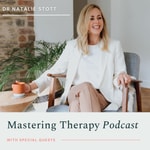
Welcome to the Mastering Therapy Podcast with me, Dr. Natalie Stott, a clinical psychologist. If you're a psychologist, psychotherapist, or counsellor looking to expand your skills, gain confidence, and discover fresh ways to make an impact with your clients, this is the show for you.
We all know that creating meaningful change for our clients is incredibly fulfilling, but let’s face it—this work can be challenging, especially if you feel like you don’t have a big team around you. Mastering Therapy is a weekly podcast that can be your go-to source of professional development and connection, where therapists can learn from one another, share practical insights, and navigate the challenges of therapy together.
Join us as Natalie sits down with experienced practitioners who dive into the nitty-gritty of what really happens in a therapy session. You’ll get a front-row seat to their methods, language, and strategies, as well as honest conversations about potential pitfalls and what to look out for.
Whether you specialise in working with adults, children, or use a particular modality—or even an integrative approach—there’s something here for everyone who wants to add practical tools to their therapy toolkit.
To stay up-to-date with new episodes and access valuable resources, visit www.masteringtherapy.com. You can also connect with us on social media and subscribe on all major podcast platforms. Looking forward to sharing this journey with you!
Site
RSS
Apple
Données mises à jour le 25/09/2026
Classements récents
Dernières positions dans les classements Apple Podcasts et Spotify.
Liens partagés entre épisodes et podcasts
Liens présents dans les descriptions d'épisodes et autres podcasts les utilisant également.
S5E2 What Community Psychology can teach every therapist | Dr Ron Dodzro
Saison 5 · Épisode 36
jeudi 24 septembre 2026 • Durée 43:01
S5E2 What Community Psychology can teach every therapist | Dr Ron Dodzro
How much of what brings someone to therapy can really be understood by looking at the individual alone?
In this episode, Dr Natalie Stott is joined by clinical psychologist Dr Ron Dodzro, also known as The Accessible Psychologist on social media, to explore community psychology and what changes when therapists widen the lens beyond the person sitting in front of them.
Drawing on his work in prisons and with young people affected by community violence, Ron discusses what it means to formulate the systems around a person, particularly when those systems may be contributing to their distress. He shares how his work has extended beyond individual therapy to include parents, teachers, prison officers and wider organisations.
Natalie and Ron also explore power and trust in therapy, including a striking example where Ron’s attempt to protect a young man’s confidentiality inadvertently made him feel less safe.
They discuss race and therapist identity, what our ideas about “professionalism” might communicate to different clients, and why sharing a demographic with someone doesn’t necessarily mean they will experience you as the right therapist for them.
An episode about looking beyond the individual and becoming more curious about what sits around the therapy room as well as what happens inside it.
Guest Information:
Dr Ron Dodzro is a clinical psychologist whose work spans trauma, community psychology and community violence. He has worked within the prison system and now works predominantly in community, charity and private settings, including with children and young people affected by community violence.
He is also co-founder of Psychologists the Streets Deserve (PTSD) providing psychological therapy, training and consultancy around trauma, PTSD and community violence.
Ron shares his work online as The Accessible Psychologist
AirNote is an affordable AI-powered note-taking app designed specifically for therapists in private practice. It securely transcribes sessions and creates professional clinical notes, without the price tag of many traditional AI scribes. Priced at only £14.99 per month. Available to mac users only
Supervisor Platform is an online directory designed for therapists, psychologists, counsellors, and other mental health professionals to connect with qualified clinical supervisors. It makes it easy for practitioners to browse, compare, and contact supervisors based on their expertise, approach, and availability, while giving supervisors a professional space to showcase their services.
Disclaimer: The Mastering therapy podcast and the information provided by Dr Natalie Stott (Dclinpsych, HPCP reg), is solely intended for informational and educational purposes and should only be used by qualified professionals.
Mentioned in this episode:
AIRNOTE | AI SCRIBE FOR THERAPISTS
AirNote is an affordable AI-powered note-taking app designed specifically for therapists in private practice.
It securely transcribes sessions and creates professional clinical notes, without the price tag of many traditional AI scribes. Early user price is at £9.99 p/m, no hidden costs. Available to mac users only
DOWNLOAD AIRNOTE (FREE TRIAL available)
S5E1: What if compassion makes a client feel worse? | Professor Paul Gilbert
Saison 5 · Épisode 37
jeudi 17 septembre 2026 • Durée 56:08
S5E1: What if compassion makes a client feel worse? | Professor Paul Gilbert
What do you do when a client understands compassion perfectly well, but rejects it, distrusts it or feels worse when you introduce it?
Professor Paul Gilbert developed Compassion Focused Therapy for precisely the clients who cannot simply “be kinder” to themselves. In this episode, he explains the three clinical shocks that helped shape CFT. This is for those moments when clients can produce more balanced thoughts but deliver them in a cold or hostile tone. Many people experience kindness as weak, undeserved or almost toxic. For others, receiving care might activate painful memories held within the attachment system.
Dr Natalie Stott, Host and clinical psychologist discuss empathic bridging, the importance of social trust and why receiving compassion from others can be particularly difficult. Paul also revisits the familiar three circles model. He explains threat, drive and the system often called “soothing” through their evolutionary functions, including the role of connection in helping us return to a regulated state.
The conversation finishes with practical ways to bring compassion into everyday behaviour. These include changing the emotional tone of self-talk, practising one compassionate skill at a time and validating the emotion underneath an immediate reaction.
Guest Information:
Professor Paul Gilbert is a professor of clinical psychology at the University of Derby. He is the founder of Compassion Focused Therapy and the Compassionate Mind Foundation. His work has shaped clinical understandings of compassion, shame, self-criticism and threat.
We open with Professor Paul Gilbert, founder of Compassion Focused Therapy, getting very practical. We talk through how to work with clients that really dislike the very concept of compassion despite in therapy recognising they might really need it
I’m talking to Dr Ron, The Accessible Psychologist, about community psychology, diversity, working in UK prisons and why he thinks being anti-diagnosis can sometimes be a position of privilege.
There’s Dr Kelly Savery on working with survivors of sexual abuse, including the conversations about sex and intimacy that therapists can be reluctant to have.
And we’re going beyond the clinical work too.
Josephine Hughes joins me to talk about niching and finding the work you really want to do. Blake Roberts from Therapy with Blake talks about social media, visibility and why therapists find putting themselves online so uncomfortable. I also speak to Jo from Pear about building a therapy matching service, fundraising and moving into the business world.
And, twelve months after our first conversation, ChatGPT is back. This time we get further into AI and therapy, safety, ethics and what we should be telling clients who are already using AI between sessions.
There are also conversations on ACT, narcissism and plenty more.
Have a listen to the trailer for a few clips from what’s coming.
Season 5 starts Thursday 17th September, with a new episode every Thursday through to December.
Follow Mastering Therapy now so you don’t miss the first episode and make sure you get yourself on the mailing list.
BONUS: When Clients Disappear: The Reality of Therapy Endings (PT2)
Saison 4 · Épisode 35
jeudi 18 juin 2026 • Durée 24:25
BONUS: When Clients Disappear: The Reality of Therapy Endings (PT2)
Ever had a client vanish just before their final session? Or wondered why endings can feel so awkward sometimes for everyone in the room? This bonus episode of Mastering Therapy is a practical guide to therapy terminations, with a clinician’s eye on what really happens (and what goes unsaid). The conversation explores messy endings, why clients “ghost”, and how therapists can plan for sessions that fizzle or never happen at all.
Expect practical tools on handling your own reactions, scripts for easing those tricky conversations, and fresh reflections on when saying “goodbye” does or doesn’t mean the work is finished. Useful whether you’re NHS-based or in private practice. No mention of Acceptance and Commitment Therapy (ACT), but plenty to chew over all the same.
The host is Dr. Natalie Stott, clinical psychologist, founder of Mastering Therapy and host of the Mastering Therapy podcast.
BONUS: What to do when... a client goes blank during therapy Sessions
Saison 4 · Épisode 34
jeudi 11 juin 2026 • Durée 31:18
What really happens when a client goes blank in therapy?
This episode dives into dissociation and distress in therapy sessions. Dr Natalie Stott helps make sense of those in-the-room moments where clients disconnect or shut down. Instead of offering set techniques, she shares what clients say actually helps, mistakes therapists often make, and how to understand what's really going on beneath the surface. There’s a strong focus on noticing before intervening, working collaboratively, and pacing sessions with care.
Highlights include:
01:15 What clients need when dissociating
04:11 Perfectionism and the urge to fix
10:13 Client quotes on what dissociation feels like
** Check out Mastering Therapy’s Youtube Channel for all podcast episodes **
For notification on up coming episodes and for occasional summaries of tools discussed on the podcast sign up here: www.masteringtherapy.com
To recommend a topic you’d like to hear about, or if you’d like to appear on the podcast please get in touch at www.masteringtherapy.com/guest
Bonus: What to do when... you are asked a personal question by a client
Saison 4 · Épisode 34
jeudi 4 juin 2026 • Durée 22:47
Do you wonder how much of yourself to share with clients in therapy?
Self-disclosure in therapy can feel like a tightrope walk,one foot in humanity, one in professionalism, and absolutely no brick walls in sight. In this sharp, practical episode, Dr Natalie Stott explores the everyday moments when clients ask about your personal life, and how your answer (or non-answer) shapes the relationship. Get clear on the difference between purposeful self-disclosure and those accidental reveals, like a stray photo on LinkedIn or being spotted with your dog at the park. We talk genuine connection, boundaries, and those inevitable “Are you married?” curveballs. This episode is essential listening for anyone navigating the unscripted art of being real in the consulting room.
TIMESTAMPS
01:17 Common client questions therapists get (and what throws us)
05:07 The four types of self-disclosure—yes, even the accidental ones
08:10 Why small disclosures can strengthen trust and reduce shame
11:01 Red flags: When disclosure meets your own needs, not your client’s
15:11 Online presence: your digital self is always in the room
18:06 Practical ways to respond to personal questions (without making it weird)
Guest Information:
Social media: https://instagram.com/masteringtherapy
Website: www.masteringtherapy.com
** Check out Mastering Therapy’s Youtube Channel for all podcast episodes **
For notification on up coming episodes and for occasional summaries of tools discussed on the podcast sign up here: www.masteringtherapy.com
To recommend a topic you’d like to hear about, or if you’d like to appear on the podcast please get in touch at
Bonus: What to do when... you're wrapping up the therapy session
Saison 4 · Épisode 34
jeudi 28 mai 2026 • Durée 22:05
How do you end your therapy sessions?
This episode looks at the art of closing a clinical hour in therapy by host Dr Natalie Stott. The discussion focuses on those crucial last few minutes of a session, how they shape the client's week, and what endings can reveal about both therapist and client. The episode covers practical ideas, common challenges in managing endings, and reflects on the role of therapist self-awareness. Full of practical tips and honest reflections, this episode offers a thoughtful approach to a part of therapy training many miss.
Highlights include:
00:25 Why endings in therapy matter
02:52 How memory works in therapy endings
05:02 Attachment patterns and client behaviour at the end of sessions
10:01 Practical time management and clear closing routines
13:05 Handling “hand on the door” disclosures
Guest Information:
Dr Natalie Stott is a Clinical Psychologist and host of the Mastering Therapy podcast. She creates practical CPD-style episodes, workshops and resources for psychologists, psychotherapists and counsellors who want to build confidence and skill in the therapy room.
** Check out Mastering Therapy’s Youtube Channel for all podcast episodes **
S4E11: When Compassion Meets Cash: The Therapist’s Money Dilemmas | Dr Katja Windheim
Saison 4 · Épisode 33
jeudi 30 avril 2026 • Durée 39:46
S4E11: When Compassion Meets Cash: The Therapist’s Money Dilemmas | Dr Katja Windheim
Let’s talk about the money elephant in the therapy room. In this episode, clinical psychologist Katja Windheim aka “The Money Psychologist”— joins us to dissect why charging, chasing payments, and setting fees make therapists squirm more than the average tax return.
We get specific about how feelings, professional culture, and early training all shape our relationship to cash and what to do when your compassionate side wants to offer therapy for the price of a sandwich. Expect practical tips on strong financial boundaries, cancellation policies that don’t make you hate your diary, and why money talk belongs in supervision just as much as client dynamics. There’s no magic wand here, but you might start seeing your terms and conditions in a whole new light.
TIMESTAMPS
02:55 Where the “Money Psychologist” idea came from
10:39 Self-funding, cancellations, and client attendance patterns
15:37 Making cancellation policies that actually work for you
22:26 The awkward business of clients who can only afford limited sessions
24:14 Sliding scales—pitfalls, resentments, and alternatives
27:20 Signs you’re pricing out of guilt or financial stress
33:05 What happens when a client’s money stress enters the therapy room
35:37 If your boundaries are all over the place, where to start
KEY TAKEAWAYS
Discuss and repeat your cancellation policy at multiple points, including during initial sessions and in reminder emails.
Treat financial boundaries with the same seriousness as therapeutic ones, and actually bring them to supervision.
Avoid piecemeal flexibility—if you bend the rules for one, you’ll end up resenting the lot.
Sliding scales quickly get complicated; consider offering limited low-cost slots, doing third-sector work, or creating community resources instead.
Before diving into a piece of work, clarify up front how many sessions a client can fund, and plan accordingly.
S4E10: Understanding Maternal Rage: A Guide for Therapists | Dr Caroline Boyd
Saison 4 · Épisode 32
jeudi 23 avril 2026 • Durée 56:39
S4E10: Understanding Maternal Rage: A Guide for Therapists | Dr Caroline Boyd
EPISODE SUMMARY
Is it just anger—or is it maternal rage? Dr. Natalie Stott sits down with Caroline to unpack why mothers feel rage so acutely, and why it matters to name it as a distinct experience. We look at the four contextual forces shaping maternal anger, how cultural myths make mothers feel inadequate, and how therapists can best support clients when rage is shrouded in shame. The episode covers practical steps for mapping client “parts”, bringing the body into therapy, and normalising anger in the context of motherhood and clinical practice. There’s also discussion on therapist disclosure, staying mindful of your own triggers, and ways to deepen your work with mothers. Acceptance and Commitment Therapy (ACT) gets a mention in passing, but this conversation keeps the focus crisply UK-centric.
TIMESTAMPS
• 00:00 Definition and importance of maternal rage
• 00:10 Four contextual forces behind maternal anger
• 08:05 Therapist perspectives: bringing your own experiences into sessions
• 10:40 Asking mums about their own upbringing and anger
• 15:12 Mapping parts, parts work, and nervous system regulation
• 21:13 Impact of childhood experiences on adult anger
• 27:04 Using body awareness for anger management
• 41:06 Mapping parts and relating to “adult self”
• 44:32 Therapist disclosure and managing activation
• 51:00 Courses and resources for therapists and mums
KEY TAKEAWAYS
• Maternal rage is distinct from everyday anger—it’s shaped by societal, cultural, and personal forces.
• Mapping parts (IFS-informed) helps clients understand protective, wounded, perfectionist, and avoidant pieces of themselves.
S4E9 Changing emotion with emotion in EFT | Dr Anna Oldershaw
Saison 4 · Épisode 31
jeudi 16 avril 2026 • Durée 44:21
S4E9 Changing emotion with emotion in EFT | Dr Anna Oldershaw
EPISODE SUMMARY
Most therapists are comfortable talking about emotions, but Emotion Focused Therapy (EFT) takes things several steps further. In this episode, Dr. Natalie Stott sits down with Dr Anna Oldershaw, consultant clinical psychologist and EFT trainer, to demystify the nuts, bolts, and chairs of EFT. They explore why “changing emotion with emotion” is central, the art of letting clients discover their own “Rome”, and why the therapy is more than a rebranding of common practice. Whether you’re curious about chairwork, anxious about secondary anger, or wondering how EFT fits in alongside Acceptance and Commitment Therapy (ACT), you’ll leave with something practical for your next session.
TIMESTAMPS
00:03 What is Emotion Focused Therapy, and why does it matter?
02:20 How Dr. Anna Oldershaw stumbled upon EFT (and SPEAKS therapy for anorexia)
05:39 Can you integrate EFT with schema therapy or ACT?
07:35 Chairwork: making internal parts less terrifying
09:38 EFT’s view on emotions: adaptive, maladaptive, and what’s really going on when clients say they’re “just angry”
16:54 Working with clients’ own process, not parachuting in with answers
26:31 The nuts and bolts of running a chair task (and what to do if things go off piste)
31:19 What can clients do between sessions to keep the work alive?
45:24 Interested in training in EFT? How to start
KEY TAKEAWAYS
• Use “chairwork” to facilitate clients’ dialogues with critical or protective parts—let them find their own insights, not yours.
• Distinguish between primary adaptive emotions (helpful, situation-relevant), primary maladaptive emotions (old wounds replaying), and secondary emotions (reactions to other feelings). Don’t take clients’ first answers at face value.
• When chairwork risks a shouting match between parts, focus on building assertiveness in the “experiencing” chair and softening of the critic—don’t force a negotiation.
Supervisor Platform is an online directory designed for therapists, psychologists, counsellors, and other mental health professionals to connect with qualified clinical supervisors. It makes it easy for practitioners to browse, compare, and contact supervisors based on their expertise, approach, and availability, while giving supervisors a professional space to showcase their services.
Disclaimer: The Mastering therapy podcast and the information provided by Dr Natalie Stott (Dclinpsych, HPCP reg), is solely intended for informational and educational purposes and should only be used by qualified professionals.
Mentioned in this episode:
AIRNOTE | AI SCRIBE FOR THERAPISTS
AirNote is an affordable AI-powered note-taking app designed specifically for therapists in private practice.
It securely transcribes sessions and creates professional clinical notes, without the price tag of many traditional AI scribes. Early user price is at £9.99 p/m, no hidden costs. Available to mac users only
DOWNLOAD AIRNOTE (FREE TRIAL available)
Supervisor Platform is an online directory designed for therapists, psychologists, counsellors, and other mental health professionals to connect with qualified clinical supervisors. It makes it easy for practitioners to browse, compare, and contact supervisors based on their expertise, approach, and availability, while giving supervisors a professional space to showcase their services.
Disclaimer: The Mastering therapy podcast and the information provided by Dr Natalie Stott (Dclinpsych, HPCP reg), is solely intended for informational and educational purposes and should only be used by qualified professionals.
Mentioned in this episode:
AIRNOTE | AI SCRIBE FOR THERAPISTS
AirNote is an affordable AI-powered note-taking app designed specifically for therapists in private practice.
It securely transcribes sessions and creates professional clinical notes, without the price tag of many traditional AI scribes. Early user price is at £9.99 p/m, no hidden costs. Available to mac users only
DOWNLOAD AIRNOTE (FREE TRIAL available)
Supervisor Platform is an online directory designed for therapists, psychologists, counsellors, and other mental health professionals to connect with qualified clinical supervisors. It makes it easy for practitioners to browse, compare, and contact supervisors based on their expertise, approach, and availability, while giving supervisors a professional space to showcase their services.
Disclaimer: The Mastering therapy podcast and the information provided by Dr Natalie Stott (Dclinpsych, HPCP reg), is solely intended for informational and educational purposes and should only be used by qualified professionals.
Mentioned in this episode:
AIRNOTE | AI SCRIBE FOR THERAPISTS
AirNote is an affordable AI-powered note-taking app designed specifically for therapists in private practice.
It securely transcribes sessions and creates professional clinical notes, without the price tag of many traditional AI scribes. Early user price is at £9.99 p/m, no hidden costs. Available to mac users only
DOWNLOAD AIRNOTE (FREE TRIAL available)
Supervisor Platform is an online directory designed for therapists, psychologists, counsellors, and other mental health professionals to connect with qualified clinical supervisors. It makes it easy for practitioners to browse, compare, and contact supervisors based on their expertise, approach, and availability, while giving supervisors a professional space to showcase their services.
Disclaimer: The Mastering therapy podcast and the information provided by Dr Natalie Stott (Dclinpsych, HPCP reg), is solely intended for informational and educational purposes and should only be used by qualified professionals.
Mentioned in this episode:
AIRNOTE | AI SCRIBE FOR THERAPISTS
AirNote is an affordable AI-powered note-taking app designed specifically for therapists in private practice.
It securely transcribes sessions and creates professional clinical notes, without the price tag of many traditional AI scribes. Early user price is at £9.99 p/m, no hidden costs. Available to mac users only
DOWNLOAD AIRNOTE (FREE TRIAL available)
Supervisor Platform is an online directory designed for therapists, psychologists, counsellors, and other mental health professionals to connect with qualified clinical supervisors. It makes it easy for practitioners to browse, compare, and contact supervisors based on their expertise, approach, and availability, while giving supervisors a professional space to showcase their services.
Disclaimer: The Mastering therapy podcast and the information provided by Dr Natalie Stott (Dclinpsych, HPCP reg), is solely intended for informational and educational purposes and should only be used by qualified professionals.
Mentioned in this episode:
AIRNOTE | AI SCRIBE FOR THERAPISTS
AirNote is an affordable AI-powered note-taking app designed specifically for therapists in private practice.
It securely transcribes sessions and creates professional clinical notes, without the price tag of many traditional AI scribes. Early user price is at £9.99 p/m, no hidden costs. Available to mac users only
DOWNLOAD AIRNOTE (FREE TRIAL available)
If you’re regularly overbooking or undercharging, pause and get support—consider a business mentor, peer discussion, or a coach.
Money worries in clients often show up in the room—name the discomfort, don’t avoid it, and be aware of your own triggers.
GUEST
Katja Windheim is a clinical psychologist working under the name “The Money Psychologist”. She specialises in helping therapists untangle the practical and emotional knots around money, fees, and boundaries within their practices. She regularly runs live Zoom webinars on the emotional side of money in independent practice. Recorded versions of these are available for purchase on her website. She also offers small group coaching for those professionals who wish to explore this further. If you'd like to hear news and updates about these offers, please sign up to her newsletter on her website.
Supervisor Platform is an online directory designed for therapists, psychologists, counsellors, and other mental health professionals to connect with qualified clinical supervisors. It makes it easy for practitioners to browse, compare, and contact supervisors based on their expertise, approach, and availability, while giving supervisors a professional space to showcase their services.
Disclaimer: The Mastering therapy podcast and the information provided by Dr Natalie Stott (Dclinpsych, HPCP reg), is solely intended for informational and educational purposes and should only be used by qualified professionals.
Mentioned in this episode:
AIRNOTE | AI SCRIBE FOR THERAPISTS
AirNote is an affordable AI-powered note-taking app designed specifically for therapists in private practice.
It securely transcribes sessions and creates professional clinical notes, without the price tag of many traditional AI scribes. Early user price is at £9.99 p/m, no hidden costs. Available to mac users only
DOWNLOAD AIRNOTE (FREE TRIAL available)
• Normalising anger, referencing current research, and naming its prevalence helps reduce client shame.
• Therapists should sensitively explore how anger was held and expressed in clients’ upbringing.
• Body-based techniques and nervous system regulation are essential for helping mothers manage anger.
• Consider the impact of perfectionism and inner critic parts, which often drive maternal distress.
• Therapist disclosure needs careful consideration—check your motives and the client’s readiness before sharing.
GUEST
Clinical psychologist Dr Caroline Boyd has over 10 years' experience working in the NHS and mental health settings, and she supports parents from pregnancy to childbirth and beyond. Caroline offers anger courses, workshops and 1:1 therapy, alongside training and supervision, in her independent psychology practice, Parent Therapy Hub. Caroline is the author of Mindful New Mum, and her published research explores mothers' experiences of intrusive thoughts about their babies. Her work has been featured in You magazine, Grazia, the Telegraph, and BBC R4’s Woman's Hour. She is an Ambassador for UK perinatal mental health charity, PANDAS, and appeared as an expert guest on ITV’s daytime show, This Morning, to discuss postpartum depression. Caroline shares psychology ideas on Instagram and in the media to help parents feel less alone and more connected - to themselves and their children.d writes extensively on maternal rage, using parts work and body-based approaches.
The course helps mums move from anger and shame to understanding and repair - in just six, manageable video lessons designed to fit around busy family life.
You don’t need to be experiencing full-blown rage to benefit. Many mums take the course simply to understand their emotions better and reconnect with themselves and those they love.
It’s for every mum who’s ever felt stretched too thin by:
🎯 Broken sleep that leaves you on edge
🎯 The invisible mental load that never ends
🎯 Toddler meltdowns that test every ounce of patience
🎯 Feeling unseen or unsupported by your partner or family
🎯 The pressure to do it all perfectly and sacrifice your own needs
Supervisor Platform is an online directory designed for therapists, psychologists, counsellors, and other mental health professionals to connect with qualified clinical supervisors. It makes it easy for practitioners to browse, compare, and contact supervisors based on their expertise, approach, and availability, while giving supervisors a professional space to showcase their services.
Disclaimer: The Mastering therapy podcast and the information provided by Dr Natalie Stott (Dclinpsych, HPCP reg), is solely intended for informational and educational purposes and should only be used by qualified professionals.
Mentioned in this episode:
AIRNOTE | AI SCRIBE FOR THERAPISTS
AirNote is an affordable AI-powered note-taking app designed specifically for therapists in private practice.
It securely transcribes sessions and creates professional clinical notes, without the price tag of many traditional AI scribes. Early user price is at £9.99 p/m, no hidden costs. Available to mac users only
DOWNLOAD AIRNOTE (FREE TRIAL available)
• Listen for process “markers” as sessions begin to decide which EFT task (chair, focusing, imagery) will actually fit.
• To boost client awareness between sessions, ask them to notice and name when certain inner critics or feelings emerge—no need to “fix”, just notice.
• Be careful about overlaying your own formulation. Use conjecture gently, reflect back, and let the client’s experience lead.
• If a client experiences blocks (i.e., “I can’t go there”), work with the blocking part directly—don’t bulldoze through.
GUEST
Dr Anna Oldershaw
Consultant clinical psychologist, internationally accredited EFT trainer and supervisor, and director of the Emotion Focused Therapy Institute. Specialises in eating disorders and developed the SPEAKS therapy approach for anorexia.
Supervisor Platform is an online directory designed for therapists, psychologists, counsellors, and other mental health professionals to connect with qualified clinical supervisors. It makes it easy for practitioners to browse, compare, and contact supervisors based on their expertise, approach, and availability, while giving supervisors a professional space to showcase their services.
Disclaimer: The Mastering therapy podcast and the information provided by Dr Natalie Stott (Dclinpsych, HPCP reg), is solely intended for informational and educational purposes and should only be used by qualified professionals.
Mentioned in this episode:
AIRNOTE | AI SCRIBE FOR THERAPISTS
AirNote is an affordable AI-powered note-taking app designed specifically for therapists in private practice.
It securely transcribes sessions and creates professional clinical notes, without the price tag of many traditional AI scribes. Early user price is at £9.99 p/m, no hidden costs. Available to mac users only
DOWNLOAD AIRNOTE (FREE TRIAL available)
Découvrez des podcasts liées à Mastering Therapy. Explorez des podcasts avec des thèmes, sujets, et formats similaires. Ces similarités sont calculées grâce à des données tangibles, pas d'extrapolations !