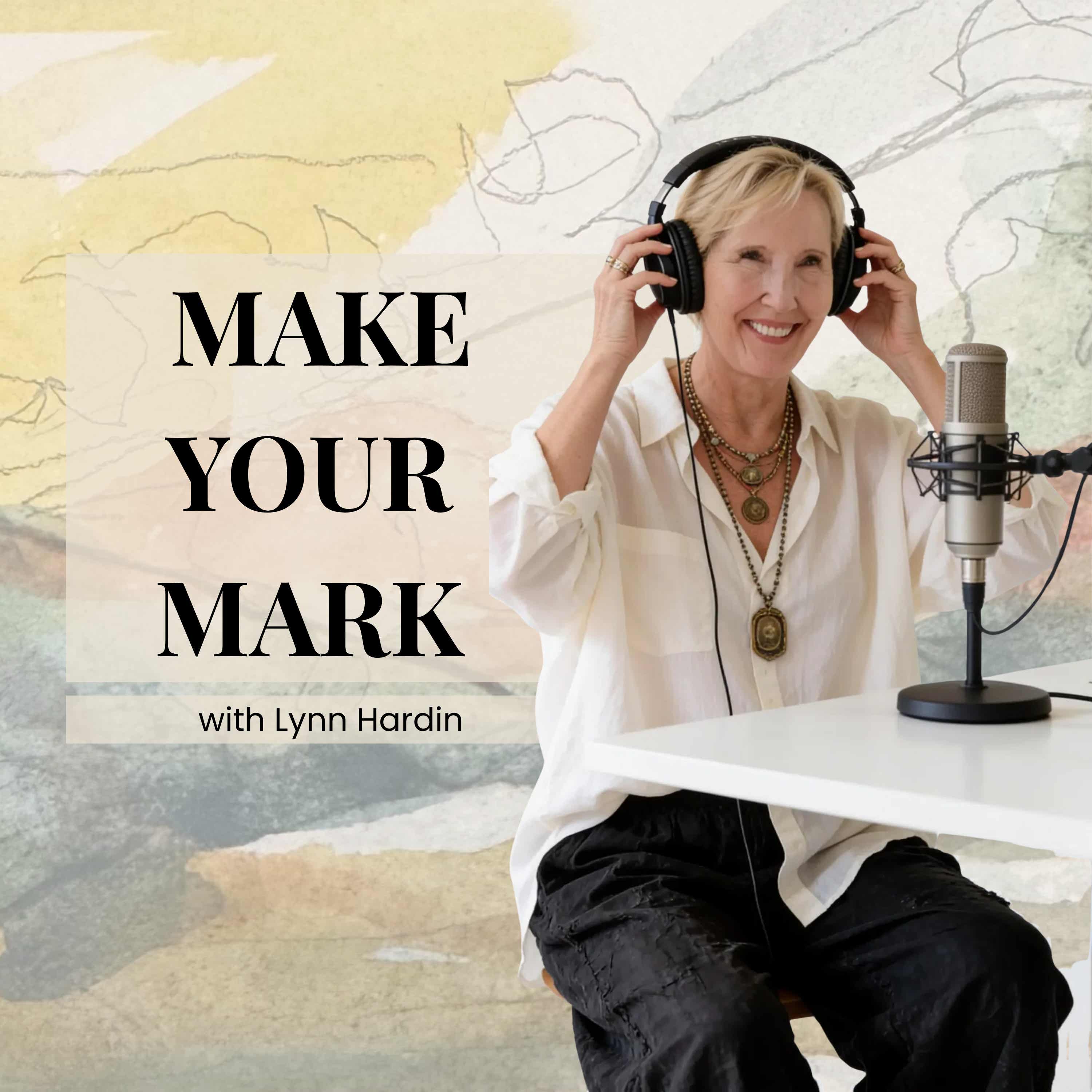
Make Your Mark is a podcast for artists who have taken the classes, learned the techniques, and are ready for what comes next: creating a body of work that feels unmistakably their own and bringing it into the world.
Artist and Master Certified Life Coach Lynn Hardin explores artistic voice, creative direction, self-trust, decision-making, and the courage to let your work be seen. Whether you want to exhibit, sell, share, contribute, or leave a creative legacy, each episode will help you stop looking outside yourself for the right answer and become the self-directed artist you want to be.
Your art matters. It is time to make your mark.
Découvrez des podcasts liées à Make Your Mark. Explorez des podcasts avec des thèmes, sujets, et formats similaires. Ces similarités sont calculées grâce à des données tangibles, pas d'extrapolations !
A disappointing painting does not settle the question of your talent.
In this episode, Lynn talks about the moment when a painting doesn’t turn out the way you hoped, and how quickly disappointment can become a judgment about yourself.
You’ll learn how to slow down that moment, separate what you observe from the story you tell about yourself, and make your next creative decision without waiting to feel completely certain.
Lynn also shares how she transformed large intuitive paintings from an art retreat in Idaho into small studies.
Instead of asking, “Which one do you think is best?” she practiced asking herself, “Which one do I want to explore?”
In this episode, you’ll discover:
* How to learn from a painting that disappoints you
* The difference between observing your work and judging yourself
* Why “I should be further along by now” is not a useful measure
* How to change the size of the question when a whole painting feels overwhelming
* How to ask for feedback without giving away your authority
* What to consider before buying another class or art supply
* How to make a choice without turning the result into a verdict about you
* Why trusting yourself does not mean liking every result
You can be disappointed and still be curious.
You can be unsure and still choose.
And one painting does not get to decide whether you are an artist.
Make Your Mark Before the Holidays
If you have art in drawers, sketchbooks, piles, or stacked against the wall, join Lynn for a live Zoom workshop on Sunday, October 18, at 10:00 AM Pacific.
Together, you’ll make three decisions:
* How you want to share your art
* How much you want to take on
* What needs to happen, and when, to make it possible
You might choose a piece as a gift, plan a small display, share your work online, or decide what you’d like to offer for sale.
You’ll leave with a clear, realistic plan for doing something meaningful with the art you’ve already made.
What did I notice, and what did I decide for myself today?
You don’t have to make something perfect. You can give yourself credit for the specific choice you practiced.
This is a public episode. If you'd like to discuss this with other subscribers or get access to bonus episodes, visit lynnhardin.substack.com/subscribe
Make Art that Looks Like You made It
lundi 14 septembre 2026 • Durée 12:49
Originality Comes from Memory: Making Art That Feels Like You
Have you ever finished a piece and thought, “I can see everything my teachers taught me, but where am I in this?”
In this conversation, I share a discovery that changed how I approach my art: bringing my own feelings and memories into the marks I make.
It began with a painting of my mother on her honeymoon. Looking at it, I could see myself in the work. There was a personal connection behind it, and I wanted to explore how to bring that connection into my everyday practice.
I share examples of what happened when I moved from “I have to get this right” to letting a memory influence my lines, paint, and choices.
In this episode:
What a painting of my mother reminded me about my artistic voice.
A lesson from Jean Oliver about pressure, relaxation, and making marks.
The difference I noticed between working from frustration and creating from a personal connection.
How love, wonder, and memories influenced my practice pieces.
Why practice can be a place for play without needing a finished result.
You don’t have to bring up an overwhelming emotion. A small memory, a familiar smile, or a sense of affection can be a starting point.
Join me for the Feeling Art Masterclass
On September 15 at 3 PM Pacific, I’ll guide you through exploring your own marks, colors, and textures and bringing them into a finished expressive piece.
Something to consider: What might change in your art if you began with a memory instead of the thought, “I need to get this right”?
This is a public episode. If you'd like to discuss this with other subscribers or get access to bonus episodes, visit
How to Stop Editing Out Your Artistic Voice
mardi 8 septembre 2026 • Durée 22:45
In this episode of The Practice, I’m showing you what happens when you feel an instinctive mark, color, or idea and replace it with the safer choice before your brush ever touches the paper.
In this episode, you’ll learn:
* Why your brain edits your creative impulses before you consciously make a decision
* The difference between a craft edit, an audience edit, and a self-protection edit
* A simple three-step Edit Protocol to help you recognize what you removed and decide whether to put it back
* Why making the “bad” or “too much” version on purpose can help you take more creative risks
* How the choices you keep editing out may contain the clearest evidence of your artistic voice
If you believe you haven’t found your artistic voice yet, this episode offers another possibility: your voice is already present in your recurring colors, marks, subjects, and instincts.
You may simply be removing it on the way to the page.
This is a public episode. If you'd like to discuss this with other subscribers or get access to bonus episodes, visit lynnhardin.substack.com/subscribe
When Creativity Talks Back: Art, Intuition, and Creative Spirit
dimanche 30 août 2026 • Durée 01:03:22
What if making art is not only about creating something beautiful? What if the things we make can speak back to us?
In this conversation, I’m joined by artist, teacher, and intuitive guide Stacey Vajta of The Feisty Crone. Stacey creates spirit dolls and magical creatures that hold stories, emotions, and wisdom.
Together, we explore the difference between simply producing art and feeling creatively alive. We talk about the rules artists carry, the pressure to make something “good,” and what becomes possible when we approach art with curiosity, play, and no predetermined outcome.
Stacey shares how her dolls become storytellers, teachers, and companions. I share how contour drawing and watercolor help me enter the creative flow and discover the marks, shapes, and visual language that are already mine.
We also talk about allowing grief, sadness, joy, and wonder into the making process. Art does not have to eliminate difficult emotions. It can give them somewhere to go.
In this conversation:
* The difference between little “c” creativity and big “C” creative energy
* Why you can make a lot of art and still feel creatively stuck
* How external rules and comparison disconnect us from our own expression
* Why your creative practice does not have to happen every day
* How keeping materials accessible makes it easier to follow creative energy
* What spirit dolls can reveal through imagination and story
* How art can help us experience and process grief
* Why play sometimes offers answers that seriousness cannot
* How intuition can arrive through art, nature, children, movement, or ordinary moments
* Why your style is already present, much like your handwriting
* What happens when you stop asking whether you made an insight up and begin listening to it
This is a public episode. If you'd like to discuss this with other subscribers or get access to bonus episodes, visit
The Art of Just Doing It with James O’Boyle, The Doodler
jeudi 27 août 2026 • Durée 37:45
What if the secret to making more art is lowering your expectations and using the time you actually have?
In this episode, I talk with artist and Substack writer James O’Boyle, creator of The Doodler.
James works full time, yet he has built a consistent sketching practice by keeping his materials simple, using small pockets of time, and letting go of the need for every drawing to be perfect.
We talk about why consistency matters more than technique, how constraints can make creating easier, and why your artistic style is not something you have to find. It is already there, and it emerges as you keep making.
James also shares how a ten-second blind contour drawing changed the direction of his art, why buying a course is not the same as practicing, and how calling himself “The Doodler” helps protect the joy in his work.
In this conversation, we explore:
* How to make art when you only have five or ten minutes
* Why adjusting your expectations helps you create more
* What makes every drawing a success
* How consistency builds both skill and confidence
* The difference between taking a course and using what you learn
* Why simple tools and constraints can prevent overwhelm
* How your artistic style develops naturally through practice
* James’s upcoming nine-day hike on the Northville-Placid Trail
* Why the point of making art is to do it, not to make every piece perfect
My favorite takeaway from James:
Your style is like your handwriting. You already have it. The more you practice, the more clearly it emerges.
Connect with James:
* Substack:
This is a public episode. If you'd like to discuss this with other subscribers or get access to bonus episodes, visit
Two Painters, One Question - The Paintings You Never Show Anyone
mercredi 26 août 2026 • Durée 53:21
What happens when two artists pull out the work they usually keep hidden?
Mariel and I recently went Live on Substack to share the art we might never show anyone. The pieces that felt ugly. The ones that did not turn out the way we imagined. The experiments we abandoned and the paintings we simply never finished.
And we laughed. A lot.
Because once we brought those pieces into the light, they did not feel quite so terrible anymore.
They became evidence of curiosity, courage, learning, and being willing to make something without knowing exactly where it would lead.
Watch our conversation if you have ever hidden a piece because it was not “good enough,” felt disappointed when your art did not match the picture in your head, or believed unfinished work did not count.
You may discover that the art you are judging most harshly has something to teach you.
Meet My Co-host, Mariel
I was delighted to share this Live with Mariel Barahona , the watercolor artist and elementary school teacher behind My Watercolour Journal.
Mariel shares her art, her process, and quiet reflections on creativity, one brushstroke at a time.
During our conversation, she brought such warmth, honesty, and humor as we showed the paintings we usually keep hidden.
She helped make this conversation feel like two artist friends laughing, sharing, and reminding each other that every painting does not have to be beautiful or finished to be valuable.
If you enjoy watercolor, thoughtful reflections, and a calm place to appreciate creativity and simple beauty, you will love Mariel’s work.
This is a public episode. If you'd like to discuss this with other subscribers or get access to bonus episodes, visit
You Don’t Need Confidence. You Need Willingness.
jeudi 20 août 2026 • Durée 17:29
What if confidence isn’t something you need before you begin?
So many of us wait until we feel confident enough to make the painting, send the email, have the conversation, apply for the job, share our work, or try something new.
But confidence may have the whole thing backwards.
In this episode of The Art Coach, I’m talking about something I learned from watching my grandson learn to walk. He didn’t need to believe he was a good walker before he took the next step. He fell. He got back up. He tried again.
He wasn’t proving anything about himself.
He was learning.
And somewhere along the way, many of us stopped doing that.
A painting we don’t like becomes Maybe I’m not a good artist.
An offer that doesn’t sell becomes Maybe nobody wants what I have to offer.
A post that gets little response becomes Maybe nobody cares what I have to say.
The event happens, and then we make the event mean something about us.
In this episode, I’ll show you another way.
Instead of asking:
How can I feel more confident?
Try asking:
Am I willing?
Am I willing to make the mark without knowing whether I’ll like it?
Am I willing to try something while feeling uncertain?
Am I willing to be seen learning?
Am I willing to find out what happens next?
I’ll also introduce you to my LEARN process:
Do something. Make the mark. Send the email. Take the step.
This is a public episode. If you'd like to discuss this with other subscribers or get access to bonus episodes, visit
Turn a feeling into line, shape, color, and composition.
vendredi 7 août 2026 • Durée 22:37
Make Art Be Happy | 22 minutes 37 seconds |
Episode description
A piece can be skillful. The proportions can work, the color can work, other people can admire it, and you can still look at it and feel strangely absent from it. Nothing is obviously wrong. Something is missing. This week Lynn makes the case that what is missing is not more skill. It is more of you.
She tells the story of the drawing she made the day after Belle died. She was not drawing Belle and she was not making a picture about grief. She was drawing a woman’s face in contour line. But the line slowed down, it hesitated, it pressed harder in some places and nearly disappeared in others, and she left most of the face as bare paper. The subject was a face. The grief was in the way she made it.
From there, a practical look at how feeling becomes a visual choice, and one small thing to try in your next studio session.
In this episode
• Why a piece can be skillful, admired, and still leave you feeling absent from it
• The drawing Lynn made the day after Belle died, and what changed in her hand without her deciding it
• How a feeling enters the work through pressure, speed, space, repetition, and what you leave unfinished
• Why the subject is almost never the feeling
• Three artists, one pear, and what makes the three pieces different
• A better question than what color is sadness
• Why your voice is not hidden somewhere waiting to be found
• What changes when you stop asking does this look right and start asking does this feel true
• How to let feeling into the work without turning your studio into therapy or your art into a confession
Timeline
0:00 Looks right versus feels true
This is a public episode. If you'd like to discuss this with other subscribers or get access to bonus episodes, visit
The Mark You Almost Make
jeudi 30 juillet 2026 • Durée 14:52
Your voice isn't a finished destination, it's the ongoing conversation between you and the work.
In this episode I tell the story of one honest mark on a napkin and what it revealed about an artist who, beneath sixty years of beautiful work, was still waiting for permission.
It's about the difference between making something beautiful and making something honest, and the mark you almost make but talk yourself out of.
The newest round of The Practice is now open if you want to build an art practice that actually feels like you.
Timeline
00:00 — Cold open: your voice, and the work, is never a finished destination. It’s an ongoing conversation between you and the practice.
01:30 — The napkin story. One strange, ugly, honest mark made over dinner. Sixty years of beautiful work, and beneath all of it she was still there. Her hand hadn’t forgotten. It was waiting for permission.
04:00 — Who this is for. Maybe you’ve stopped making art altogether, or you’re still making it but the work no longer feels alive.
05:30 — The important clarification: this isn’t about throwing out what sells or what makes your living. What you’re pointing to lives inside the practice, where only you see it.
07:00 — Beautiful versus honest. You know how to make something beautiful. You’ve gotten so good at knowing what works that you’ve forgotten how to be surprised.
08:30 — This week’s homework: notice the mark you almost make. Instead of talking yourself out of it, give it somewhere to live. It doesn’t need to be good. It only needs to be yours.
10:00 — The invitation. If having a practice matters to you but your art no longer feels like you, this is what The Practice is for. A practice you actually live, not one you keep promising to return to someday.
11:30 — Close: make the inconvenient mark, the one that feels a little too honest. It may be the one that leads you back to yourself.
This is a public episode. If you'd like to discuss this with other subscribers or get access to bonus episodes, visit
The Quiet Promises You Break to Yourself
jeudi 23 juillet 2026 • Durée 12:12
You keep your word to everyone. Your kids, your husband, your friends, the people at church who somehow got your number. But that painting you stopped doing, the walk you keep meaning to take, the book with the bookmark stuck on page 12 since spring?
This episode is about the promises you only ever make to yourself, and why those became the ones it feels safe to drop.
This isn’t about guilt, and it isn’t about discipline. If you follow through for everyone else, you have plenty of discipline.
You’ve just spent every last drop of it on other people.
What’s really underneath the broken promises is something quieter and a good bit older, and once you see it, the whole thing changes.
Timeline
00:00 — A careful hello, and why this one is easy to hear wrong00:40 — The promises you keep for everyone else vs. the quiet ones to yourself01:15 — The pause. “Oh, that one. Yeah, that’s been on the list a while.”01:55 — A woman I worked with: reliable for everyone, sure something was wrong with her02:50 — The list — the painting, the morning walk, the bookmark that never moved03:30 — “I just need more discipline,” and why that isn’t true04:20 — Look at your actual life: you keep the promises that cost you something05:05 — The tank is empty by the time you get to your own list05:45 — “When you were small, what got you loved around here?”06:30 — Good, easy, not needing anything — and how that once kept her safe07:20 — The turn: you’re the one person you decided it’s safe to disappoint08:15 — A different perspective: follow-through isn’t productivity, it’s loyalty09:05 — Putting your own name on the list of people you won’t break your word to09:45 — You don’t get there by blowing up your life on Monday10:20 — One small promise, almost embarrassingly small — and keeping it11:00 — How she started (the walk came first, the painting came later)11:35 — You count. Lower down in your body where it’s true.12:00 — If you’re ready for the deeper work, and how to set up a consult
This week’s practice
Make one promise to yourself. Make it so small you cannot wriggle out of it.
The 10-minute walk, the one page, the paints left out on the table whether or not you touch them. Then keep it.
This is a public episode. If you'd like to discuss this with other subscribers or get access to bonus episodes, visit
One of my favorite reminders from this conversation is that the pressure can come off. You do not have to make art for Instagram, create a finished masterpiece, or know where the work is going.
You can make something because the energy is there. You can follow it, play with it, and ask:
Where else could this take me?
About Stacey Vajta
Stacey is an artist, teacher, and intuitive guide who creates spirit dolls and other magical creatures. Her work explores what happens underneath the things we make, where imagination, energy, intuition, and story enter the creative process.
Find Stacey on Substack at The Feisty Crone, on Instagram, or through her website, Sacred Art and Story. She also offers dollmaking classes for anyone ready to discover the stories their hands want to tell.
Feeling Art
On September 15, I’m teaching Feeling Art, a 90-minute live masterclass about using feeling to guide the marks you make.
We will choose a feeling or quality and explore how it can influence color, line, pressure, shape, space, and movement.
We are not painting pictures of feelings.
We are allowing feeling to guide our artistic choices so the work carries more of our energy, voice, and aliveness.
If you have been waiting for more time, better supplies, greater confidence, or the perfect idea, let this episode remind you that you can begin with one pen, one page, and the few minutes you have today.
If you would like to make art that resonates then join me September 15, 2026 for an online experience.
By the end of 90 minutes, you’ll have created a piece that feels more personal, expressive, and unmistakably yours.
Make the inconvenient mark — it may be the one that leads you back to yourself. Lynn, The Practice.
And if you are ready to loosen your grip on getting it right and make choices that feel more like you, join me for Feeling Art, a live 90-minute masterclass.
You will make one piece differently than you normally would, follow an impulse instead of immediately correcting it, and learn how to translate a feeling into color, line, movement, pressure, and space.
3:06 The studio looked the same, the room felt different
4:05 The line moved differently that day
4:58 The watercolor, and what she left unpainted
5:32 The subject is not the feeling
6:56 What we are taught to do first
8:29 A feeling is a visual choice
9:33 Three artists, one pear
11:12 Sadness does not have to be blue
12:11 A better question than what color is the feeling
13:21 Your voice is not hiding from you
14:23 Does this look right, or does this feel true
15:30 The drawing did not have to be a confession
16:18 You are not required to expose yourself
17:39 The line knew before I had the words
19:02 Joy has a visual language too
19:49 The practice for this week
22:02 The closing question
The practice for this week
• Choose your subject the way you normally would. A face, a flower, a pear, a landscape.
• Before you start, ask what you want this to feel like. Quiet, warmth, energy, distance, tenderness, strength. Keep it simple.
• Ask how that feeling moves. Does it push or pull. Does it need room. Does it repeat, fade, interrupt, expand. Is it heavy or fragile. Fast or slow.
• Make one visual choice from your answer. Just one. Heavier pressure. More space. A repeated mark. Less color. A larger subject. An edge you let disappear.
• When you finish, do not decide whether it is good. Ask where you are in it, and where the feeling changed the way you worked.
There is no correct picture of quiet. There is no official line for grief. There is no perfect color for joy. There is only you and your response.
The closing question
When you look at the last piece you made, what feeling is showing, even if you did not put it there on purpose?
Comment on the episode, send a text, or send a DM.
Your voice isn’t a finished destination. It’s the ongoing conversation between you and the work, and sometimes it comes back through one strange, honest mark nobody asked for.
In this episode I tell the story of a mark made on a napkin over dinner, and what it revealed about an artist with sixty years of beautiful work behind her: that beneath the style, beneath the discipline, her hand hadn’t forgotten. It was waiting for permission.
This one is for you if you’ve stopped making art altogether, or if you’re still making it but the work no longer feels alive. It’s not about throwing out what sells or how you make your living. It’s about what happens inside your consistent practice, the part only you see, there for you to do with as you wish.
We get into the difference between making something beautiful and making something honest, and why getting so good at knowing what works can quietly cost you the ability to be surprised.
This week’s homework: Notice the mark you almost make. Instead of talking yourself out of it, give it somewhere to live. It doesn’t need to be good. It doesn’t need to belong in the finished piece. It only needs to be yours.
The newest round of The Practice is now open. If having an art practice matters to you but your art no longer feels like you, I’d love to help you build one that does: loose and purposeful, consistent, spacious, honest, surprising. A practice you actually live, not one you only think about.
Make the inconvenient mark, the one that feels a little too honest. It may be the mark that leads you back to yourself.