In Pursuit of Development – Détails, épisodes et analyse
Détails du podcast
Informations techniques et générales issues du flux RSS du podcast.
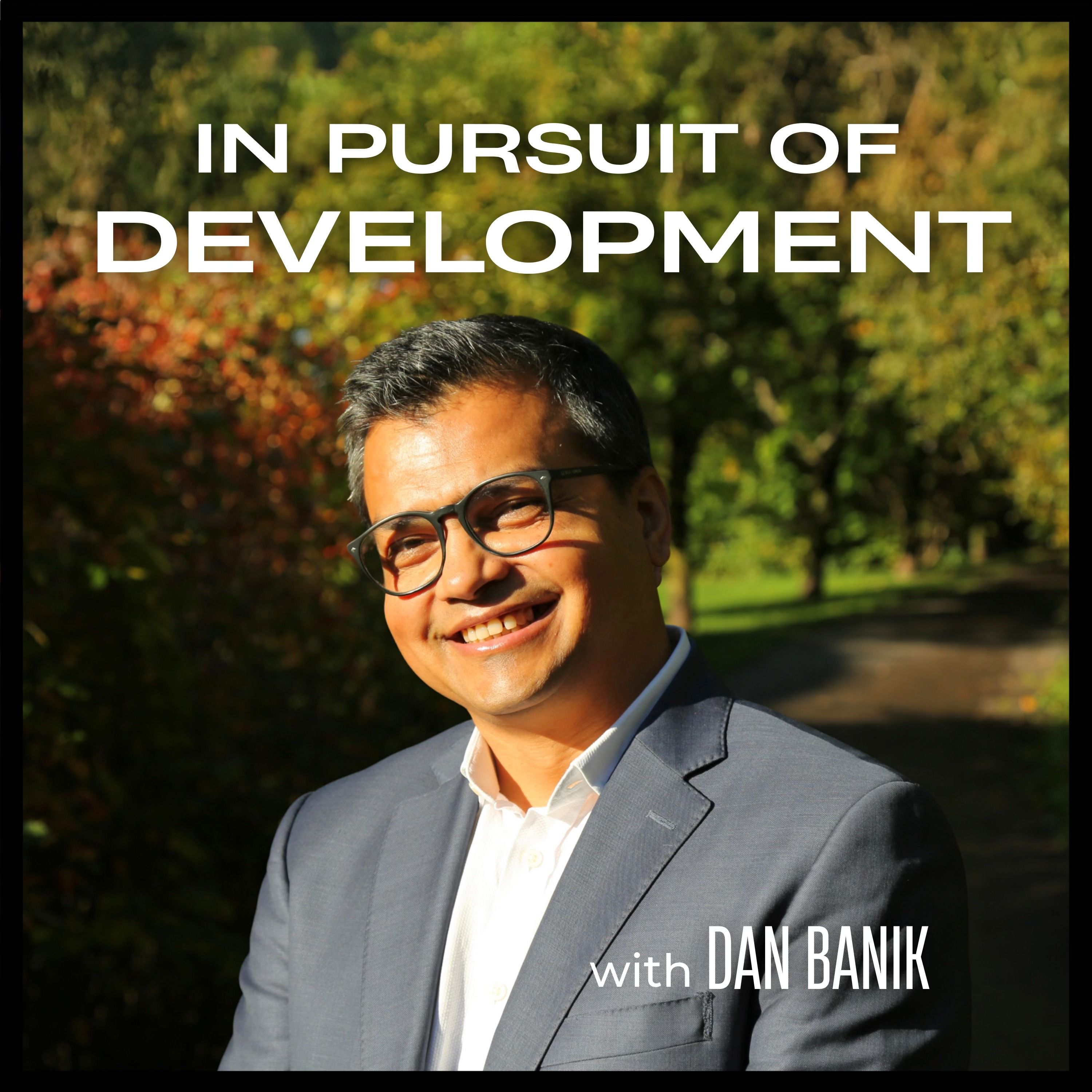
In Pursuit of Development
Dan Banik
Fréquence : 1 épisode/12j. Total Éps: 176

Classements récents
Dernières positions dans les classements Apple Podcasts et Spotify.
Apple Podcasts
🇬🇧 Grande Bretagne - socialSciences
31/05/2026#84🇨🇦 Canada - socialSciences
30/05/2026#84🇬🇧 Grande Bretagne - socialSciences
30/05/2026#60🇨🇦 Canada - socialSciences
27/05/2026#37🇺🇸 États-Unis - socialSciences
26/05/2026#75🇺🇸 États-Unis - socialSciences
25/05/2026#48🇬🇧 Grande Bretagne - socialSciences
24/05/2026#92🇺🇸 États-Unis - socialSciences
24/05/2026#85🇫🇷 France - socialSciences
24/05/2026#98🇬🇧 Grande Bretagne - socialSciences
23/05/2026#79
Spotify
Aucun classement récent disponible
Liens partagés entre épisodes et podcasts
Liens présents dans les descriptions d'épisodes et autres podcasts les utilisant également.
See all- https://twitter.com/danbanik
121 partages
- https://twitter.com/GlobalDevPod
112 partages
- https://twitter.com/eolander
16 partages
Qualité et score du flux RSS
Évaluation technique de la qualité et de la structure du flux RSS.
See allScore global : 73%
Historique des publications
Répartition mensuelle des publications d'épisodes au fil des années.
From crisis to possibility | Dan Banik
Saison 6 · Épisode 1
lundi 13 octobre 2025 • Durée 17:08
In the first episode of In Pursuit of Development Season 6, host Dan Banik returns after an unexpected year-and-a-half hiatus following a serious health emergency. Dan examines how the world has entered a period of profound flux. The once-stable liberal international order is giving way to a more fragmented and contested multipolar reality. He explores how trade wars, weakening multilateral institutions, debt crises, environmental stress, and disruptive technologies are reshaping global politics and development. However, amidst this turbulence, he identifies a powerful countercurrent — the growing visibility and influence of the Global South. Dan unpacks how countries across Asia, Africa, and Latin America are asserting new forms of leadership and cooperation — through the G20, BRICS, and South–South partnerships — and how this shift is transforming debates on trade, climate justice, technology, and governance. The episode also reflects on the challenges within the Global South itself, including internal inequalities, differing national interests, and the risk of reproducing old hierarchies in new ways.
Despite the uncertainty of this “interregnum” moment, Dan closes with a message of cautious optimism — a politics of hope grounded in evidence. He highlights global progress in health, education, poverty reduction, and renewable energy, emphasizing that crises often generate creativity and collaboration. The episode sets the stage for a new season of conversations with scholars, activists, and policymakers who will explore how the Global South’s choices — and the world’s response — will shape the future of global development.
Host:
Centre for Global Sustainability, University of Oslo
Subscribe:
Empowering Bureaucrats for Better Government Performance — Dan Honig
Saison 5 · Épisode 30
samedi 13 juillet 2024 • Durée 54:07
Season finale! It is my great pleasure to welcome back a person I have very much enjoyed speaking with earlier— Dan Honig, an Associate Professor of Public Policy at University College London and Georgetown McCourt School of Public Policy (@rambletastic). His latest book is Mission Driven Bureaucrats: Empowering People To Help Government Do Better. Mission-driven bureaucrats, according to Dan, are individuals who work within the bureaucracy with a genuine desire to serve their organization's mission of helping citizens. They perform their jobs out of a strong belief in their purpose, rather than being driven by a set of rules or incentives that compel them to act in specific ways. But what are the historical roots of the term "mission," and how can mission-driven bureaucrats thrive? The book argues that the key to better government lies in empowerment and trust, rather than stricter controls and more rigorous oversight.
Key highlights
- Introduction – 00:24
- Mission driven bureaucrats – 04:04
- Managers like Ted Lasso – 18:21
- Managing for empowerment versus managing for compliance – 25:12
- Demotivated and unmotivated bureaucrats – 37:46
- Characteristics of efficient bureaucracies around the world – 35:06
- New public management and the centrality of citizens – 43:52
Host:
Centre for Global Sustainability, University of Oslo
Subscribe:
Empowering Change: Leadership's Role in Global Development — Willem Fourie
Saison 5 · Épisode 21
mercredi 20 mars 2024 • Durée 45:53
Effective leadership is characterized by its ability to inspire collective action, foster inclusivity, and navigate the intricate dynamics of political, economic, and cultural landscapes to drive meaningful change. The challenge of leadership in the context of development is further complicated by the need for adaptability and resilience. Leaders must be capable of steering their communities through uncertainties and crises, demonstrating a commitment to long-term goals while addressing immediate needs. This balance requires a nuanced approach that values empathy, ethical governance, and the empowerment of local voices, ensuring that development initiatives are both participatory and reflective of the communities they aim to serve. In an era where global challenges are increasingly complex, the role of leadership in development extends beyond immediate problem-solving to envisioning a sustainable future.
Willem Fourie is an Associate Professor at Stellenbosch University, South Africa. He has a joint appointment in the Stellenbosch Business School and in the School for Data Science and Computational Thinking. In Why Leaders Fail and What it Teaches Us About Leadership he delves into the critical factors that lead to leadership failure. These include a lack of awareness of one’s own shortcomings, excessive belief in one’s ability to sway others, harmful favoritism towards one’s own group, a bad fit in an organization, and poor assessment of risks. @_Willem_Fourie
Key highlights
- Introduction – 00:24
- What good leadership means – 03:25
- Meeting high expectations of followers – 10:02
- Understanding leadership failure – 14:40
- Leadership for longterm goals – 23:38
- Strategies for resolving crises – 34:22
- Corruption, integrity and leadership – 38:26
Host:
Centre for Global Sustainability, University of Oslo
Subscribe:
Population and development: Risks and opportunities — Lauren Johnston
Saison 2 · Épisode 12
mercredi 7 avril 2021 • Durée 57:26
An article in The Economist magazine in September 2018 argued that high birth rates is one of the main culprits for pervasive poverty on the African continent. The article, in particular, cited the example of Tanzania, where the then President John Magufuli did not apparently see the point with birth control, having announced in 2016 that women could throw away their contraceptives as state schools will be free. President Magufuli subsequently claimed that a major consequence of widespread contraception is a shrinking labour force, which in turn is bad for development. But others, including the Gates Foundation, have pointed to the Democratic Republic of Congo and Nigeria, which are projected to witness massive increases in their populations in the next few decades. And such rapid population growth can potentially pose major challenges for government policies aimed at promoting the well-being of citizens.
So, what is the link between population and development and are there some lessons that the world can learn from China’s attempts at controlling population growth in recent decades?
Lauren Johnston is a research associate at SOAS China Institute, and currently a World Bank consultant for a population ageing and China research project. She holds a PhD in Economics from Peking University and is widely published on topics relating to China’s economy with respect to demographics and economic ties with Africa.
- Lauren Johnston on Twitter
- Dan Banik and In Pursuit of Development on Twitter
Host:
Centre for Global Sustainability, University of Oslo
Subscribe:
Imperialism and the developing world — Atul Kohli
Saison 2 · Épisode 11
mercredi 31 mars 2021 • Durée 01:02:58
Western imperialism has fundamentally shaped the developing world. In particular, Great Britain and the United States – the dominant capitalist powers of the 19th and 20th centuries, respectively, have played a major role in this historical process. But why did they pursue imperialism? And what effects did such imperial practices have on the developing world? These are the key questions that Atul Kohli examines in his brilliant new book, Imperialism and the Developing World: How Britain and the U.S. Shaped the Global Periphery (Oxford University Press, 2020). Kohli meticulously examines both the causes and consequences of modern imperialism. He finds that the impact of imperialism on the developing world has been primarily negative. Indeed, the key argument in the book is that there is an inverse relationship between imperialism and development, i.e., the less control a state has over its own affairs, the less likely it is that the people of the state will experience steady and inclusive economic progress.
Atul Kohli is the David K.E. Bruce Professor of International Affairs at Princeton University and one of the world’s leading experts in comparative political economy with a focus on developing countries.
- Dan Banik and In Pursuit of Development on Twitter
Host:
Centre for Global Sustainability, University of Oslo
Subscribe:
Summit diplomacy and African agency — Folashadé Soulé
Saison 2 · Épisode 10
mercredi 24 mars 2021 • Durée 01:03:34
Several countries are vying for the African continent’s attention. While there has been considerable attention on China’s and India’s motives and interests, Russia, Germany, France, the UK, Turkey, Japan, South Korea and Middle Eastern countries are all trying to increase their footprint on the continent.
An important first step for many of these countries is to organize a summit – a major gathering of leaders and other high-level officials to discuss how African countries can further strengthen trade and diplomatic relations with this one country hosting the summit. The goal of these events is basically to promote the idea of achieving win-win outcomes for all involved parties.
This growth in so-called Africa plus 1 summit diplomacy has generated renewed interest in better understanding the growing competition among major world powers on the continent. But in trying to explain this growing interest in strengthening relations with African countries, there is often a tendency to downplay the role and influence of African countries in setting the agenda of these high-profile events, and how African leaders articulate their needs and interests.
My guest this week argues that we really need to better understand the motives behind the increased engagement in ‘Africa + 1’ summitry by African politicians and bureaucrats.Indeed, rather than viewing these individuals as passive participants, we must recognize the numerous ways in which such summits and other high-level platforms that involve the continent, offer opportunities for African leaders to express and exert agency in both symbolic and substantial ways.
Dr Folashadé Soulé is a Senior Research Associate at the Blavatnik School of Government, University of Oxford. She studies agency in Africa’s international relations and the politics of South-South cooperation. She is also the initiator of the Africa-China negotiation workshop series, which brings together African negotiators and senior policymakers to exchange and build better negotiation practices when dealing with China.
- '"Africa+1" summit diplomacy and the ‘new scramble’ narrative: Recentering African agency', African Affairs, volume 119, Issue 477, October 2020, pp. 633–646
- 'How popular is China in Africa? New survey sheds light on what ordinary people think', The Conversation, November 2020
- 'Tips for African Negotiators Doing Deals with China: Rebalancing Asymmetries', Natural Resource Governance Initiative (NRGI) blog post, February 2020
- Folashadé Soulé on Twitter
- Dan Banik and In Pursuit of Development on Twitter
Host:
Centre for Global Sustainability, University of Oslo
Subscribe:
India-Africa relations — Renu Modi
Saison 2 · Épisode 9
mercredi 17 mars 2021 • Durée 01:07:45
While a considerable amount of world attention is focused on China’s commanding presence on the African continent and the impact of Beijing’s ambitious Belt and Road Initiative, India’s activities in Africa have received limited attention. This is indeed surprising because India has an over 2000-year presence on the continent and India-Africa relations have witnessed a major upsurge in recent years.
In its relations with African countries, India frequently highlights the economic and philanthropic contributions of the Indian diaspora, Indo-African partnership in the post-colonial period, and solidarity with and support for the Non-Aligned Movement and the fight against racism. It also often highlights Mahatma Gandhi’s role in fighting oppression in South Africa and Prime Minister Jawaharlal Nehru’s active international lobbying efforts for African independence.
Following Prime Minister Narendra Modi’s visit in 2018, New Delhi signed numerous bilateral agreements and outlined ten guiding principles for a renewed engagement with African countries. New Delhi has also, in recent years, stepped up its diplomatic presence and outreach in Africa by announcing new missions and is prioritizing the training of its foreign services personnel in French and Portuguese.
India’s diverse and deep historical footprint in Africa has been somewhat different to that of other powers and only in recent decades has the country moved from idealism to pragmatism and the explicit pursuit of commercial interests.
Renu Modi is a Professor at the University of Mumbai and Director of the University’s Centre for African Studies.
- Research project: India's Footprint in Africa: South-South Cooperation and the Politics of Gifts and Reciprocity (INDAF)
- COVID-19 Crisis in Africa: Impacts and Responses
- Interview: Professor Renu Modi on India-Africa partnerships | India UK Development Partnership Forum
- India-Africa: Mapping Trade and Bilateral Partnerships
- India-Senegal: People to People Connections through the Ages
- A look at how India's Africa strategy is working
- South-South Cooperation between India and Africa: Advancing the 2030 Agenda for Sustainable Development
- Pan African e-network: A Model of South-South Cooperation
- Time to Overhaul African Healthcare
- Accessing Healthcare Beyond State Borders
Dan Banik and In Pursuit of Development on Twitter
Host:
Centre for Global Sustainability, University of Oslo
Subscribe:
Corruption and political settlements — Mushtaq Khan
Saison 2 · Épisode 8
mercredi 10 mars 2021 • Durée 01:10:49
One of the dominant explanations for elusive development in many parts of the world is the negative role played by corruption in the development process. And many national and local governments as well as international aid agencies have spent considerable time and resources trying to come up with plans to combat the corruption menace. But anti-corruption policy has often been difficult to implement and many well-intentioned efforts have had limited impact.
Despite the challenges associated with researching the phenomenon, corruption has attracted considerable academic interest over the years. And one of the leading thinkers on anti-corruption, governance and economic development is my guest this week. Mushtaq Khan is a professor of economics at SOAS, University of London where he directs the Anti-Corruption Research Consortium (ACE).
- Mushtaq Khan and Anti-Corruption Research Consortium on Twitter
- Dan Banik and In Pursuit of Development on Twitter
Host:
Centre for Global Sustainability, University of Oslo
Subscribe:
The impact of the sustainable development concept — Frank Biermann
Saison 2 · Épisode 7
mercredi 3 mars 2021 • Durée 01:05:18
Since its inception in the international development discourse in the late 1980s, sustainable development has often been celebrated for its rhetorical appeal to political correctness. But is it a useful tool for global development?
The idea of “sustainable development” has not only acquired new layers of meaning over the years but has in many ways witnessed a rejuvenation since 2015 following the adoption by world leaders of the 2030 Agenda and its accompanying 17 Sustainable Development Goals (SDGs).
The SDGs – grouped under overarching themes of people, planet, dignity, prosperity, justice and partnership – have been widely praised for a strong articulation of an environmental dimension, in addition to breaking new ground with global goals on inequality, economic growth, energy, and peace.
Despite being imperfect and highly ambitious, the SDGs are the result of a comprehensive participatory process, unparalleled in the history of global development. Indeed, while its predecessor – the Millennium Development Goals (MDGs) – focused exclusively on low-income countries, the SDGs encompass a much broader agenda that applies to all countries.
By closely linking “sustainability” with “development” through the principles of “universality”, “integration” and “leave no one behind”, the 2030 Agenda has been much celebrated in activist, business and policy circles as a means to stimulate a radical shift in world affairs. But the SDGs have also been criticized for their unrealistic ambitions and lack of focus.
The world was already off-track in achieving many of the SDGs before Covid struck. And now there are major concerns over the extent to which these ambitious global goals can be achieved in the next 9 years.
Frank Biermann is a professor of Global Sustainability Governance at Utrecht University’s Copernicus Institute of Sustainable Development. Frank is a leading scholar of global institutions and organizations in the sustainability domain. In addition to being a prolific writer, he pioneered the ‘earth system’ governance paradigm in 2005 and was the founder and first chair (2008-2018) of the Earth System Governance Project, a leading global transdisciplinary research network of sustainability scholars.
- Frank Biermann's recent publications
- Frank Biermann on Twitter
- Dan Banik and In Pursuit of Development on Twitter
Host:
Centre for Global Sustainability, University of Oslo
Subscribe:
The future of aid — Jonathan Glennie
Saison 2 · Épisode 6
mercredi 24 février 2021 • Durée 01:02:16
International public finance, that is required to address global challenges in the decades to come, is woefully inadequate. And rather than aid, which offers an obsolete approach, we should be talking about joint investments – or as my guest this week puts it, Global Public Investment (GPI).
In his recent book, The Future of Aid: Global Public Investment, Jonathan Glennie urges us to move away from the patronizing and outdated aid narrative.
For starters, he points to the ambitious SDGs and the need for more money to achieve these goals in the years ahead. Domestic resources, he argues, is insufficient to address the challenges the world currently faces and will face in the years ahead. What we must do, he argues, is to turn around the donor-recipient relationship and encourage even the poorest countries to contribute 0.7 % of their GNI to international development. This would in turn require a transformational governance structure where everyone sits around the table – a structure that mitigates the fact that some countries have more money and contribute more than others.
Jonathan Glennie is a writer and campaigner on human rights, international cooperation, sustainable development and poverty.
- Jonathan Glennie on Twitter
- Dan Banik and In Pursuit of Development on Twitter
Host:
Centre for Global Sustainability, University of Oslo
Subscribe:
Podcasts Similaires Basées sur le Contenu