Full Court Tennis with Brian Teacher: Vision to Reality – Détails, épisodes et analyse
Détails du podcast
Informations techniques et générales issues du flux RSS du podcast.
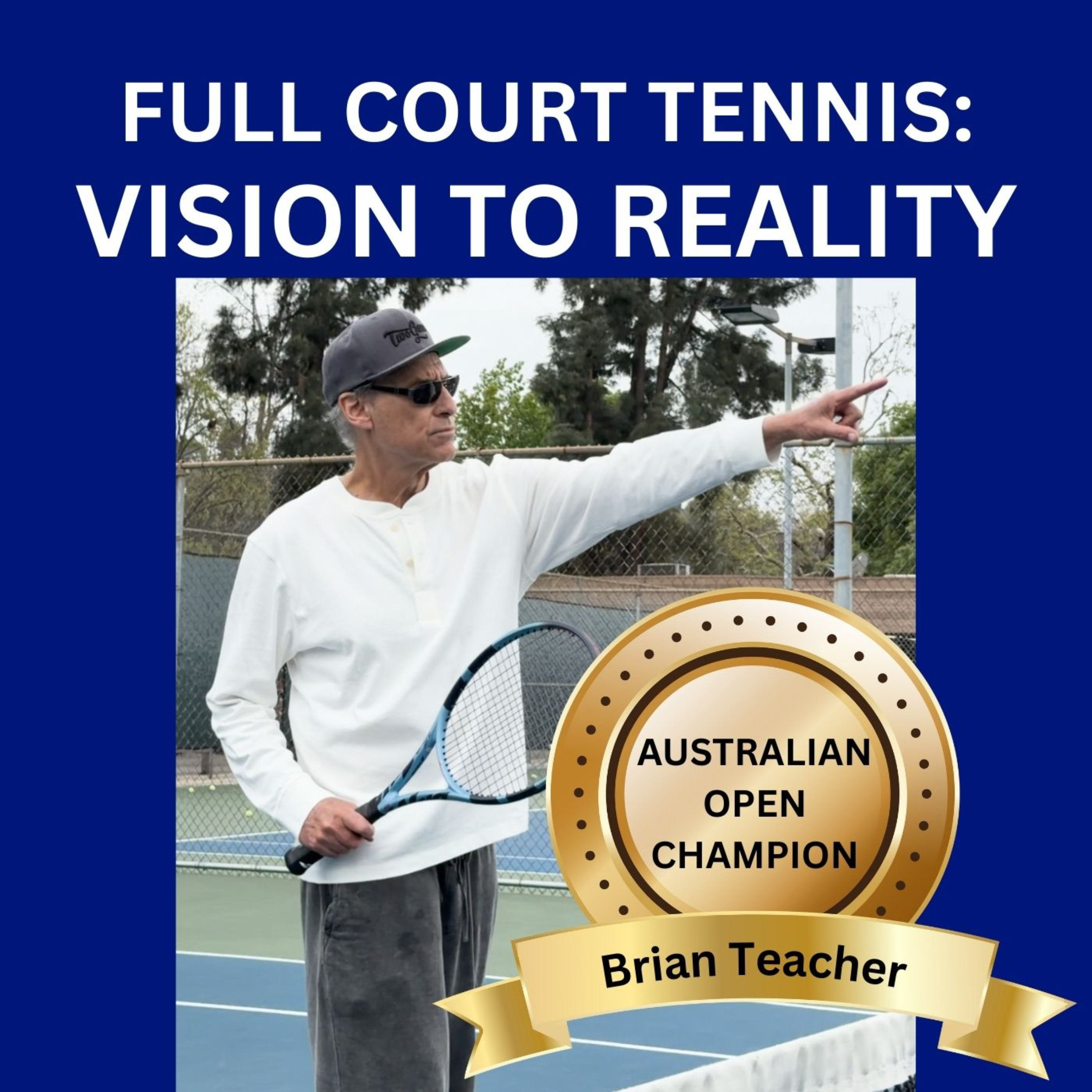
Full Court Tennis with Brian Teacher: Vision to Reality
Full Court Tennis
Fréquence : 1 épisode/8j. Total Éps: 51

Classements récents
Dernières positions dans les classements Apple Podcasts et Spotify.
Apple Podcasts
🇬🇧 Grande Bretagne - tennis
29/06/2026#64🇬🇧 Grande Bretagne - tennis
26/06/2026#99🇬🇧 Grande Bretagne - tennis
25/06/2026#93🇬🇧 Grande Bretagne - tennis
24/06/2026#86🇬🇧 Grande Bretagne - tennis
23/06/2026#75🇬🇧 Grande Bretagne - tennis
22/06/2026#73🇬🇧 Grande Bretagne - tennis
21/06/2026#66🇺🇸 États-Unis - tennis
21/06/2026#100🇬🇧 Grande Bretagne - tennis
20/06/2026#62🇺🇸 États-Unis - tennis
20/06/2026#90
Spotify
Aucun classement récent disponible
Liens partagés entre épisodes et podcasts
Liens présents dans les descriptions d'épisodes et autres podcasts les utilisant également.
See all- https://www.fullcourttennis.com
3 partages

- https://fullcourttennis.com
2 partages
- https://www.nonlineartennis.net/
1 partage
Qualité et score du flux RSS
Évaluation technique de la qualité et de la structure du flux RSS.
See allScore global : 52%
Historique des publications
Répartition mensuelle des publications d'épisodes au fil des années.
Why Alcaraz's Elite Shot Selection Destroys Most Players (Most Coaches Teach This Wrong)
vendredi 19 juin 2026 • Durée 07:15
Most players lose to moonballers not because of bad technique — but because of a slow mind.
In this episode, 1981 Australian Open Champion and Full Court Tennis founder Brian Teacher breaks down why elite shot selection is impossible without Zero Latency thinking, and exactly how to rewire your brain and body to move like the world's best.
What you'll hear in this episode:
— Why latency in your mind stops your feet and hands the point to physics before you even swing
— The 45-degree hitting zone that Agassi, Djokovic, Nadal, Alcaraz, and Sinner all use to dominate from the baseline
— The "Motherload" moment — what it feels like when spacing, timing, and power all click at once
— How your Default Mode Network triggers the choke under pressure, and the CEO Mindset technique to override it using your prefrontal cortex
— Why your ego lies to you about your footwork — and how video analysis reveals the brutal truth
— How Carlos Alcaraz trains his neural network through shadow drills and why you can do the same
Whether you're a competitive junior, a club player, or a serious adult competitor, the principles in this episode will immediately change how you think about movement, spacing, and mental control on the court.
Download the Full Court Tennis app at FullCourtTennis.com to upload your footage and get real feedback from ATP and WTA coaches.
Next episode: The specific shadow drills and balance games Alcaraz uses to build 3D spatial awareness — and how to add them to your training.
Elite Tennis Footwork: Why Most Players Mentally Collapse (The Zero Latency Secret)
vendredi 12 juin 2026 • Durée 08:56
Why do so many tennis players hit a technical wall or watch their footwork completely fall apart as a match progresses? According to Australian Open Champion and elite coach Brian Teacher, it isn’t a fitness failure—it’s a software crash.
In this episode of Full Court Tennis: Vision to Reality, Brian dives deep into the cognitive science of elite movement. Using 19-year-old sensation João Fonseca’s legendary 5-set battles against the world's best as a blueprint, Brian explains how "Zero Latency" separating the top pros from everyone else.
Inside this episode, you’ll discover:
The Latency Trap: Why standard coaching advice like "watch the ball" causes a data delay in your Visual Cortex, forcing your Cerebellum into a lazy, arm-driven survival mode.
Writing New Biological Code: How to activate your Prefrontal Cortex as an "Inner Dictator" to consciously override deep-seated, bad footwork habits.
Two High-Intensity On-Court Drills: A deep dive into the Zero Latency Call-Out and 45-Degree Footwork Patterns designed to build automatic, ground-up kinetic sequencing.
The Between-Point System Reboot: A 4-step mental routine to clear your brain's RAM, manage cognitive fatigue, and reset your strategy before the next point begins.
Brian also breaks down the reality of the "10,000-rep tax"—why fixing an old habit takes three times longer than learning a new one, and how you can accelerate that timeline using visual feedback loops.
Links & Resources mentioned in this episode:
Get your movement patterns and reaction frames audited by the world's best. Download the app or upload your video at FullCourtTennis.com.
The “Lightsaber” Forehand Problem (Why Players Think They Hit Like Alcaraz)
vendredi 27 mars 2026 • Durée 07:22
Many players believe they’re hitting a modern forehand. What they’re actually doing is copying the surface without the structure.
In this episode of Full Court Tennis: Vision to Reality, Australian Open Champion Brian Teacher explains the growing “Lightsaber Forehand” problem he sees across junior tennis.
Players try to imitate the explosive racket speed of stars like Carlos Alcaraz, Jannik Sinner, and Rafael Nadal, but without the coordination between the feet, torso, and timing that makes those swings work.
Brian breaks down:
• Why chasing racket speed creates a “whip-snap” arm swing
• The coordination system he calls the Human Supercomputer
• Why footwork training often fails when it’s taught in isolation
• The medicine ball loading drill that reconnects the body
• A real case study of an ATP player who jumped 50 ranking spots in four months after fixing this exact issue
If your forehand feels fast but the ball doesn’t feel heavy, this episode explains what’s missing.
Download the Full Court Tennis App or visit fullcourttennis.com to compare your strokes side-by-side with professional players in the Pro Library.
EP 5: Beyond Fast Feet: The Flight Control Secret to Elite Tennis
Saison 1 · Épisode 5
vendredi 20 mars 2026 • Durée 05:50
Building World-Class Footwork: The Substance of the Flow
In this episode, Australian Open Champion Brian Teacher steps into the flight control room to discuss the physics of tennis footwork and why coordination fuels your game. Learn how specific footwork drills and agility drills are critical for court movement, why modern footwork is failing juniors, the secret of the 3lb medicine ball, and why copying technical anomalies can lead to career-ending injuries.
This tennis training session emphasizes core tennis fitness to improve your performance.
Ep 4: Vision to Reality – Taylor Fritz, The 18% Break Rate, and the Psychology of the Favorite
Saison 1 · Épisode 4
vendredi 13 mars 2026 • Durée 07:26
Why is a Top 3 server on the ATP tour struggling to break through in big matches?
In Episode 4 of Vision to Reality, Australian Open Champion Brian Teacher breaks down the shock upset of Taylor Fritz by Alex Michelsen at Indian Wells.
Brian reveals the "Blueprint of Vision's Reality" explaining why physical stats are lagging indicators of internal focus. We go deep into the numbers: Why Taylor’s 80% first-serve win rate is a world-class shield, but his 50% second serve return rate is a 50/50 coin toss that isn't enough to win Grand Slams.
In this episode, you will learn:
- The Mental Architecture: Why reality is constructed in the mind first.
- The 80% Shield: How Taylor Fritz dominates the serve metrics.
- The 18% Reality: Why Taylor's return games won has dropped to near the bottom of the Top 50.
- The Sinner/Alcaraz Standard: The 4% gap that creates a 30% break rate.
- The Wimbledon Lesson: Why Taylor cannot win a baseline footrace against Carlos Alcaraz.
- Precision Visualization: Rehearsing sensory data through the Full Court Tennis App.
Emulating Champions: Why Copying US Open Champ Dominic Thiem Could Be a Trap
Saison 1 · Épisode 3
vendredi 6 mars 2026 • Durée 05:31
If you want to be a great tennis player, you need to emulate the top pros. But you have to find a consensus among the Top 50 players, rather than just copying one unique athlete.
In Episode 3 of Vision to Reality, Australian Open Champion Brian Teacher explains the danger of copying an anomaly. We look at the biomechanics of 2020 US Open Champion Dominic Thiem. Thiem was an absolute workhorse, but his unique forehand technique put immense pressure on his body and could be a dangerous trap to copy.
In this episode, you will learn:
- The Forehand Consensus: Why you should look at the leg-loading mechanics shared by the majority of the Top 50.
- The Thiem Question: Why Dominic Thiem's violent wrist snap worked for him, but could be a trap for your body.
- The Jan Choinski Case Study: How Brian used the Full Court Tennis App to fix this exact flaw for an ATP pro.
Download the Full Court Tennis App today to compare your strokes side-by-side with pros like Taylor Fritz in the FCT Pro Library!
Ep 2: The Software Update – Neuroplasticity, Machine Learning, and The Monica Seles Proof
Saison 1 · Épisode 2
vendredi 27 février 2026 • Durée 05:58
Are you running buggy software on the tennis court? Science is currently using epigenetic reprogramming to reverse aging—proving that the human body is a programmable computer, not just depreciating hardware. In Episode 2 of Vision to Reality, Australian Open Champion Brian Teacher explains how you can use neuroplasticity to rewrite your tennis code.
You will learn:
· The Monica Seles Proof: Why you don't need to be fast afoot to have world-class footwork, spacing, and power.
· The Math of Tennis: Why copying the "flow" of the pros is a trap, and how to build your game from Addition to Advanced Machine Learning.
· The Alcaraz Update: Why Carlos loosened his wrist and straightened his toss (and the crazy "Cuckoo's Nest" drill he used to do it).
· The Full Court Tennis Audit: How to use the app to expose your slow reaction times and fix your spacing.
Stop trying to be a "good athlete." Start programming the Scientific Machine. Download the Full Court Tennis app and visit FullCourtTennis.com
The Blur vs The Machine: Why Copying Alcaraz and Sinner Fails
Saison 1 · Épisode 1
vendredi 20 février 2026 • Durée 05:04
In the first episode of Full Court Tennis with Brian Teacher: Vision to Reality, Brian Teacher explains why modern players are failing by copying what they see on television.
Carlos Alcaraz and Jannik Sinner have different styles. Different rhythms. Different personalities.
But they share the same structural machine underneath.
This episode explores:• Why style without physics breaks down• The importance of leg loading and ground force• How elite players calculate spacing in milliseconds• The evolution from athlete to scientific competitor• Why champions are obsessed with improvement
The blur is seductive. The machine wins.
Download the Full Court Tennis app and visit fullcourttennis.com to learn more.
USA Tennis Coaches: Stop Outsourcing Your Competence!
Saison 1 · Épisode 34
vendredi 6 février 2026 • Durée 08:26
Many US tennis coaches and players are stuck in a flawed system that doesn’t prepare them for real success. In this episode of the Full Court Tennis Advantage podcast, Brian Teacher breaks down why caring alone doesn’t equal coaching competence and why coaches must take responsibility for their own education.
Learn how to:
See the reality of the game clearly.
Build true competence instead of relying on organizations.
Teach players effectively what you’ve actually studied.
Create a better reality for yourself and your players.
Download the Full Court Tennis app and visit fullcourttennis.com to get access to the full map of tennis.
Who Owns Reality in Tennis? The Truth About Player Development
Saison 1 · Épisode 33
vendredi 30 janvier 2026 • Durée 08:48
Why do so many players train hard and go nowhere?
In this episode, Brian Teacher explains why tennis development must be grounded in reality, not perception or outcomes. He explores the importance of complete skills, precise footwork and mechanics, and how technology can help players and coaches see what is actually happening rather than guessing.
This is a direct look at what is broken in the current tennis system and what must change if players want real improvement instead of temporary confidence.
Podcasts Similaires Basées sur le Contenu