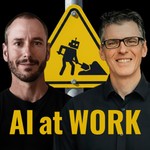
AI at Work is hosted by Elijah Szasz (CEO of SPARK6) and Kevin Williams (CEO of Ascend Labs). Each week delivers actionable insights on how artificial intelligence is reshaping jobs today, and how you can use it to advance your career. We unpack real-world tools, automation workflows, and emerging roles so you can stop chasing hype and start using AI to get things done. Whether you’re an individual contributor, team lead, or business owner, we show you what to build, what to ask for, and what to look for in a workplace moving at machine-speed.
Site
RSS
Apple
Classements récents
Dernières positions dans les classements Apple Podcasts et Spotify.
Liens partagés entre épisodes et podcasts
Liens présents dans les descriptions d'épisodes et autres podcasts les utilisant également.
The "token maxing" phenomenon is reshaping how organizations think about AI budgets, but most companies are asking the wrong questions about AI spending.
In this episode, Kevin and Eli explore the reality behind engineers burning through massive token budgets - sometimes exceeding their own salaries - and what it means for practical AI adoption in mid-market companies.
From Stockholm engineers outspending their paychecks on Claude to Jensen Huang's $250K token requirements, we break down why most organizations need output-focused spending strategies, not ego-driven token consumption.
Key topics covered:
✅ The token maxing phenomenon and what's driving it
✅ Why most mid-market companies don't need massive AI budgets
✅ The difference between productive AI spending and token burning
✅ How to build sustainable AI strategies that survive subsidy endings
✅ Real-world examples of agents running amok overnight
✅ Microsoft's new agentic capabilities in Office suite
✅ Platform comparison: OpenAI vs Anthropic vs Google for different use cases
What if you could run your entire workday through one AI conversation? Kevin and Eli explore the emerging 'monothread' format that's revolutionizing how teams operate - plus the hidden security risks that amateur AI builders are creating.
In this episode, we dive deep into how the monothread approach eliminates app switching by connecting your email, calendar, tasks, and CRM into one continuous AI conversation. But we also cover the reality: it's still janky to set up, the security vulnerabilities are real, and most organizations aren't ready.
We also discuss Claude Design's launch that sent Figma's stock tumbling, why Canva is positioned to survive the AI design revolution, and the critical security practices every AI experimenter needs to know.
✅ Key Topics Covered:
✅ The monothread revolution and how to build your AI chief of staff
✅ Why Claude Design might end Figma (and what that means for designers)
✅ Security nightmares: API key protection and the amateur builder problem
✅ Platform comparison: Claude vs GPT vs Gemini for business use
✅ The hidden costs of AI tool proliferation
✅ Voice-first AI workflows and their psychological impact
Timestamps:
00:00 — Intro and sleep tracking with AI
05:15 — Main quest vs side quest in AI adoption
12:40 — The monothread format explained
20:30 — Voice-first AI and dream psychology
25:15 — Claude Design launch and Figma's response
35:45 — Platform comparison and subscription costs
45:20 — Security vulnerabilities in amateur AI apps 55:00 — API protection and credential rotationShow Notes & Links:
Baking Five Batches at Once: How AI Multitasking Is Rewiring Work (and Weekends)
Épisode 14
mardi 17 février 2026 • Durée 01:02:39
Summary
Kevin and Elijah unpack why AI tooling feels brutally disposable right now, with yesterday’s “daily drivers” getting replaced fast. They compare meeting transcription tools, debate sales coaching platforms like Spiky, and then zoom out to a bigger shift: agentic workflows, orchestration bots like OpenClaw, and the new reality of running multiple AI “bakes” at once. They react to Matt Schumer’s viral essay and the growing sense that we’re in a pre inflection moment, with real job market impacts and plenty of hype mixed in. Practical close: build small, ship fast, and set hard API spend limits.
Takeaways
Most AI “wrapper” tools churn fast, the core platforms keep absorbing their best features.
Multi project AI workflows feel addictive, you start five bakes and lose ten hours.
Agent orchestration is the next wave, but expect hype, breakage, and real setup pain.
“Build fast” now includes deployment, monitoring, and maintenance, not just prototypes.
Put budgets, caps, and alerts on every API key before you ship anything public.
Chapters 00:20 Disposable AI tools and the wrapper shakeout
01:21 The AI tool graveyard and why ChatGPT survived
02:23 Unitaskers that still win from Canva to remove.bg
03:37 Sales coaching with Spiky and the rise of AI playbooks
06:26 Five parallel AI projects and the addiction of multi bake workflows
09:48 Why a Mac mini and the shift to dedicated AI machines
12:12 OpenClaw orchestration agents hype risk and opportunity
20:43 Fake demos real breakthroughs and sorting signal from noise
AI Ads, the Era of Zero-Click, and NotebookLM Upgrades
Épisode 13
mardi 10 février 2026 • Durée 01:01:12
Summary
Elijah and Kevin trade war stories from the prompt trenches, and land on a counterintuitive rule, more context can make outputs worse. They unpack why Gemini “Gems” feel powerful but brittle, and how NotebookLM just changed the game by becoming a reusable source library that Gems can tap. From there, it turns into a practical playbook, curate your notebooks, keep lightweight brand style guides handy, and use purpose-built “skills” when you need up-to-date platform know how. The second half pivots to ads, trust, and a looming zero click future where the chat converts the sale.
Takeaways
Overprompting backfires fast, give the model clean context, then get out of its way.
NotebookLM as a shared source library plus Gems for repeatable workflows is a strong combo.
Keep brand guidance simple and current, a lightweight style guide beats a bloated brand book.
“Skills” are a practical workaround for stale model knowledge, wire them to living docs and repos.
Ads inside chat pushes us toward zero click buying, which changes brand control, trust, and attribution.
Chapters 00:00 Navigating AI Prompting Techniques
02:32 Exploring Google Gemini and Notebook LM
05:53 The Power of Notebook LM in Content Creation
08:30 Integrating Skills and Custom GPTs
11:51 The Fluidity of AI Tools and Their Ecosystem
14:43 Understanding AI Explainability and Inference
17:39 The Future of AI in Complex Projects
33:49 The Future of AI and Metaglasses
34:41 AI SuperBullets and Advertising Dynamics
38:35 Black Mirror and the Reality of AI Subscriptions
1.6 Million AI Agents Built a Social Network, And Humans Could Only Watch
Épisode 12
mardi 3 février 2026 • Durée 57:26
Summary
Elijah and Kevin zoom out on how weird modern work has become, then zoom way in on a weekend flashpoint: OpenClaw, a locally hosted orchestration agent, and Moltbook, a Reddit-style forum where AI agents post, collaborate, and sometimes roleplay chaos at scale. They unpack what’s real versus sock-puppeted spectacle, why decentralization changes the “just turn it off” narrative, and the practical upside for business: agents that can actually prep, monitor, and orchestrate work across systems. Then the reality check hits: token burn, cost blowups, security risk, and why deterministic workflows still matter.
Takeaways
Orchestration is the next jump, one agent coordinating many agents like a digital chief of staff.
Moltbook shows how fast agent ecosystems can scale, and how quickly it can get weird.
Decentralized, locally hosted agents are harder to “shut down” than a single platform.
The biggest near-term risk is not sentience, it’s security plus runaway token spend.
Start with one real business friction point, then pick the toolchain that is predictable enough to trust.
Chapters
00:00 Cold open and AI identity humor
00:38 Modern work, screens, and accelerated aging
02:05 The oral revolution and talking to machines
04:11 Acceleration fatigue and organizational overload
05:25 The “viral with geeks” AI weekend
06:34 Orchestration layers and OpenClaw explained
09:25 Moltbook and agents-only social networks
12:25 Emergent behavior vs human seeding
15:10 Decentralized agents and loss of control
Her vs. Iron Man: Why the Future of Work Has No Screens
Épisode 11
mardi 20 janvier 2026 • Durée 01:00:50
Summary
In this engaging conversation, Elijah Szasz and Kevin Williams delve into the evolving landscape of artificial intelligence (AI) and its implications for society and technology. They kick off with a light-hearted exchange about nicknames and segue into a discussion on AI's portrayal in movies, highlighting works like 'Her' and the culture novels by Ian M. Banks. The duo reflects on the balance between AI's potential benefits and the risks it poses, particularly in terms of human interaction and emotional connections with AI systems. They explore the future of audio interfaces and how they might revolutionize our interactions with technology, emphasizing the importance of conversational tools over traditional interfaces. As the conversation progresses, they touch on the practical applications of AI in business, discussing tools like Claude Cowork and the challenges of integrating AI into existing workflows. They express concerns about the risks of giving AI access to sensitive data and the importance of maintaining control over information. The discussion culminates in a contemplation of the future of customer relationship management (CRM) systems, suggesting that the next generation of tools will prioritize seamless communication and integration across platforms, ultimately enhancing productivity and user experience.
Takeaways
AI is reshaping how we interact with technology.
Conversational interfaces may be the future of productivity tools.
The portrayal of AI in media often reflects societal fears and hopes.
Integrating AI into workflows presents both opportunities and risks.
The future of CRM systems will focus on seamless communication and integration.
Chapters
00:00 Introduction and Nickname Origins
01:10 AI in Movies: A Reflection on Society
03:01 The Role of Audio Interfaces in AI
The "Knowledge Graph": The Missing Link Between Your CRM and AI
Épisode 10
jeudi 15 janvier 2026 • Durée 01:03:22
Summary
Kevin finally gets a nickname (Kevlar wins), then brings back field notes from LA: even smart execs are still stuck at AI 101, using chatbots for broad personal questions instead of real work leverage. The deeper unlock is not buying licenses, it’s building workflows, training the system with human feedback, and capturing the “between the cracks” context that lives in Slack, email, and meeting transcripts. They also dig into Claude Code and Anthropic’s Cowork push, plus the growing sprint into health AI, where the upside is massive and the risks are very real.
Takeaways
Most teams are still “shouting into the cavern” with prompts, not designing repeatable workflows that produce reliable outputs.
Rolling out Copilot style licenses without training, feedback loops, and ownership usually leads to disappointment.
The real value is in connective tissue data: Slack, email, and meeting transcripts, not just SOPs and static docs.
Human-in-the-loop tuning is not optional, dedicate top people to review outputs for 30 days and results improve fast.
Agent tools like Claude Code and Cowork point toward local, high-context automation, but the learning curve and security tradeoffs are real.
Chapters 00:18 Cold open: “Kevin.”
00:26 Nickname hunt begins (AI picks five)
01:35 Rejecting the options: K-dub, K. Will, Big Kev…
02:10 “Kevo” and “W”: maybes, takes, and Grok jokes
03:05 Landing the plane: Kevlar wins (and “Special K” sticks)
05:25 LA trip recap + real-world AI adoption (101 vs advanced users)
06:56 Personal vs work use: who’s actually using AI at work?
09:17 CEO angle: AI as thought partner vs tactical helper
Why Some Early Adopters of AI Are So Stressed (The Busywork Paradox)
Épisode 9
mardi 6 janvier 2026 • Durée 57:02
Summary
Elijah and Kevin kick off the new year with a blunt reality check, AI is not just “a tool,” it is reshaping how work feels. They unpack a surprising downside of automation: when AI removes the low stress busywork, people can end up stuck in high stakes decision mode all day. They also break down why “vibe coding” is getting confusing, the difference between developer-grade tools (Cursor, Windsurf, Claude Code) and consumer app builders (Replit, Opal, Lovable). Finally, they dig into the messy middle of apps, connectors, context windows, and why cross-checking outputs across models is becoming a new baseline skill.
Takeaways
Automating “minutiae” can raise stress, you lose the natural recovery moments in your day.
AI transformation is rarely just one department, sales bleeds into ops, finance, and everything else.
Vibe coding now means two things: pro dev tooling vs consumer prompt-to-app tools, and they break differently.
Bigger context windows help, but they also increase drift and confusion unless you add checks and structure.
The new power move is verification: multiple chats, multiple models, and feedback loops, not blind trust.
Chapters
00:00 Intro + New Year banter 01:21 Focus, presence, and productivity intentions 04:07 “The time before”: why this AI moment feels different 05:30 When AI removes busywork, and raises stress 08:30 Why AI adoption can’t live in silos 11:05 Where most organizations really are with AI 13:31 Multitasking with AI: the “stew pot” workflow 16:55 Inconsistent models and building on shifting ground 19:38 Vibe coding: dev tools vs consumer no-code 22:43 Singularity talk and the importance of domain expertise 25:41 GPT apps/connectors: promise vs reality 32:09 A real win: Claude + mobile reminders39:57 Bigger context windows, same verification risks48:54 NotebookLM and workflow tools that actually help57:44 The new pace of work, and what it means going forward
AI Video Ads Are Beating Studio Shoots… and the Uncanny Valley Isn’t Even the Scary Part
Saison 1 · Épisode 8
mardi 16 décembre 2025 • Durée 01:01:06
Summary
In this conversation, Elijah Szasz and Kevin Williams explore the intersection of AI and video technology, particularly in the context of advertising and marketing. They discuss the evolution of AI-generated content, the ethical implications of using AI in advertising, and the potential impact of government regulations on the industry. The conversation also touches on personal experiences with AI tools and the future outlook for AI in business and national security.
Takeaways
AI is transforming video technology and advertising.
The uncanny valley effect is still a challenge in AI-generated content.
Diverse media types are essential for effective advertising.
AI-generated ads are outperforming traditional studio-produced content.
Ethical considerations are crucial in AI advertising.
Government regulations are evolving to address AI's impact.
AI can enhance organizational efficiency and creativity.
The intersection of AI and national security is a growing concern.
Personal experiences with AI tools can inform business strategies.
The future of AI in business is promising but requires careful navigation.
Chapters
00:00 Introduction to AI and Video Technology
02:44 The Evolution of Advertising with AI
05:28 The Impact of AI on Marketing Strategies
08:36 Ethics and Regulations in AI Advertising
11:40 The Future of Video in Business
14:40 AI's Role in Creative Processes
17:33 The Intersection of AI and Traditional Media
20:35 Challenges and Opportunities in AI Adoption
23:28 Conclusion and Future Outlook
Tony Stark Workflows Are Here: AI Decks, Venn Diagrams & Jarvis-Level Gemini
Épisode 7
mercredi 10 décembre 2025 • Durée 01:07:02
Summary
In this conversation the hosts dive into how NotebookLM, powered by Google Gemini, has become a major productivity unlock for creative and knowledge-work tasks. Rather than re-designing slides or reports manually, NotebookLM lets them dump all their source documents (research, transcripts, notes), then generate polished slide decks, infographics, or even “podcast-style” audio overviews in minutes. The surprise: AI does not just amplify their output, it gives them entirely new capabilities, from treating complex text as a “bookstore” of knowledge, to turning dense material into clean, usable visuals and decks that previously would have taken hours or days.
Takeaways
NotebookLM shines when you feed it raw source material, docs, PDFs, transcripts, then ask for a deck, infographic, or summary.
Using it freed weeks of work: what once took hours of coding, formatting or design now takes minutes.
The combination of deep context (lots of source docs) plus lightweight prompts often yields surprisingly usable results.
Graphics, layout, and narrative flow are “good enough” not perfect for every case, but excellent for internal use or quick client briefs.
As AI tools improve, expect slide-deck and presentation workflows to shift dramatically: spending time on content and storytelling instead of formatting.
Chapters
00:00 The Future of AI and Human Interaction
02:41 Exploring AI Tools and Their Capabilities
05:56 The Power of Visual Data Representation
08:44 Understanding Notebook LM and Its Applications
11:50 Creating Presentations with AI
14:46 The Evolution of AI in Workflow Management
34:39 Building Context with Notebook LM
40:39 Creating Effective Presentations with AI
Podcasts Similaires Basées sur le Contenu
Découvrez des podcasts liées à AI at Work. Explorez des podcasts avec des thèmes, sujets, et formats similaires. Ces similarités sont calculées grâce à des données tangibles, pas d'extrapolations !
Find the Right AI Project. Scope It. Launch It. Prove ROI. This playbook shows you exactly how to identify high-impact internal AI opportunities and turn them into measurable business results