A History of the World in 100 Objects – Détails, épisodes et analyse
Détails du podcast
Informations techniques et générales issues du flux RSS du podcast.
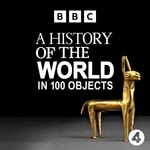

Director of the British Museum, Neil MacGregor, narrates 100 programmes that retell humanity's history through the objects we have made.
Classements récents
Dernières positions dans les classements Apple Podcasts et Spotify.
Apple Podcasts
🇨🇦 Canada - history
21/06/2026#55🇬🇧 Grande Bretagne - history
21/06/2026#79🇺🇸 États-Unis - history
21/06/2026#86🇨🇦 Canada - history
20/06/2026#54🇺🇸 États-Unis - history
20/06/2026#80🇫🇷 France - history
20/06/2026#99🇨🇦 Canada - history
19/06/2026#56🇺🇸 États-Unis - history
19/06/2026#76🇨🇦 Canada - history
18/06/2026#51🇬🇧 Grande Bretagne - history
18/06/2026#82
Spotify
Aucun classement récent disponible
Liens partagés entre épisodes et podcasts
Liens présents dans les descriptions d'épisodes et autres podcasts les utilisant également.
See allQualité et score du flux RSS
Évaluation technique de la qualité et de la structure du flux RSS.
See allScore global : 38%
Historique des publications
Répartition mensuelle des publications d'épisodes au fil des années.
Object 101
vendredi 25 décembre 2020 • Durée 37:51
Ten years on from the ground-breaking Radio 4 series, "A History of The World in 100 Objects", former director of the British Museum Neil MacGregor looks back at the impact of the series, on how storytelling in museums has changed over a turbulent decade and asks which object from 2020 would best encapsulate our modern age.
Producer: Paul Kobrak
Solar-powered lamp and charger
vendredi 22 octobre 2010 • Durée 13:34
The very last episode in Neil MacGregor's history of humanity as told through the things that time has left behind. The director of the British Museum in London has spent the past year choosing objects from the museum's vast collection to represent a two million year story of humanity. Throughout this week he has been with objects that that speak of the great shifts in human organisation and thinking in the modern world. Here he describes the object that he has picked as his last; it's a solar-powered lamp and charger that he believes can revolutionise the lives of poor people around the globe. The portable panel can provide up to 100 hours of light after just 8 hours of direct sunlight. It can also charge mobile phones and help bring power to millions of people around the world who have no access to an electrical grid. Simple, cheap and clean - this is revolutionary technology for the future. Professor Nick Stern, the expert on the economics of climate change, describes the potential impact of new solar technology - and we hear examples of how the technology is being adopted in Africa and India. Neil explains why he has chosen a solar-powered lamp and charger as his final object - with examples of how it is already being used in rural Bengal and urban Kenya.
Producer: Anthony Denselow
Ship's chronometer from HMS Beagle
lundi 11 octobre 2010 • Durée 14:02
Neil MacGregor's history of the world as told through things. Throughout this week he is examining the global economy of the 19th century - of mass production and mass consumption. Today he is with an instrument that first helped Europeans to navigate with precision around the world - a marine chronometer. The one Neil has chosen actually accompanied Darwin on his great voyage to South America and the Galapagos Islands - a journey that was to help lead him to his revolutionary theories on evolution. The geographer Nigel Thrift and the geneticist Steve Jones celebrate the chronometer and the profound changes it prompted.
Producer: Anthony Denselow
Mummy of Hornedjitef
lundi 18 janvier 2010 • Durée 13:48
The Director of the British Museum, Neil MacGregor, retells the history of human development from the first stone axe to the credit card using 100 selected objects from the Museum. His history will cover two million years and include items that were made in every part of the globe. But his journey begins when, at the age of eight, he visited the British Museum for the first time and came face-to-face with an object that fascinated and intrigued him ever since - an Egyptian mummy.
Hornedjitef was a priest who died around 2250 years ago, and he designed a coffin that, he believed, would help him navigate his way to the afterlife. Little did he know that this afterlife would be as a museum exhibit in London. This ornate coffin holds secrets to the understanding of his religion, society and Egypt's connections to the rest of the world.
Neil MacGregor tells the story of Hornedjitef's mummy case, with contributions from egyptologist John Taylor, Egyptian author Ahdaf Soueif and Indian economist and Nobel Prize winner Amartya Sen
Jade bi
vendredi 8 octobre 2010 • Durée 14:02
Neil MacGregor's world history told through the things that time has left behind. Throughout this week, Neil has been looking at Europe's discoveries around the world and its engagement with different cultures during the 18th century - the European Enlightenment project.
Today he describes what was happening in China during this period, as the country was experiencing its own Enlightenment under the Qianlong Emperor. He tells the story through a jade disc (called a Bi) that was probably made around 1500 BC and then written over by the Emperor himself. What does this prehistoric piece of jade tell us about life in 18th century China and how they explored their past? The historian Jonathan Spence and the poet Yang Lian find meaning in this intriguing object.
Producer: Anthony Denselow
Australian Bark Shield
jeudi 7 octobre 2010 • Durée 13:46
The history of humanity as told through one hundred objects from the British Museum in London. This week, Neil MacGregor, the Director of the Museum, is looking at Europe's engagement with the rest of the world during the 18th century.
Today he is with an object "freighted with layers of history, legend, global politics and race relations". It is a shield from Australia, originally owned by one of the men to first set eyes on Europeans as they descended on Botany Bay nearly 250 years ago. This remarkably well-preserved object was brought to England by the explorer Captain Cook. What can this object tell us about the early encounter between two such different cultures? Phil Gordon, the aboriginal Heritage Officer at the Australian Museum in Sydney, and the historian Maria Nugent help tell the story.
Producer: Anthony Denselow
North American Buckskin Map
mercredi 6 octobre 2010 • Durée 13:53
The history of humanity - as told through one hundred objects from the British Museum in London - is once again in North America. This week, Neil MacGregor, the museum's director, is looking at Europe's engagement with the rest of the world in the 18th century.
Today he tells the story of a map, roughly drawn on deerskin that was used as the colonists negotiated for land in the area between the Great Lakes and the Mississippi. It was probably drawn up by a Native American around 1774. Neil looks at how the French and the British were in conflict in the region, and examines the different attitudes to land and living between Europeans and Native Americans. Martin Lewis, an expert on maps from this region, and the historian David Edmunds describe the map and the clash of cultures that was played out within its boundaries.
Producer: Anthony Denselow
Hawaiian feather helmet
mardi 5 octobre 2010 • Durée 13:55
This week Neil MacGregor's history of the world is telling the story of European encounters across the globe during the 18th century.
Today he finds out what happened to Captain Cook as he was mapping and collecting in the Pacific. Neil tells the story through a chieftain's helmet made from a myriad of colourful bird feathers that was given to Cook when he landed in Hawaii in 1778. This is not a story with a happy ending. The anthropologist Nicholas Thomas and the Hawaiian academics Marques Hanalei Marzan, Kyle Nakanelua and Kaholokula help describe Cook's impact in the Pacific and the meaning of the feathered helmet.
Producer: Anthony Denselow.
Akan Drum
lundi 4 octobre 2010 • Durée 14:18
Neil MacGregor's history of the world as told through things that time has left behind. Throughout this week, he is examining the often troubled relationship between Europe and the rest of the world during the 18th century.
Today he tells the extraordinary story of a now fragile African drum. It was taken to America during the years of the slave trade and where it came into contact with Native Americans. The drum was brought to England by Sir Hans Sloane, whose collection became the British Museum in 1753. This drum, the earliest African-American object in the Museum, is a rare surviving example of an instrument whose music was to profoundly influence American culture - bought to America on a slave ship and transported to Britain by a slave owner. The historian Anthony Appiah and the writer Bonnie Greer consider the impact of this drum.
Producer: Anthony Denselow Music research specifically for the Akan drum: Michael Doran
Reformation Centenary Broadsheet
vendredi 1 octobre 2010 • Durée 13:51
Neil MacGregor's world history as told through things that time has left behind. This week Neil is looking at the co-existence of faiths - peaceful or otherwise - across the globe around 400 years ago. So far he has looked at objects from India and Central America, Iran and Indonesia that embody the political consequences of belief. Today he is back in Europe, with a document that marks an anniversary and that is designed to raise morale. It's a woodblock print, a broadsheet, commissioned in Saxony in 1617 to mark a hundred years of the Protestant Reformation and anti-Catholic sentiment. Neil describes the broadsheet and the uncertain Protestant world that produced it. Was this the first time that an anniversary was commemorated in this way, with a kind of souvenir? The broadcaster and journalist Ian Hislop considers the broadsheet as an early equivalent to the tabloid press while the religious historian Karen Armstrong describes the reforming motivation that the broadsheet celebrates.
Producer: Anthony Denselow